I Am Among You As One Who Serves (Luke 22:24-30)

The Last Supper, by Mamdouh Kashlan (1929-2022)

A dispute also arose among them as to which one of them was to be regarded as the greatest. But he said to them, “The kings of the Gentiles lord it over them; and those in authority over them are called benefactors. But not so with you; rather the greatest among you must become like the youngest, and the leader like one who serves. For who is greater, the one who is at the table or the one who serves? Is it not the one at the table? But I am among you as one who serves.

“You are those who have stood by me in my trials; and I confer on you, just as my Father has conferred on me, a kingdom, so that you may eat and drink at my table in my kingdom, and you will sit on thrones judging the twelve tribes of Israel. (New Revised Standard Version)

Jesus and his disciples had prepared for the Passover meal. They ate and drank together. Christ gave them words which have endured throughout Christian history as the Lord’s Supper. He spoke of the bread as his body, and the cup as the new covenant in his blood. Jesus communed with them and communicated about his impending death.

It was a moving experience for all. The disciples received from their Lord an intense act of love; and a new humanity around Christ’s body and blood. Indeed, the essence of new life is self-sacrificial love.

And then… the disciples began quarreling with each other about positions, and titles, and honors, and who was better, and who would be top dog in God’s kingdom….

It was a moment that I think every parent can relate to, at some level. Sitting around a dinner table, enjoying a rich conversation, becoming close with one another as a family… and then the kids begin bickering with each other about the most mundane of things.

Just a minute ago, you believed you were getting somewhere, and experiencing a shared family bond of love, commitment, and purpose… and then, in a matter of seconds, it all crashes down in a ridiculous display of posturing and positioning of one sibling over another….

I admit, this has happened to me more than once, when my own kids were growing up. And I also admit that I lost my sanctification on more than one occasion, watching this crazy schizophrenic scene play out in front of me.

Which is why I have a lot of respect for Jesus in responding to his disciples with humility, calmness, and a forthright spirit. He addressed their puny questions in a way that rebuked them without making them feel like they just got a Dad lecture.

In the sort of table fellowship that Jesus practiced with his disciples throughout his earthly ministry, he consistently sought to undermine the existing systems of domination in all levels of society. Even the religious system of Christ’s day had a distinct stratifying of persons in an inequitable structure of power.

The kingdom of God, however, is different. God’s economy is characterized by equality, mutuality, diversity, and shared power. It’s all based in a communal, as well as individual, relational connection with the Creator God.

God almighty, Creator of heaven and earth, is gracious, merciful, and kind. The Lord brings rain on both the righteous and the wicked. Thus, any sort of claim to being greater or superior or better than another person or group of people, has no place around the table of Christ’s body and blood.

Catholics are no better than Protestants. Evangelical Christians have no superiority over Progressive Christians. The Coptic Church doesn’t have the high ground on Eastern Orthodoxy. Christians who observe the Lord’s Supper as a remembrance are not greater than those who discern the Table as a sacrament.

And if one has the ears to hear it, Christians really ought to know better than to believe they should have greater control over the world and its systems than Buddhists, Muslims, or Jews.

Puffing up one’s chest and insisting that “My Dad is better than your Dad” is the stuff of childish preoccupations, and not of God’s kingdom.
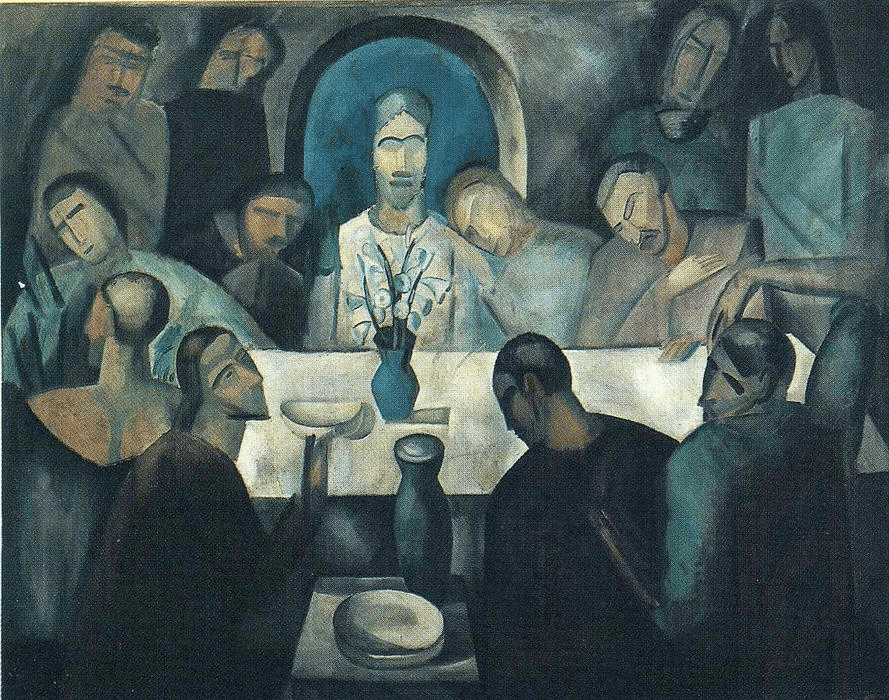
The Last Supper of Jesus, by André Derain (1880-1954)

There are plenty of people in this old messed-up world who lord their power and authority over others. If we take the words of Jesus seriously, Christians are not to be part of that structure and system.

And yet, here we are, in this contemporary time and place in history, having a chunk of the population thinking Christendom is the way to go, that a form of Christian Nationalism should be the political system – as if the kingdom of God and the kingdom of this world are what’s on the ballot.

Christians are the very folks who need to insist on serving, not leading; building up, not tearing down; loving, not hating; being integrated and connected, not fragmented and disconnected from others, as well as from reality.

Any sort of earthly power and authority the Christian has, must be used to include, help, and support, instead of excluding, ignoring, and destroying. The greatest among us must become like the youngest, and the leader like one who serves.

Christians must support and promote the idea of political office as a public service; and the concept of being a citizen as serving the common good of all persons, not just some persons.

Jesus came to this earth to serve. Therefore, his followers are also to serve. The words and ways of Christ centered in humble service, merciful justice, and prayer for one’s enemies. His followers must do no less.

Jesus Christ came to usher in a moral and ethical kingdom in which God’s gracious and benevolent will is done on this earth, as it is always done in heaven. He did not come to make sure Christians have lots of political power and authority over all the non-Christians.

Yes, indeed, we will be given power and authority – but not to baptize existing earthly structures so that the system serves the interests of Christians. We receive so that we can give. We give so that we might serve. And we serve because our Lord is a servant.

So, if Christians truly desire to bring change and transformation to this world, it will be through a compassionate and caring system of service to our fellow humanity – and not by imposing our beliefs and will upon others in a modern day form of the Inquisition.

Let us then, traffic in love; aspire to meekness; practice servanthood; and become the wait staff for the world’s needs.

That is what it really means to stand with Jesus in this time of trial.

Gracious and loving God, you work everywhere reconciling, loving, and healing your creatures and your creation. In your Son, and through the power of your Holy Spirit, you invite each of us to join you in your work.

I ask you to form me more and more in your image and likeness, through my prayers and worship of you; and through the study of Holy Scripture, so that my eyes will be fully opened to your mission in the world.

Send me into my family, church, community, workplace, and world to serve Christ with faith, hope, and love, through the power of the Holy Spirit. Amen.


Get Up and Pray! (Luke 22:39-46)

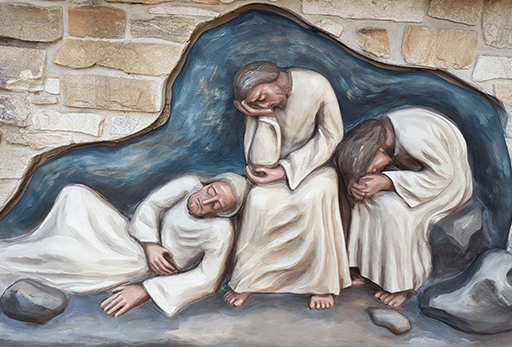
The Garden of Gethsemane by He Qi

Jesus went out as usual to the Mount of Olives, and his disciples followed him. On reaching the place, he said to them, “Pray that you will not fall into temptation.” He withdrew about a stone’s throw beyond them, knelt down and prayed, “Father, if you are willing, take this cup from me; yet not my will, but yours be done.” An angel from heaven appeared to him and strengthened him. And being in anguish, he prayed more earnestly, and his sweat was like drops of blood falling to the ground.

When he rose from prayer and went back to the disciples, he found them asleep, exhausted from sorrow. “Why are you sleeping?” he asked them. “Get up and pray so that you will not fall into temptation.” (New International Version)

The prayer of Jesus and the sleeping of his disciples presents a contrast of approach when severe stress is upon us.

The Prayer of Jesus

Christ’s prayer expresses the tension all devout persons face: expressing our own wishes while seeking to submit to the Father’s wishes.

However, what is not the same, between our own prayers and the prayers of Jesus, is that we too often believe that if we are intense, wordy, and insistent enough with God, that our prayers will be answered.

While only feigning a few words about God’s will, we put our real efforts into lawyer-like presentations of why the Lord should answer our prayers in the way we want them answered.

Thus, prayer can too easily become a willful imperative that God grant our demands based in a very limited understanding of the big picture.

There is a big difference between willfulness and willingness. We must embrace the latter and eschew the former.

Jesus clearly stated exactly what he wanted: to have this terrible suffering, especially the pain about to be experienced, taken from him. Yet, he asks this with a willingness to accept the Father’s will for his life. Although an angel comes to bring comfort and strength, Christ’s request was denied. And Jesus was good with that.

We can, following the example of Jesus, unashamedly express our anguish, while at the same time, accepting God’s will for us, no matter what it may be.

Christ in Gethsemane by Michael O’Brien

It was God’s will for Jesus to suffer. And Christ not only suffered in the Garden of Gethsemane and on the cross; Jesus experienced the full range of human suffering throughout his life. He knew what it felt like to face continual adversity and hardship. 

The suffering of Christ helps us make sense of our own suffering. We can only truly be free from our stubborn expectations by embracing that which makes us suffer. 

Some suffer through the death of a loved one; some through cancer or a serious health issue; other believers right now throughout the world are suffering due to grinding poverty and la ack of food and clean water; many others suffer through violence done to them or their families.

Because of this reality, some of us may not even express our anguish to God in prayer. After all, what is a harshly worded e-mail, or trying to lose a few extra pounds, or an unexpected car repair, compared to starving children in the world? 

It’s good to keep our life situations in proper perspective, but it is also not good to tell God what he should and shouldn’t care about in this world. 

If the only things that matter and qualify as hardship and difficulty is human trafficking or the terrors of war, then you will soon find yourself plastering a smile on your face and nodding over-enthusiastically whenever someone asks you how you are doing…. Good grief…. I find chronically happy Christians to be insufferable (pun intended).

The sufferings of Christ qualified him to be a compassionate high priest, able to help us (Hebrews 2:5-18). A priest is one who stands in between the person and God, making things right with God. Christians possess a union with Jesus Christ because of his suffering, death, and resurrection. He is our champion. He stands with us in our suffering and temptations.    

The Sleep of the Disciples

Even though their Lord told them to pray, the disciples nod-off in a stress-induced sleep. Jesus wanted them to remain awake, and he was talking of more than just physical alertness. The disciples needed to keep watch so that they didn’t fall into temptation.

Throughout his earthly ministry, Jesus had been warning them that his cross will lead to their own cross to bear. They, too, will have times of trial, so intense that it will be emotionally and spiritually overwhelming. Christ desired the disciples to follow his own example of offering anguished prayer which is thoroughly submissive to God.

So, our great task is to get up and pray!

Get up and pray so that no temptation can overtake you! (1 Corinthians 10:13)

Get up and pray so that you can endure hardship! (Hebrews 12:7)

Get up and pray for the enemies who persecute you so that you may be children of your Father in heaven! (Matthew 5:44-45)

Get up and pray so that you can encourage others and build them up in the faith! (1 Thessalonians 5:10-11)

Get up and pray so that you can be joyful in hope and patient in affliction! (Romans 12:12)

Get up and pray so that you may have peace in this world of trouble! (John 16:33)

Get up and pray so that you can submit to God and resist the devil! (James 4:7)

Get up and pray so that you will not be overcome by evil but overcome evil with good! (Romans 12:11)

Get up and pray so that you can submit to one another out of reverence for Christ! (Ephesians 5:21)

Get up and pray so that you can be the salt of the earth and the light of the world! (Matthew 5:13-16)

Get up and pray so that you can proclaim that the kingdom of God is near! (Matthew 10:7)

Get up and pray so that you can preach the Word with great patience and careful instruction! (2 Timothy 4:1-2)

Get up and pray so that you can have confidence in your leaders and submit to their authority, because they keep watch over you as those who must give an account. (Hebrews 13:17)

Get up and pray!…

Pride Comes Before the Fall (Luke 22:31-33, 54-62)

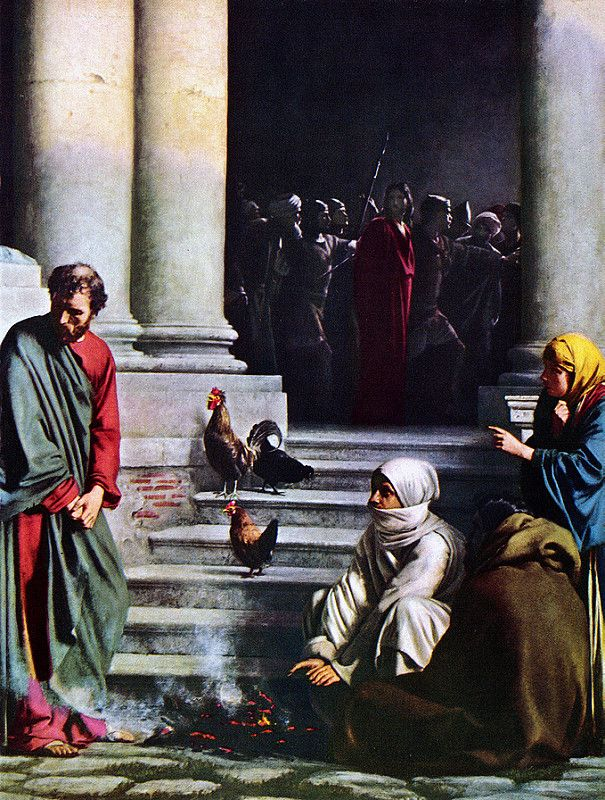
The Denial of Peter by Carl Bloch (1834-1890)

“Simon, Simon, Satan has asked to sift all of you as wheat. But I have prayed for you, Simon, that your faith may not fail. And when you have turned back, strengthen your brothers.”

But he replied, “Lord, I am ready to go with you to prison and to death….”

Then seizing Jesus, they led him away and took him into the house of the high priest. Peter followed at a distance. And when some there had kindled a fire in the middle of the courtyard and had sat down together, Peter sat down with them. A servant girl saw him seated there in the firelight. She looked closely at him and said, “This man was with him.”

But he denied it. “Woman, I don’t know him,” he said.

A little later someone else saw him and said, “You also are one of them.”

“Man, I am not!” Peter replied.

About an hour later another asserted, “Certainly this fellow was with him, for he is a Galilean.”

Peter replied, “Man, I don’t know what you’re talking about!” Just as he was speaking, the rooster crowed. The Lord turned and looked straight at Peter. Then Peter remembered the word the Lord had spoken to him: “Before the rooster crows today, you will disown me three times.”And he went outside and wept bitterly. (New International Version)

A Lesson In Trust

One day I watched a lifeguard handle a group of kids for their first time in the pool. She went to each one and told them to put their ears in the water and their belly buttons in the air while she was holding them up. “When I count to three, you won’t feel my hands underneath you, but they’re there,” she said. 

Most of the kids frantically jerked their knees toward their chins and flailed their arms.

Even though nearly all people float when they assume a posture of rest, many believe they’ll sink, and don’t keep their posture for long. 

The disciples had a hard time trusting Jesus. They couldn’t seem to rest and relax because Jesus said and did things that they were not expecting him to say and do. 

Jesus preached the necessity of humility and loving one’s enemies; and he focused on ministry to the least persons around them. The disciples had not yet really bought into Christ’s kingdom agenda because they kept pulling their knees up by thinking Jesus was going to lead a rebellion against the Romans and put Israel back on the map – believing it would be just like the old days of Jewish domination of the land.

But Jesus is all about a different agenda: transformation of the inner person that leads to greater submission to God’s will so that the least persons among us will be reached.

Bad News Before Good News

Many already believe they know what God wants and how to follow Jesus, and so, aren’t much open to the Spirit. They acknowledge they’re sinners, yet don’t believe their sin is as bad as others. “O, sure, we sin, but not like murderers and child molesters. Our sins are ‘respectable’– a little resentment, a little prejudice, and a little gossip is even necessary to make sure people submit to the unwritten rules.”

We must first hear the bad news before we can hear the good news. Once we hear the bad news and accept it, we must receive God’s remedy for it. In order to do this, let’s compare and contrast two disciples: Peter and Judas.

Peter’s Denial, 17th Century Ethiopian

Peter and Judas

Peter and Judas shared a similar vision about seeing Israel restored to its previous glorious prominence. Judas was a Zealot, ready to take military action, if necessary; and Peter had no problem taking up the sword when it seemed the time was ripe for a political rebellion and takeover.

Even though Peter insisted he would never turn on Jesus, Jesus knew better. And, sure enough, Peter did a full-fledged moral belly flop in the pool of denial by disowning Jesus three times.

Judas actually caught on, quicker than Peter, that Jesus wasn’t going to lead a military coup. Judas had enough of wasting time on poor marginalized people; they weren’t going to make good soldiers. After Judas clearly saw that Jesus had no intention of forcing an earthly political kingdom, he actively sought an opportunity to betray him.

Neither Judas or Peter, nor any of the disciples wanted to take a step into the world of suffering as the means of reaching others and embracing the kingdom of God. They wanted glory not suffering. But Jesus chose the cup of suffering.

Both Judas and Peter realized after denying Jesus that they had made a terrible mistake. But that is where the similarities end. 

Judas realized what he had done, and so, went out and died by suicide. Rather than throw himself upon the mercy of God, Judas tried to atone for his own sin. He tried to fix something that could not be undone. It was a refusal of grace.

Peter responded by weeping bitterly, consistent with someone experiencing repentance. He realized he was poor in spirit and mourned over his sin. Peter later becomes a genuinely meek person with God’s righteousness taking root within him as he, in the book of Acts, demonstrated mercy and became a preacher of truth and grace.

The Need for Transformation

There cannot be systemic and structural renewal without personal transformation. And there cannot be personal transformation without a brutally honest assessment of myself. “I will never fall,” comes from a heart of pride that believes “I’m not so bad.”

Our sins and failures stem ultimately from a lack of trust. We keep pulling our knees up because we are too anxious to let the agenda of Jesus control our lives. 

Proud people don’t pray much because they are self-sufficient. But humble people pray a lot because they don’t want to fall into temptation. They pray because they discern they’re prone to being like a cockeye little dog who thinks he is a big dog. 

Even Jesus felt the need to watch and pray so that he could face his hour of pain and suffering on behalf of all mankind.

Following Either Close or From a Distance

Jesus was arrested and Peter followed him at a distance. If we are brutally honest with ourselves, this too, describes much of our own following of Jesus. We want to see how everything will shake-out before we commit. 

Christ is asking us to trust him, to make and keep promises before we even know what it all means. We need to acknowledge and admit that we have commitment-it is; we have made a mess of our lives by our stubbornness and holding on to our own ideas for how we think things ought to go.

If you find yourself in a mess, whether it is of your own making or of somebody else, the only thing that can handle it is a close following of grace. We are to approach God with brutal honesty, humility, and a willingness to rest and relax when he is telling you to. 

The Lord will give you his righteousness; you need not try to obtain it on your own. So, let the knees go down and stick the belly button out – rest in Jesus.