The Holy Name of Jesus (Luke 2:15-21)

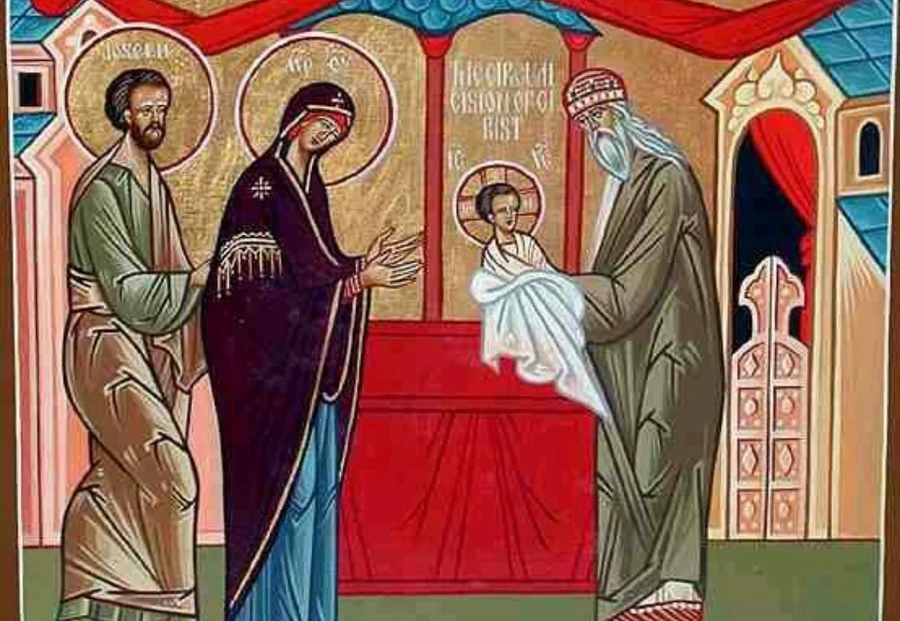
Orthodox depiction of the circumcision and naming of Jesus

When the angels had left them and gone into heaven, the shepherds said to one another, “Let us go now to Bethlehem and see this thing that has taken place, which the Lord has made known to us.” So they went with haste and found Mary and Joseph and the child lying in the manger. When they saw this, they made known what had been told them about this child, and all who heard it were amazed at what the shepherds told them, and Mary treasured all these words and pondered them in her heart. The shepherds returned, glorifying and praising God for all they had heard and seen, just as it had been told them.

When the eighth day came, it was time to circumcise the child, and he was called Jesus, the name given by the angel before he was conceived in the womb. (New Revised Standard Version)

“The Holy Name of Jesus” is a celebration, observed by some Christian traditions, each year on January 1 – which is the eighth day after the birth of Jesus, when he was named and circumcised at the temple in Jerusalem.

An angel of the Lord appeared to him in a dream and said, “Joseph, son of David, do not be afraid to take Mary as your wife, for the child conceived in her is from the Holy Spirit. She will bear a son, and you are to name him Jesus, for he will save his people from their sins.” (Matthew 1:20-21, NRSV)

In the Law of Moses, all male infants are to be circumcised on the eighth day after their birth (Leviticus 12:3). Throughout most of the history of the Christian Church, January 1 has been celebrated as a feast day devoted to the naming of Jesus.

The name “Jesus” comes from the Hebrew Yeshuah (Joshua) which means “Yahweh will save.” It is a name fitting for the person and work of Christ.

Therefore God exalted him even more highly
    and gave him the name
    that is above every other name,
so that at the name given to Jesus
    every knee should bend,
    in heaven and on earth and under the earth,
and every tongue should confess
    that Jesus Christ is Lord,
    to the glory of God the Father. (Philippians 2:9-11, NRSV)

Faith is always followed by obedience. So, the faith of Joseph and Mary in believing the words of the angel Gabriel, translated into the obedient naming of their son as “Jesus.” (Luke 1:31-32)

Jesus, bearing the name of savior, is holy in every way. Not only does the name of Jesus point to his divinity – because of his miraculous conception by the Holy Spirit – but it also directs us toward the special mission for which he entered this world.

Jesus Christ, the Son of God, and Son of Humanity, is God’s agent of deliverance for both Israel and the whole world.

“Do not be afraid, for see, I am bringing you good news of great joy for all the people: to you is born this day in the city of David a Savior, who is the Messiah, the Lord….” (Luke 2:10-11, NRSV)

The Gospel writer Luke provides us with a birth narrative “pregnant” with theological information and importance:

  • Jesus has divine sonship, and possesses the status of king (Luke 1:31-35)
  • Jesus comes from the city of David, which is Bethlehem, not Jerusalem (Luke 2:4, 11)
  • Jesus is described by the angel Gabriel as Son of the Most High, Son of God, Savior, Messiah, and Lord; each of these titles direct us to his identity and mission (Luke 1:32, 35; 2:11)

I like the collective response of the shepherds, after they received heavenly good news from a group of angels.

They could have dismissed the entire thing as having drunk too much brandy on a brisk winter night. They could have kept the whole affair to themselves, reasoning that nobody would believe a bunch of stinky shepherds.

Instead, much like Mary who hurried off to Elizabeth after receiving the angelic message, the shepherds dropped everything to go and see the feeding trough with a newborn baby wrapped in swaddling cloth.

In other words, the shepherds belief in what they heard and experienced, quickly translated into action. It was only appropriate that it was shepherds who discovered the newborn king, the Son of David, himself a shepherd who was anointed by God.

The shepherds went and followed the signs given to them by the angel. And they believed. A motley group of shepherds returned to their fields, kicking up their heels, praising and glorifying God. They knew that things would never be the same again.

The name of Jesus is holy, simply because the Lord Jesus Christ is the Holy One. Christians recognize Jesus as Savior, the fulfillment of all God’s promises. His singular birth, life, death, resurrection, and ascension is exactly, I believe, what this old fallen world is most in need of.

It is never too late to resolve knowing Jesus. At the beginning of this year, there is perhaps no better resolution to make, again and again, of knowing Jesus Christ and honoring his holy name.

Eternal Father, you gave to your incarnate Son the holy name of Jesus to be the sign of our salvation. Plant in our hearts the love of Jesus, truly God and truly human, and grant that we may praise and bless your Holy Name with our whole mind, heart, body, and spirit, that we may know your boundless compassion and mercy. In Christ’s name, we pray. Amen.

First Sunday after Christmas Day – Where Is Jesus? (Luke 2:41-52)

The Boy Jesus In the Temple, by He Qi

Now every year his parents went to Jerusalem for the festival of the Passover. And when he was twelve years old, they went up as usual for the festival. When the festival was ended and they started to return, the boy Jesus stayed behind in Jerusalem, but his parents were unaware of this. Assuming that he was in the group of travelers, they went a day’s journey.

Then they started to look for him among their relatives and friends. When they did not find him, they returned to Jerusalem to search for him. After three days they found him in the temple, sitting among the teachers, listening to them and asking them questions. And all who heard him were amazed at his understanding and his answers. 

When his parents saw him they were astonished, and his mother said to him, “Child, why have you treated us like this? Your father and I have been anxiously looking for you.” 

He said to them, “Why were you searching for me? Did you not know that I must be in my Father’s house?” But they did not understand what he said to them. 

Then he went down with them and came to Nazareth and was obedient to them, and his mother treasured all these things in her heart.

And Jesus increased in wisdom and in years and in divine and human favor. (New Revised Standard Version)

Luke is the only New Testament Evangelist who included a story of Jesus’s childhood. It provides us some interesting biographical information. Yet, more importantly, the story gives us a sense of Christ’s destiny, of why Jesus grew up to  engage in his unique earthly ministry.

In many ways, Jesus was a typical Jewish boy, in a non-descript pious Jewish family. The family was careful to be observant, and annually made their pilgrimage to Jerusalem for Passover.

Joseph and his family traveled in a large caravan of people, which was common for that day. They were on their camels an entire day before they discovered Jesus was missing.

Mary likely assumed Jesus was riding on the other camel with Uncle Zechariah and his cousin John. 

But Jesus was neither with them nor with Aunt Elizabeth. So, the second day, Joseph and Mary backtracked to Jerusalem, hoping and praying they wouldn’t find Jesus in the ditch, like in the story of the Good Samaritan.

Having not found their son along the road, Joseph and Mary spent the third day scouring Jerusalem in search of Jesus. 

It seems to me that far too many people go about their daily lives without realizing Jesus is even missing. They simply assume he’s here. But he isn’t.

So, let’s search for him. And in finding him, may we see Jesus as we have never seen him before, so that our faith in God might be strengthened, and so that we do not end up losing him yet again.

Turns out, the entire time, Jesus was at the temple. As a parent and grandparent myself, I’m not a bit surprised that a twelve-year-old stayed behind and thought nothing of it. 

Jesus was curious and inquisitive with the rabbis at the temple. Those ancient teachers taught in a different way than Christians preachers today. They gave instruction more like a modern day counselor or therapist.

The rabbis didn’t just impart information; they asked questions to help people discover truth for themselves. And the rabbis were amazed at Jesus’s ability to discover truth.

Keep in mind that Jesus was not a thirty-year-old adult in a twelve-year-old body. Christ was sinless, indeed; but still immature.

The human experience involves growth and maturation. Jesus shared fully in our humanity, not partially. When Christ was born, he was not a fully aware adult looking through the eyes of a baby.

Because Jesus is fully human, he had to grow up just like us and learn in every way, just like us. (Hebrews 4:15; 5:8)

Staying in Jerusalem was not a rebellious act by Jesus. It was typical. Twelve-year-old’s do all kinds of things without saying anything to their parents.

There’s a world of difference between defiant rebellion, and just plain old garden variety immaturity. It’s unwise for adults to expect adult behavior from adolescent kids.

Jesus felt a deep need to stay and talk with the rabbis. As a human boy, he had to go through the process of self-discovery… of finding out that he was the Son of God… of reading the scriptures for himself and learning… and finding that he was reading about himself! 

To say that Jesus simply knew everything because he was God is to fall into a heresy the early church condemned at the Council of Nicaea called Docetism – a belief that Jesus is fully God and only appeared to be human.

No, the Nicaean Council said, Jesus is really a human being and did not simply appear to be one. He is like us, in every way, except sin.

Well, of course, Joseph and Mary finally found Jesus. And Jesus got the third degree from his mother: “What do you mean putting your father and I through this? I gave you birth, and you treat us like this?  What were you thinking?  What part of meeting at the two-humped camel at 9:00 don’t you understand!?”

Since Jesus grew in wisdom and stature and in favor with God and others, how much more do we need to put ourselves in a position to grow and learn and develop and mature? 

There is no spiritual machine in which God miraculously zaps into our brains all the wisdom and knowledge we need.

Rather, emulating our Lord, we must learn, grow, read, pray, ask questions, struggle, and dialogue about the good news of Jesus Christ with each other. In short, we must discover the truth of God.

Perhaps Jesus is asking us, as he did to Mary and Joseph, “Why were you searching for me?  Didn’t you know that I had to be in my Father’s house?” 

The answer of Jesus to his parents’ anxious searching of him points to Christ’s growing self-awareness about his messianic mission. The story centers around Jesus, as all stories do in the Gospel narratives, and not so much around the others.

Since Christ is the proper middle to everything for the Christian, we will, like Joseph and Mary, struggle to know where in the heck Jesus is, and why he is where he is, whenever we find him.

But it isn’t really all that hard to find Jesus, at least, once you know where to look, and where he typically hangs out.

When looking for Jesus, he will be doing the things of his Father. In the Gospel of Luke, those things are clearly connected to the prophet Isaiah’s description:

“The Spirit of the Lord is upon me,
    because he has anointed me
        to bring good news to the poor.
He has sent me to proclaim release to the captives
    and recovery of sight to the blind,
        to set free those who are oppressed,
to proclaim the year of the Lord’s favor.” (Luke 4:18-19, NRSV; cf. Isaiah 61:1-2)

The ones rejoicing at Christ’s birth, and why they were filled with such joy, is very much connected to the messianic mission of Jesus. They understood that freedom and deliverance had just been born.

O God, from our mother’s womb you have known us. You call us to follow you every single day of our lives. And you seek us out whenever we wander from you. As we grow up and grow older, clothe us with your love, so that we may mature in grace and find favor in your sight; through Jesus Christ our Savior and Lord. Amen.

Nativity of the Lord (Luke 2:1-20)

Nativity, by He Qi, 1998

In those days a decree went out from Caesar Augustus that all the world should be registered. This was the first registration and was taken while Quirinius was governor of Syria. 

All went to their own towns to be registered. Joseph also went from the town of Nazareth in Galilee to Judea, to the city of David called Bethlehem, because he was descended from the house and family of David. He went to be registered with Mary, to whom he was engaged and who was expecting a child. 

While they were there, the time came for her to deliver her child. And she gave birth to her firstborn son and wrapped him in bands of cloth and laid him in a manger, because there was no place in the guest room.

Now in that same region there were shepherds living in the fields, keeping watch over their flock by night. Then an angel of the Lord stood before them, and the glory of the Lord shone around them, and they were terrified. 

But the angel said to them, “Do not be afraid, for see, I am bringing you good news of great joy for all the people: to you is born this day in the city of David a Savior, who is the Messiah, the Lord. This will be a sign for you: you will find a child wrapped in bands of cloth and lying in a manger.” 

And suddenly there was with the angel a multitude of the heavenly host, praising God and saying,

“Glory to God in the highest heaven,
    and on earth peace among those whom he favors!”

When the angels had left them and gone into heaven, the shepherds said to one another, “Let us go now to Bethlehem and see this thing that has taken place, which the Lord has made known to us.” 

So they went with haste and found Mary and Joseph and the child lying in the manger. When they saw this, they made known what had been told them about this child, and all who heard it were amazed at what the shepherds told them, and Mary treasured all these words and pondered them in her heart. 

The shepherds returned, glorifying and praising God for all they had heard and seen, just as it had been told them. (New Revised Standard Version)

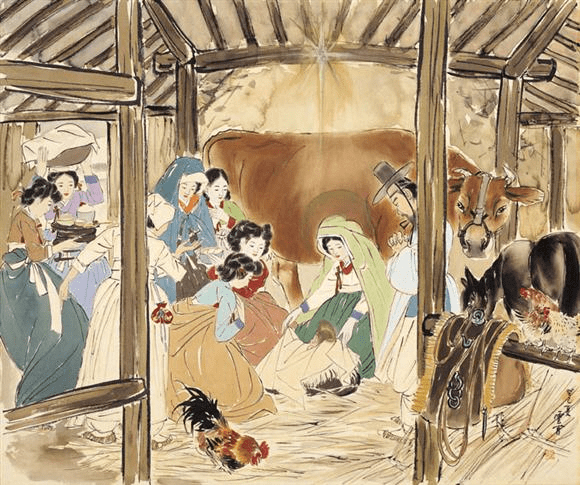
The Birth of Jesus Christ, by Woonbo Kim Ki-chang, 1953

Overwhelmed. That’s the word I imagine the characters in this story had, for various reasons.

To have spiritual or emotional overwhelm is to feel overpowered by several circumstances at once. It’s experiencing a lot of emotions all at the same time.

The sense of overwhelm can come from many different things, including complicated grief, relational distance, and too many responsibilities. Depending upon why we are overwhelmed, it will likely either leave us stuck and chronically tired, or free and forever rejoicing.

A good sense of overwhelm is awe and wonder. A bad sense of overwhelm is despondency and dejection.

Mary probably experienced the full range of overwhelm. An angel showed up and announced to her that she would give birth to a son and name him Jesus, meaning that God will save the people. He will fulfill the promise of being the Son of the ancient King David who has a permanent reign.

In other words, Mary would give birth to the Messiah. That sounds like the very definition of overwhelm, in both its good and bad sense.

Despite the temporal worldly power of the Roman Empire, Mary’s child would have a kingdom without end. And in spite of the Romans, God’s will and purpose would prevail.

And yet, Mary and Joseph were still subject to Roman authority. That meant they needed to be registered, along with everyone else in the Empire, so that the government knew about their tax base, and who was going to pay it.

The decree from Ceasar meant that, even though Mary was quite pregnant, she and Joseph would have to travel to Bethlehem, the family’s ancestral town, in order to be properly registered.

Jesus would not be born in the city of overwhelming power and control in Jerusalem. Rather, Bethlehem, a small non-descript town south of the city, is the place for an overwhelming birth experience to happen.

It’s appropriate that from the beginning, the life and ministry of Jesus would be more about the smaller and less powerful place and people.

And so, the new king, from the line of David, is born in the most humble of circumstances. It is fitting that the humblest of persons were the first to receive the birth news.

Shepherds were literally out on the margins of society. Their typical reputation was not good. They stink. They drink too much. They’re on the lower rung of cultural power.

Yet, a huge angelic delegation was sent from heaven to shepherds to announce the birth. It was an overwhelming experience, no matter how you view it.

Seeing Shepherds, by Daniel Bonnell

Angels showed up, and the shepherds were nearly paralyzed with fear. But their terror turned on a dime to awe, wonder, and joy.

What’s more, the good news shared with the lowliest of persons, is for everyone. All the overwhelm and awe is contained in a savior who has been born, Christ the Lord.

Overwhelming feelings were a regular experience of people in the Gospel of Luke who encountered angels – fear being the initial response. But it’s then followed by an assurance that God is extending grace to them, not judgment. No one need be afraid, because God is with them.

It’s not a new message; but it is a message that is newly focused in this savior of a baby. He is Immanuel, God with us. The presence of God is here, because the attention and love of God are here.

Out of my distress I called on the Lord;
    the Lord answered me and set me in a broad place.
With the Lord on my side I do not fear.
    What can mortals do to me?
The Lord is on my side to help me;
    I shall look in triumph on those who hate me. (Psalm 118:5-7, NRSV)

The real genuine authentic power of the universe is here – not found within political empires or governments, nor with the wealthy and influential – but discovered in the arrival of the actual savior, who holds all power and authority, and wields it according to proper justice and righteousness.

All along, God is the true deliverer who backs up the needy and oppressed. It is demonstrated in the angelic proclamations of good news about this Savior, the Christ, the One anointed and chosen by God, the son of David, the deliverer from ancient enemies.

The angel’s proclamation erupts with the sudden appearance of a multitude of God’s heavenly messengers praising God, declaring God’s glory, favor, and blessing of peace on the earth. The emphasis is upon God’s grace rather than human action.

In response to the announcement they received, the shepherds went to see if what they had heard was true, and indeed, it all was. When they saw the sign for themselves, they could not keep silent about all they had heard and seen.

The shepherds praised God, out of an overwhelming sense of amazement that the Lord had paid attention to them.

Praise is still the reaction in the life of the person touched by all that they have seen and heard.

Creator God, by your greatness you became small; by your power you became powerless; and by your limitlessness you became limited. Through the birth of your son, we can live in the divine light that shines on a world transformed by the limitless power of your love. Amen. Praise the Lord!

Who Is Jesus? (Luke 2:22-40)

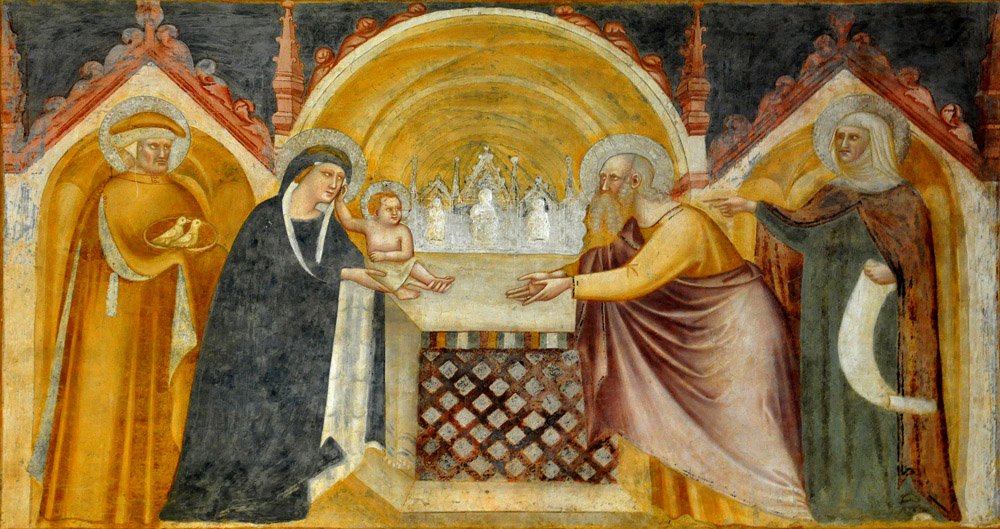
The Presentation in the Temple, 14th century fresco in Pomposa Abbey, Codorigo, Italy

When the time came for the purification rites required by the Law of Moses, Joseph and Mary took him to Jerusalem to present him to the Lord (as it is written in the Law of the Lord, “Every firstborn male is to be consecrated to the Lord”), and to offer a sacrifice in keeping with what is said in the Law of the Lord: “a pair of doves or two young pigeons.”

Now there was a man in Jerusalem called Simeon, who was righteous and devout. He was waiting for the consolation of Israel, and the Holy Spirit was on him. It had been revealed to him by the Holy Spirit that he would not die before he had seen the Lord’s Messiah. Moved by the Spirit, he went into the temple courts. When the parents brought in the child Jesus to do for him what the custom of the Law required, Simeon took him in his arms and praised God, saying:

“Sovereign Lord, as you have promised,
    you may now dismiss your servant in peace.
For my eyes have seen your salvation,
    which you have prepared in the sight of all nations:
a light for revelation to the Gentiles,
    and the glory of your people Israel.”

The child’s father and mother marveled at what was said about him. Then Simeon blessed them and said to Mary, his mother: “This child is destined to cause the falling and rising of many in Israel, and to be a sign that will be spoken against, so that the thoughts of many hearts will be revealed. And a sword will pierce your own soul too.”

There was also a prophet, Anna, the daughter of Penuel, of the tribe of Asher. She was very old; she had lived with her husband seven years after her marriage, and then was a widow until she was eighty-four. She never left the temple but worshiped night and day, fasting and praying. Coming up to them at that very moment, she gave thanks to God and spoke about the child to all who were looking forward to the redemption of Jerusalem.

When Joseph and Mary had done everything required by the Law of the Lord, they returned to Galilee to their own town of Nazareth. And the child grew and became strong; he was filled with wisdom, and the grace of God was on him. (New International Version)

The Gospel accounts of Matthew, Mark, Luke, and John actually contain very little information about the childhood of Jesus. That’s because the Gospels are not biographies – in the sense we think of them – but rather they are narratives that seek to answer a fundamental question about faith and life on this earth: Who is this Jesus?

C.S. Lewis went about exploring that very question. He reasons with us in his classis work, Mere Christianity:

“I am trying here to prevent anyone saying the really foolish thing that people often say about Him: I’m ready to accept Jesus as a great moral teacher, but I don’t accept his claim to be God. That is the one thing we must not say. A man who was merely a man and said the sort of things Jesus said would not be a great moral teacher. He would either be a lunatic — on the level with the man who says he is a poached egg — or else he would be the Devil of Hell. You must make your choice. Either this man was, and is, the Son of God, or else a madman or something worse. You can shut him up for a fool, you can spit at him and kill him as a demon or you can fall at his feet and call him Lord and God, but let us not come with any patronizing nonsense about his being a great human teacher. He has not left that open to us. He did not intend to.”

C.S. Lewis, Mere Christianity

St. Luke’s account of Christ’s childhood stories, seeks to make some important theological points about Jesus:

  • born a Jew amongst devout religious Jews in a thoroughly Jewish society, under Roman authority (Luke 2:1-7)
  • born of a woman, born under the law (Galatians 4:4-5)
  • obedient to his heavenly Father (Luke 2:49; Mark 3:35)
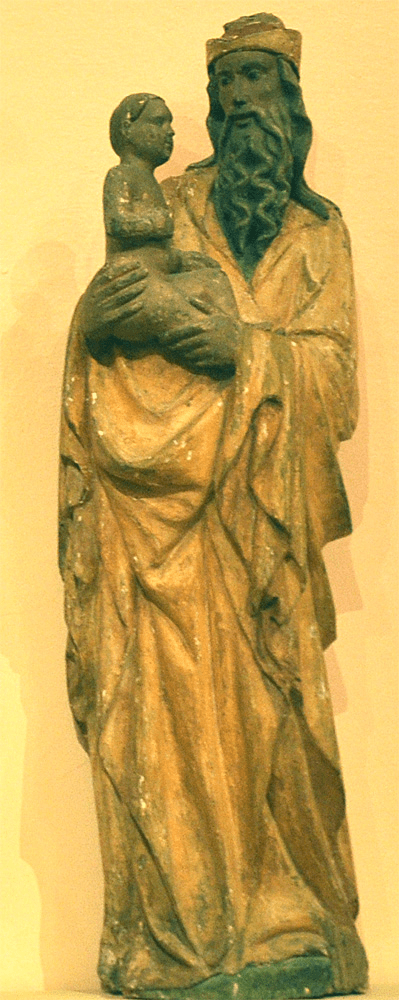
The Presentation in the Temple, 14th century marble statue in the National Museum of the Middle Ages, Paris, France

So, as such, the presentation of Jesus in Jerusalem at the temple is motivated by specific requirements of the law of Moses:

The Lord said to Moses, “Say to the Israelites: ‘A woman who becomes pregnant and gives birth to a son will be ceremonially unclean for seven days…. On the eighth day the boy is to be circumcised. Then the woman must wait thirty-three days to be purified from her bleeding. She must not touch anything sacred or go to the sanctuary until the days of her purification are over….

“‘When the days of her purification for a son… are over, she is to bring to the priest at the entrance to the tent of meeting a year-old lamb for a burnt offering and a young pigeon or a dove for a sin offering….

“‘These are the regulations for the woman who gives birth to a boy… But if she cannot afford a lamb, she is to bring two doves or two young pigeons, one for a burnt offering and the other for a sin offering. In this way the priest will make atonement for her, and she will be clean.’” (Leviticus 12:1-8, NIV)

What’s more, every first-born male (as Jesus was) specifically belongs to the Lord, and is set apart.

The Lord said to Moses, “Consecrate to me every firstborn male. The first offspring of every womb among the Israelites belongs to me… you are to give over to the Lord the first offspring of every womb….”

“In days to come, when your son asks you, ‘What does this mean?’ say to him, ‘With a mighty hand the Lord brought us out of Egypt, out of the land of slavery. When Pharaoh stubbornly refused to let us go, the Lord killed the firstborn of both people and animals in Egypt.

This is why I sacrifice to the Lord the first male offspring of every womb and redeem each of my firstborn sons.’ And it will be like a sign on your hand and a symbol on your forehead that the Lord brought us out of Egypt with his mighty hand.” (Exodus 13:1-2, 12, 14-16, NIV)

Luke was making the connection that when Joseph and Mary presented Jesus to the Lord in Jerusalem, they were essentially dedicating his life to God. Jesus will be the means of redemption for all the people.

Mary would have remembered the words the angel Gabriel told her, that her son will not only be holy, but also be called the Son of God. The life of Jesus – conception, birth, and presentation at the temple – is demonstrably dedicated fully and completely to his heavenly Father. Deliverance for both Jews and Gentiles is focused in the person of Jesus.

Simeon and the Child Jesus, 16th century statue in Zadar, Croatia

Simeon and Anna show up at the presentation of Jesus as devout Jews who are awaiting the fulfillment of God’s promises of consolation and redemption for Israel.

“I, the Lord, have called you in righteousness;
    I will take hold of your hand.
I will keep you and will make you
    to be a covenant for the people
    and a light for the Gentiles.” (Isaiah 42:6, NIV)

Break forth; shout together for joy,
    you ruins of Jerusalem,
for the Lord has comforted his people;
    he has redeemed Jerusalem.
The Lord has bared his holy arm
    before the eyes of all the nations,
and all the ends of the earth shall see
    the salvation of our God. (Isaiah 52:9-10, NRSV)

Simeon and Anna became the spokespersons for the redemption that is to come through Jesus. They both got a glimpse of the salvation that would, one day, reveal itself to the whole world. Forgiveness of sins, deliverance from death and hell, and freedom from guilt and shame all become laser focused on the suffering servant of God.

Who is Jesus? He is the ultimate meaning of Christmas, the incarnation of the Son of God, the Savior of the world. Amen.