Luke 14:25-33 – The Cost of Being a Disciple

Large crowds were traveling with Jesus. And turning to them he said: “If anyone comes to me and does not hate father and mother, wife and children, brothers and sisters—yes, even their own life—such a person cannot be my disciple. And whoever does not carry their cross and follow me cannot be my disciple.

“Suppose one of you wants to build a tower. Won’t you first sit down and estimate the cost to see if you have enough money to complete it? For if you lay the foundation and are not able to finish it, everyone who sees it will ridicule you, saying, ‘This person began to build and wasn’t able to finish.’

“Or suppose a king is about to go to war against another king. Won’t he first sit down and consider whether he is able with ten thousand men to oppose the one coming against him with twenty thousand? If he is not able, he will send a delegation while the other is still a long way off and will ask for terms of peace. In the same way, those of you who do not give up everything you have cannot be my disciples. (New International Version)

The goal of the Christian life is to be a disciple, and to do the work of discipleship. “Disciple” is another word for “follower.” We are to be faithful followers of Jesus; and the Church is to engage in the task of inviting others to join us along the way of following Jesus.

Jesus made it clear to the large crowds of people following him that the disciple’s life and work of discipleship (following Jesus) is to be of highest importance to us – it is why we exist as the Church. We are to discover what this kind of life entails, and we are to decide volitionally and intentionally to follow Jesus in every area of our lives with everything we have. 

Therefore, it is necessary to carefully consider the implications of Christ’s words to us and weigh the cost of following Jesus. 

Discipleship (following Jesus) requires obedience. Love of family must not stand in the way. Jesus said we are to “hate” family and even self. In our culture, we typically use the words “hate” and “love” as descriptions of our emotions or feelings. However, in Scripture, love and hate are primarily terms of allegiance or priority. 

In other words, Jesus is saying that our primary loyalty must clearly lie with following him over every earthly relationship. To follow Jesus means that we will not use family responsibilities to avoid obeying Christ, nor use other commitments to work or school as a reason to put our cross down.

The bottom line is this: In this life, with all its competing loyalties, the call of Jesus to discipleship not only takes precedence, but it also redefines all the other loyalties we have. 

The call of discipleship involves some detachment from other things in order to pursue following Jesus. All of life is to be infused with being a disciple and doing the work of discipleship. If we insist on making other commitments and loyalties as high a priority as following Jesus, we will find ourselves in a pickle. 

Several years ago, I took a trip with some other church leaders into the Canadian wilderness. We were so far out in the boonies that we needed special first aid training because if someone got hurt it would be hours before help could come. We canoed the lakes, carrying our backpacks and canoes between the lakes for an entire week.

Whatever we took with us, we had to carry. Some people thought they needed all kinds of clothes and other accessories. Not far into the week, they quickly began to leave things along the trail and learned, over time, to see that what they thought was important in their life wasn’t really important to what they were doing.

We must get back to basics and do what is essential; and what is of most importance is following Jesus. An un-salty disciple is worthless. Making a commitment to Christ without counting the cost is foolish.  Discipleship was never designed to be easy; it was intended to be a public display that Jesus is Savior and Lord in every area of my life. 

That means we will struggle with questions such as: 

  • How do I be a faithful follower of Jesus in my family? 
  • How do I be a disciple, and do the work of discipleship at work? 
  • How do I practice following Jesus in my neighborhood, and everywhere I go?

If we do not plan to follow Jesus at home and in the world, we won’t, because all kinds of competing loyalties will take over if we are not intentional about being disciples and making disciples. 

Everything and everyone is to take a back seat to Jesus, who is to be our primary loyalty.  Jesus used two examples to illustrate that we need to count the cost of discipleship. In the first, a builder plans and should ensure that he has enough money and materials to complete the entire structure. 

We must take stock to finish what we have started; if we started well with Christ, we need to do whatever it takes to finish well as a disciple of Jesus. What will we do when the going is difficult?

“Jesus has many who love his kingdom in heaven, but few who bear his cross. He has many who desire comfort, but few who desire suffering. He finds many to share his feast, but few his fasting. All desire to rejoice with him, but few are willing to suffer for his sake. Many follow Jesus to the breaking of bread, but few to the drinking of the cup of his passion. Many admire his miracles, but few follow him in the humiliation of the cross.”

Thomas à Kempis, The Imitation of Christ

We only know real joy whenever we give up pursuing happiness. In God’s upside-down kingdom, to live is to die, and to die is to live. Until we grasp this, we will be endlessly frustrated with our circumstances and other people.  

The second illustration from Jesus is of a king and war. The king makes a battle plan, and if he thinks he cannot defeat the opposing army, he wisely seeks a peace treaty. My friends, no one is going to oppose God and win, so it is best to make peace. 

Rather than trying to fit Jesus into our calendar, we are to let our calendar fill out around the center of following Jesus. If we insist we are too busy for prayer; do not have time for daily reading of the Scriptures; for loving one another; for making disciples (which requires much time and effort) then we have lost our way and must listen to this call of Jesus to be his disciple.

What then, shall we do?  

Imagine that in our heart is a big conference room: a big table, leather chairs, coffee, bottled water, and a whiteboard. A committee sits around the table in your heart. There is the social self, the private self, the work self, the sexual self, the recreational self, the religious self, and others.

The committee is arguing and debating and voting, constantly agitated and upset. Rarely can they come to a unanimous, wholehearted decision. We may tell ourselves we are this way because of so many responsibilities or too little abilities. Yet, the truth is that we’re just divided, unfocused, hesitant, and not free. 

One way to deal with the situation is to invite Jesus onto the committee. Give him a vote, too. But then he becomes just one more complication. A better way is to say to Jesus, “My life isn’t working. Please come in and fire my committee, every last one of them. I hand myself over to you. I am your responsibility now. Please run my whole life for me.” 

Being a disciple of Jesus is not just adding Jesus. It is also subtracting the idols that are in our hearts. Saying that we belong to Jesus means that he will come in with a whip, overturn tables, and throw out a bunch of people.

If you are ready for that, pray with me…

Almighty and everlasting God, from our recliners and comfortable chairs, we solve all the world’s problems. We take people to task for what they say and do, without lifting a finger to be a part of the solution. We are too often de-sensitized to your mercy and compassion because we are not involved in your dream for all people to be your disciples. 

Remove the scales from our eyes and lift the indifference from our hearts, so that we may see your vision – a vision of people following Jesus in the mission of being disciples and of making disciples. 

Transform our lives, so that we may accomplish your purpose. 

Anoint us with your Spirit that we might bring good news to the oppressed, bind up the brokenhearted, and proclaim release to the captive. 

Give us a new urgency to reach out to those whom no one else will touch, to accept the unacceptable, to embrace the enemy, to do justice and love mercy. 

Surround us with your love, fill us with your grace, and strengthen us for your service. Empower us to respond to the call of Jesus – to deny ourselves, take up our crosses, and follow Christ our Lord, in whose name we pray. Amen.

Luke 14:15-24 – The Parable of the Great Banquet

When one of those at the table with him heard this, he said to Jesus, “Blessed is the one who will eat at the feast in the kingdom of God.”

Jesus replied: “A certain man was preparing a great banquet and invited many guests. At the time of the banquet, he sent his servant to tell those who had been invited, ‘Come, for everything is now ready.’

“But they all alike began to make excuses. The first said, ‘I have just bought a field, and I must go and see it. Please excuse me.’

“Another said, ‘I have just bought five yoke of oxen, and I’m on my way to try them out. Please excuse me.’

“Still another said, ‘I just got married, so I can’t come.’

“The servant came back and reported this to his master. Then the owner of the house became angry and ordered his servant, ‘Go out quickly into the streets and alleys of the town and bring in the poor, the crippled, the blind and the lame.’

“‘Sir,’ the servant said, ‘what you ordered has been done, but there is still room.’

“Then the master told his servant, ‘Go out to the roads and country lanes and compel them to come in, so that my house will be full. I tell you, not one of those who were invited will get a taste of my banquet.’” (New International Version)

If the gospel of forgiveness in Jesus Christ is such good news, and God is so good, then why aren’t people breaking the door down to get into the Church? 

Today’s Gospel lesson gives us one reason why: They just aren’t interested. The parable Jesus told was of people, when invited to come to the great banquet, kept making one excuse after the other why they couldn’t come.

Keep in mind that Jesus wasn’t talking to sinful outsiders, but the religious insiders – they were the ones making the excuses why they could not participate. 

Let’s cut to the chase: If professing believers in Jesus Christ are not excited about the gospel… If Christians are not enthused over what they possess in the gospel… If the Church is content to go through the motions of Christianity without a concern to be with Jesus… If we are simply too busy to come and attend God’s banquet of grace…

Then, why in the world would any Christian or any Church believe that others ought to show up and be a part of their fellowship, that they would even remotely entertain a thought to profess Christ as Savior and break down the door to get into Christianity?

Jesus was offering a penetrating warning: The unresponsive religious insiders will be replaced by the responsive sinful outsiders. 

If the insiders take for granted what they possess and have better things to do, then God is going to call people who will hear, listen, and respond to the gracious invitation.

The deeply probing question for every believer in Christ today is: Are we so familiar with Jesus, and so content with the way things are that when God breaks into our lives in the form of an invitation that we refuse to respond because we are not interested in going to some stupid banquet? 

There is an incredible abundant feast for us – in fact, Jesus said that his food and drink was to do the Father’s will, that Scripture was his bread. (John 4:34) 

It’s much too easy to take the spiritual abundance of grace and mercy – as well as our physical abundance of food and water – for granted. After all,…

  • Being well-fed, it’s easy to assume that everyone else is, too.
  • Enjoying good health, it’s easy to forget that others are hurting and in pain.
  • Having money and the ability to work hard, it’s easy to think that there are not many poor people around.
  • Living around other Christians all the time, it’s natural to assume that everyone knows the gospel of Jesus – but they don’t!

In Christ’s story, the people making excuses see no real importance to take the invitation to the banquet seriously. And so, they go off to take care of their business and their family.

Like them, we can be much too busy with mundane activities to notice that people need the Lord. And then, when we get around to acknowledging that there are people who need Jesus, we keep devising ways to reach them without having to change our own lives to do it.

Jesus has no intention of calling and inviting us to a discipleship that requires no change on our part. The refusal to alter our lives to accommodate God’s invitation will result in the invitation going out to others. 

So, the master’s servant in the parable goes out into the roads and country lanes and invites any common person to come – anyone he can find.

And that is the scandal of Christ’s gospel – that the invitation to God’s abundant mercy is open to outcasts and failures, to problem people and unimpressive low-life’s, to backwater rednecks and uneducated hicks, to the jobless and the needy, to all sorts of people who are not like your circle of friends. 

People who are flawed are especially dear to Jesus, and not just people who have it all together. It’s the people who outwardly have it all together that are being replaced wholesale with those who admit their guilt, shame, and brokenness. 

Lord, have mercy. Christ, have mercy. Lord, have mercy upon us sinners.

Gracious God, forgive me for wasting time in things that just don’t matter in the scope of eternity. I choose to go out and compel outsiders to come in, so that your house will be full for the great feast at the end of the age. Through Jesus, in the power of the Holy Spirit, I pray. Amen.

Luke 14:1, 7-14 – How Can I Be Blessed?

Jesus eating with “sinners.”

One Sabbath, when Jesus went to eat in the house of a prominent Pharisee, he was being carefully watched….

When he noticed how the guests picked the places of honor at the table, he told them this parable:“When someone invites you to a wedding feast, do not take the place of honor, for a person more distinguished than you may have been invited. If so, the host who invited both of you will come and say to you, ‘Give this person your seat.’ Then, humiliated, you will have to take the least important place. But when you are invited, take the lowest place, so that when your host comes, he will say to you, ‘Friend, move up to a better place.’ Then you will be honored in the presence of all the other guests. For all those who exalt themselves will be humbled, and those who humble themselves will be exalted.”

Then Jesus said to his host, “When you give a luncheon or dinner, do not invite your friends, your brothers or sisters, your relatives, or your rich neighbors; if you do, they may invite you back and so you will be repaid. But when you give a banquet, invite the poor, the crippled, the lame, the blind, and you will be blessed. Although they cannot repay you, you will be repaid at the resurrection of the righteous.” (New International Version)

A lot of people live by the old adage, “You scratch my back and I’ll scratch yours.” It’s a phrase referring to reciprocity. In other words, if you give me something I want, I will then respond by giving you something you want.

That old adage works fine, that is, unless you have no ability to give or give back to another. If we only operate by the principle of reciprocity, a large chunk of people automatically get left out. And this situation is untenable and unacceptable to Jesus.

Christ observed that the religious insiders of his day were keeping entire groups of people on the outside through their practice of scratching one another’s backs.

We need to get ahold of the reality that God loves us, as well as everyone else – even the people we may not give the time of day to. God so loved the world that he sent his Son. Jesus has come to feed us all, not just some.

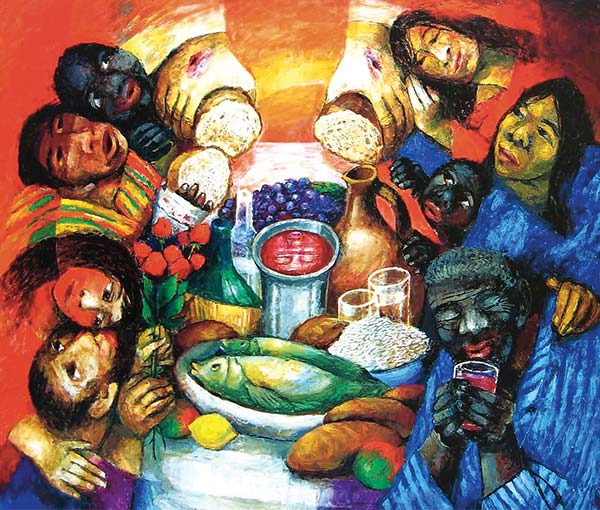
Jesus eats with sinners by Sieger Köder (1925-2015)

The kingdom of God is about food. The food given by Jesus is to feed the hungry by staging a banquet. It is a feast of God’s abundance. Yet, many seem to hoard the resources they have, only thinking about their friends, family, and people just like them. They act as if there is no need to invite outsiders, consumed as they are with their own daily lives.

We have an incredible abundant feast contained in Scripture – in fact, Jesus said that his food and drink was to do the Father’s will, that Scripture was his bread. (Matthew 4:4; John 4:34) 

It’s much too easy to take our blessings of food for granted. After all, when we are well-fed, it’s easy to assume that everyone else is, too. Feeling healthy, it’s easy to forget that others are hurting. Making money, it’s easy to think there are not many poor people around. Living in a community with plenty of churches and more bibles than people, it’s natural to assume that everyone knows the gospel of Jesus – but they don’t!

Then, whenever we get around to acknowledging there are people who need Jesus, we keep devising ways to reach them without having to change or accommodate our own lives to do it.

Christ’s call to faithful discipleship requires people to change from having a narrow focus on our small circle of friends, to including those who have no means to pay us back.

Table fellowship by Sieger Köder 

The gospel of Jesus Christ is open to outcasts and failures, to problem people and unimpressive persons. People with needs and flaws are especially dear to Jesus. It’s the people who outwardly have it all together who are being replaced wholesale with those who admit their need. 

We must not be picky about who we invite to participate in the largess of abundance we possess. We are to avoid the spiritual snobbery of looking down our noses at the needy and less fortunate, who have nothing to offer us in return.

Those who give need to do so without prejudice or favoritism. Even the lazy, the fool, and the sinner still need basic resources to live. By opening our hearts in almsgiving, we open ourselves to Christ, who is present in the least of those among us.

Refusing mercy to people deemed as unworthy, givers then actually shut themselves off from the very mercy God desires for them. There is no reward from God when there is only reward from others.

“If we are going to examine lives, we will never have mercy upon any human being; rather, hindered by this inopportune meddlesomeness, we will remain fruitless and destitute of all help ourselves.”

St. John Chrysostom, On Repentance and Almsgiving

It’s not only the poor who suffer when the rich fail to give. In judging whether or not a particular person is worthy of love and aid, the wealthy person rejects the spiritual fruit that he would have received by giving with humility.

Giving to the poor, simply to relieve our own conscience, is not real charity; it doesn’t consider the other. We attend fully to the other by observing their spiritual and holistic needs for community, purpose, respect, and dignity. Dispassionate giving from a distance, without relationship, refuses to acknowledge the whole person. It exploits the poor for the mental comfort of the rich.

We need to be involved in people’s lives, and that takes a lot of blood, sweat, and tears. There are too many lost people who need Jesus – and, I may add, too many Christians who are the walking wounded and need the healing touch of Jesus – for us to pay scant attention to the call of Jesus to invite the needy into our lives. 

Seeing people come into God’s great banquet, and into a joyous and vital relationship with Christ, will likely take ten times more work than what you are thinking it does right now. Yet, this is the pathway of true blessing – to having God’s stamp of approval on our lives.

How can I be blessed? Not by posturing for the best place in the room but by being a blessing to the most vulnerable and needy amongst us.

Merciful God, thank you for the abundance of life, relationships, health, comfort, and wealth you have provided to so many. Thank you that, even in times of need, despair, and brokenness, you are there. Please, put your arms around children and families in  poverty and disability so that they feel your comfort and hope. Meet their needs both physically and spiritually. And guide me so I can be your hands and feet pursuing justice for the poor and upholding the cause of the needy, in the way of Jesus Christ our Lord. Amen.

Luke 14:12-14 – Abundance and Inclusion For All

The Great Banquet by Hyatt Moore

Then Jesus said to his host, “When you give a luncheon or dinner, do not invite your friends, your brothers or sisters, your relatives, or your rich neighbors; if you do, they may invite you back and so you will be repaid. But when you give a banquet, invite the poor, the crippled, the lame, the blind, and you will be blessed. Although they cannot repay you, you will be repaid at the resurrection of the righteous.” (New International Version)

A lot of people live by the old adage, “You scratch my back and I’ll scratch yours.” It’s a phrase referring to reciprocity. In other words, if you give me something I want, I will then respond by giving you something you want.

That old adage works fine, that is, unless you have no ability to give or give back to another. If we only operate by the principle of reciprocity, a large chunk of people automatically get left out. And this situation is untenable and unacceptable to Jesus.

Christ observed that the religious insiders of his day were keeping entire groups of people on the outside through their practice of scratching one another’s backs.

We need to get ahold of the reality that God loves us, as well as everyone else – even the people we may not give the time of day to. God so loved the world that he sent his Son. Jesus has come to feed us. 

The kingdom of God is about food. The food given by Jesus is to feed the hungry by staging a banquet. It is a feast of God’s abundance. Yet, many seem to hoard the resources they have, only thinking about their friends, family, and people just like them. They act as if there is no need to invite outsiders, consumed as they are with their own daily lives.

We have an incredible abundant feast contained in Scripture – in fact, Jesus said that his food and drink was to do the Father’s will, that Scripture was his bread. (Matthew 4:4; John 4:34) 

It’s much too easy to take our blessings of food for granted. After all, when we are well-fed, it’s easy to assume that everyone else is, too. Feeling healthy, it’s easy to forget that others are hurting. Making money, it’s easy to think there are not many poor people around. Living in a community with plenty of churches and more bibles than people, it’s natural to assume that everyone knows the gospel of Jesus – but they don’t!

Then, whenever we get around to acknowledging there are people who need Jesus, we keep devising ways to reach them without having to change or accommodate our own lives to do it.

Christ’s call to faithful discipleship requires people to change from having a narrow focus on our small circle of friends, to including those who have no means to pay us back.

The gospel of Jesus Christ is open to outcasts and failures, to problem people and to unimpressive persons. People with needs and flaws are especially dear to Jesus. It’s the people who outwardly have it all together who are being replaced wholesale with those who admit their need. 

We must not be picky about who we invite to participate in the largess of abundance we possess. We are to avoid the spiritual snobbery of looking down our noses at the needy and less fortunate, who have nothing to offer us in return.

St. John Chrysostom (348-407, C.E.) was a Bishop of Constantinople and arguably one of the greatest preachers in the history of Christianity. John always thought of both the recipient and the giver in his sermons, insisting that both need God’s mercy.

With a concern for the giver’s soul, John insisted that givers provide for all – even the lazy, the fool, and the sinner. By opening our hearts in almsgiving, we open ourselves to Christ, who is present in the least of those among us. Refusing mercy to people deemed as unworthy, givers then actually shut themselves off from the very mercy God desires for them.

There is no reward from God when there is only reward from others.

“If we are going to examine lives, we will never have mercy upon any human being; rather, hindered by this inopportune meddlesomeness, we will remain fruitless and destitute of all help ourselves.”

St. John Chrysostom, On Repentance and Almsgiving

It’s not only the poor who suffer when the rich fail to give. In judging whether or not a particular person is worthy of love and aid, the wealthy person rejects the spiritual fruit that he would have received by giving with humility.

Giving to the poor, simply to relieve our own conscience, is not real charity; it doesn’t consider the other. We attend fully to the other by observing their spiritual and holistic needs for community, purpose, respect, and dignity. Dispassionate giving from a distance, without relationship, refuses to acknowledge the whole person. It exploits the poor for the mental comfort of the rich.

We need to be involved in people’s lives, and that takes a lot of blood, sweat, and tears. There are too many lost people who need Jesus, and too many Christians who are the walking wounded and need the healing touch of Jesus, for us to pay scant attention to the call of Jesus to invite the needy into our lives. 

Seeing people come into God’s great banquet, and into a joyous and vital relationship with Christ, probably takes about ten times more work than what you are thinking it does right now. Yet, this is the pathway of true blessing – to having God’s stamp of approval on our lives.

Merciful God, thank you for the abundance of life, relationships, health, comfort, and wealth you have provided to so many. Thank you that, even in times of need, despair, and brokenness, you are there. Please, put your arms around children and families in  poverty and disability so that they feel your comfort and hope. Meet their needs both physically and spiritually. And guide me so I can be your hands and feet pursuing justice for the poor and upholding the cause of the needy, in the way of Jesus Christ our Lord. Amen.