Leadership Matters (2 Kings 9:30-37)

Jehu Commanding Jezebel’s Death, by Philip Galle, c.1561

Jehu then went to Jezreel. When Jezebel heard of it, she put on her eye shadow and arranged her hair. She looked down out of the window. When Jehu came through the gate, she said, “Do you come in peace, Zimri, you master murderer?”

Jehu looked up to the window and said, “Who’s on my side? Anyone?” Two or three high officials looked down at him. Then he said, “Throw her out!” So they threw her out of the window. Some of her blood splattered against the wall and on the horses, and they trampled her. 

Jehu then went in to eat and drink. He said, “Deal with this cursed woman and bury her. She was, after all, a king’s daughter.” They went to bury her, but they couldn’t find her body. Only her skull was left, along with her hands and feet. They went back and reported this to Jehu.

He said, “This is the Lord’s word spoken through his servant Elijah from Tishbe: Dogs will devour Jezebel’s flesh in the area of Jezreel. Jezebel’s corpse will be like dung spread out in a field in that plot of land in Jezreel, so no one will be able to say, This was Jezebel.” (Common English Bible)

“Jezebel” is not a common name for a reason. Few parents would ever give their child such a moniker. Jezebel is portrayed in Old Testament Scripture as a pagan priestess who cared nothing for Israel’s one true God; and would do anything to get her way – even if it meant fabricating false witnesses and committing murder (1 Kings 21). Here name is used synonymously in the New Testament with spiritual prostitution and opposition to God (Revelation 2:20).

Jezebel was from the city of Tyre, and married King Ahab. She introduced her husband and his nation to the chief Canaanite god Baal. Jezebel promoted the worship practices of Baal. She brought to Israel 450 prophets of Baal, and 400 prophets of Asherah. What’s more, Jezebel’s commitment to Baal led her to persecute and kill the prophets of God (1 Kings 18:4, 13).

Jehu was a military man, called by God through the prophet Elisha:

“This is what the Lord, the God of Israel, says: ‘I anoint you king over the Lord’s people Israel. You are to destroy the house of Ahab your master, and I will avenge the blood of my servants the prophets and the blood of all the Lord’s servants shed by Jezebel. The whole house of Ahab will perish. I will cut off from Ahab every last male in Israel—slave or free. I will make the house of Ahab like the house of Jeroboam son of Nebat and like the house of Baasha son of Ahijah. As for Jezebel, dogs will devour her on the plot of ground at Jezreel, and no one will bury her.’”  (2 Kings 9:6-10, NIV)

Eventually, Jehu made his way to Jezebel – and she knew full well that he intended on killing her. So, Jezebel readied by presenting herself as beautiful as possible. It seems that she intended on seducing or currying favor with Jehu so that she might continue in the royal court. But Jehu wasn’t having it.

The new king of Israel, Jehu, in seeing Jezebel, didn’t even bother to go up to her when she showed herself out of the upper level latticed window. He simply asked where the loyalty is, from those attending her. The eunuchs responded by throwing Jezebel out the window to her death. Thus, the details of Elijah’s earlier prophecy came to pass in a gruesome way.

In my reading of the story this time around, I wondered how many people are in jobs who are working for someone they see continually doing selfish and unfair things. My mind gravitated toward the eunuchs – Jezebel’s servants – who daily dealt with her. I wondered:

  • Were the eunuchs ever disturbed by Jezebel’s actions?
  • Did they ever get angry over all the injustice they saw? Or, were the eunuchs just like their mistress, having no regard for the many lives she destroyed?
  • What was the nature of their loyalty? Was it forced, or was it just shrewd?
  • Did the eunuchs dispose of their mistress because they finally saw a way out, or did they toss her out the window as a mere watching out for themselves and wanting to be on the winner’s side?

The text never tells us about the life or motives of the eunuchs. Yet, I imagine they most likely saw the situation for what it was at the time. And I suspect they had a sense that Jezebel’s reign of injustice needed to be finished.

In saying this, I’m in no way advocating for dislodging an unjust and unfair leader by violent means. But what I am saying is that, if one has a strong sense of goodness within them, its distressing to see a bad leader act in sinister and malevolent ways day after day. Consider the following statistics from the Niagara Institute:

57% of all workers have left a job in their lifetime because of bad leadership. 32% say they have considered leaving a job due to poor management, and/or due to unbearable working conditions.

69% of workers would pay better attention to their work if they were treated with more respect by their employers. 79% of employees have quit a job in their lifetime due to a lack of appreciation.

96% of employees said that management showing empathy would make them want to stay with the company. Moreover, management thinks they’re doing a good job, with 92% of managers saying that their company is empathetic; whereas only 50% of employees agree.

35% of employees say their direct manager is their biggest source of stress at work.

Over 120,000 deaths every year may be attributed to how U.S. organizations manage their employees. This doesn’t even account for the physical and mental toll an ineffective leader can take over a period of time.

Maybe Jezebel’s eunuchs knew their own deaths were just a matter of time.

I’ve been on both ends of being an employee/worker and a leader/manager. I can say that I have suffered abuse in both roles. Yet, in my judgment, the onus on making a workplace a good and positive environment is on management.

Whatever role we occupy in this life, it is everyone’s responsibility to ensure that there is no injustice; and that integrity and fairness are ubiquitous. Leaders are especially called to exhibit what is good, right, and just in everything they do.

Let’s all be willing to hold one another accountable for how we work and live together in this world. If not, we’ll keep having stories like Jehu and Jezebel.

“A Blessing for Leaders,” by John O’Donohue

May you have the grace and wisdom

To act kindly, learning

To distinguish between what is

Personal and what is not.

May you be hospitable to criticism.

May you never put yourself at the center of things.

May you act not from arrogance but out of service.

May you work on yourself,

Building up and refining the ways of your mind.

May those who work for you know

You see and respect them.

May you learn to cultivate the art of presence

In order to engage with those who meet you.

When someone fails or disappoints you,

May the graciousness with which you engage

Be their stairway to renewal and refinement.

May you treasure the gifts of the mind

Through reading and creative thinking

So that you continue as a servant of the frontier

Where the new will draw its enrichment from the old,

And you never become a functionary.

May you know the wisdom of deep listening,

The healing of wholesome words,

The encouragement of the appreciative gaze,

The decorum of held dignity,

The springtime edge of the bleak question.

May you have a mind that loves frontiers

So that you can evoke the bright fields

That lie beyond the view of the regular eye.

May you have good friends

To mirror your blind spots.

May leadership be for you

A true adventure of growth.

Luke 14:25-33 – The Cost of Being a Disciple

Large crowds were traveling with Jesus. And turning to them he said: “If anyone comes to me and does not hate father and mother, wife and children, brothers and sisters—yes, even their own life—such a person cannot be my disciple. And whoever does not carry their cross and follow me cannot be my disciple.

“Suppose one of you wants to build a tower. Won’t you first sit down and estimate the cost to see if you have enough money to complete it? For if you lay the foundation and are not able to finish it, everyone who sees it will ridicule you, saying, ‘This person began to build and wasn’t able to finish.’

“Or suppose a king is about to go to war against another king. Won’t he first sit down and consider whether he is able with ten thousand men to oppose the one coming against him with twenty thousand? If he is not able, he will send a delegation while the other is still a long way off and will ask for terms of peace. In the same way, those of you who do not give up everything you have cannot be my disciples. (New International Version)

The goal of the Christian life is to be a disciple, and to do the work of discipleship. “Disciple” is another word for “follower.” We are to be faithful followers of Jesus; and the Church is to engage in the task of inviting others to join us along the way of following Jesus.

Jesus made it clear to the large crowds of people following him that the disciple’s life and work of discipleship (following Jesus) is to be of highest importance to us – it is why we exist as the Church. We are to discover what this kind of life entails, and we are to decide volitionally and intentionally to follow Jesus in every area of our lives with everything we have. 

Therefore, it is necessary to carefully consider the implications of Christ’s words to us and weigh the cost of following Jesus. 

Discipleship (following Jesus) requires obedience. Love of family must not stand in the way. Jesus said we are to “hate” family and even self. In our culture, we typically use the words “hate” and “love” as descriptions of our emotions or feelings. However, in Scripture, love and hate are primarily terms of allegiance or priority. 

In other words, Jesus is saying that our primary loyalty must clearly lie with following him over every earthly relationship. To follow Jesus means that we will not use family responsibilities to avoid obeying Christ, nor use other commitments to work or school as a reason to put our cross down.

The bottom line is this: In this life, with all its competing loyalties, the call of Jesus to discipleship not only takes precedence, but it also redefines all the other loyalties we have. 

The call of discipleship involves some detachment from other things in order to pursue following Jesus. All of life is to be infused with being a disciple and doing the work of discipleship. If we insist on making other commitments and loyalties as high a priority as following Jesus, we will find ourselves in a pickle. 

Several years ago, I took a trip with some other church leaders into the Canadian wilderness. We were so far out in the boonies that we needed special first aid training because if someone got hurt it would be hours before help could come. We canoed the lakes, carrying our backpacks and canoes between the lakes for an entire week.

Whatever we took with us, we had to carry. Some people thought they needed all kinds of clothes and other accessories. Not far into the week, they quickly began to leave things along the trail and learned, over time, to see that what they thought was important in their life wasn’t really important to what they were doing.

We must get back to basics and do what is essential; and what is of most importance is following Jesus. An un-salty disciple is worthless. Making a commitment to Christ without counting the cost is foolish.  Discipleship was never designed to be easy; it was intended to be a public display that Jesus is Savior and Lord in every area of my life. 

That means we will struggle with questions such as: 

  • How do I be a faithful follower of Jesus in my family? 
  • How do I be a disciple, and do the work of discipleship at work? 
  • How do I practice following Jesus in my neighborhood, and everywhere I go?

If we do not plan to follow Jesus at home and in the world, we won’t, because all kinds of competing loyalties will take over if we are not intentional about being disciples and making disciples. 

Everything and everyone is to take a back seat to Jesus, who is to be our primary loyalty.  Jesus used two examples to illustrate that we need to count the cost of discipleship. In the first, a builder plans and should ensure that he has enough money and materials to complete the entire structure. 

We must take stock to finish what we have started; if we started well with Christ, we need to do whatever it takes to finish well as a disciple of Jesus. What will we do when the going is difficult?

“Jesus has many who love his kingdom in heaven, but few who bear his cross. He has many who desire comfort, but few who desire suffering. He finds many to share his feast, but few his fasting. All desire to rejoice with him, but few are willing to suffer for his sake. Many follow Jesus to the breaking of bread, but few to the drinking of the cup of his passion. Many admire his miracles, but few follow him in the humiliation of the cross.”

Thomas à Kempis, The Imitation of Christ

We only know real joy whenever we give up pursuing happiness. In God’s upside-down kingdom, to live is to die, and to die is to live. Until we grasp this, we will be endlessly frustrated with our circumstances and other people.  

The second illustration from Jesus is of a king and war. The king makes a battle plan, and if he thinks he cannot defeat the opposing army, he wisely seeks a peace treaty. My friends, no one is going to oppose God and win, so it is best to make peace. 

Rather than trying to fit Jesus into our calendar, we are to let our calendar fill out around the center of following Jesus. If we insist we are too busy for prayer; do not have time for daily reading of the Scriptures; for loving one another; for making disciples (which requires much time and effort) then we have lost our way and must listen to this call of Jesus to be his disciple.

What then, shall we do?  

Imagine that in our heart is a big conference room: a big table, leather chairs, coffee, bottled water, and a whiteboard. A committee sits around the table in your heart. There is the social self, the private self, the work self, the sexual self, the recreational self, the religious self, and others.

The committee is arguing and debating and voting, constantly agitated and upset. Rarely can they come to a unanimous, wholehearted decision. We may tell ourselves we are this way because of so many responsibilities or too little abilities. Yet, the truth is that we’re just divided, unfocused, hesitant, and not free. 

One way to deal with the situation is to invite Jesus onto the committee. Give him a vote, too. But then he becomes just one more complication. A better way is to say to Jesus, “My life isn’t working. Please come in and fire my committee, every last one of them. I hand myself over to you. I am your responsibility now. Please run my whole life for me.” 

Being a disciple of Jesus is not just adding Jesus. It is also subtracting the idols that are in our hearts. Saying that we belong to Jesus means that he will come in with a whip, overturn tables, and throw out a bunch of people.

If you are ready for that, pray with me…

Almighty and everlasting God, from our recliners and comfortable chairs, we solve all the world’s problems. We take people to task for what they say and do, without lifting a finger to be a part of the solution. We are too often de-sensitized to your mercy and compassion because we are not involved in your dream for all people to be your disciples. 

Remove the scales from our eyes and lift the indifference from our hearts, so that we may see your vision – a vision of people following Jesus in the mission of being disciples and of making disciples. 

Transform our lives, so that we may accomplish your purpose. 

Anoint us with your Spirit that we might bring good news to the oppressed, bind up the brokenhearted, and proclaim release to the captive. 

Give us a new urgency to reach out to those whom no one else will touch, to accept the unacceptable, to embrace the enemy, to do justice and love mercy. 

Surround us with your love, fill us with your grace, and strengthen us for your service. Empower us to respond to the call of Jesus – to deny ourselves, take up our crosses, and follow Christ our Lord, in whose name we pray. Amen.

Matthew 6:19-24 – Where Is Your Loyalty Placed?

Jesus said, “Do not store up for yourselves treasures on earth, where moths and vermin destroy, and where thieves break in and steal. But store up for yourselves treasures in heaven, where moths and vermin do not destroy, and where thieves do not break in and steal. For where your treasure is, there your heart will be also.

“The eye is the lamp of the body. If your eyes are healthy, your whole body will be full of light. But if your eyes are unhealthy, your whole body will be full of darkness. If then the light within you is darkness, how great is that darkness!

“No one can serve two masters. Either you will hate the one and love the other, or you will be devoted to the one and despise the other. You cannot serve both God and money. (New International Version)

Nobody can pursue two diametrically opposed commitments. 

Trying to live in both worlds of pursuing earthly treasure and heavenly treasure is not possible. 

Jesus has no place for any of his followers to ride the fence between those two worlds.

We cannot practice God’s will, and at the same time have a moonlighting job with the world.

As followers of God, we must have a single-minded loyalty to kingdom values. 

We are to do the will of God, from a right and sincere heart, and follow Christ’s teaching alone. 

We may give of ourselves, and give of our money, with sincerity, but if we walk away from that and believe the rest of my money, time, talents, and resources are mine to use as I want (since I fulfilled my duty) then we have a divided loyalty between the kingdom of God and the domain of darkness.

Jesus, as he typically does in the Gospels, used metaphors to communicate that we must have an unswerving loyalty to God’s kingdom values.

The Treasure Metaphor

Do not store up for yourselves treasures on earth. So, what are earthly treasures? 

Stuff, money, possessions, control, power, position, and recognition from others. 

You may rightly ask in response, “Is any of that really, in and of itself, wrong?” 

No. However, that’s not the real issue. The real question is this:

Do we use our earthly treasure to build heavenly treasure, or do we hoard earthly treasure for our own purposes apart from Christ’s kingdom values?

A man in a crowd said to Jesus, “Teacher, tell my brother to give me my share of what our father left us when he died.”

Jesus answered, “Who gave me the right to settle arguments between you and your brother?”

Then he said to the crowd, “Don’t be greedy! Owning a lot of things won’t make your life safe.”

So, Jesus told them this story:

A rich man’s farm produced a big crop, and he said to himself, “What can I do? I don’t have a place large enough to store everything.”

Later, he said, “Now I know what I’ll do. I’ll tear down my barns and build bigger ones, where I can store all my grain and other goods. Then I’ll say to myself, ‘You have stored up enough good things to last for years to come. Live it up! Eat, drink, and enjoy yourself.’ ”

But God said to him, “You fool! Tonight, you will die. Then who will get what you have stored up?”

“This is what happens to people who store up everything for themselves but are poor in the sight of God.” (Luke 12:13-21, CEV)

Earthly possessions are tools to be used. Jesus warns that we must not accumulate personal wealth, esteem, and success for the sake of placing ultimate security in money, but for advancing God’s kingdom values. 

Why do that? 

Because earthly treasure is temporary, and heavenly treasure is permanent. 

Heavenly treasure is righteousness; it’s right and just relationships. Humility, peace, grace, mercy, purity, and forgiveness are all relational values. The only thing that we will take with us when we die is relationships; it’s the only thing that’s permanent.

If I am genuinely committed to God’s kingdom, my most cherished values will be established by God. 

Whatever it is that we value, those values consume our thoughts and our efforts. In other words, what’s truly in our hearts directs our work.

And what we value derives from how we perceive our identity. For many Americans, we are defined primarily not as citizens or workers, but consumers. Jesus is neither advocating that we take vows of poverty, nor that we ought not to enjoy the good things in life. Rather, Jesus wants us to define where our loyalties truly lie.

The Light Metaphor

In the ancient world, the eye represented what you fixed your gaze on, or what your focus was. In our culture, we could replace the word “eye” with the word “goal.” The word “body” represents the entirety of one’s life.  So, we may interpret Christ’s words in this way: 

A goal is the focus of a life. If your goals are good, your whole life will be full of proper focus. But if your goals are bad, your whole life will be full of blindness. If then, the focus within you is only really blindness, how great is that darkness!

If the goals and dreams of life are toward earthly treasure, you will blindly move in that direction and your life will end up in disordered love and misplaced values. At death, you will have nothing to take with you because all the eggs have been put in the temporal basket.

The Slavery Metaphor

Jesus flatly stated that we cannot simultaneously serve God and money. Pick and choose. You must go one way or the other; there is no middle ground. 

The question Jesus is posing is: “Who’s your Master?” 

  • When deciding between two jobs, or two homes, or how to spend your time or your money, what set of values comes into play?… values that define me as a follower of Jesus?… or values that define me as an American consumer? 
  • Will I be a bondservant of Jesus, or a slave to credit card debt? 
  • Will I serve God, or serve the lifestyle that I believe I deserve?

Conclusion

None of us are immune from the temptations of all the world’s shiny things, of ambling into misdirected goals.  If you find that you are slave to the wrong god, then there is good news: There is an infinite storehouse of grace that flows from the very heart of God through Jesus Christ. 

If we confess our sins, he is faithful and just to forgive us our sins and cleanse us from everything we’ve done wrong. (1 John 1:9, CEB)

Choose this day whom you will serve.

Our Father in heaven,
may your name always be kept holy.
May your kingdom come
and what you want, be done,
    here on earth as it is in heaven.
Give us the food we need for each day.
Forgive us for our sins,
    just as we have forgiven those who sinned against us.
And do not cause us to be tempted,
but save us from the Evil One.

The kingdom, the power, and the glory are yours forever. Amen. (Matthew 6:9-13, NCV)

Hosea 6:1-10 – “I Want Mercy, Not Sacrifice”

“Come, let us return to the Lord.
He has torn us to pieces
    but he will heal us;
he has injured us
    but he will bind up our wounds.
After two days he will revive us;
    on the third day he will restore us,
    that we may live in his presence.
Let us acknowledge the Lord;
    let us press on to acknowledge him.
As surely as the sun rises,
    he will appear;
he will come to us like the winter rains,
    like the spring rains that water the earth.”

“What can I do with you, Ephraim?
    What can I do with you, Judah?
Your love is like the morning mist,
    like the early dew that disappears.
Therefore I cut you in pieces with my prophets,
    I killed you with the words of my mouth—
    then my judgments go forth like the sun.
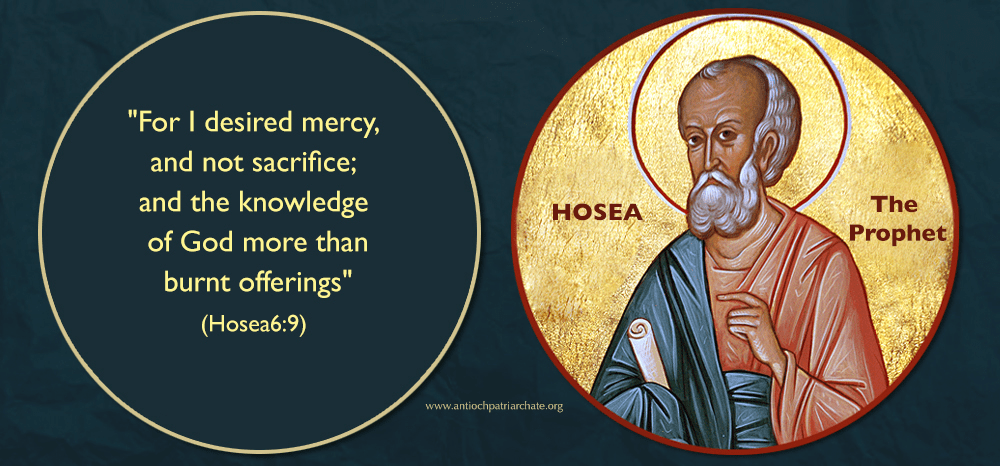
For I desire mercy, not sacrifice,
    and acknowledgment of God rather than burnt offerings.
As at Adam, they have broken the covenant;
    they were unfaithful to me there.
Gilead is a city of evildoers,
    stained with footprints of blood.
As marauders lie in ambush for a victim,
    so do bands of priests;
they murder on the road to Shechem,
    carrying out their wicked schemes.
I have seen a horrible thing in Israel:
    There Ephraim is given to prostitution,
    Israel is defiled. (New International Version)

My favorite word in all of Holy Scripture is the Hebrew word חסד (“chesed” pronounced in English “kes-ed).  It is such a rich word that no one English word can capture its depth and import. 

So, chesed is translated in various ways across English translations of the Bible as:

  • Goodness (American Standard Version)
  • Faithful love (Common English Bible)
  • Loyalty (God’s Word Translation)
  • Constant love (Good News Translation)
  • Mercy (King James Version)
  • Love that lasts (The Message)
  • Faithfulness (New English Translation)
  • Loving-kindness (New Life Version)
  • Steadfast love (New Revised Standard Version)

Chesed is God’s committed, gracious, and loving covenant loyalty to people. The Lord’s very attributes are sheer Love.

Since chesed marks the character and activity of God, the Lord very much desires people to reflect this same stance toward one another. In other words, because God is merciful and kind, we, as people created in God’s image, are to be marked with this same character in all we do. 

In today’s Old Testament lesson, God is calling and wooing wayward people to return to a life of closeness with the Lord. God demonstrated chesed by not sending the people away, like a spouse outright divorcing an unfaithful partner. Instead, the Lord is committed to loving the Israelites even when they were unlovely.

At all times, the response God wants from people is not simply to go through the motions of outward worship. Ritual practices mean little if there is no heart behind them. The Lord longs for people to demonstrate both fidelity and fealty through mercy and a steadfast love to God and neighbor.

Both our work and our worship are to be infused with divine mercy. 

God deeply desires a close relationship with humanity. The Lord is deeply grieved when people whore after other gods to meet their needs for love and belonging. Hosea’s prophecy is an impassioned plea for all persons to find their true fulfillment and enjoyment in a committed loving divine/human union, like a marriage.

In Christian readings of Hosea’s prophecy, repentance means accepting God’s chesed through Jesus Christ.

The believer is to allow the character of God to rule and reign in their heart so that love and commitment come flowing out in words, actions, thoughts, and dispositions.

Mercy, in Christianity, finds its highest expression in the person and work of Jesus.

It is no wonder, then, that Jesus lifted Hosea’s prophecy as a treasured principle of operation when asked why he deliberately made connections with “questionable” people:

As Jesus continued on from there, he saw a man named Matthew sitting at a kiosk for collecting taxes. He said to him, “Follow me,” and he got up and followed him. As Jesus sat down to eat in Matthew’s house, many tax collectors and sinners joined Jesus and his disciples at the table.

But when the Pharisees saw this, they said to his disciples, “Why does your teacher eat with tax collectors and sinners?”

When Jesus heard it, he said, “Healthy people don’t need a doctor, but sick people do. Go and learn what this means: I want mercy and not sacrifice. I didn’t come to call righteous people, but sinners.” (Matthew 9:9-13, CEB)

And when confronted about “questionable” activities, Jesus appealed to the same source of Hosea’s prophecy:

“Look! Your disciples are doing something that is not right to do on the day of rest—a holy day.”

Jesus asked them, “Haven’t you read what David did when he and his men were hungry? Haven’t you read how he went into the house of God and ate  the bread of the presence? He and his men had no right to eat those loaves. Only the priests have that right. Or haven’t you read in Moses’ Teachings that on the day of rest—a holy day, the priests in the temple do things they shouldn’t on the day of rest yet remain innocent? I can guarantee that something  greater than the temple is here. If you had known what ‘I want mercy, not sacrifices’ means, you would not have condemned innocent people. (Matthew 12:2-7, GW)

One can never go wrong with mercy and grace. If in doubt between whether to judge another or show mercy, the Christian’s choice is clear.

Grace and love reconnects the disconnected. The heart of true Christian spirituality is a deep kinship with the divine. Whenever that relation is broken or severed, it is vital to restore it. The means of doing so is not judgment; it’s mercy.

Chesed is more than a word; it is a way of life.

God wants mercy. Grace is the Lord’s divine will. So, let us today receive the forgiveness of Jesus and devote ourselves to prayer and works of love which come from a heart profoundly touched by grace. 

May the result of our return to the Lord be healing of that which has been broken, and reconciled relationships with others.

Merciful and loving God, the One who shows amazing grace, forgive us for our wanderings away from the divine life. Return us, again, to the grace of Jesus Christ our Savior so that our hearts will be renewed and aflame with love for others. In the Name of the Father, Son, and Spirit, the Great Three in One. Amen.