On Knowing Christ

Pietà by Elisabeth Frink

The ancient Philippian church had lost sight of their purpose, of what is the primary reason for their being in existence. Simply put, they needed to unify around what is the central and most valuable core of Christianity: knowing Jesus Christ. For the Apostle Paul, in his letter to the Church at Philippi, Jesus was so valuable that he literally gave up everything to become a Christian and follow Jesus. (Philippians 3:4-14)

It was no little thing that Paul did, converting in such a completely life-altering way to Christ. Paul had everything going for him. He was the up and coming star in Judaism. Paul had the Jewish pedigree, the intelligence, the personality, and the drive to become one of the greatest Pharisees of all time. And yet he forsook it all to pursue and know Christ. 

It might be hard for us to imagine just how significant Paul’s turn around was. On a much smaller scale, it would be like Green Bay Packer quarterback, Aaron Rodgers, at the height of his career, leaving football altogether to become a missionary to some remote place few people have ever heard of. Most might likely think he lost his marbles and was throwing away (pun intended) something valuable and important. So, it was with Paul.  Everyone thought he was nuts for becoming a Christian.

However, this would be to misunderstand what is really of greatest value. There are plenty of people in our society telling us what we need. With all the noisy rhetoric, from political pundits to commercial marketers, the person and work of Jesus can easily get lost in an ocean of competing voices. On a practical level, it can be far too easy to simply toss Christian discipleship on the smorgasbord of good ideas we get handed each day. Jesus might get misplaced and forgotten on our plate of life because of the mass of other food that is piled alongside him.

World Communion Sunday (always the first Sunday in October each year) reminds Christians that Jesus is our surpassing greatness, the highest and most worthy asset we possess. When we come to the Lord’s Table, there is nothing else to feast upon except Jesus, and Jesus alone. In the act of receiving the common elements of bread and cup, we proclaim that we need no one else and no other thing to make us happy in this life. Jesus is enough for us. What is more, we stand united with our brothers and sisters in Christ throughout the world in a common purpose and value of knowing Jesus Christ, and him crucified.

The Elements of Holy Communion by Jacques Iselin

The core value and heart of Christianity is a faith and love relationship with Jesus, to know him. This was the heartfelt cry of the Apostle Paul, and it was so meaningful to him that he gave up everything to pursue Christ and follow Jesus.  If we ever strip Christianity of this core value and stray from knowing Christ, the vacuum will be quickly filled with all kinds of other stuff, like the sheer duty of perfunctory prayers, clean living, and dispassionate robotic service. 

Paul longed to know Christ better. There are two words in the Greek language for “know.” One word refers to information; the other refers to an experiential knowledge – and that is the word Paul used with the Philippians. He deeply desired an intimate experience of Jesus. And Paul craved this so much that literally everything, when compared to Jesus, was “rubbish” to him. 

In the ancient world there were no landfills and dumps – the street served as the place people threw their garbage. The trash then got trampled into the ground, along with the generous amounts of animal dung. That is how Paul thought of even the best things in life as compared to knowing Jesus. 

There is no comparison between a freshly grilled T-bone steak and microwaved liverwurst. There is no comparison between a billion dollars and a penny. There is no comparison between the Green Bay Packers and the Chicago Bears (sorry Chi-Town). And there is no comparison between Jesus and anyone or anything else, no matter whom or what it is. 

Saint Augustine, Bishop of Hippo, in the fifth century, described life apart from Jesus as “disordered love.” By that he meant we pursue whatever our affections are set upon. One might love family, friends, job, and hobbies, yet if Jesus is absent or must compete for our affections in the middle of those things, then it is a disordered love. The solution, for Augustine, is to rightly order our love by having Jesus as the premier object of our affection. The New Testament frames it this way: Repent and believe the gospel.

To have “disordered love” is a nicer way of saying “spiritual adultery.” Using this metaphor, the appropriate response is to return to our first love. “You have forsaken your first love,” said Jesus to the church in Ephesus.  “Remember the height from which you have fallen!  Repent and do the things you did at first” (Revelation 2:4-5). 

Christianity is not some religion in which we strike a deal with God to go to heaven if we accept Jesus. Rather, Christianity centers all of life in the person and work of Jesus. The Lord is a jealous God, feeling slighted when Christians moonlight with the world at night while acknowledging Jesus during the day.

Specifically, Paul wanted to know the power of Christ’s resurrection. He yearned to experience a supernatural change from the inside-out – to be a new person in Christ. Paul did not simply turn over a new leaf; he did a dramatic 180 degree turn and went hard after Jesus. A desire and/or decision to know Christ is to be more than a milquetoast “I’ll try to do better.” Christianity, at its core, is dying to self and being reborn in Jesus with new life.

Furthermore, Paul wanted to know Christ and the fellowship of sharing in his sufferings. Paul ached to know Jesus so much that he embraced suffering, just as his Lord did. Paul was not some spiritual masochist; he rightly recognized that spiritual growth and intimacy with Jesus largely comes from the harsh realities of life’s trials and difficulties, as faith is stretched.  We would not know Christ the healer if we were not broken; Christ the provider if we were not in want; and, Jesus Christ and him crucified unless we were aware of sin in the world along with our own personal sin.

Each time a Christian approaches the Lord’s Table, they set aside competing voices and forsake rival gods to have Jesus. For us who believe, let the ingesting of the elements be an act of fellowship with God. May we, along with Paul, Augustine, and all past saints desire to have Jesus completely take over our lives because he is so valuable to us. We never need to be perfect to partake of bread and cup. Instead, we only need to strive toward what is ahead and decide that today we will press on toward the higher goal of knowing Christ.

Revelation 3:7-13 – Love and Obedience

Chuck Colson quote

“To the angel of the church in Philadelphia write:

These are the words of him who is holy and true, who holds the key of David. What he opens no one can shut, and what he shuts no one can open. I know your deeds. See, I have placed before you an open door that no one can shut. I know that you have little strength, yet you have kept my word and have not denied my name. I will make those who are of the synagogue of Satan, who claim to be Jews though they are not, but are liars—I will make them come and fall down at your feet and acknowledge that I have loved you. Since you have kept my command to endure patiently, I will also keep you from the hour of trial that is going to come on the whole world to test the inhabitants of the earth.

I am coming soon. Hold on to what you have, so that no one will take your crown. The one who is victorious I will make a pillar in the temple of my God. Never again will they leave it. I will write on them the name of my God and the name of the city of my God, the new Jerusalem, which is coming down out of heaven from my God; and I will also write on them my new name. Whoever has ears, let them hear what the Spirit says to the churches. (NIV)

Over thirty-five years ago, the late Chuck Colson, a former White House Counsel and founder of Prison Fellowship, wrote a timely and influential book entitled Loving God.  In it, he presented a simple yet biblical premise concerning the life of every believer in Jesus: The way to love God is to obey God.  Everything turns on our listening to God and doing what he says to do.

Jesus himself communicated to the church at Philadelphia (not Pennsylvania, but ancient Asia Minor, now present-day Turkey) affirming their faithful obedience of the message.  Because of their steadfast observance of the gospel, the Philadelphian believers would be protected and loved by Jesus.

The church at Philadelphia did much more than offer a confession of loving God – they affirmed that confession through loving obedience to Jesus. In some Christian circles, we call this “living into our baptism.”  That is, it is one thing to experience the sign of baptism as being set apart by the Holy Spirit for a relationship with God through the person and finished work of Jesus.  It is quite another thing to “live into” this reality by knowing God’s Word and dutifully obeying it.

Human beings are complex creatures in their psychology, sociology, and history. However, there is at least one simple straightforward biblical truth we all can live into: To love God is to obey God. Therefore, it is quite necessary for us to spend extended times reading and knowing our Bibles well so that we can adhere to what it says.

“It is not what we do that matters, but what a sovereign God chooses to do through us. God doesn’t want our success; He wants us. He doesn’t demand our achievements; He demands our obedience. The Kingdom of God is a kingdom of paradox, where through the ugly defeat of a cross, a holy God is utterly glorified. Victory comes through defeat; healing through brokenness; finding self through losing self.” –Chuck Colson

Gracious God, thank you for the message of good news that in Jesus Christ I have forgiveness of sins.  Help to hold onto this gospel through all the vicissitudes of life so that obedience springs from my heart in all things by the power of the Holy Spirit.  Amen.

John 14:15-21 – On Loving God

Welcome, friends! Simply click the video below and let us enjoy our virtual presence with one another.

You can also view this video on TimEhrhardtYouTube

To reflect on God’s love for us, click You Are My King (Amazing Love) written by Billy James Foote and originally sung by Philips, Craig, and Dean.

To reflect on our love for God, click I Love You Lord written and sung by Laurie Klein.

May your week be filled with love and obedience in the power of the Spirit.

On Loving God

Last Supper Barbados
Depiction of the Upper Room by Unknown artist from Barbados.

This week, as I reflected on the words of Jesus:

“If you love me, you will obey what I command,” (John 14:15) 

my thoughts kept coming back to a dear friend of mine.  In the Fall of 1992, Wesley was on his deathbed in an Iowa hospital.  At the time, I was pastoring a small Michigan congregation and was able to take some time off to go and be with him. I was there for a week, spending my days at the hospital and only leaving his room to sleep for the night. It was my habit to rise about 5:00am and make my way to Wesley’s room where we would spend some quiet unhindered time with each other for a few hours before family members arrived. Wesley was deathly ill and could barely communicate anything above a whisper. Yet, those hours with him were incredible times of spiritual bonding and true Christian friendship.

You see, what was so amazing about my relationship with Wesley is that only a year before, he and I had a strained, difficult, and awkward relationship as he was about as far from God as anyone could be and did not want much to do with a Pastor.  Yet, in a matter of a few months, we had become devoted to one another as brothers.  Through a series of circumstances that I ascribe as God’s gracious hand, Wesley embraced a spiritual life that was as rich and full as I have ever seen (that is a story for another time). Now, as I sat with him six months later, Wesley was at the edge of his life.

During that week, I watched in the background as day after day, friend after friend, and relative after relative came into Wesley’s room to visit him for the last time.  The majority were much like Wesley before he wholeheartedly followed the love of Christ – having made a profession of faith as children, they had long since outgrew their Sunday School belief.  With each person, as frail as Wesley was, barely able to lift an arm more than a few inches, he would grab a hold, pull them close and say into their ear: “Look at me! I am dying. Is this how you want to end up?”  And then he said to every one of them: “If you are really a Christian and love Jesus, obey him and live your life for him.”

Love and obedience – they go together in Scripture like a hand in a glove.  The words of Jesus to love through obedience are part of what we call the Upper Room Discourse, or Farewell Speech. They are the Lord’s final words to his followers before his crucifixion – quite literally being Jesus’ deathbed message to those he loved. These are the words Jesus did not want his followers to forget. The disciples were distressed and troubled over the prospect that Jesus would not be with them, and they needed some focused words to live effectively with encouragement in the days and years ahead.

Upper Room
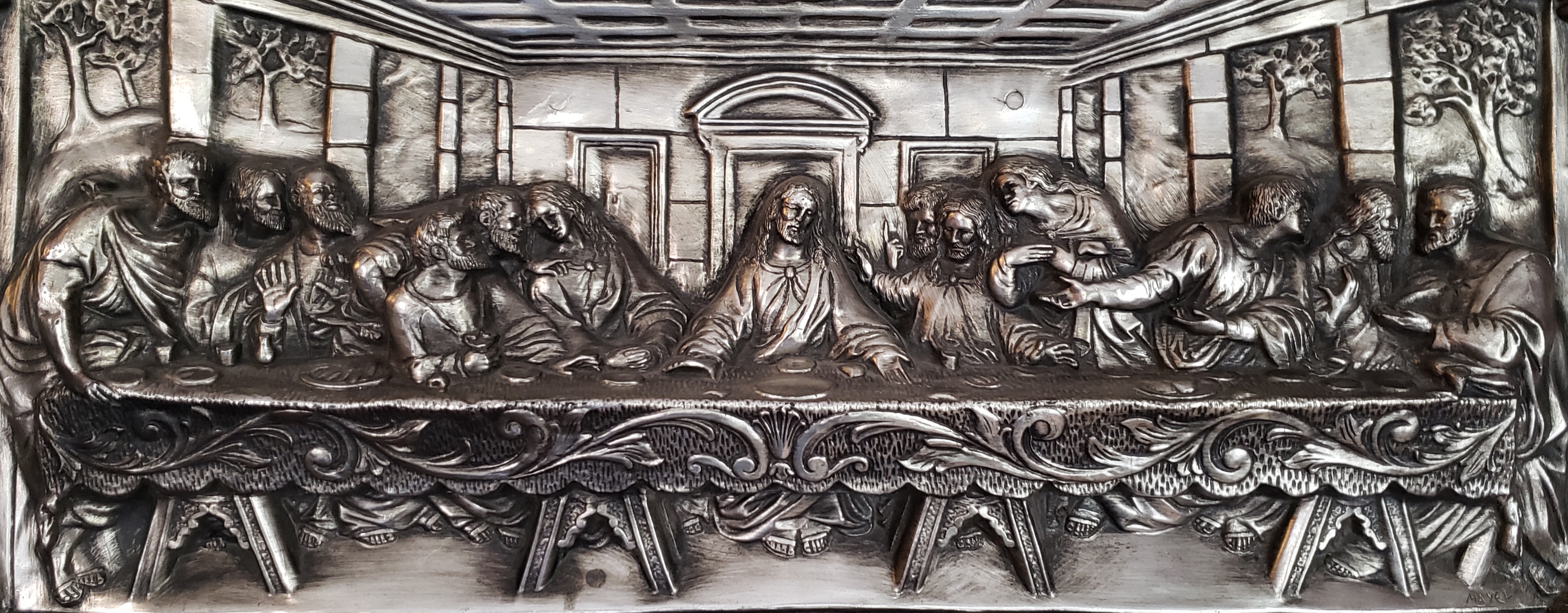
Pewter art of Da Vinci’s Last Supper. A gift from Wesley.

There are a two truths Jesus said to his disciples (and saying to us) as he was grabbing them and holding them close before his death:

Love is practiced through obedience to Christ’s commands.

Love through obedience is accomplished through the Holy Spirit’s help.

If we are to love Jesus, we will obey him – which begs the question: What are his commands?  There are three summaries of Christ’s teaching and commands in the Gospels that encompass loving him through obedience: The Great Commission; The Great Commandment; and, The Beatitudes.

When Jesus first began his teaching and healing ministry, he sat all the people down who were following him and gave them a summary of the Old Testament understanding of God’s righteousness.  These are the things, Jesus explained, that characterize a person who loves God:

Blessed are the poor in spirit, for theirs is the kingdom of God. 

Blessed are those who mourn, for they shall be comforted. 

Blessed are the meek, for they will inherit the earth. 

Blessed are those who hunger and thirst for righteousness, for they will be filled. 

Blessed are the merciful, for they will be shown mercy. 

Blessed are the pure in heart, for they will see God. 

Blessed are the peacemakers, for they will be called sons of God. 

Blessed are they who are persecuted for righteousness, for theirs is the kingdom of God (Matthew 5:12-17, NIV).

Genuine lovers of Jesus are characterized by their: authentic humility; deep concern to the point of tears over sin; gentle and meek spirit toward others; intense desire for personal righteousness and corporate justice; daily life of mercy, purity, and peacemaking; and, willingness to accept adversity for the sake of Jesus. Yes, lovers of Jesus are distinctly and profoundly characterized by grace. To act justly, to love mercy, and to walk humbly with their God is the normal everyday default life-setting for lovers of Jesus Christ.

When Jesus wanted to put all the Law and the Prophets (The Old Testament of the Bible) into a summary that would be easy to remember and understand he said:

Love the Lord your God with all your heart and with all your soul and with all your mind.  This is the first and greatest commandment.  And the second is like it:  Love your neighbor as yourself.” (Matthew 22:36-40, NIV)

What Jesus requires is an holistic love for God. Humanity is meant for wholeness, integration, and alignment between head, heart, and gut – with the glue of love. We are designed to have all of life in parity and balance – work, play, family, and church – because Jesus is Lord over it all, not just the church part. In the totality of our lives, in every relationship, and in every activity, Jesus invites us to grab hold of the kind of love that seeks a righteous agenda based in grace and mercy.

What is more, Jesus gave clear instructions of how to occupy our time on this earth while he is away preparing a place for us so that he can take us to be with him.  The gracious and pure living of the Beatitudes and the love of the Great Commandment are to be fully utilized with the Great Commission. Jesus stated:

All authority in heaven and earth has been given to me.  Therefore, go and make disciples of all nations, baptizing them in the name of the Father and of the Son and of the Holy Spirit, and teaching them to obey everything I have commanded you.  And surely I am with you always to the very end of the age.(Matthew 28:18-20, NIV)

Making disciples is at the heart of Christ’s commands. Every Christian is to be Christ’s apprentice learning the ways of Jesus in all of life, being spiritually developed so that we can be characterized by the Beatitudes and the Great Commandment. Jesus wants lifelong students in the faith, continually learning to love God through integrated and aligned selves in the church and in the world.

This is a big job.  In fact, the task is so huge that Jesus left us with the means of accomplishing it – he has given us another “Counselor” to be with us forever (John 14:16). “Counselor” (NIV) is translated in various ways in versions of the New Testament because the Greek term “Paraclete” is a rich word that is hard to encompass with a single English word. Other translations include: “Advocate,” “Comforter,” and “Helper.”  They are all accurate words to describe the Holy Spirit.  I think the best term to portray who the Holy Spirit is for God’s people is “True Friend.”

A true friend is the kind of person who you can call in the middle of the night and they will answer and listen; will drop everything to come and be with you in a time of need; will say hard things to you in love so that you can be a better person and have a better relationship with them; and, maintains a committed and consistent relationship with you.  A true friend is simply a person you enjoy and are deeply thankful for having them in your life.

Upper Room Holy Spirit
The Holy Spirit given to the disciples of Jesus.

That is what the Holy Spirit is – the Spirit helps us when we need help; encourages us when we are down; comes immediately to our side when we are in need; and, gives us a good loving kick in the backside when appropriate.  The Holy Spirit is our True Friend in the world.  The Spirit continually speaks truth to us and leads us into truth. The Spirit will come alongside and apprentice us in the faith and guide us in grateful obedience to Jesus.

Because of God the Father’s love in sending the Son; the Son’s sacrificial love through the cross; the Spirit’s consistent loving presence; and, the triune God’s insistence on living a life of love, Christianity is both duty and delight – and they go together in perfect harmony.

Wesley miraculously lived through his deathbed experience. God was not quite finished with him yet.  Wesley’s Christian life displayed that loving assurance and trust in Jesus leads to a no-holds-barred obedience which is grateful and joyous despite the most awful of circumstances.

In the summer of 1993, at 29 years of age, Wesley went to be with his Lord.  Not in my lifetime have I personally seen such a complete turn-around of a person so far away from God to a person whose every thought and word reflected the Beatitudes, the Great Commandment, and the Great Commission.  And I enjoyed a relationship that was totally changed from one of animosity to one that could be characterized as “true friend.”  Because of his love for God, Wesley now sees Jesus.

There is only one level of commitment to Christ – the high charge and privilege of duty and delight. A true disciple, a genuine follower of Jesus, loves him and lives an obedient life to the Lord in the strength of the Holy Spirit. Sometimes we have our lives so planned and pre-determined that when the Holy Spirit shows up to take us to a place of obedience to Jesus, we struggle to realize what’s happening. And we miss what God is doing in this world.  At other times we observe the commands of Scripture and feel the gentle nudging of God’s Spirit, yet we either cannot or will not respond out of fear, busyness, or even grief.  And then there are times when we are attentive to God’s Word and God’s Spirit and seek to obey Jesus – only to mess up so that we are left wondering if God could ever really do anything in us.

The truth is this: Love conquers all. Grace overcomes everything. Mercy never fails. We are here on this earth because of our True Friend. Even though we walk with Jesus in a three-steps-forward-two-steps-backward kind of way, the Spirit accommodates to our weakness.  To be a disciple, an apprentice, means we keep learning the ways of Jesus under the tutelage of God’s Spirit who patiently and powerfully works within us so that God’s kingdom breaks into this world and his will is done on earth as it is in heaven.