Galatians 5:2-6 – Faith Expressing Itself Through Love

The Sneetches

Mark my words! I, Paul, tell you that if you let yourselves be circumcised, Christ will be of no value to you at all. Again, I declare to every man who lets himself be circumcised that he is obligated to obey the whole law. You who are trying to be justified by the law have been alienated from Christ; you have fallen away from grace. For through the Spirit we eagerly await by faith the righteousness for which we hope. For in Christ Jesus neither circumcision nor uncircumcision has any value. The only thing that counts is faith expressing itself through love. (NIV)

Everyone needs the grace of faith expressing itself through love. I didn’t grow up committed to learning the Bible or following Christ. I pretty much went my own way throughout childhood, and especially the teenage years. I still remember what it felt like to not follow in the way of Christ. My view of the world was jaded, believing that most of humanity were basically uncaring self-absorbed creatures. I also knew the darkness of my own heart. When people, as I did long ago, view the world and self this way, there is a tragic loneliness where no one reaches out to the other, since everyone is guarded. A person and a world devoid of grace and reliant on law is, at best, a harsh place; and, at worst, a sort of dystopian nightmare.

It seems people who have a graceless past and only looked out for themselves often have a temptation to embrace strict rules when they become Christians. They know what it feels like to not have Jesus in their lives, so they sometimes, out of fear of returning to the old life, go beyond Scripture and impose standards on themselves, and then others, to keep on the straight and narrow to avoid sin.

If, or when, that happens, the Apostle Paul has something to say about it.  Embracing certain practices to obtain or maintain righteousness mean diddly-squat in God’s kingdom.  Here is how the Common English Bible version translates Paul’s words to the church who went down the path of strict outward rule-keeping:

“You people who are trying to be made righteous by the Law have been estranged from Christ. You have fallen away from grace! We eagerly wait for the hope of righteousness through the Spirit by faith. Being circumcised or not being circumcised doesn’t matter in Christ Jesus, but faith working through love does matter.” (Galatians 5:4-6, CEB)

A form of Christianity which ignores God’s grace in favor of controlling one’s own faith through certain rules is not Christianity at all, and Paul would have nothing to do with it. His position was clear and pointed:

“You were called to freedom, brothers and sisters; only don’t let this freedom be an opportunity to indulge your selfish impulses but serve each other through love.” (Galatians 5:13, CEB)

Grace is the currency of God’s kingdom, flowing freely through love. God has your back. With him we need not be guarded. God’s grace forgives, and never runs out. God’s love endures and never withdraws. When we get a hold of this essential and beautiful truth about God, the only rule we want to keep is Paul’s admonition to the Roman church:

“Let no debt remain outstanding, except the continuing debt to love one another, for whoever loves others has fulfilled the law.” (Romans 13:8, NIV)

So, are there any practices, rules, beliefs, or doctrines you impose on yourself which are burdensome to you?  Why do you do them? Do you expect others to do them, too? What would change if you threw grace and love in the mix?

It must continually be borne in mind that love does not foster an antinomian spirit of being against the law because love itself is the fulfillment of law. Paul, again, explained his reasoning:

The commandments, “You shall not commit adultery,” “You shall not murder,” “You shall not steal,” “You shall not covet,” and whatever other command there may be, are summed up in this one command: “Love your neighbor as yourself.” Love does no harm to a neighbor. Therefore, love is the fulfillment of the law. (Romans 13:9-10, NIV)

The Apostle Paul’s issue was not so much with circumcision itself as it was why the church wanted to practice it to begin with. Circumcision has always been an outward sign of an invisible reality – for the Jewish people – a truth which seemed lost on the Gentile churches. Paul’s agitation and frustration had to do with the church’s reason for considering circumcision. Much like the star-bellied Sneetches of Dr. Seuss’s classic story, the impetus behind wanting circumcision was to leverage power and superiority over others.

A vision of a new egalitarian society of redeemed persons based in the finished work of Jesus Christ (grace) was at risk, and Paul was going to address any imposed practices of exclusion (law) which would compromise and erode true community. Methinks the Apostle Paul and Dr. Seuss would have gotten along well together:

The day they decided that Sneetches are Sneetches

And no kind of Sneetch is the best on the beaches

That day, all the Sneetches forgot about stars

And whether they had one, or not, upon thars.

The Sneetches, by Dr. Seuss, 1961

Gracious God, your love has extended so far as to give your one and only Son on our behalf.  Through Jesus, I embrace the faith and love gifted to me through his redeeming work.  Help me to daily die to myself and my propensity for outward rule-keeping, and to live the gracious life you died to procure for me in the power of your Holy Spirit.  Amen.

Revelation 2:1-7 – The Duty and Delight of Divine Love

love for Jesus

“Write this letter to the angel of the church in Ephesus. This is the message from the one who holds the seven stars in his right hand, the one who walks among the seven gold lampstands:

“I know all the things you do. I have seen your hard work and your patient endurance. I know you don’t tolerate evil people. You have examined the claims of those who say they are apostles but are not. You have discovered they are liars. You have patiently suffered for me without quitting.

“But I have this complaint against you. You don’t love me or each other as you did at first! Look how far you have fallen! Turn back to me and do the works you did at first. If you don’t repent, I will come and remove your lampstand from its place among the churches. But this is in your favor: You hate the evil deeds of the Nicolaitans, just as I do.

“Anyone with ears to hear must listen to the Spirit and understand what he is saying to the churches. To everyone who is victorious I will give fruit from the tree of life in the paradise of God. (NLT)

One of the great tragedies of this world is a love which has grown cold. No one simply wakes in the morning and deliberately decides to withhold love. Instead, love is one of those qualities which needs continual attention. Love must be cultivated and tended. Small decisions of procrastination in overlooking the growing weeds in love’s garden or wandering away and forgetting to wander back are the more common ways of a love which is withering.

It is probably inevitable that love will ebb and flow because love is one of those wondrous animations which never remains still. Love is always moving, either growing with life each day or becoming small. In either case, the critical element to love is the lover’s attention to its object of love because it takes time for love to both develop into something beautiful and, conversely, to devolve into a shell of its former self.

So, I have just presented an agrarian metaphor. After all, I spent my entire childhood on an Iowa farm. There are yet other metaphors and images of love we can use. The Apostle John’s received revelation mentions the churches as “lampstands,” imaging Christians as light. Like the use of an electrical dimmer switch, we can control how bright the light can shine to observe all that it in the room. Or, we can lower the illumination to suit the purpose. Whichever image we employ with love, it rarely stands still or remains the same. Love does wax and wane over time.

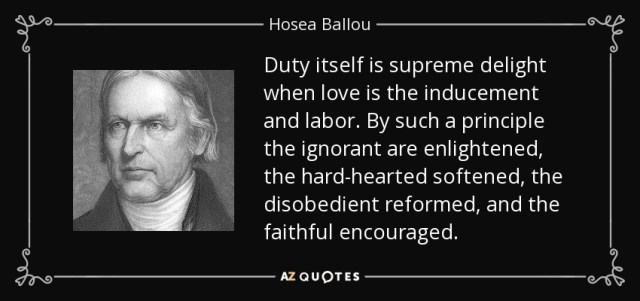
Hosea Ballou quote

For love to endure it needs both duty and delight. Delight in love’s object without duty is mere sentiment. And duty without delight is maintaining the forms of love yet eviscerating it of all feeling and meaning. Couples and people grow apart when they cannot or will not hold both duty and delight together over a long period of time.

What is amazing to me about Revelation chapter two is that the risen and ascended Christ personally addresses the churches, his bride. I detect in the words of Jesus to the church at Ephesus a wound of the heart, a hurt in which duty has continued and delight has ebbed away. Jesus was looking for love, and he was finding his bride dutifully soldiering on with perseverance under suffering and yet drained of those little things that lovers do in the early days of their relationship – things which thoroughly express delight.

Oh, I really do get it. Being under continued hard circumstances can wear on us. In the effort to simply make it, we can retreat into the singular focus of getting necessary things done. And Jesus most certainly noticed and affirmed the Ephesian’s herculean effort of maintaining the hard work of faith in the middle of adversity. Since duty and delight need one another, Jesus knew it would not be long until the duty part of the equation would give way, unable to bear the weight of being out of balance.

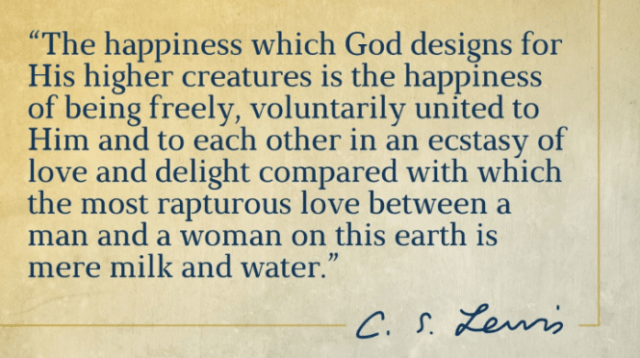
C.S. Lewis quote

What was at risk for the Ephesian church was both their love for Jesus and love for one another. In another pair of loves meant to be held together, Jesus and his people are inseparable. To love the one is to love the other, and vice versa. The answer to the inability of holding love’s duty and delight, and love’s objects of God and each other is to turn around and begin again to do the things you did at first when the relationship was fresh. Paying attention to the little things adds up to a wondrous pile of love.

One of the lessons here is that all of us who value a strong work ethic must be thoroughly and continually motivated by a compassionate and generous spirit, or our love grows cold and becomes worthless. We must pay attention or find that we lose ourselves. The Apostle Paul addressed the same sort of malformed love to the church at Corinth:

“I may speak in different languages, whether human or even of angels. But if I don’t have love, I am only a noisy bell or a ringing cymbal. I may have the gift of prophecy, I may understand all secrets and know everything there is to know, and I may have faith so great that I can move mountains. But even with all this, if I don’t have love, I am nothing. I may give away everything I have to help others, and I may even give my body as an offering to be burned. But I gain nothing by doing all this if I don’t have love…. So, these three things continue: faith, hope, and love. And the greatest of these is love.” (1 Corinthians 13:1-3, 13, ERV)

Receive today this blessing, my friends:

When you find your love has drifted and has fallen out of delight, may you pause, feel the strain, and open to Love’s possibilities once again.

When your words and your actions are mundanely parroted day in and day out, may you again hear the song of Love’s first music within you.

When you discover affection is unraveling, replaced with a staid duty, may your soul be kissed once again with Love’s tender touch.

Now is the time to take the chalice of Love and drink deeply of the divine, reawakening to the longing of Love which has lain dormant within.

For God is Love, and Love is God. With God, it is always Spring.

2 Thessalonians 2:13-3:5 – A Life-Giving Message

OakTreeUnknownArtist
“Grow in the grace and knowledge of our Lord and Savior Jesus Christ.” (2 Peter 3:18)

We ought always to thank God for you, brothers and sisters loved by the Lord, because God chose you as first-fruits to be saved through the sanctifying work of the Spirit and through belief in the truth. He called you to this through our gospel, that you might share in the glory of our Lord Jesus Christ.

So then, brothers and sisters, stand firm and hold fast to the teachings we passed on to you, whether by word of mouth or by letter.

May our Lord Jesus Christ himself and God our Father, who loved us and by his grace gave us eternal encouragement and good hope, encourage your hearts, and strengthen you in every good deed and word.

As for other matters brothers and sisters, pray for us that the message of the Lord may spread rapidly and be honored, just as it was with you. And pray that we may be delivered from wicked and evil people, for not everyone has faith. But the Lord is faithful, and he will strengthen you and protect you from the evil one. We have confidence in the Lord that you are doing and will continue to do the things we command. May the Lord direct your hearts into God’s love and Christ’s perseverance. (NIV)

As with most sections of Holy Scripture, if we merely focus on this singular passage from the Bible and seek daily to live into its message, it is likely we would live a consistently rich and full spiritual life. As the Apostle Paul said to the Thessalonians, and indeed to us, standing firm and holding a solid grip on apostolic teaching will mean a daily life of loving words and actions.

Notice the many elements of this Scripture for us to spotlight for our spiritual lives: gratitude; salvation; sanctification; truth; spiritual calling; sharing in God’s glory; love; grace; hope; encouragement; prayer; faithfulness; perseverance; and, deliverance. We could even highlight just one of these words and, if seeking to do a deep dive with it, could spend unending days learning and living into its multi-faceted dimensions.

I want to pause here and do a bit of a check-in with you. How we approach this passage of Scripture, as well as any other verses which encourage us to hold onto sound teaching and living, will likely determine our level of joy, satisfaction, confidence, and success. It all begins with our view of self. If we come at the Christian life and Holy Scripture with a view of self as a mere tool or object for God’s use – then we are truly objectifying ourselves.

The key point of awareness to realizing whether we have such an objectifying view is if we continually “should” ourselves. The word “should,” brings self-hatred. We primarily see only shortcomings and original sin – and are blind to the majesty of being in God’s image. In such a view there is typically boat loads of shame for not living up to the ideal form of a devoted Christian. Belittling ourselves inwardly only transfers outwardly to looking down on others for their failures. Any exhortation from me or anybody else would be seen in this view as a demanding duty.

OakTreeTomBrown
“The gospel is bearing fruit and growing throughout the whole world—just as it has been doing among you since the day you heard it and truly understood God’s grace.” (Colossians 1:6)

Instead, we can come to Scripture’s admonitions, encouragements, and exhortations with the glasses of grace. After all, our text for today says that God loved us and by his grace gave us this teaching. The dense amount of Christian living in such a few verses, when viewed through the lenses of grace, are merciful words communicating support. God wants to strengthen us with grace just because he loves us. God does not objectify us by seeing us as pawns in some twisted divine game for his own cosmic pleasure. Rather, God is looking to direct our hearts toward a delight in his love. Because it is only with love and grace that we can really persevere throughout our Christian lives.

Not everyone has faith, and that saddens the heart of God. It also puts us, at times, in awkward situations. Again, the love of God does not leave us alone. Divine love will strengthen and protect us. The Apostle Paul never wags his finger and levels the “should” on us like some uptight legalist. Paul expresses confidence, knowing that we most certainly have the capacity to live the will of God. The Scriptures are given to engender strengthening of faith and spiritual growth rather than self-hatred, which has a nasty tendency to come out sideways in a lack of compassion and grace toward others.

This letter was written by Paul to the church because they were finding it difficult to endure their hard circumstances. The Thessalonian Christians began longing for heaven to such a degree that they were losing their grip on living presently in the moment of now. This is part of the reason why Paul encouraged them to pray for him and his colleagues. The people needed to put some focus on the now of spreading the message of God’s grace.

To be rather frank, truth be told, the chief reason I write these daily reflections on Scripture is because I need God’s Word. Yes, I do write for the reader. I want to contribute to people’s growth in grace and I have a deep desire to make the message known. Yet, honestly, I write more for myself. This is a way for me to remind myself of God’s love and grace and utilize it every day.

When I hear Paul talking in biblical texts like these, I detect some of the same reason – Paul himself wants to continue growing in grace, and when writing to and for others he is very much writing to himself. The reading of the Bible and the dedication to living its message is meant to be life-giving, or rather, eternally life-giving.

So, today, I leave with this blessing:

May you take refuge in the wondrous grace of God, and all the little miracles of mercy which he bestows each day.

May you always be inclined to rush into God’s Holy Word and discover its life working within you.

May you imitate the flower as it opens to the day’s sunshine in receiving all that God has for you this day.

May you be in solidarity with brother stone, who sits in silence, calm and secure, and be excessively gentle with yourself.

May you wisely steer clear of those vexed in spirit with only God knows what; and, when in that space of others walking all over your boundaries, may your confidence surge and God’s protection deliver you.

May you return to the glory that is yourself, learning a new respect for your heart, and the joy that has always been there, given graciously to you by a God who has invited you to share in Jesus Christ.

Amen.

John 14:15-17 – Love and the Trinity

Trinity Love

[Jesus said] “If you love me, keep my commands. And I will ask the Father, and he will give you another advocate to help you and be with you forever— the Spirit of truth. The world cannot accept him because it neither sees him nor knows him. But you know him, for he lives with you and will be in you.” (NIV)

“The best love is the kind that awakens the soul and makes us reach for more, that plants a fire in our hearts and brings peace to our minds.”–Noah, from the movie, The Notebook

“Dear friends, let us love one another, for love comes from God. Everyone who loves has been born of God and knows God.” (1 John 4:7)

Love makes the world go around. Love is the invisible spiritual and emotional atom giving our lives substance, energy, and meaning. God is that atom, constantly creating love within himself in an explosion of attentive fatherly protons, gracious messianic neutrons, and active Spirit electrons.

In this post Day of Pentecost time, as well as the anticipation of Trinity Sunday, we are reminded of the connection between God the Son, God the Father, and God the Spirit. Yes, as today’s Gospel lesson demonstrates to us, Christians serve a triune God – one God in three persons. Many metaphors have been attempted (attempt is the right term for my atom analogy) to try and explain the Trinity. The truth is, although some images are helpful, they all fall short. That is because I can no more explain God than I can explain my wife and daughters. Just as females are an enigma to males, so God moves, acts, and speaks in ways that are ofttimes puzzling to humanity. Maybe that is why Jesus said the world does not discern or accept the Holy Spirit. Far too many folks like nice tidy answers to clear questions. Jesus babbling about some person living in us appears highly nonsensical to a chunk of humanity.

So, for me, I continually come back to what I know and understand about the Trinity: It is an intimate fellowship of love. In love, the Father and the Son have sent the Spirit to be with us forever – the Spirit of truth. In a world where evidence-based reasoning typically eschews any sort of intuitive knowledge, there are many learned people who believe spiritual matters are best left to guys like me. Yet, we severely truncate our ability to know anything if our epistemic presuppositions are bereft of knowledge beyond our five senses. For Christians and many other spiritually sensitive people, we discern there are senses beyond taste, touch, sight, smell, and hearing. Indeed, for those with spiritual eyes to see and ears to hear, there is a vast multi-dimensional world far above and beyond the habitation of our three-dimensional space. And love binds it all together.

I once asked an extremely secular-minded friend about love. He talked of loving words and actions that are derived from biological instinct and well-developed brain chemistry. After he spoke at some length about this, I simply asked him, “Does that kind of understanding about love help you in your relationships, especially with your girlfriend?” He looked at me like I had caught him with his hand in the cookie jar. “It doesn’t – and we are not doing so well in our relationship.”

I am not here to make digs at secular thinkers. In fact, I deeply appreciate the many friends I have whose worldviews are quite different than mine. I just have personally discovered that the Bible rings true for me (and it did not for many years when I was younger) and that the Trinity is a reality because of the Holy Spirit’s witness of truth in me.

Trinity Love 2

Love is a matter of the gut and the head as well as the heart. Love can no more be relegated to limited spheres of being than a mule can be tamed with nicely asking him to settle down. Love is much too big, expansive, and powerful to be contained. So, it resides within God because God is the only Being which can hold it. God’s words and actions are not merely loving – God himself is love. And God lovingly bestows that love to us in measures and in ways we can absorb it and know it. Just as people can die of a broken heart, so their hearts can burst if filled with such overwhelming love. The Father and the Son have graciously given the Spirit to be a kind of steward of love within us – dispensing love with great care and attention in ways we feel it and may not be able to explain it with words.

I take great solace in the fact that the Holy Spirit is my Advocate. We all have times in our lives when we just cannot seem to get anywhere – or do not have the ability to express what we want. In such times, we need an advocate, someone who has the weight to be heard by others – someone who has our back when we are experiencing limitations. The Spirit is such a person. And the Spirit advocates for us in loving ways for all parties involved. The only thing impossible for God is to be unloving and unkind; it is not in his nature. Because of divine love, God sent the Son, then the Spirit, to be with us forever so that we would never be alone and always have someone to champion our well-being.

Living in obedience to the God of Love is sheer joy and delight. Laboring for the Lord seems almost effortless when we have a true vision of God high above, surveying all creation with eyes of love for his people – as well as a vision of God below and right next to us, listening with rapt attention to our every word and himself delighted with each movement we make.

Look upon us, O Lord, and let all the darkness of our souls vanish before the beams of your brightness. Fill us with holy love, and open to us the treasures of your wisdom. All our desires are known to you, therefore, perfect what you have begun and what your Spirit has awakened us to ask in prayer. Turn your face toward us and show us your great love and glory. Then shall our longings be satisfied, and our peace shall be perfect.

–A Prayer of St. Augustine, 354–430 CE