1 Corinthians 9:1-16 – Showing Tolerance

Tolerance, statue by Spanish artist Jaume Plensa

Am I not free? Am I not an apostle? Have I not seen Jesus our Lord? Are you not the result of my work in the Lord? Even though I may not be an apostle to others, surely, I am to you! For you are the seal of my apostleship in the Lord.

This is my defense to those who sit in judgment on me. Don’t we have the right to food and drink? Don’t we have the right to take a believing wife along with us, as do the other apostles and the Lord’s brothers and Cephas? Or is it only I and Barnabas who lack the right to not work for a living?

Who serves as a soldier at his own expense? Who plants a vineyard and does not eat its grapes? Who tends a flock and does not drink the milk? Do I say this merely on human authority? Doesn’t the Law say the same thing? For it is written in the Law of Moses: “Do not muzzle an ox while it is treading out the grain.” Is it about oxen that God is concerned? Surely, he says this for us, doesn’t he? Yes, this was written for us, because whoever plows and threshes should be able to do so in the hope of sharing in the harvest. If we have sown spiritual seed among you, is it too much if we reap a material harvest from you? If others have this right of support from you, shouldn’t we have it even more?

But we did not use this right. On the contrary, we put up with anything rather than hinder the gospel of Christ.

Don’t you know that those who serve in the temple get their food from the temple, and that those who serve at the altar share in what is offered on the altar? In the same way, the Lord has commanded that those who preach the gospel should receive their living from the gospel.

But I have not used any of these rights. And I am not writing this in the hope that you will do such things for me, for I would rather die than allow anyone to deprive me of this boast. For when I preach the gospel, I cannot boast, since I am compelled to preach. Woe to me if I do not preach the gospel! (NIV)

A person who cannot tolerate small misfortunes can never accomplish great things.

Chinese Proverb

There is a reason for tolerance. You and I employ it in all kinds of ways and contexts so that we might achieve an important purpose.

Parents of newborn babies put up with a lot from the little one. As a father myself, who has raised three daughters with my wife, I can testify that over the course of many years I have been puked-on, peed-on, poked in the eye, and kicked in places I would rather not discuss. I have patiently helped with homework, taken time out to play with dolls, and stayed up late waiting for teenagers to come home. None of those things ever showed-up on my bucket list.  So, why did I do them?

Yes, you already know that was a rhetorical question with a decisive answer. It is because I love my girls. I would do anything for them. I was committed to doing whatever it took to raise virtuous, fun-loving, well-adjusted, God-seeking, responsible persons. I was willing to put up with a lot to see that happen.

The Apostle Paul was passionate and committed about reaching lost people and raising them in the Christian faith.  He was willing to put up with a lot to see that purpose come to fruition. Paul was determined not to put any obstacle in the way of gospel proclamation.

Paul was motivated by seeing the good news of Jesus Christ take root in people. He did all that he could to communicate the message. Paul had a committed personal conviction to not let his personal rights stand in the way of what was most important.

“Toleration is the greatest gift of the mind; it requires the same effort of the brain that it takes to balance oneself on a bicycle.”

helen keller

Mature faith in Christ patiently, lovingly, and deliberately helps others know Jesus Christ better. Mature people will put up with a lot to raise godly disciples. They refuse to let themselves or anything else stand in the way of a young Christian’s spiritual growth. They willingly set aside personal agendas and even rights and needs to see them grow up in faith. They protect and serve, teach, and nurture, all while enduring all kinds of unpleasant stuff.

Tolerance for tolerance sake means nothing. But tolerance purposely used to spiritually form others in Jesus Christ is part of being a devoted follower of God.

Patient God, you know all about enduring humanity’s failings, immaturity, weaknesses, and sins.  Yet, you put up with a lot to see us born again, grow in faith, and become productive Christians.  Enable me to persevere for the grand purpose of seeing others come to discover you, know Christ, and experience the power of the Holy Spirit.  Amen.

Galatians 5:2-15 – Faith Expressing Itself Through Love

Mark my words! I, Paul, tell you that if you let yourselves be circumcised, Christ will be of no value to you at all. Again, I declare to every man who lets himself be circumcised that he is obligated to obey the whole law. You who are trying to be justified by the law have been alienated from Christ; you have fallen away from grace. For through the Spirit, we eagerly await by faith the righteousness for which we hope. For in Christ Jesus neither circumcision nor uncircumcision has any value. The only thing that counts is faith expressing itself through love.

You were running a good race. Who cut in on you to keep you from obeying the truth? That kind of persuasion does not come from the one who calls you. “A little yeast works through the whole batch of dough.” I am confident in the Lord that you will take no other view. The one who is throwing you into confusion, whoever that may be, will have to pay the penalty. Brothers and sisters, if I am still preaching circumcision, why am I still being persecuted? In that case the offense of the cross has been abolished. As for those agitators, I wish they would go the whole way and emasculate themselves!

You, my brothers, and sisters, were called to be free. But do not use your freedom to indulge the flesh; rather, serve one another humbly in love. For the entire law is fulfilled in keeping this one command: “Love your neighbor as yourself.” If you bite and devour each other, watch out or you will be destroyed by each other. (NIV)

Faith, expressing itself through love, is the grace others need from us. I did not grow up committed to learning the Bible or following Christ. I pretty much went my own way throughout childhood, and especially my teenage years. I still remember what it feels like to not be a Christian. 

I have found throughout my Christian life that folks with a past in which they did not live by grace, but only looked out for themselves, have a temptation to embrace strict rules when they become Christians. They know what it feels like to not have Jesus in their lives, so they sometimes go beyond Scripture and impose standards on themselves, and then others, to keep on the straight and narrow.

If, and when, that happens, the Apostle Paul has something to say about it. Embracing certain practices to obtain or maintain righteousness mean nothing in God’s kingdom. For the Galatian church who went down the path of strict outward rule-keeping, Paul had strict words. Here is how one version of the New Testament puts it:

“You people who are trying to be made righteous by the Law have been estranged from Christ. You have fallen away from grace! We eagerly wait for the hope of righteousness through the Spirit by faith. Being circumcised or not being circumcised doesn’t matter in Christ Jesus, but faith working through love does matter.” (Galatians 5:4-6, CEB)

Any Christian tradition or individual believer which ignores God’s grace in favor of controlling one’s own faith through certain rules is no Christianity, at all. Paul would have nothing to do with it. His position was clear and pointed. We are called to freedom, and we are to use that freedom to serve others through love. Freedom is not something where we do whatever we want without regard to others. That is selfishness, not freedom.

“Grace must find expression in life, otherwise it is not grace.”

karl barth

Freedom is a gift of grace. It is given to us so that we will live freely into who we are meant to be as humanity. In other words, there are to be no obstacles of extra-biblical or unbiblical rules impeding us to realize our full potential as Christians saved by grace through faith. Our possibilities include full unhindered expressions of love, joy, peace, patience, kindness, goodness, faithfulness, gentleness, and self-control for the benefit of ourselves and the entire community of the redeemed.

Grace is the currency of God’s kingdom, flowing freely through love. God has your back. Grace forgives, and never runs out. Love endures and never withdraws. When we grab hold of this essential and beautiful truth about God with spiritual gusto, then the only rule we want to keep is the continuing debt to love one another.

Are there any practices, rules, beliefs, or doctrines you impose on yourself which are burdensome to you, or others?  Why do you do them?  Do you expect others to keep them?  What would change if you threw grace and love into the mix?

Gracious God, your love has extended so far as to give your one and only Son on our behalf.  Through Jesus, I embrace the faith and love gifted to me through his redeeming work.  Help me to daily die to myself and my propensity for outward rule-keeping, and to live the gracious life you died to procure for me.

Psalm 139:1-6, 13-18 – Specially Crafted by the Divine

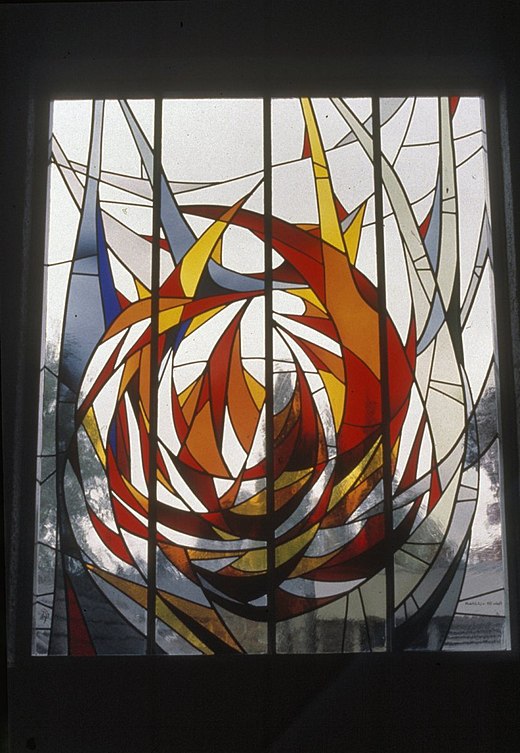
Psalm 139 stained glass by Dutch artist Ted Felen (1931-2016)

Lord, you have examined me.
    You know me.
You know when I sit down and when I stand up.
    Even from far away, you comprehend my plans.
You study my traveling and resting.
    You are thoroughly familiar with all my ways.
There isn’t a word on my tongue, Lord,
    that you don’t already know completely.
You surround me—front and back.
    You put your hand on me.
That kind of knowledge is too much for me;
    it’s so high above me that I can’t reach it….

You are the one who created my innermost parts;
    you knit me together while I was still in my mother’s womb.
I give thanks to you that I was marvelously set apart.
    Your works are wonderful—I know that very well.
My bones weren’t hidden from you
    when I was being put together in a secret place,
    when I was being woven together in the deep parts of the earth.
Your eyes saw my embryo,
    and on your scroll every day was written that was being formed for me,
    before any one of them had yet happened.
God, your plans are incomprehensible to me!
    Their total number is countless!
If I tried to count them—they outnumber grains of sand!
    If I came to the very end—I’d still be with you. (CEB)

It is no wonder so many people struggle with their self-image. Beautiful people reign in television and movies; the rich and powerful are highlighted in the media; and people with perfect teeth and immaculate attire are splashed in front of us in the daily barrage of advertisements. Meanwhile, the rest of us 99% of the population quickly notice we do not measure up to such a standard. You don’t have to be a people watcher to know that less than perfect bodies are the norm and that most folks do not have a budget to live like the other 1% humanity.

If we make comparisons with others too much and for too long, it gets downright depressing. Yet, into this dark abyss of one’s self-image enters the biblical truth that each one of us, no matter our station in life, was personally hand-crafted by a heavenly Being who loves us dearly. We are indeed fearfully and wonderfully made.

The Creator God took great care to make us and form us just so. The psalmist, David, praised God for the way we were created. The real standard from which we ought to judge ourselves is this: God knows us intimately, inside-and-out, and neither condemns us nor shames us but loves us wholly.

Psalm 139 by Dutch painter Ellen Van Randeraat, 2013

So then, rather than wasting our emotional energy and mental faculties on wishing we looked different or were more like so-and-so who seems to always have it all together, try practicing what David did: Praise God. 

Whenever we have the notion that we do not measure up to our imposed arbitrary standard, keep in mind that the only real measurement is grace. No matter who we are, the entire race of humanity has been created in the image of God, and, on that basis alone, we have inherent value, worth, and majesty. Let us, then, treat ourselves and others with the yardstick of grace.

The inner critic, that is, the inner judgmental dialogue we have with ourselves, needs to be replaced with the truth of Psalm 139. Although we might be rather hard on ourselves and say things in the reclusive parts of our minds and hearts that we would never say to others, nor tolerate others saying about someone else – God speaks to us with tender words of grace. Perhaps you think that only you know the depth of your own sorrows, hurts, fears, insecurities, and worries.  Except….

God. The Lord knows it all intimately – and is not one bit repulsed. You see, God knows that the answer to all the self-doubts is Divine care and protection. You and I have the freedom to plumb the recesses of our hearts and souls – to bring out all that is inside the cluttered closet of our minds and lay it all on the table without fear of God calling you what you call yourself.

Therefore, please do not quickly pass over the inspired words from Holy Scripture contained in today’s psalm. Take the time to carefully digest each phrase slowly so that the message becomes internalized and believed in real-time experience.

One of the theories of human psychology is that people are driven by two primary needs: 

  1. To intimately know another person.
  2. To be intimately known by another person. 

God knows us even better than we know ourselves – and still loves us! There is nothing we learn about ourselves that God does not already know. No human relationship can even come close to the level of knowing that God has for us and about us.

To know God is perhaps the greatest and highest pursuit we could ever enjoy. God is so immense and infinite that we will spend an eternity getting to know the Lord and will never get to the end of it. That is the kind of God we serve. Be encouraged today and always with the reality that you are known and can know God – and even more, loved deeply as a specially fashioned creature.

O God, thank you that I am wonderfully made in your likeness.  I praise you that I am fully accepted, even when I do not accept myself.  In Jesus Christ you have demonstrated the height of your love and mercy.  May this grace be with me every day so that I will conduct myself in a manner worthy of being part of the human family.  Amen.

Luke 6:27-31 – Love Your Enemies

“But to you who are listening I say: Love your enemies, do good to those who hate you, bless those who curse you, pray for those who mistreat you. If someone slaps you on one cheek, turn to them the other also. If someone takes your coat, do not withhold your shirt from them. Give to everyone who asks you, and if anyone takes what belongs to you, do not demand it back. Do to others as you would have them do to you.” NIV)

“Maturity is looking at every person we meet and saying to yourself, ‘I will never, God helping me, do anything to harm you: not by angrily lashing out at you, lusting over you, faithlessly slipping away from you, verbally hitting back at you, or even justifiably disliking you.’”

–Frederick Dale Bruner

Here are a few rhetorical questions, considering the astounding words from Jesus to love enemies: Have you ever had someone not like you?  Offend you? Purposely say or do things that upset you? I once had a next-door neighbor who was plain mean. Once, when my dog accidentally strayed into her yard and left a package, she picked it up and placed the package directly in front of my backdoor. 

When such things happen, it is tempting to respond in kind with the same behavior as the obnoxious person.  Many of us have sly passive aggressive tendencies of getting back at others when they do or say offensive things, and we consider them an enemy.

The situation with my neighbor was frustrating, yet quite benign. It is an entirely different matter trying to love someone who has deeply hurt us. Their words of malice or actions of abuse are evil, and we naturally seek to defend and respond by hurting them back. This is no trite saying of Jesus to proclaim that we are to love the enemy. It will be hard to love a villain apart from the grace of God, and Jesus knew what he was asking of us.  He does not ask of us anything that he himself has not already done.

We are often pleased with ourselves if we love our family and friends, because even that is a struggle for us, at times. We need to treat all people with respect and kindness, even active love, because that is what God does.

Jesus did not say anything new in calling for neighbor love. The Old Testament clearly says to do so: 

You must not take revenge nor hold a grudge against any of your people; instead, you must love your neighbor as yourself; I am the Lord. (Leviticus 19:18, CEB)

Nowhere in the Old Testament does it say to hate your enemy. However, over time, the idea became popular that if we are told to love our neighbor, then we must hate our enemy (who is not our neighbor). Jesus was once asked, “Who is my neighbor?” He responded by telling the parable of the Good Samaritan. The conclusion to that parable is that everyone I encounter is my neighbor, and so must be shown mercy when they are in need. (Luke 10:25-37)

Jesus let us know that when we walk in the way of love, we will sometimes be treated harshly by the world (Matthew 5:10-12).  When that happens, Christ says we must not exact revenge or retaliate. Even more, we are to respond with overt gestures of love, rather than simply ignoring them.

We are to pray for our enemies. It is hard to hate someone or a group of people when we are devoted to praying for them. Pray the Spirit would open their eyes so they can see the error of their way. Make sure to leave the judgment to God, for that is divine business, not ours.

We are to love because God loves. To love those who offend us emulates God’s benevolence. When we love our enemies, without expecting anything in return, we imitate God’s character as children of God:

Watch what God does, and then you do it, like children who learn proper behavior from their parents. Mostly what God does is love you. Keep company with him and learn a life of love. Observe how Christ loved us. His love was not cautious but extravagant. He did not love to get something from us but to give everything of himself to us. Love like that. (Ephesians 5:1-2, MSG)

If we have no love for our enemies, then we are no different from them. Christians are to be distinctive because of the way they treat others, especially outside the faith. We are to model our lives after God’s love, not by the standard of niceness to those who are nice to us. God does not expect us to live as followers of Jesus by only showing reciprocity, that is, just giving back to those who already have given something to us. Instead, we give even when we are persecuted. We do this because God shows no distinction in the distribution of sunshine and rain. Showing basic respect and goodness to all people, no matter who they are, can be God’s rain and sun toward others.

“To return evil for good is devilish. To return good for good is human. To return good for evil is divine. To love as God loves is moral perfection.” Alfred Plummer

Grace, undeserved kindness, is not something we can just conjure up, as if we might will ourselves to love our enemies. It is not natural – it is supernatural, and so must come from a supernatural Being. 

During World War II, a Lutheran pastor, imprisoned in a German concentration camp, was tortured by an S.S. officer who wanted to force him to a confession.  The pastor did not respond to the torture.  His silence only enraged the officer to such a degree that he hit the pastor harder and harder until he finally exploded and shouted at him, “don’t you know that I can kill you!?”  The pastor looked him the eye and said, “Yes, I know – do what you want – but I have already died.”  At that point, the officer lost power over the pastor.  All of the officer’s cruelty had been based on the idea that the pastor would hold onto his life as his most valuable property and would be willing to give a confession in exchange for his life.  But with the grounds for his violence gone, torture had become a ridiculous and futile activity.

Our human relationships may easily become subject to verbal violence, bitterness, and destruction, when we make enemies of each other and treat people as properties to be defended or conquered instead of precious gifts to be received. If we have nothing to defend, then we have no enemies who can harm us.

Jesus, Prince of Peace,
you have asked us to love our enemies 
and pray for those who persecute us.
We pray for our enemies and those who oppose us.

With the help of the Holy Spirit, 
may all people learn to work together 
for the justice which brings true and lasting peace.
Holy Spirit of God, we ask you for the strength and the grace to love those who harm us, that we may shine as beacons of Christian light in a world of revenge, retaliation, and darkness.

We pray for those who have hurt us.
Bless them always and in every way, Lord.

We pray for those who hate us.
Bless them always and in every way, Lord.

We pray for those who insult us.
Bless them always and in every way, Lord.

We pray for those who have stolen from us.
Bless them always and in every way, Lord.

We pray for those who will not hear us.
Bless them always and in every way, Lord.

We pray for those who have hurt our church.
Bless them always and in every way, Lord.  Amen.