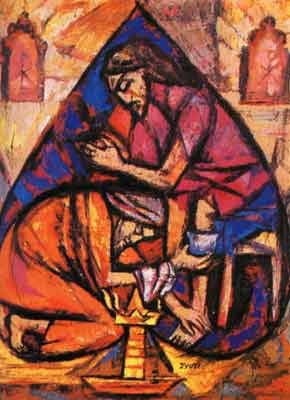
Psalm 36:5-11 – Monday of Holy Week

Crucifixion by Graham Sutherland, 1947

Your steadfast love, O Lord, extends to the heavens,
    your faithfulness to the clouds.
Your righteousness is like the mighty mountains,
    your judgments are like the great deep;
    you save humans and animals alike, O Lord.

How precious is your steadfast love, O God!
    All people may take refuge in the shadow of your wings.
They feast on the abundance of your house,
    and you give them drink from the river of your delights.
For with you is the fountain of life;
    in your light we see light.

O continue your steadfast love to those who know you,
    and your salvation to the upright of heart!
Do not let the foot of the arrogant tread on me,
    or the hand of the wicked drive me away. (NRSV)

We have a Holy Week because of love. There is a journey along the Via Dolorosa (traveling through a place in route to a destination) because of God’s steadfast love.

Love suffers. Every parent knows this. Because of a parent’s committed and faithful love toward a child, they feel not only the joys but also the sorrows and pain of their children. I can say that this feeling does not go away, even with adult children. And it is compounded with grandchildren. Just as our love is big enough to hold multiple children and grandchildren, so our capacity for experiencing deep emotion for their welfare is equally large.

Holy Week reminds us that God’s committed parental love suffers. It is because of God’s immense and steadfast love that there was a road to the cross and a tortured death for Jesus. The cost of our salvation involved a very bloody affair. Deliverance came at the price of horrible violence. Jesus Christ lived and died for us, because of love. He suffered much because he loved much.

God’s people, walking in the way of love, quickly discover that it is simultaneously walking in the way of suffering. From Old Testament times through the New Testament and into the present day, the faithful have always experienced suffering as a central part of their piety and devotion in showing steadfast love. 

The medieval mystics of the Church understood well the connection between suffering and love. They could not imagine a Christian life without hardship, difficulty, and persecution. Thomas à Kempis, a sort of pastor to pastors, wrote in the fifteenth century these words:

“Sometimes it is to our advantage to endure misfortunes and adversities, for they make us enter into our inner selves and acknowledge that we are in a place of exile and that we ought not to rely on anything in this world. And sometimes it is good for us to suffer contradictions and know that there are those who think ill and badly of us, even though we do our best and act with every good intention…. When men ridicule and belittle us, we should turn to God, who sees our innermost thoughts, and seek His judgment…. It is when a man of good will is distressed, or tempted, or afflicted with evil that he best understands the overwhelming need he has for God, without whom he can do nothing…. It is in such times of trial that he realizes that perfect security and full peace are not to be found in this world.”

And yet, it is because of love that suffering is transformed and endured as something wholly other than sheer pain or hurt. Thomas à Kempis went on to say:

“Love is a mighty power, a great and complete good; Love alone lightens every burden and makes the rough places smooth. It bears every hardship as though it were nothing and renders all bitterness sweet and acceptable. The love of Jesus is noble and inspires us to great deeds; it moves us always to desire perfection. Love aspires to high things and is held back by nothing base. Love longs to be free, a stranger to every worldly desire, lest its inner vision become dimmed, and lest worldly self-interest hinder it, or ill-fortune cast it down…. Love knows no limits, but ardently transcends all bounds. Love feels no burden, takes no account of toil, attempts things beyond its strength; love sees nothing as impossible, for it feels able to achieve all things. Love therefore does great things; it is strange and effective; while he who lacks love faints and fails.”

Holy Week’s message is certainly one of suffering love. Jesus went to the greatest lengths possible to give Divine steadfast love to humanity. So, let us not run away from the cross, but journey with Jesus to Golgotha, embracing the love of God for us. In so doing, we will find the inner resources needed to love the world, even in all its unloveliness.

Grant, we pray, almighty God, that, though in our weakness we fail, we may be revived through the Passion of your Only Begotten Son, who lives and reigns with you in the unity of the Holy Spirit, one God, now and forever.

John 3:16 – The Greatest Reality Ever

Welcome, friends! John 3:16 may be a familiar Bible verse to many, yet a closer inspection reveals an immense treasure of the greatest realities ever for people everywhere. Click the videos below and let’s enjoy the love of God in Christ….

Pastor Tim Ehrhardt, John 3:16
God So Loved Lyric Video – Hillsong Worship

To God the Father, who loved us,
and made us accepted in the Beloved:
to God the Son who loved us,
and loosed us from our sins by his own blood:
to God the Holy Spirit,
who spreads the love of God abroad in our hearts:
to the one true God be all love and all glory
for time and for eternity. Amen.

The Greatest Ever

John 3:16 by Holly Rhodes

For God so loved the world that he gave his one and only Son, that whoever believes in him shall not perish but have eternal life. (John 3:16, NIV)

John 3:16 is a Bible verse so familiar as to be cliché. But when Jesus originally said these words, they were both tremendously freeing and incredibly scandalous. When something is familiar, we tend not to explore it any further. We need a closer look at the message of John 3:16 so we can not only see why some people embrace its light, but why others remain in darkness.

Perhaps another examination the gospel will dispel dullness and impel us toward praise, as well as to share its life-giving message not because we must, but because we want to. John 3:16 contains nine of the greatest spiritual realities we could ever experience.

1.“God” is the greatest subject ever.

The Bible contains lots of messages, promises, and commands. However, those are not the primary purpose for having the Holy Scriptures. The Bible has been given to us as a revelation of God to us so that we might know God. Every time the Scriptures are used, read, quoted, prayed, taught, learned, and heard – we know God a bit better. Anything short of knowing God falls short of the Bible’s intended purpose.

I constantly encourage a regular daily regimen of Bible-reading because it is the primary means of knowing God. Yes, we get to know God in creation and through experience, yet one of the best ways of experiencing God is through taking time for reading, meditating, memorizing, and praying of the Scriptures. Some of my most encouraging times are when I hear what people are learning about the Lord in God’s Word. With the Holy Spirit being our teacher, we discover more and more that God is the greatest subject we could ever learn about, talk about, and give our lives to.

2. “So” is the greatest extent ever.

There is a great wideness to God. God is a huge Being! Nothing is outside of God’s reach. So, when God decides to do something, nothing can stop it. We might be limited in our strength and abilities to accomplish things. But God’s extent is limitless. Knowing God means becoming familiar with an all-knowing and all-powerful Being. Prayer, then, becomes a response to God. God speaks to us through the Word, and we speak back with prayer so that the Word and prayer go like a hand in a glove. Our extent is temporary and small. Yet God takes our human prayers and uses them to accomplish divine purposes on this earth.

3. “Loved” is the greatest demonstration ever.

There is no greater demonstration of love than our triune God loving us with a sacrificial self-emptying love that saw our great need for deliverance and went to the greatest lengths possible to accomplish it. Our own love for God, each other, and the world is a direct result of God’s love for us.

This is how we know what love is: Jesus Christ laid down his life for us. And we ought to lay down our lives for our brothers and sisters…. This is how God showed his love among us: He sent his one and only Son into the world that we might live through him. This is love: not that we loved God, but that he loved us and sent his Son as an atoning sacrifice for our sins. Dear friends, since God so loved us, we also ought to love one another. (1 John 3:16; 4:9-11, NIV)

Where there is a lack of love there is an absence of God. Every human on planet earth needs the love of God in Christ. Without it we are lost. You are loved with sacrificial love. The greatest thing that can be said of you is that you are “loved.” Whatever has happened, is happening, and will happen that breaks you down, belittles you, hurts you, or causes you to feel like the north end of a southbound cow, is not what defines you. All may be going to hell around you, but nothing will change the unalterable reality that in Christ you are “loved!”

4. “The world” is the greatest object ever.

Up to this point you might not have sensed anything scandalous about this message of God’s grace and love. But this was the game-changing term for the original hearers of Christ’s words: God so loved the world. Many of Christ’s listeners could easily understand God loved the nation of Israel. But to say that God loved the world was going too far. It meant God loved Gentiles, specifically, Romans who occupied their land and oppressed them.

To capture the punch of this, it would be like Jesus showing up in our world today and saying that God so loved whomever we despise or hate. We often tend to assume that God hates who we hate. Right? Wrong. Yes, God hates evil and is opposed to all that destroys. Yet, God loves people for whom is placed the divine image within. For God to love the world is an incredible because there are so many unlovely people in the world.

Since God loves the world and demonstrated it in through Jesus, Christ’s Church is to reflect and embody this same love for the world. This has enormous implications for followers of Jesus. The Church is must embrace the same pejorative title as given its leader, Jesus: “Friend of Sinners.”  People come to know Jesus through the love given us in Christ. Since this is our title, Christian ministry then becomes not about my personal preferences but about what will most effectively love the world to Jesus.

5. “That he gave his one and only Son” is the greatest gift ever.


John 3:16 by an 11 year old

For God did not send his Son into the world to condemn the world, but to save the world through him. (John 3:17, NIV)

We do not get God’s leftovers or second-hand items. God gave the dearest, best, and most beloved gift he could ever give: his Son. Therefore, the greatest and dearest gift we can give to another person is Jesus. Sharing such a gift Jesus must come freely from the depths of divine love. Apart from love we are only a resounding gong or a clanging cymbal. If it takes cajoling and exhortation for us to give the gift of the gospel, then the problem lies in our hearts. It takes coming back to God’s Word and knowing the love of God in Christ through the Scriptures.

6. “That whoever” is the greatest opportunity ever.

If the greatest gift a person can receive is Jesus, then the best opportunity one could take advantage of is Jesus. We are all at differing places in our relationship with Jesus. Yet no matter the person, the opportunity for grace and love is more than anything you could hope or ask for. 

We are fortunate to have such a grace to know Jesus as Lord, Savior, teacher, healer, and friend. Those familiar with the name of Jesus all their lives but it has not gone much further than that, then the next point is vitally important….

7. “Believes in him” is the greatest commitment ever.

Jesus wants more than our acknowledgment of him; he wants us. Whenever I go home, my dog, Max Power, gets extremely excited. Honestly, I don’t really get excited about him. My typical response to him is, “Yes, Max, I acknowledge your existence.” I say it in hopes he will just kind of leave me alone and let me go about my business. But Max wants more. He wants my affection, my love, and my commitment. He wants a pet, a walk, food, and water.

God does not want to be treated like an annoying puppy. God wants our commitment. The Lord desires more than the tepid response, “I acknowledge your existence.”  The most common response I get from people when sharing the gift of Jesus is “Yes, I believe in Jesus.”  It is their way of saying they acknowledge his existence but are not much interested in giving their lives to him because they want to go about their business without God pestering them about anything. But God does demand something from us – our very souls. If we gain a view of God as gracious and loving, then we willingly desire an intimate commitment.

8. “Shall not perish” is the greatest rescue ever.

People perish not because God is unloving but because their theology is twisted – not to mention that we like our sin, and we don’t want to accommodate a holy God. The Titanic lost hundreds of people not for a lack of lifeboats. In fact, most of the lifeboats went into the water about three-fourths capacity. Many people simply did not believe they were perishing. They trusted in the ship’s reputation as being “unsinkable.” Jesus is our lifeboat.

9. “But have eternal life” is the greatest promise ever.

The promise begins now, not someday. Everlasting life means experiencing a life-saving and life-giving relationship with Jesus today.

Conclusion

If you ever had the feeling there is something more to life than what you are experiencing; if you ever wished you could start over; if you ever felt you cannot do this on your own; then, I have the greatest news ever. God has made a way to handle all your guilt, shame, and darkness. God loves you deeply in the person of Jesus Christ. There is new life in Jesus.

Psalm 107:1-3, 17-22 – The Steadfast Love of God

O give thanks to the Lord, for he is good;
    for his steadfast love endures forever.
Let the redeemed of the Lord say so,
    those he redeemed from trouble
and gathered in from the lands,
    from the east and from the west,
    from the north and from the south….

Some were sick through their sinful ways,
    and because of their iniquities endured affliction;
they loathed any kind of food,
    and they drew near to the gates of death.
Then they cried to the Lord in their trouble,
    and he saved them from their distress;
he sent out his word and healed them,
    and delivered them from destruction.
Let them thank the Lord for his steadfast love,
    for his wonderful works to humankind.
And let them offer thanksgiving sacrifices,
    and tell of his deeds with songs of joy. (NRSV)

I’ve always found it a bit curious that there are people who continually equate the God of the Old Testament as nothing but a vengeful and wrathful God, continually perturbed and upset, exasperated with us stupid little sinful people. Certainly, there are sections in Scripture dealing with God’s wrath and the divine action spurred from not being okay with injustice running amok on the earth. 

Everything God does comes from a place of love.

The Lord has never been okay with sin because it damages and destroys people who are meant for better things. Which is why, when people are in need and cry out to the Lord, God is there for them. 

Far more prevalent is the reality that the Old Testament is thickly populated with references to God’s “steadfast love.”  This is God’s covenant-keeping love. It is the kind of love that holds on and doesn’t let go. It’s the type of love that is tirelessly gracious, merciful, and kind. It is the love that has compassion on the needy and mercifully does something about their plight.

In today’s psalm, even when there were people sick and in distress because of their own doing, their own sin, and their own fault, God saved them from their mess. That, my friend, is precisely what God does – expertly delivers people with care and precision. 

So then, we truly need to get some robust theology to overwhelm and break those old nasty ideas about a fickle God who shakes his finger at us when we screw up and gives a big disappointed *sigh* over our dumb decisions. Just as the psalms steadily and persistently portray to us a God of abiding love, they also equally tell us of a God who is “slow to anger,” not going off the handle quickly. (Psalm 86:15, 103:8, 145:8)

Know deep in your soul that God shows steadfast love. 

God doesn’t tell us “I told you so” or “that’s what you get for sinning,” like some obnoxious and overzealous schoolgirl. Nope. God delivers and does it because of steadfast love. It flat out gives God pleasure to save and redeem wayward folk.

That’s why I believe people all over the world have learned to sing the praises of the God of the Bible. It’s why persons from every walk of life and every culture have found God as the great lover of humanity. Their overflowing response to such a loving God is singing, praising, thanking, and offering their lives to the great Lover of their souls.

If you or someone you know struggles with seeing God as capricious, indifferent, or angry, then I strongly urge a steady and daily diet of the psalms over the course of the next month. Call it an intervention of psalms. Reading just five psalms per day gets you through all one-hundred fifty of them in a month. More than that, pray the psalms. Allow them to give you a new perspective on the world, relationships, and self.

“God’s love is like when you sit in front of a fire in winter — you are just there in front of the fire. You don’t have to be smart or anything. The fire warms you.”

Desmond Tutu

This prolific reading of the psalms is not some new or weird thing. It has been around for an awfully long time. The daily recitation of the entire Book of Psalms was an early monastic custom, especially among the Desert Fathers of the 3rd and 4th centuries. By the time Saint Benedict came along with his Rule for monks (c.515 C.E.) many communities had settled on the weekly praying of the entire Psalter. As good old Benedict said, praying less than a full psalter a week betrays “extreme indolence and lack of devotion.”

That might seem over the top to modern readers, yet the big idea is that once the steadfast love of God from the psalms gets into your spiritual bloodstream, the praying and singing of the psalms becomes a delight. I can testify to that. Seems I cannot ever get enough of the psalms. Which really means I love the steadfast love of God!

The Psalms are, I believe, the fulcrum of the Holy Scriptures. They recite and reflect upon the historical acts of God in the Old Testament. They tell of the Lord’s continuing covenantal care for people. The Psalms express the full gamut of human emotion and spiritual devotion of the people of God. Reciting the Psalms aloud frequently puts us in good company with our spiritual ancestors in the faith.

So, what the heck are you waiting for? Go ahead. Read and recite today’s psalm over again and again. Let them do their gracious work in your spirit.

God of all that is good, your steadfast love has been shown to millions who find in you the desire of their hearts.  May I see your overflowing goodness, your steadfast love, and your infinite mercy operating in this broken world and in my needy heart; through your Son, my Savior, Jesus Christ, who with you and the Holy Spirit lives and reigns forever.  Amen.