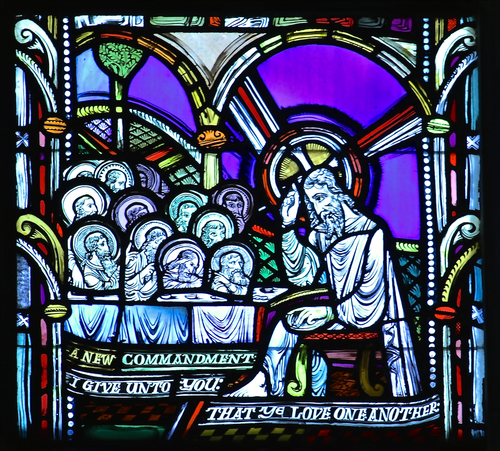
John 13:31-35 – Love One Another

Stained glass by Edgar Miller (1899-1993)

When he was gone, Jesus said, “Now the Son of Man is glorified, and God is glorified in him. If God is glorified in him, God will glorify the Son in himself, and will glorify him at once.

“My children, I will be with you only a little longer. You will look for me, and just as I told the Jews, so I tell you now: Where I am going, you cannot come.

“A new command I give you: Love one another. As I have loved you, so you must love one another. By this everyone will know that you are my disciples if you love one another.” (New International Version)

The Church was formed to represent Christ on earth. The Church is a new community of believers in Jesus, called and empowered by the Holy Spirit for mission.

Christianity was never intended to be just a personal faith; it was designed by God to be the community of the redeemed. Christian community is vital to every individual’s faith.

“No one can have God for his Father who does not have the Church for his Mother.”

John Calvin (1509-1564)

Loyalty and commitment to God translates to having a dedicated and devoted spirit to one another in the church. 

One of the last commands Jesus gave to his disciples before he went to the cross was to “love one another.” The Old Testament instructed the Israelites to love each other (Leviticus 19:18). Yet, Jesus gives new meaning to the command through four distinctions of loving one another.

A New Model of Love: Jesus

Our Lord’s life and teaching gave new meaning to the command to love each other. Notice what Jesus did in the Upper Room just before giving the command to love one another:

It was almost time for the Jewish Passover festival. Jesus knew that the time had come for him to leave this world and go back to the Father. Jesus had always loved the people in the world who were his. Now was the time he showed them his love the most.

Jesus and his followers were at the evening meal. The devil had already persuaded Judas Iscariot to hand Jesus over to his enemies. (Judas was the son of Simon.) The Father had given Jesus power over everything. Jesus knew this. He also knew that he had come from God. And he knew that he was going back to God. So while they were eating, Jesus stood up and took off his robe. He got a towel and wrapped it around his waist. Then he poured water into a bowl and began to wash the followers’ feet. He dried their feet with the towel that was wrapped around his waist. (John 13:1-5, ERV)

Jesus modeled a service-oriented love of compassionately meeting the need of another, regardless of who that person is. It is instructive to us that Jesus washed the feet of Judas Iscariot, along with all the other disciples. 

Christ died for us while we were still sinners. This demonstrates God’s love for us.

Romans 5:8, GW

We are to love everyone in the community of saints, and not just our friends or the ones we like. Loving one another also means we will be realistic in understanding that community is messy and downright hard work.  

A New Motive: Christ First Loved Me

Jesus has loved us with a love that took care of our brokenness once for all. Because of that love, we are now motivated to love each other. John would later say in his first epistle: 

God showed his love for us by sending his only Son into the world, so that we might have life through him. This is what love is: it is not that we have loved God, but that he loved us and sent his Son to be the means by which our sins are forgiven. Dear friends, if this is how God loved us, then we should love one another. (1 John 4:9-11, GNT)

Love is an attitude and a frame of mind. The motivation for the Christian is different than anyone else’s motive:  We are so thankful for Christ’s love to us, that we cannot help but extend that same love to one another in the church. 

This kind of love transcends human willpower. This is love as a grateful response for the grace shown us in Christ.

A New Motivator: The Holy Spirit

The Spirit energizes and enables us to love each other. Jesus also said in the Upper Room: 

If you love me, you will do as I command. Then I will ask the Father to send you the Holy Spirit who will help you and always be with you. (John 14:15-16, CEV)

There are times when we may lack the ability or spiritual energy needed for the work of loving each other. It is in those times that we need to check our spiritual electrical box to make sure we haven’t tripped a breaker by trying to live the Christian life on our own strength. 

We need the Spirit. The Spirit gives us the zeal we need to love one another. 

We typically don’t do anything in life unless we have the motivation for it. The Spirit is like the Christian’s personal trainer – encouraging, exhorting, getting in our face, comforting, and spurring us – toward the new way of love. 

A New Mission: World Evangelization

All people will know we are Christ’s disciples if we love one another. The way we treat each other in the church is foundational and fundamental to the mission of loving our neighbors who don’t know Jesus.

“Mission is putting love where love is not.”

St. John of the Cross (1542-1591)

When the church has a healthy and even supernatural dynamic of loving one another, they joyfully proclaim the good news to every person that Jesus is the answer to the terrible brokenness of this world.

Community is necessary to mission. Lesslie Newbigin (1909-1998) was a British missionary to India for forty years. After retiring and returning to Britain, he found his homeland was very different than when he left. He was astounded to find Britain had become very less Christian and was now predominantly un-Christian. It was clearly a post-Christian society. What to do about it? Here is Newbigin’s response:

“I have come to feel that the primary reality of which we have to take account in seeking for a Christian impact on public life is the Christian congregation.  How is it possible that the gospel should be credible, that people should come to believe that the power which has the last word in human affairs is represented by a man hanging on a cross? 

I am suggesting that the only answer, the only hermeneutic of the gospel [the only way society can discern who Jesus is] is a congregation of men and women who believe it and live by it. I am, of course, not denying the importance of the many activities by which we seek to challenge public life with the gospel – evangelistic campaigns, distribution of Bibles and Christian literature, conferences, and even books such as this one. But I am saying that these are all secondary, and that they have power to accomplish their purpose only as they are rooted in and lead back to a believing community.”

Conclusion

The implications of community for our faith are significant. If we keep other Christians at a distance and give them the stiff arm, we are really giving God the stiff arm. Jesus identifies so closely in love to his people, that to love them is to love him.

The late African-American preacher E.V. Hill told the following story about an experience with a white Christian leader in the 1950s:

“As a freshman at Prairie View College (part of the Texas A&M system) I was actively involved and was one of two students selected to go to our denomination’s annual meeting in Memphis. The trip through the South was by car—three whites and two blacks traveling together. I had no idea how we’d eat or how we’d sleep. So great was my anxiety and hatred over how the trip might turn out that I almost backed out entirely …. In all my experience I had never seen a white man stand up for a black man and never felt I would. 

But then Dr. Howard, the director of our trip and a white man spoke up. ‘We’ll be traveling together,’ he said. ‘If there isn’t a place where all of us can eat—none of us will eat. If there’s not a place all of us can sleep—none of us will sleep.’ That was all he said, but it was enough! For the first time in my life, I had met a white man who was Christian enough to take a stand with a Christian black man.” 

May the Spirit give us the courage together to love one another.

Gracious Lord, I pray for those who will believe in you through the good news of forgiveness in Christ. I pray that all of them may be one just as you are one. May they be brought to complete unity to let the world know that you sent the Son, Jesus, and have loved them even as you have loved us. Righteous God, may you help us make you known in the world so that the love you have for us may be in them through the cross of Christ. Amen.

Romans 12:17-21, 13:8-10 – Let Love Be Your Only Debt

Don’t mistreat someone who has mistreated you. But try to earn the respect of others and do your best to live at peace with everyone.

Dear friends, don’t try to get even. Let God take revenge. In the Scriptures the Lord says,

“I am the one to take revenge
    and pay them back.”

The Scriptures also say,

“If your enemies are hungry,
    give them something to eat.
And if they are thirsty,
give them something
    to drink.
This will be the same
as piling burning coals
    on their heads.”

Don’t let evil defeat you but defeat evil with good….

Let love be your only debt! If you love others, you have done all that the Law demands. In the Law there are many commands, such as, “Be faithful in marriage. Do not murder. Do not steal. Do not want what belongs to others.” But all of these are summed up in the command that says, “Love others as much as you love yourself.” No one who loves others will harm them. So, love is all that the Law demands. (Contemporary English Version)

Not everybody is likable. We all have others that drive us crazy on the inside with their annoying habits or ungodly ways of life. 

Sometimes we might experience much more than being irritated. Raging vitriol that results in verbal persecution; becoming the targets of evil intent; and, in some cases, finding ourselves victims of violence done to us or a loved one can stretch our Christian sensibilities to their maximum. It is understandable that in such cases we would be upset, angry, in grief, and desire justice.

As we reflect back on Reformation Day and the great truth that we are justified apart from any work of our own but by grace alone through faith, this helps to give understanding as to why we do not take vengeance into our own hands. 

We are clearly exhorted in today’s New Testament lesson to repay no one evil for evil because vengeance belongs to God alone, not us. 

If justification is a work of God to rescue and redeem sinners from their plight, then wrath is also a work of God. Just as justification is initiated and made possible through Christ by faith, so vengeance belongs to God, as well. Our part in the whole affair is to trust God to take care of judging the world. Judgment is way above our pay grade.

Our responsibility is showing love, even to those whom we consider enemies. If we are to love our neighbors as ourselves, then we will leave plenty of room for God to do what God does best: either show mercy to sinners or execute judgment upon them. It’s all God’s business what happens with humanity. Our business is coming under the lordship of Christ and allowing God’s new creation to work itself out through us. 

We are to work for the kind of justice that provides others with what they need, not what they deserve. The world cannot become a better place if we keep insisting on playing judge, jury, and executioner. Sometimes the best way to show love is to sincerely pray for the person for whom we have such difficulty loving. 

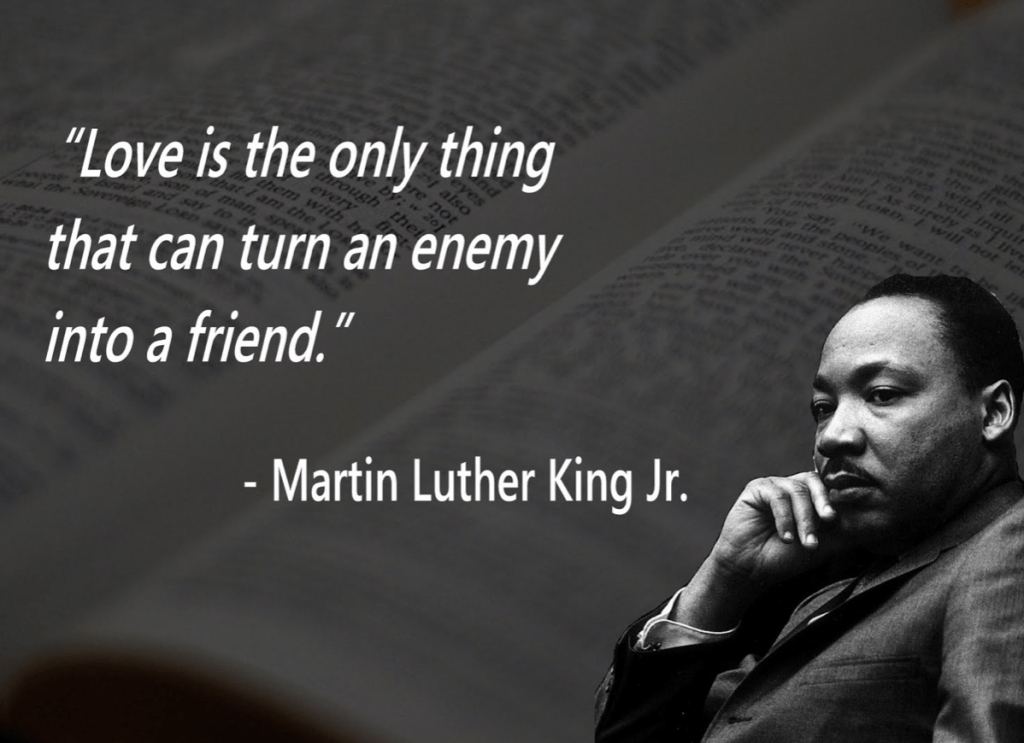
Who do you need to love today? Here is an excerpt from a sermon by Dr. Martin Luther King Jr., delivered at the Dexter Avenue Baptist Church, Montgomery, Alabama, on November 17, 1957:

“Love has within it a redemptive power. And there is a power there that eventually transforms individuals. That’s why Jesus says, ‘Love your enemies.’ Because if you hate your enemies, you have no way to redeem and to transform your enemies. But if you love your enemies, you will discover that at the very root of love is the power of redemption. You just keep loving people and keep loving them, even though they’re mistreating you.

Here’s the person who is a neighbor, and this person is doing something wrong to you and all of that. Just keep being friendly to that person. Keep loving them. Don’t do anything to embarrass them. Just keep loving them, and they can’t stand it too long. Oh, they react in many ways in the beginning. They react with bitterness because they’re mad because you love them like that. They react with guilt feelings, and sometimes they’ll hate you a little more at that transition period, but just keep loving them.

And by the power of your love, they will break down under the load. That’s love, you see. It is redemptive, and this is why Jesus says love. There’s something about love that builds up and is creative. There is something about hate that tears down and is destructive. So, love your enemies.”

Just and merciful God, you are the rightful Judge of all the earth. Help me to trust in you so that I can give room for you to do whatever you want to do in others’ lives. I pray you will grace many people with the repentance that leads to new life in Jesus. Amen.

John 13:1-17 – Stinky Feet Love

Jesus washing the feet of the disciples, by Leszek Forczek

Now before the festival of the Passover, Jesus knew that his hour had come to depart from this world and go to the Father. Having loved his own who were in the world, he loved them to the end. The devil had already put it into the heart of Judas son of Simon Iscariot to betray him. And during supper Jesus, knowing that the Father had given all things into his hands, and that he had come from God and was going to God, got up from the table, took off his outer robe, and tied a towel around himself. Then he poured water into a basin and began to wash the disciples’ feet and to wipe them with the towel that was tied around him. He came to Simon Peter, who said to him, “Lord, are you going to wash my feet?” Jesus answered, “You do not know now what I am doing, but later you will understand.” Peter said to him, “You will never wash my feet.” Jesus answered, “Unless I wash you, you have no share with me.” Simon Peter said to him, “Lord, not my feet only but also my hands and my head!” Jesus said to him, “One who has bathed does not need to wash, except for the feet, but is entirely clean. And you are clean, though not all of you.” For he knew who was to betray him; for this reason, he said, “Not all of you are clean.”

After he had washed their feet, had put on his robe, and had returned to the table, he said to them, “Do you know what I have done to you? You call me Teacher and Lord—and you are right, for that is what I am. So, if I, your Lord and Teacher, have washed your feet, you also ought to wash one another’s feet. For I have set you an example, that you also should do as I have done to you. Very truly, I tell you, servants are not greater than their master, nor are messengers greater than the one who sent them. If you know these things, you are blessed if you do them. (New Revised Standard Version)

One of the reasons I like Jesus so much is that he loves me as I am, and not as I should be. Jesus loves me even with my dirty stinky feet, my herky-jerky commitment to him, and my pre-meditated sin. Jesus loved even Judas and washed his feet. Jesus serves people because they need his love, and not so that they will love him back.

I read about a man who lives in Paris. His wife has Alzheimer’s. He was an important businessman, and his life was filled with busyness. Yet, he said when his wife fell sick, “I just couldn’t put her into an institution, so I kept her. I fed her. I bathed her. Through the experience of serving my wife every day, I have changed. I have become more human. The other night, in the middle of the night, my wife woke me up. She came out of the fog for a moment, and she said, ‘Darling, I just want to say thank you for all you are doing for me.’ Then she fell back into the fog. I wept for hours to know this grace.”

Sometimes Christ calls me to love people who either cannot or will not love me in return. They live in the fog of some sort of disability, depression, poverty, or common spiritual blindness. As I serve them, I may only receive brief glimpses of gratitude. Just as Jesus loves me within my own spiritual confusion, so I desire to continue loving others as they walk through whatever fog they are in.

Lord willing, my life will be useful through my words and my witness. If God desires, my life will bear fruit through my prayers, my service, and my love. Yet, the usefulness of my life is God’s concern, not mine; it would be indecent of me to worry about that. I simply desire follow my Lord’s example.

Neither many Christians nor churches wash feet anymore. So, the following is today’s Gospel lesson put in a slightly different context:

It was just before the biggest and most important feast of the year, Passover. Jesus knew that it was finally the time for him to face the cross and die for the world’s sins. Having spent the past three years loving his followers, he now wanted to leave them with a clear demonstration of his love that they would never forget.

The evening meal was being served, and the devil had already gotten a hold of Judas Iscariot to betray Jesus to those who wanted him dead and gone. But it was all according to plan. Jesus knew that his heavenly Father had given him all authority because he was his Son, and he was ready to do what needed to be done to secure salvation and return to his rightful place at his Father’s right hand.  So, Jesus got up from the meal, rolled up his sleeves, put an apron on, and ran a sink full of hot water.  Jesus told the servants to take the night off, and he began taking the dishes from the dinner table and started washing them, taking care to do all that waiters and dishwashers would do.

When Jesus came to take care of Simon Peter’s dishes and serve him dessert and coffee, Peter said to him, “Lord, are you going to serve me?” Jesus replied, “I know you do not understand why I am doing this since it seems like something that is beneath me to do, but later you will look back on this night and understand completely what I am doing.”

“No,” said Peter, “this is not right – you are the Master, and this is not what a well-respected rabbi does – you are only disrespecting yourself and making us all look foolish. You are not going to take my dishes and wash them.”

Jesus answered, “Unless I wash these dishes and serve you, you are not going to be able to follow me anymore and you will have no part of what I am doing in this world.”

“Well, then, Lord,” Simon Peter replied, “if that is the way it really is, then don’t just wash the dishes – come on over to my place and clean out the fridge and scrub the kitchen floor!”

Jesus answered, “A person who has had a decent meal needs only to wash the dishes so that he can enjoy the freedom of hospitable relationships with me and those around him.  And all of you here have had a decent meal, though not every one of you.”  For Jesus knew that Judas was only picking at his food in anticipation of betraying him.

When Jesus was all done washing the dishes and serving his disciples, he took his apron off, rolled his sleeves back down, and returned to the table.  He looked them all squarely in the eye and said, “Do you understand what I just did for you?  You call me ‘Teacher’ and ‘Master,’ and rightly so, for that is exactly what I am.  So, now that I, your Master, and your Teacher have washed your dishes, you also should wash one another’s dishes.  I have set you an example that you should do as I have done for you.  I am telling you the plain truth that no follower is greater than the one he follows, nor is a preacher greater than the one he preaches about.  Now that you know that it is your task in this life to provide humble loving service, you will have God’s stamp of approval on your life if you quit thinking about how to possess and use power for your own purposes and start thinking about how to use the authority I am giving you to love other people into the kingdom of God.

Loving Lord Jesus, how shocking it was for your disciples to be served by you in such a humble manner.  But I cannot be spiritually cleansed unless I allow you to love me in an almost embarrassing fashion.  Help me not to be so proud that I neither refuse your humble loving service toward me, nor neglect to offer that same kind of service to others.  May love be the word, the idea, and the action that governs my every motivation and movement in your most gracious Name, I pray.  Amen.

Job 4:1-21 – Where Is God?

Eliphaz and the other friends of Job, speaking down to him in his suffering, from a fresco in the Cathedral of the Annunciation in Moscow

Job, will you be annoyed if I speak?
    I can’t keep quiet any longer.
You have taught many people
    and given strength to feeble hands.
When someone stumbled, weak and tired,
    your words encouraged him to stand.
Now it’s your turn to be in trouble,
    and you are too stunned to face it.
You worshiped God, and your life was blameless;
    and so you should have confidence and hope.
Think back now. Name a single case
    where someone righteous met with disaster.
I have seen people plow fields of evil
    and plant wickedness like seed;
    now they harvest wickedness and evil.
Like a storm, God destroys them in his anger.
The wicked roar and growl like lions,
    but God silences them and breaks their teeth.
Like lions with nothing to kill and eat,
    they die, and all their children are scattered.

Once a message came quietly,
    so quietly I could hardly hear it.
Like a nightmare it disturbed my sleep.
    I trembled and shuddered;
    my whole body shook with fear.
A light breeze touched my face,
    and my skin crawled with fright.
I could see something standing there;
    I stared, but couldn’t tell what it was.
Then I heard a voice out of the silence:
“Can anyone be righteous in the sight of God
    or be pure before his Creator?
God does not trust his heavenly servants;
    he finds fault even with his angels.
Do you think he will trust a creature of clay,
    a thing of dust that can be crushed like a moth?
We may be alive in the morning,
    but die unnoticed before evening comes.
All that we have is taken away;
    we die, still lacking wisdom.” (Good News Translation)

The Christian spiritual classic, The Dark Night of the Soul, was written nearly five hundred years ago by St. John of the Cross. The gist of John’s observation is that God sometimes takes the Christian through dry times of hiding himself from the believer. 

The pain of wondering where God is and if he will even show up; experiencing unanswered prayer; enduring uncaring and misdirected comments from well-meaning people; all these and more are inevitably part of the Christian spiritual experience. 

The dark night of the soul is not to be confused with personal sinfulness. Its origin is not in self, but God. 

“Silence is God’s first language.”

St. John of the Cross

Whenever one knows with a settled confidence that personal integrity is intact, but trouble abounds, we need not immediately rush to the conclusion that something is wrong with us. It may be the Spirit of God thrusting us into a desert experience to test and approve our faith.

Job’s “friend” Eliphaz offered one of those tired age-old arguments that bad things only happen to bad people. He comes at Job with the inexperience and absurdity of making misguided assumptions. He rhetorically asks: Who that was innocent ever perished?  Where were the upright cut off? 

The conclusion of Eliphaz, therefore, was bound to be off the mark – believing secret sin must surely be the culprit behind Job’s awful misfortune. Certainly, Eliphaz thinks, Job cannot possibly go through such terrible suffering without having done something to anger God.

Times change; the basic nature of people, not so much. In today’s church and world, the same notions still endure. If I had a quarter for every time I heard crazy comments, like the following, I would be a rich man: 

“He’s poor because he is lazy and doesn’t want to work.”

“She keeps having chronic health issues. God is punishing her.”

“The pandemic is God’s judgment on us for not having the Ten Commandments in our courthouses.”

“If you just confess your sin and have faith, you’ll be healed.”

“They’re in big trouble. They obviously did something evil.”

On and on the wrong-headed statements continue, ad nauseum.

The Apostle Peter understood how to view trouble in a healthy way. He said we all suffer – both the good person and the wicked. It’s just a matter of whether we will suffer for doing good and the right thing, or suffer because of saying shallow, illogical, and stupid comments that offend God and hurt others. (1 Peter 3:17-18)

Even Christ suffered. And it wasn’t because of his own sin. It was because of ours. Jesus suffered once for sins, the righteous for the unrighteous, that he might bring us to God. 

Jesus suffered; so, the follower of Jesus will suffer. There is a big picture only God sees. Whenever we suffer, there is something going on behind the spiritual scene. We must allow God to do divine work, and then, trust that the Lord bends all human suffering for good and redemptive purposes.

“Where there is no love, pour love in, and you will draw love out.”

St. John of the Cross

So, let’s change the rhetoric. Instead of jumping to judgment, reflexively hop to grace with comments like these:

  • “He has poverty of spirit. He’s blessed and will inherit the kingdom of God.”
  • “She’s in chronic pain. God has allowed her the privilege of suffering in solidarity with her Lord.”
  • “We’re in a pandemic. Here’s a chance for us to live out of the Ten Commandments.”
  • “If we confess the world’s sins of pride, hate, and injustice, perhaps God’s mercy will deliver us.”
  • “We’re in a big pickle. No better time than now to grow in grace.”

Where is God? Beside you, quietly and confidently holding you up in your suffering.

Lord God, I entrust myself to you because you know what you are doing. Thank you for the trials of life which humbles my heart to pray. Do your work in me so that my faith is fortified for a lifetime of service in the church and the world, through Jesus Christ, my Lord. Amen.