Welcome, friends! Micah 6:1-8 lets us know exactly what God desires for us as God’s people: to act justly, to love mercy, and to walk humbly with our God. Click on the videos below, and we will consider the Word of the Lord together.
Blessed God and Father of our Lord Jesus Christ, fill the hearts of your people with the fire of your love and mercy, and with the desire to ensure justice is done for the common good of all persons. Amen.
“Stand up, plead my case before the mountains; let the hills hear what you have to say.
“Hear, you mountains, the Lord’s accusation; listen, you everlasting foundations of the earth. For the Lord has a case against his people; he is lodging a charge against Israel.
“My people, what have I done to you? How have I burdened you? Answer me. I brought you up out of Egypt and redeemed you from the land of slavery. I sent Moses to lead you, also Aaron and Miriam. My people, remember what Balak king of Moab plotted and what Balaam son of Beor answered. Remember your journey from Shittim to Gilgal, that you may know the righteous acts of the Lord.”
With what shall I come before the Lord and bow down before the exalted God? Shall I come before him with burnt offerings, with calves a year old? Will the Lord be pleased with thousands of rams, with ten thousand rivers of olive oil? Shall I offer my firstborn for my transgression, the fruit of my body for the sin of my soul? He has shown you, O mortal, what is good. And what does the Lord require of you? To act justly and to love mercy and to walk humbly with your God. (New International Version)
We are the people of God, the Church, the Body of Christ, the army of God, a holy temple. Those biblical labels are a picture of who we are and what we are to do. These metaphors all describe a people set apart for service, working in concert together toward a shared purpose.
In the prophet Micah’s day, the Israelites lost sight of the purpose and meaning of being God’s people. They needed to remember that the Lord acts in and through them for the redemption of the world. The kind of sacrifice and service which God wants is not so much a largess of tangible offerings we give. Rather, it is neatly summarized this way: Act justly. Love mercy. Walk humbly with your God.
This Old Testament passage has the feel of a courtroom scene. The defense lawyer is Micah, representing God. The people of Israel are the plaintiffs. The world is the judge. All of creation is the jury.
Israel was complaining about God. It’s an age old complaint from many people through the millennia: Blame God for anything that goes sideways in my life. The reasoning goes something like this: After all, God is powerful and in control. God should fix everything.
In their small-minded and short-sighted ways, the people seem unable to discern that easy fixes rarely help anyone. Like yanking up a big weed next to a small plant, it destroys both of them.
The defendant, Micah, speaks on behalf of God. What have I done to you? How have I burdened you? In fact, God has done just the opposite of failing to act or wronging the people in some way. The Lord actively delivered the Israelites:
When the people groaned and grumbled under Egyptian slavery, God delivered them with a series of miraculous deeds.
When the Israelites were heading to the Promised Land and vulnerable to their enemies, God protected them from the Moabites. The Lord even used a talking donkey to work on their behalf. God miraculously turned the efforts of Balak to curse the people into a blessing.
When the people entered the land, they did so by the powerful act of God to stop the Jordan River from flowing so the Israelites could cross over.
These saving acts of God are the motivation for living a life pleasing to God. Micah sarcastically pressed his argument, essentially asking if there’s anything that can be done to keep the people happy? What extremes need to happen to meet such excessive demands? The response by God is this: Do justice. Love mercy. Walk humbly with God.
Walk Humbly with God
Faith and action are meant to work seamlessly together. Doing justice and loving mercy are possible as we walk with God. Walking everyday with Jesus gives us the power and passion to invest in the healing of the world. God desires that we journey with Jesus and follow his words and ways. Throughout the New Testament, the Christian life is described as a road or a way we walk. In fact, the earliest believers were known as “The Way.” (Acts 9:1-19)
Jesus is the way (John 14:6). Jesus is the way to deal with our current concerns and anticipated anxieties. He himself is the way. The way is not through a program of self-improvement. The way is not through a fake-it-till-you-make-it approach. The way is not through an ability to articulate well-crafted words or through being able to answer with certainty every question of faith. The way is not through finding just the right plan or system.
Jesus is our way – he is the way of rescue, the road to a life of harmonious peace and settled rest even when the world is going to hell around us. Jesus is the way for the church everywhere – fellowship, encouragement, acts of loving service, teaching, and strengthening of faith all center around Jesus because he is love incarnate.
Jesus is the way for the world – serving neighbors and nations, advocating for those who are mistreated and facing injustice, tackling the dozens of world problems which oppress humanity – come through the continuing presence of Jesus here on this earth, that is, through the Holy Spirit and God’s people.
Love Mercy
This phrase (in the NIV) is translated various ways in other Bible versions:
“Embrace faithful love” (CEB)
“Let mercy be your first concern” (CEV)
“Show constant love” (GNT)
“Be compassionate and loyal in your love” (MSG)
“Love being kind to others” (NCV)
“Love kindness” (NRSV).
The reason for the variations is that the phrase in Hebrew carries a lot of meaning – and it’s difficult to capture that meaning in just one or two English words. It has to do with God’s steadfast loyalty to people based in a committed love and determination to do what is good and kind on their behalf – no matter whether they deserve such a grace, or not.
To love mercy comes from a large heart. The Grinch had a small heart. It caused him to be a nasty green curmudgeon who could steal gifts from a sweet little Who-girl. Only when his heart was enlarged did he mercifully return the gifts and then participate with the Whoville folks in their grand celebration.
God was merciful! We were dead because of our sins, but God loved us so much that he made us alive with Christ, and God’s wonderful kindness is what saves you. (Ephesians 2:4-5, CEV)
Love one another as if your lives depended on it.
1 Peter 1:22, MSG
Act Justly
Because many people define justice as a punitive act toward a wrongdoer, they struggle with this admonition to “do justice.” Giving people what they deserve doesn’t primarily mean someone is supposed to go to prison. Some people deserve that. Most don’t.
Instead, to act justly means to create a world in which everyone has what they need to live, thrive, and develop the gifts God has placed within them. Everyone deserves their basic human needs met – to have an equal opportunity in realizing the meeting of their needs. And that is what the heart of biblical justice is. Therefore, justice includes practical things like:
Providing tutors so that kids in urban schools have the same opportunities to read and as suburban kids.
Supporting an overwhelmed single parent who is struggling to find the time and resources to give adequate time to his or her children.
Taking in a foster child who needs the environment of a loving family.
Employing a person coming out of prison so that the terrible rates of recidivism don’t keep going.
Advocating for an underprivileged person who needs adequate healthcare or good housing.
Doing justice is more than giving away money or resources. It’s helping people to help themselves. It’s providing others the dignity and respect of putting them in a position so that they can take pride in their own efforts, just like we do. It’s not only giving someone a fish but taking the time and effort in teaching them how to fish.
Speak up for people who cannot speak for themselves. Help people who are in trouble. Stand up for what you know is right and judge all people fairly. Protect the rights of the poor and those who need help. (Proverbs 31:8-9, ERV)
Conclusion
What does the Lord require or desire of you?
What gifts and abilities has God given to you to act justly, love mercy, and walk humbly?
How can you and I step outside our comfort zones to other areas the Lord might be desiring for us?
The answers to those questions will determine whether we sink or swim as the people of God.
Father God, you have made all people in your image. It’s your desire and requirement that they be gathered together as one family in yourself. Fill the hearts of humanity with the fire of your love and the desire to ensure justice for all. By sharing the good things, you give us, may we secure equality for all our brothers and sisters throughout the world. May there be a truly human society built on love and peace, through Jesus Christ our Lord. Amen.
By the grace God has given me, I laid a foundation as a wise builder, and someone else is building on it. But each one should build with care. For no one can lay any foundation other than the one already laid, which is Jesus Christ. If anyone builds on this foundation using gold, silver, costly stones, wood, hay or straw, their work will be shown for what it is, because the Day will bring it to light. It will be revealed with fire, and the fire will test the quality of each person’s work. If what has been built survives, the builder will receive a reward. If it is burned up, the builder will suffer loss but yet will be saved—even though only as one escaping through the flames.
Don’t you know that you yourselves are God’s temple and that God’s Spirit dwells in your midst? If anyone destroys God’s temple, God will destroy that person; for God’s temple is sacred, and you together are that temple. (New International Version)
God is holy, pure, beautiful, and completely separated from all that is evil.
However, there is a problem; but it isn’t with God.
Ever since the fall of humanity into guilt, shame, and impurity, people cannot be near or approach a perfect Being. Just as we will surely go blind by looking directly at the sun – or be totally disintegrated by getting too close to it – so humans cannot be with such a holy God.
In the Old Testament, God graciously devised a system whereby people could approach the divine. A temple was built. It had very detailed and strict prescriptions about how it was to be built. There needed to be curtains, walls, and borders everywhere to shield the people from being destroyed by the sheer holiness of God.
Entering the New Testament, Jesus is the exact representation of God’s holy being and presence. In Christ, God became intimately close to people. Through the redemptive events of Jesus, humanity is delivered from the vexing problem of being far away from God.
If that were not enough, God the Father and Son sent God the Holy Spirit to be the continuing presence of Jesus on this earth.
In today’s New Testament lesson, the Apostle Paul tells us that, as the church, we are a holy temple which is graciously, patiently, and with great care being built into a spiritual house that can be the place where God meets with humanity.
The triune God has conspired and gone out of the way to be with us. The Lord has bended the arc of history for good purposes to be with us. Like a lover separated from his beloved, God has pulled out all the stops to make us holy so that we can abide with him in divine holiness.
From the solid foundation of Jesus Christ as the chief cornerstone, we take care to build a spiritual infrastructure worthy of holiness.
As he who called you is holy, be holy yourselves in all your conduct;for it is written, “You shall be holy, for I am holy.” (1 Peter 1:15-16, NRSV)
God’s will is for you to be holy… God has called us to live holy lives, not impure lives. (1 Thessalonians 4:3, 7, NLT)
Some Christians mistakenly believe that holiness means to exclusively separate as far from everything and everyone who is impure. Any hint or smell of unsound dogma or nonconformity with established rules results in separation. Yet, this predilection for separation is really a form of division – which is contrary to the holiness of God. Because the Lord bends over backwards to accommodate the sinner’s ability to approach the divine presence.
Indeed, holiness involves a separation from all that is evil so that we can attach ourselves to God and others. Holiness isn’t simply an end in itself. To be holy means we are prepared and ready to engage in the highest of aims: Love.
Now that you have purified yourselves by obeying the truth so that you have sincere love for each other, love one another deeply, from the heart. For you have been born again, not of perishable seed, but of imperishable, through the living and enduring word of God. (1 Peter 1:22-23, NIV)
Holiness without a clear trajectory toward love is like putting a new collar on a dead dog. It just doesn’t make any sense.
Yet, too many folks have put a leash on that shiny new collar and are dragging the deceased around – much to the chagrin and revulsion of the world – who rightly sees this behavior as both downright crazy and plain stupid.
Paul would say that kind of behavior will be shown for what it is: Building on the wrong spiritual foundation.
It’s really all about Jesus. Christians bear the name of Christ because we (ideally) center our entire existence – past, present, and future – on the redemption provided through Jesus.
And that’s what this Christian season of the year is about: We celebrate the birth of Christ, God’s breaking into this world, to bridge the great divide between divinity and humanity.
The incarnation of Jesus Christ is our foundation.
Being a holy temple means being a sacred space large enough to hold love for all people.
From that strong support, there is no limit to the breadth and height of God’s kingdom. So, may you, along with the Apostle Paul pray:
I’m asking God to give you a gift from the wealth of his glory. I pray that he would give you inner strength and power through his Spirit. Then Christ will live in you through faith. I also pray that love may be the ground into which you sink your roots and on which you have your foundation. This way, with all of God’s people you will be able to understand how wide, long, high, and deep his love is. You will know Christ’s love, which goes far beyond any knowledge. I am praying this so that you may be completely filled with God. (Ephesians 3:16-19, GW)
May grace and peace be yours in abundance in the knowledge of God and of Jesus our Lord.
His divine power has given us everything needed for life and godliness, through the knowledge of him who called us by his own glory and goodness. Thus, he has given us, through these things, his precious and very great promises, so that through them you may escape from the corruption that is in the world because of lust and may become participants of the divine nature. For this very reason, you must make every effort to support your faith with goodness, and goodness with knowledge, and knowledge with self-control, and self-control with endurance, and endurance with godliness, and godliness with mutual affection, and mutual affection with love. For if these things are yours and are increasing among you, they keep you from being ineffective and unfruitful in the knowledge of our Lord Jesus Christ. For anyone who lacks these things is short-sighted and blind and is forgetful of the cleansing of past sins. Therefore, brothers and sisters, be all the more eager to confirm your call and election, for if you do this, you will never stumble. For in this way, entry into the eternal kingdom of our Lord and Savior Jesus Christ will be richly provided for you.
Therefore, I intend to keep on reminding you of these things, though you know them already and are established in the truth that has come to you. I think it right, as long as I am in this body, to refresh your memory, since I know that my death will come soon, as indeed our Lord Jesus Christ has made clear to me. And I will make every effort so that after my departure you may be able at any time to recall these things. (New Revised Standard Version)
One of the greatest deceptions which befall humanity is the lie that we aren’t enough – that somehow we lack something in our core personhood. Another great deception is that God is holding out on us – that we’ve gotten the short end of things.
It is my hope and prayer that today’s New Testament lesson puts a stake through the heart of those twin deceiving vampires. Erroneous beliefs only suck the life out of us. Instead, we must imbibe deeply of sound theology which enables us to live robustly in this old fallen world.
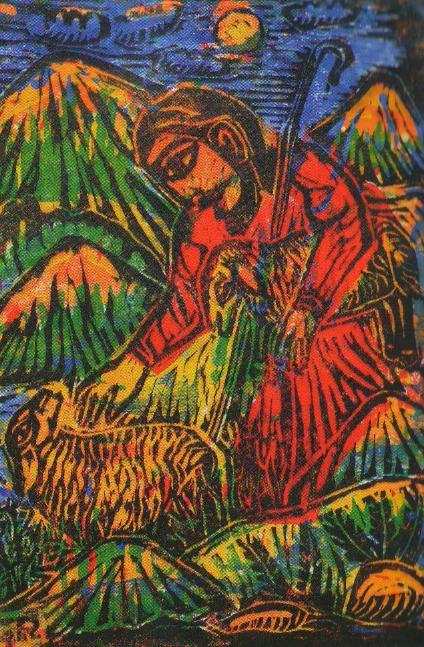
The Lord is my shepherd; I have all that I need.
Psalm 23:1, NLT
We have everything we need to grow in grace. God’s provision for us is total and complete. By grace, we can discern between truth and error; endure hostility, hardship, even persecution; live with patience as we await the new heaven and new earth; and face anything in this present life with confidence and hope because we’ve been equipped for it all.
Core to all this provision is the very life of Christ. Jesus is the source of the power and grace needed to live this incredible life. The same resurrection power which raised Christ from the grave is available and provided to us.
Believers are not in some weird holding pattern, like a plane circling the airport waiting to land, twiddling our thumbs until Christ returns. No! This present life is to be fully engaged with the tools given us of faith, hope, and love. And those spiritual implements are sufficient to walk with boldness through the valley of the shadow of death.
It continually must be borne in mind that we are to take up the gifts given us and use them in our present sojourn on this earth. Let us put significant energy into our faith development through knowing our call to holiness; and knowing Christ Jesus our Lord, his power and suffering.
Carefully and confidently using our faith, we are to fully participate in God’s divine power through the qualities of:
Goodness. Cultivation of moral excellence is both helpful and needed in all our relationships. Goodness is like a seed planted. We need to give it proper amounts of water and sun and keep the weeds away.
Knowledge. There are two words in the ancient Greek for knowledge: one is a reference to acquiring information; and the other refers to actively using the information provided. The Apostle Peter uses the latter – an experiential knowledge which is wise, discerning, and discreet.
Self-Control. This is the ability to get a grip on yourself, to avoid controlling others and focus on all things within your own control. Ultimate control belongs to God; and we are called to self-control.
Endurance. To see the big picture, to look ahead and keep your eye on the goal, is the lived practice of endurance or perseverance. Everyone has patience. It’s rather a matter of whether we will tap into it, or not.
Godliness. The heart of godliness is awareness of self, others, and God – rightly relating to them all with wholeness and integrity.
Mutual Affection. Basic human kindness is imperative between two people, especially with fellow believers.
Love. This is the Christian’s consummate virtue. Whereas affection is to be mutual, love can always be done whether someone loves us back, or not. Genuine love can be directed at the unlovely, even enemies.
We are to be effective and productive in adding divine virtues to our lives. It’s not a matter of more but better.
Even a smidge of faith can move a mountain.
A kernel of goodness can produce a harvest of righteousness.
A little bit of knowledge can be turned into love.
Small self-control can develop into immense self-control.
Keeping our head up for a few seconds can help us see the goal and endure to the end.
One insight can create a cascade of godliness.
A single act of kindness can change a life forever.
Love, no matter how big or small, can change the world.
We possess all these qualities and are in want of nothing. We are enough because Christ is enough.
Lord, make us instruments of your peace. Where there is hatred, let us sow love; where there is injury, pardon; where there is discord, union; where there is doubt, faith; where there is despair, hope; where there is darkness, light; where there is sadness, joy. Grant that we may not so much seek to be consoled as to console; to be understood as to understand; to be loved as to love. For it is in giving that we receive; it is in pardoning that we are pardoned; and it is in dying that we are born to eternal life. Amen. – A Prayer of St. Francis of Assisi








 Rev. Tim Ehrhardt