Have Spiritual Eyes to See (1 Peter 1:8-12)

You love him, although you have not seen him, and you believe in him, although you do not now see him. So you rejoice with a great and glorious joy which words cannot express, because you are receiving the salvation of your souls, which is the purpose of your faith in him.

It was concerning this salvation that the prophets made careful search and investigation, and they prophesied about this gift which God would give you. They tried to find out when the time would be and how it would come. This was the time to which Christ’s Spirit in them was pointing, in predicting the sufferings that Christ would have to endure and the glory that would follow. 

God revealed to these prophets that their work was not for their own benefit, but for yours, as they spoke about those things which you have now heard from the messengers who announced the Good News by the power of the Holy Spirit sent from heaven. These are things which even the angels would like to understand. (Good News Translation)

No less real than our actual physical eyes are our spiritual eyes – which enable us to see things invisible to our physical eyesight. Faith is the glasses that bring those things into focus.

To have faith is to be sure of the things we hope for, to be certain of the things we cannot see. (Hebrews 11:1, GNT)

Our life is a matter of faith, not of sight.

(2 Corinthians 5:7, GNT)

Faith creates the conditions for love. Cold dispassionate ideas and thoughts are just that; but faith gives us sight to see the true nature and meaning of love. Faith enables us to see Jesus Christ, who is Love incarnate.

This spiritual sight, made possible by faith, and bringing Christ into focus, is the basis for joy and the foundation of hope. It is more than joy; it’s joy unspeakable, beyond words, greater than the vocal chords can produce. It’s the sort of joy that takes your breath away.

Joy elevates us and brings us face to face with the glory of heaven. And once we have experienced this, our contentment is solely in Christ, and we have no need for anything the world offers. This is what it means to be saved.

Salvation always involves two equal and important facets: deliverance from something, so that we may attach to something else.

For the believer, with spiritual eyes to see in faith, we are saved from all the snake oil promises and allurements of the world; we are delivered from the weight of guilt and shame we carry; and we are snatched from the flames of hell and the machinations of the devil to ensnare us in evil.

The deliverance comes so that we can then connect with goodness, truth, justice, integrity, wholeness – with the love of God in Jesus Christ. Experiencing this wondrous spiritual fruit leads to a pure confession of faith:

But all those things that I might count as profit I now reckon as loss for Christ’s sake. Not only those things; I reckon everything as complete loss for the sake of what is so much more valuable, the knowledge of Christ Jesus my Lord. For his sake I have thrown everything away; I consider it all as mere garbage, so that I may gain Christ and be completely united with him. (Philippians 3:7-9, GNT)

I am neither a Christian because I was raised in cultural Christianity, nor because it was all I knew at the time. Rather, I am a Christian – a follower of Jesus Christ – because I was given a great gift of faith and saw divine love given for me, even though I deserved none of it.

So, my heart fully and forever belongs to Christ. It is a life worth living, a life of faith, hope, and love. No matter the hardship, adversity, or crud which happens to me on this earth, I am thoroughly surrounded by God’s grace, peace, and love.

And if I have to explain it to you, you probably don’t have it. That’s because it takes a different sort of eyesight, a countercultural set of ears, and a new meaning of touch, smell, and taste.

This sort of deliverance from sin, death, and hell, and into a great inheritance of faith, is so incredible that the ancient prophets, and the even older angels, longed to know what this salvation truly is.

And what they foretold, and believers now know, is that the cross is the way to victory; death is the passage to life; suffering is the road to glory.

Therefore, our present afflictions need not discourage nor debilitate us, as though we were miserable without any hope. Even more, it is through these very troubles that we are blessed.

No matter the evil thrown our way, there is always glory attached to it. If we must suffer, let us do so in the same spirit as Christ suffered:

My dear friends, do not be surprised at the painful test you are suffering, as though something unusual were happening to you. Rather be glad that you are sharing Christ’s sufferings, so that you may be full of joy when his glory is revealed. 

Happy are you if you are insulted because you are Christ’s followers; this means that the glorious Spirit, the Spirit of God, is resting on you. If you suffer, it must not be because you are a murderer or a thief or a criminal or a meddler in other people’s affairs. However, if you suffer because you are a Christian, don’t be ashamed of it, but thank God that you bear Christ’s name. (1 Peter 4:12-16, GNT)

Allow your spiritual eyes to confirm the truth, and to behold the living Christ.

“Why are you alarmed? Why are these doubts coming up in your minds? Look at my hands and my feet, and see that it is I myself.” Jesus (Luke 24:38-39, GNT)

May you know Christ, and him crucified, risen, and coming again. And may you know the hope of glory, indescribable joy, and everlasting love. May you know salvation.

The Love of God for You (Song of Songs 8:6-7)

God Is Love, by Voss Creative

Place me like a seal over your heart,
    like a seal on your arm;
for love is as strong as death,
    its jealousy unyielding as the grave.
It burns like blazing fire,
    like a mighty flame.
Many waters cannot quench love;
    rivers cannot sweep it away.
If one were to give
    all the wealth of one’s house for love,
    it would be utterly scorned. (New International Version)

Throughout most of church history, the Old Testament poem of Solomon’s Song of Songs has been interpreted allegorically as the love between God and God’s people.

A more literal hermeneutic views the Song as an actual relationship between a man and woman – which has it’s merits in that it acknowledges and affirms our bodily nature.

Yet, no matter what interpretive grid one uses for the Song, this wondrous and unique biblical book is an Ode to Love, lifting the centrality and power of Love as the greatest force in the world.

As for me, I believe it’s likely that the Song purposely has both the literal and allegorical in view. There are many places throughout Holy Scripture which have intended double and even triple meanings to the text. However one chooses to see the Song, love begins with God, and gives shape to our own human love for God, one another, and one’s lover.

“God carries your picture in his wallet.”

Tony Campolo

We learn a great deal of love from God. The Lord is a jealous God. That doesn’t mean the Lord is some weird stalker deity with insecurities about losing the devotion of worshipers. No, instead, divine jealousy is the positive quality of showing steadfast love and commitment, being completely devoted to following through with divine promises and presence.

The Song is far from the only place in Scripture which likens the relationship between God and God’s people as a marriage of lovers. In fact, God’s covenant relationship with people is at the heart of understanding the whole of Scripture.

In the prophecy of Hosea, God expressed a longing for Israel to remain faithful, because the Lord loves her. Hosea had an unfaithful wife, and throughout the book of Hosea the relationship between him and his wife Gomer mirrored the relationship between God and Israel. Just as Hosea kept showing faithful love to Gomer, even though she was brazenly unfaithful, so too, God looked at Israel with affection and steadfast love, not bearing to give her up.

“If you have never known the power of God’s love, then maybe it is because you have never asked to know it – I mean really asked, expecting an answer.”

Frederick Buechner, The Magnificent Defeat

The love of God shall always win the day, despite our own human love, which can wax and wane according to mood or circumstance. Grace, mercy, and love are deep in the nature of God; Love is who God is, not just what God does.

The one marrying you is the one who made you—
    the Lord of heavenly forces is his name.
The one redeeming you is the holy one of Israel,
    the one called the God of all the earth.
As an abandoned and dejected woman the Lord has summoned you;
    as a young wife when she is rejected,
        says your God.
For a brief moment I abandoned you,
    but with great mercy I will bring you back.
    In an outburst of rage,
    I hid my face from you for a moment,
    but with everlasting love I have consoled you,
    says your redeemer, the Lord.

These are like the days of Noah for me,
    when I promised that Noah’s waters would never again cover the earth.
    Likewise I promise not to rage against you or rebuke you.
The mountains may shift,
    and the hills may be shaken,
    but my faithful love won’t shift from you,
    and my covenant of peace won’t be shaken,
    says the Lord, the one who pities you. (Isaiah 54:5-10, CEB)

As the Old Testament draws toward the end, God’s love remains constant, desiring the people to hold fast to their Lord:

This is what the Lord All-Powerful says: “I have a very strong love for Jerusalem. My strong love for her is like a fire burning in me.” (Zechariah 8:2, NCV) 

Into the New Testament, the love of God continues to burn for God’s people. In the Gospels, Jesus showed committed love to all sorts of people, going so far as to be the ultimate martyr, giving himself as sacrifice of atonement on behalf of a world who mostly rejected him.

“Do you see this woman? I came into your house. You did not give me any water for my feet, but she wet my feet with her tears and wiped them with her hair. You did not give me a kiss, but this woman, from the time I entered, has not stopped kissing my feet. You did not put oil on my head, but she poured perfume on my feet. Therefore, I tell you, her many sins have been forgiven—as her great love has shown. But whoever has been forgiven little loves little.” (Luke 7:44-47, NIV)

One of Christ’s disciples, the Apostle John, learned to channel his passionate anger into passionate love. John knew that people’s needs are supremely and fully met through the Lord who loves them – and not through alternate avenues of love:

Do not love this world nor the things it offers you, for when you love the world, you do not have the love of the Father in you. For the world offers only a craving for physical pleasure, a craving for everything we see, and pride in our achievements and possessions. These are not from the Father, but are from this world. And this world is fading away, along with everything that people crave. But anyone who does what pleases God will live forever. (1 John 2:15-17, NLT)

God knows that going elsewhere to satisfy our needs, ultimately gets us nowhere, especially our need for love. God yearns, passionately, for us to find our pleasure and enjoyment in him. God waits with loving patience to show grace and compassion.

“The Love of God” by Frederick M. Lehman, 1917

The love of God is greater far
than tongue or pen can ever tell;
it goes beyond the highest star,
and reaches to the lowest hell.
The wand’ring child is reconciled
by God’s beloved Son.
The aching soul again made whole,
and priceless pardon won.


O love of God, how rich and pure!
How measureless and strong!
It shall forevermore endure—
the saints’ and angels’ song.

Come Away with Me (Song of Songs 2:8-15)

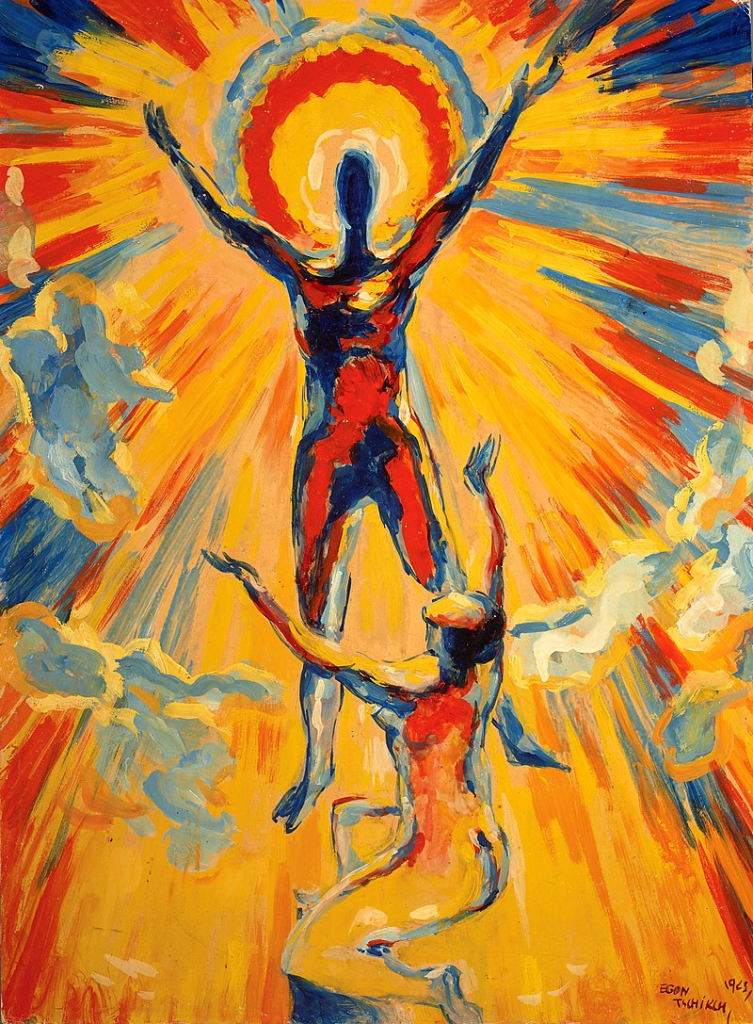
Song of Songs No. 19, by Egon Tschirch, 1923

Ah, I hear my lover coming!
    He is leaping over the mountains,
    bounding over the hills.
My lover is like a swift gazelle
    or a young stag.
Look, there he is behind the wall,
    looking through the window,
    peering into the room.

My lover said to me,
    “Rise up, my darling!
    Come away with me, my fair one!
Look, the winter is past,
    and the rains are over and gone.
The flowers are springing up,
    the season of singing birds has come,
    and the cooing of turtledoves fills the air.
The fig trees are forming young fruit,
    and the fragrant grapevines are blossoming.
Rise up, my darling!
    Come away with me, my fair one!”

My dove is hiding behind the rocks,
    behind an outcrop on the cliff.
Let me see your face;
    let me hear your voice.
For your voice is pleasant,
    and your face is lovely.

Catch all the foxes,
    those little foxes,
before they ruin the vineyard of love,
    for the grapevines are blossoming! (New Living Translation)

Spring is the season of love, the time of coming together and enjoying one another’s presence.

God is love. God is calling us. God wants to be with you.

There is a reason why so many people in this cruel and calloused world are unloving and unkind: They are unaware that God loves them, desires to be with them, and is calling out to them. 

If we neither believe nor know God’s infinite love and desire for us, then our words and our actions will reflect more of hate than love. God really truly does want to be with you and me. This is crucial. Do not forget this. Believe it. Live it. Enjoy it. Know it. Tell it to yourself until you are thoroughly bathed in it, because it is more wonderful than any ‘70’s sappy love song could ever describe it.

I believe the small Old Testament book of Solomon’s Song of Songs too often gets a weird hermeneutical spin of literalism from modern-minded simpletons. For nearly all of history, this poetic ode to love was understood as an allegory of divine love for humanity – and the believer’s reciprocal response.

Song of Songs No. 8, by Egon Tschirch, 1923

When Scripture says I am my beloved’s and my beloved is mine, and that his desire is for me, it is a wonderful way of communicating that God’s love for us is not abstract, distant, or detached. (Song of Songs 6:3, 7:10) 

The truth is: We belong to God. The Lord’s desire is for you and me. God has an intense and overpowering longing for you. Let the deep desire of God for you shape and form your thoughts so that fear is replaced with faith; loneliness with enjoyment; the fickle nature of others with satisfaction; praying as duty with praying because I want to be with the God who loves me so much.

Oh, how we need a vision of God singing over us with joy! Yes, God loves you that much! Grab a hold of what the prophet says:

The Lord will take delight in you with gladness.
    With his love, he will calm all your fears.
    He will rejoice over you with joyful songs. (Zephaniah 3:17, NLT)

Even the most unlovely of people are made lovely through God’s persistent and pursuing love for them. You are being wholly seen every single day by the infinite gaze and eternal compassion of God, who watches our every step with delight.

Christianity does not “happen” simply by knowing some beliefs about God, as if it is a mere contractual signing-off on a doctrinal statement. Rather, Christianity “happens” when individuals experience the white hot burning love of God in Jesus Christ. 

Jesus came not only for those who skip church and only occasionally read their Bibles. Christ came also for the hard-hearted prick, the immoral adulterer, the strung-out addict, the terrorist, the murderer, and for all those caught in bad choices and failed relationships. 

“I have not come to call respectable people, but outcasts.” (Matthew 9:13, GNT)

“Go out and train everyone you meet, far and near, in this way of life.” (Matthew 28:19, MSG)

“You will be witnesses for me.” (Acts 1:8, GNT)

“Love each other in the same way that I have loved you.” (John 13:34, GW)

All Christ’s words and actions are because of the Lord’s intense desire to love the world, and to love it through the divine beloved people of God.

God’s love is never based on our performance, or how good we look to others; it is never conditioned by our moods. The love of God only looks longingly at you and me with the potential of what we can become in Christ and cares for us as we are. It is a world-altering revolutionary thought that God loves me as I am and not as I should be. 

God has shown us how much he loves us—it was while we were still sinners that Christ died for us! (Romans 5:8, GNT)

Despite the erosion of church attendance, the majority of people still believe God exists. Conversely, however, many people do not believe God really loves them. We are in a crisis of love. People need to know the God who is pure Love. They need to hear and heed the call to come away with God.

Christianity never begins with what we do for God to make ourselves lovely. Christianity always starts with what God has done for us, the great and wonderful love that exists for us in Christ Jesus.

It wasn’t so long ago that we ourselves were stupid and stubborn, easy marks for sin, ordered every which way by our glands, going around with a chip on our shoulder, hated and hating back.

But when God, our kind and loving Savior God, stepped in, he saved us from all that. It was all his doing; we had nothing to do with it. He gave us a good bath, and we came out of it new people, washed inside and out by the Holy Spirit.

Our Savior Jesus poured out new life so generously. God’s gift has restored our relationship with him and given us back our lives. And there’s more life to come—an eternity of life! You can count on this. (Titus 3:3-8, MSG)

All the wrong turns in the past, the mistakes and the moral lapses, everything that is ugly or painful, all melts in the light of God’s acceptance and love for us.

If the consuming passion of Christ’s followers is not showing God’s love, then we have lost both our mission and our first love of Jesus. Perhaps we must let time evaporate, as we bow at the foot of the cross, and experientially know the great love of God in Christ for us and for the world.

May it be so, to the glory of God.

Maundy Thursday (Psalm 116:1-2, 12-19)

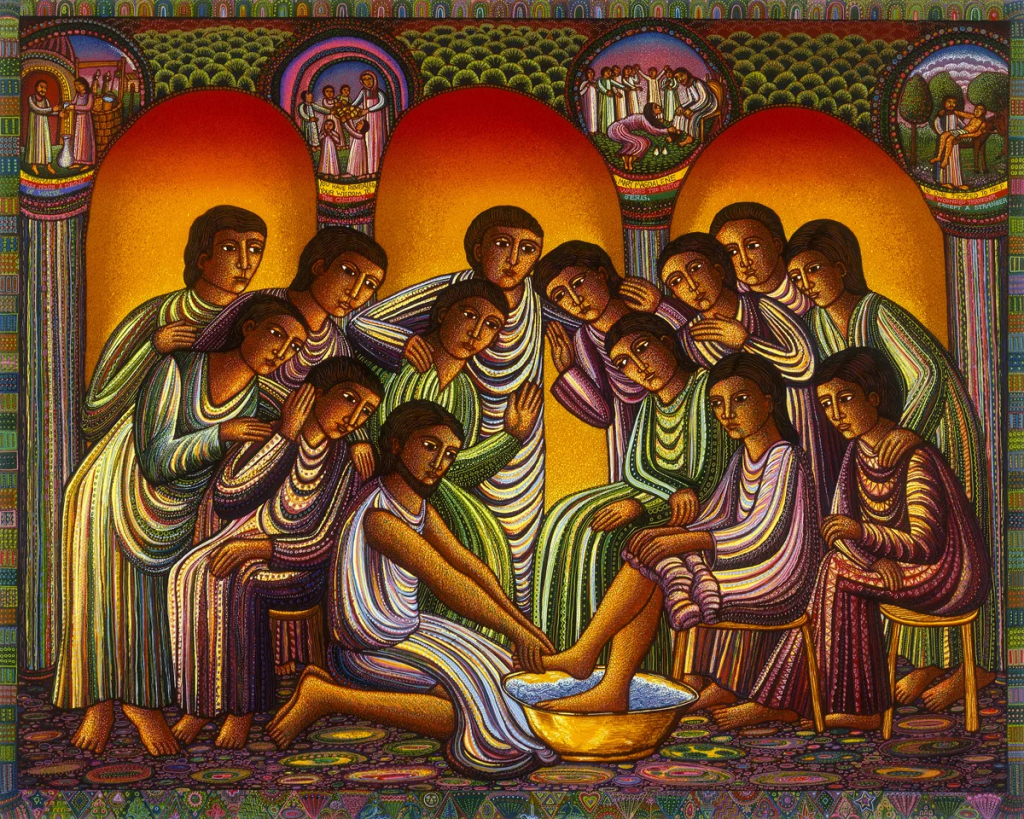
Washing of the Feet, by John August Swanson, 2000

I love the Lord because he has heard
    my voice and my supplications.
Because he inclined his ear to me,
    therefore I will call on him as long as I live….

What shall I return to the Lord
    for all his bounty to me?
I will lift up the cup of salvation
    and call on the name of the Lord;
I will pay my vows to the Lord
    in the presence of all his people.
Precious in the sight of the Lord
    is the death of his faithful ones.
O Lord, I am your servant;
    I am your servant, the child of your serving girl.
    You have loosed my bonds.
I will offer to you a thanksgiving sacrifice
    and call on the name of the Lord.
I will pay my vows to the Lord
    in the presence of all his people,
in the courts of the house of the Lord,
    in your midst, O Jerusalem.
Praise the Lord! (New Revised Standard Version)

“Pain and suffering have come into your life, but remember pain, sorrow, suffering are but the kiss of Jesus — a sign that you have come so close to Him that He can kiss you.”

Mother St. Térèsa of Calcutta (1910-1997)

There is more to the passion of Christ than sheer suffering and sorrow; the Via Dolorosa is, paradoxically, also the road to joy.

Yes, suffering is painful and unpleasant. Yet, since we all must suffer in some way, the real issue is whether our suffering is meaningless or has purpose to it. We are able to bear our suffering if we are confident that a redemptive outcome is at the end of it.

The Lord Jesus submitted to suffering because he knew that all the mockery, torture, and abuse was the pathway to deliverance for humanity.

Because of the joy awaiting him, he endured the cross, disregarding its shame. Now he is seated in the place of honor beside God’s throne. Think of all the hostility he endured from sinful people; then you won’t become weary and give up. (Hebrews 12:2-3, NLT)

Since Jesus has gone before us, enduring shame so that it could be put to death in us, we are able to live free from guilt and the ignominy of sin. What’s more, Christ’s suffering gives shape and meaning to our own suffering.

“I cannot but wonder at the virtue that lies in suffering; we are worth nothing without the cross. I tremble and am in an agony while it lasts, and all my conviction of its salutary effects vanish under the torture, but when it is over, I look back at it with admiration, and am ashamed that I bore it so ill.”

François Fénelon (1651-1715)

On this Maundy Thursday, we remember that in the midst of suffering there is the hope of glory, and in the center of pain there is the confident expectation that it will be used as the fertilizer to help love grow and bloom in the dormant places of this world.

“Love proves itself by deeds, so how am I to show my love? Great deeds have forbidden me. The only way I can prove my love is by scattering flowers and these flowers are every little sacrifice, every glance and word, and the doing of the least actions for love.”

St. Thérèse of Lisieux (1873-1897)

There cannot be love without suffering; to love is to sacrifice on behalf of another.

Because we live in a broken world full of pride and hubris, greed and avarice, hate and envy, we are victims of loveless systems and unjust actions. We need love to rescue and redeem us from the sheer muck of existential guilt and shame, evil and injustice.

Christians around the world are journeying through Holy Week, the most sacred time of the year for followers of Christ. When we think about Holy Week, we are familiar with Good Friday and certainly Easter, but Maundy Thursday? 

On this day, the Church remembers the final evening Jesus shared with his disciples in the upper room before his arrest and crucifixion. The experiences in the upper room were highly significant because this was the last teaching, modeling, and instruction Jesus gave before facing the cross. Jesus was careful and deliberate to communicate exactly what was important to him: to love one another.

“A new command I give you: Love one another. As I have loved you, so you must love one another.  By this everyone will know that you are my disciples if you love one another.” (John 13:34-35, NIV)

Maundy Thursday marks three important events in Christ’s Last Supper with his disciples: 

  1. The washing of the disciples’ feet (the action of loving service)
  2. The instituting of the Lord’s Supper (the remembrance of loving sacrifice)
  3. The giving of a “new” commandment to love one another (the mandate of a loving lifestyle)

The message of Maundy Thursday is this: Jesus Christ loves me just as I am, and not as I should be. He loves me even with my dirty stinky feet, my herky-jerky commitment to him, and my pre-meditated sin. 

Today is a highly significant day on the Church Calendar and in the Christian Year – one which deserves to be observed, and an opportunity to remember the important words and actions of Jesus on our behalf. Through Jesus Christ we are to live always in love, modeling our life and ministry after him. 

“I have found the paradox that if I love until it hurts, then there is no hurt, but only more love.”

Mother Térèsa

In Christ, love is to characterize our life together as we proclaim God’s love in both word and deed. A watching world will take notice and desire to lay down their hate and animosity if the followers of Christ are deeply and profoundly centered in the love of God.

God our Father, you invite us to participate in the life, suffering, death, and resurrection of your Son. Inspire us by his service, and unite us in his love; who lives and reigns with you, in the unity of the Holy Spirit, one God, now and forever. Amen.