The Power of a Blessing (Genesis 27:30-46)

Isaac Blesses Jacob, by Yoram Raanan

After Isaac had finished blessing Jacob, and just as Jacob left his father Isaac, his brother Esau came back from his hunt. He too made some delicious food, brought it to his father, and said, “Let my father sit up and eat from his son’s game so that you may bless me.”

His father Isaac said to him, “Who are you?”

And he said, “I’m your son, your oldest son, Esau.”

Isaac was so shocked that he trembled violently. He said, “Who was the hunter just here with game? He brought me food, and I ate all of it before you came. I blessed him, and he will stay blessed!”

When Esau heard what his father said, he let out a loud agonizing cry and wept bitterly. He said to his father, “Bless me! Me too, my father!”

Isaac said, “Your brother has already come deceitfully and has taken your blessing.”

Esau said, “Isn’t this why he’s called Jacob? He’s taken me twice now: he took my birthright, and now he’s taken my blessing.” He continued, “Haven’t you saved a blessing for me?”

Isaac replied to Esau, “I’ve already made him more powerful than you, and I’ve made all of his brothers his servants. I’ve made him strong with grain and wine. What can I do for you, my son?”

Esau said to his father, “Do you really have only one blessing, Father? Bless me too, my father!” And Esau wept loudly.

His father Isaac responded and said to him,

“Now, you will make a home
    far away from the olive groves of the earth,
        far away from the showers of the sky above.
You will live by your sword;
        you will serve your brother.
But when you grow restless,
        you will tear away his harness
        from your neck.”

Esau was furious at Jacob because his father had blessed him, and Esau said to himself, When the period of mourning for the death of my father is over, I will kill my brother.

Rebekah was told what her older son Esau was planning, so she summoned her younger son Jacob and said to him, “Esau your brother is planning revenge. He plans to kill you. So now, my son, listen to me: Get up and escape to my brother Laban in Haran. Live with him for a short while until your brother’s rage subsides, until your brother’s anger at you goes away and he forgets what you did to him. Then I will send for you and bring you back from there. Why should I suffer the loss of both of you on one day?”

Rebekah then said to Isaac, “I really loathe these Hittite women. If Jacob marries one of the Hittite women, like the women of this land, why should I go on living?” (Common English Bible)

Jacob and Esau

The twins Esau and Jacob are the very definition of sibling rivalry. Even at their birth, they jostled and positioned for their entry into the world. Although brothers, they were different from one another in every way. As their aged father, Isaac, was near the end of his days, he was looking to pass on a family blessing to Esau, the firstborn. And that’s where things got dicey.

Jacob, always the trickster, was still playing out the rivalry. When his brother Esau was out hunting and preparing to receive his father’s blessing, Jacob posed as his brother and deceitfully gained the blessing of Isaac.

Both Isaac and Esau were shocked to discover what happened. Esau’s response was one of grief, disappointment, bitterness, with tears and weeping. Despite Esau not being known for his sensitivity to God or family before this event, we can certainly feel his cry: “Do you have only one blessing, my father? Bless me too, my father!”

The Blessing

As a Pastor and a Chaplain who works with a variety of people, I have heard many times over the lament of individuals without a blessing from their father. As people created in the image and likeness of God, we were meant to be blessed – to have a loving and enduring stamp of approval from both our heavenly Father and our earthly fathers.

And when an earthly father, or father figure, either cannot or will not extend a vital blessing to children, it is a terrible wound – like an invisible open putrid abscess which continually leaves the person emotionally and spiritually sick.

Blessing is needed. Without blessing we flounder in the world, struggling to see hope, wondering if we are loved, and lacking confidence in our faith. To be blessed is to receive a beautiful gift.

The term “blessing” in Scripture is a powerful communication of God’s presence and approval.

So, when humans bless one another, we offer commitments of love and connection. We provide powerful words of encouragement and picture a special future for those we are close to.

None of this is optional. To bless others is the way of building up one another and fortifying each other for the rigors of this world. When blessing is withheld, and even worse, when it is replaced with cursing, then individuals are left untethered, bereft of support to face stressful situations. Like a ship adrift without any power or wind, so the person trying to live in this world without blessing is dead in the water.

Jesus Blesses

Where there is no blessing, like Esau, revenge fills our hearts. But Jesus clearly understood the need and the power of blessing, and he was not deterred in deliberately offering it:

People were bringing little children to Jesus for him to place his hands on them, but the disciples rebuked them. When Jesus saw this, he was indignant. He said to them, “Let the little children come to me, and do not hinder them, for the kingdom of God belongs to such as these. Truly I tell you, anyone who will not receive the kingdom of God like a little child will never enter it.” And he took the children in his arms, placed his hands on them and blessed them. (Mark 10:13-16, NIV)

I wonder how this simple encounter affected the lives of those children on that day in which Jesus blessed them. I am curious in what ways they grew-up and how Christ’s blessing shaped their lives. Because that is what blessing does: it forms us into the kind of people we were meant to be.

So, receive today this blessing from Holy Scripture:

The Lord bless you and keep you;
the Lord make his face to shine upon you, and be gracious to you;
the Lord lift up his countenance upon you, and give you peace. Amen. (Numbers 6:24-26)

People Are a Bundle of Contradictions (Romans 7:7-20)

“Contradictions” by Michael Lang, 2015

But I can hear you say, “If the law code was as bad as all that, it’s no better than sin itself.” That’s certainly not true. The law code had a perfectly legitimate function. Without its clear guidelines for right and wrong, moral behavior would be mostly guesswork. Apart from the succinct, surgical command, “You shall not covet,” I could have dressed covetousness up to look like a virtue and ruined my life with it.

Don’t you remember how it was? I do, perfectly well. The law code started out as an excellent piece of work. What happened, though, was that sin found a way to pervert the command into a temptation, making a piece of “forbidden fruit” out of it. The law code, instead of being used to guide me, was used to seduce me. Without all the paraphernalia of the law code, sin looked pretty dull and lifeless, and I went along without paying much attention to it. But once sin got its hands on the law code and decked itself out in all that finery, I was fooled, and fell for it. The very command that was supposed to guide me into life was cleverly used to trip me up, throwing me headlong. So sin was plenty alive, and I was stone dead. But the law code itself is God’s good and common sense, each command sane and holy counsel.

I can already hear your next question: “Does that mean I can’t even trust what is good [that is, the law]? Is good just as dangerous as evil?” No again! Sin simply did what sin is so famous for doing: using the good as a cover to tempt me to do what would finally destroy me. By hiding within God’s good commandment, sin did far more mischief than it could ever have accomplished on its own.

I can anticipate the response that is coming: “I know that all God’s commands are spiritual, but I’m not. Isn’t this also your experience?” Yes. I’m full of myself—after all, I’ve spent a long time in sin’s prison. What I don’t understand about myself is that I decide one way, but then I act another, doing things I absolutely despise. So if I can’t be trusted to figure out what is best for myself and then do it, it becomes obvious that God’s command is necessary.

But I need something more! For if I know the law but still can’t keep it, and if the power of sin within me keeps sabotaging my best intentions, I obviously need help! I realize that I don’t have what it takes. I can will it, but I can’t do it. I decide to do good, but I don’t really do it; I decide not to do bad, but then I do it anyway. My decisions, such as they are, don’t result in actions. Something has gone wrong deep within me and gets the better of me every time. (The Message)

“Contradictions in human character are one of its most consistent notes.”

Muriel Sparks, “Loitering with Intent”

The Apostle Paul’s vulnerable expression of his dilemma resonates deeply with many people. There are times when we say things to ourselves such as:

“I told myself I wasn’t going to be like my mother, and here I am responding just like she would.”

“I know better than to drive by the liquor store on my way home and pick up a pint of vodka, yet, I still did it.”

“I don’t want to die, but my thoughts keep racing about a plan for suicide.”

There are many situations in which we are both frustrated and befuddled by doing the things we do not want to do, and not doing the things we want to do.

Yes, indeed, Paul’s existential angst is a timeless description of our common human condition. We all can relate to the seeming inability to do what is right in so many situations. It can drive us nuts, even to a constant and never-ending low-level discouragement that underlies almost everything we do.

Paul’s prescription for dealing with this does not rely on law. He understood that putting our willpower and effort into obeying commands gets us nowhere, because we will eventually fail. Neither our brains nor our spirits work that way. Our willpower was never designed to be the driver of what we do and do not do. If anything, willpower, and the lack thereof, demonstrates just how much we are climbing the ladder on the wrong wall.

People are a bundle of contradictions, doing good, then bad, and flip-flopping back and forth with great frustration.

God’s law was not crafted to transform us from the inside-out. The law has three solid purposes, none of which are meant to bring deep personal transformation:

  1. Attention to the law works to restrain sin in the world
  2. Use of the law provides us with a helpful guide for grateful living in response to divine grace
  3. Reflection on the laws show us how bad off we really are in this world, and how much we are in need of forgiveness

We need a change of habits, and this is different than adopting a list of laws.

Habits are developed from our desires, our affections. In other words, we do what we love – more specifically, our ultimate love(s) drive us to do what we want. To put it in a more straightforward way:

We sin because we like it. And the path to overcoming any besetting sin is to have an ultimate love surpass the lesser sin which we like.

For example, I have developed daily habits or rituals of faith which enable me to commune with God. I love God with all my heart, soul, mind, and strength, and this ultimate love enables me to push out all competing gods who want my devotion. I also love my wife with all my heart. We work on developing habits of a marital relationship which reinforce our love for each other. Love is what drives me to do right and good by her.

So, what do we do when we mess up? For the Christian, no matter what the question is, the answer is always grace.

God’s grace in the finished work of Jesus Christ applied to us by the Holy Spirit is the operative power that changes lives. The law has no power to do that kind of work. Freedom from the tyranny of our misplaced desires and disordered loves comes from Christ’s forgiveness through the cross. Like a lover enamored with his beloved, our desires become oriented toward Jesus for his indescribable gift to us. That is the strength of grace.

Saving God, I thank you for delivering me from sin, death, and hell through your Son, the Lord Jesus. May your Holy Spirit apply the work of grace to my life every day so that I can realize spiritual healing and practical freedom from all that is damaging and destructive in my soul. Amen.

Free to Live a New Life (Romans 7:1-6)

You shouldn’t have any trouble understanding this, friends, for you know all the ins and outs of the law—how it works and how its power touches only the living. For instance, a wife is legally tied to her husband while he lives, but if he dies, she’s free. If she lives with another man while her husband is living, she’s obviously an adulteress. But if he dies, she is quite free to marry another man in good conscience, with no one’s disapproval.

So, my friends, this is something like what has taken place with you. When Christ died he took that entire rule-dominated way of life down with him and left it in the tomb, leaving you free to “marry” a resurrection life and bear “offspring” of faith for God. For as long as we lived that old way of life, doing whatever we felt we could get away with, sin was calling most of the shots as the old law code hemmed us in. And this made us all the more rebellious. In the end, all we had to show for it was miscarriages and stillbirths. But now that we’re no longer shackled to that domineering mate of sin, and out from under all those oppressive regulations and fine print, we’re free to live a new life in the freedom of God. (The Message)

The goal of salvation is to be delivered from oppressive bondage so that we are free to live a true and beautiful life – a holy life, set apart for good.

Romans chapters 6-8 are the Apostle Paul’s pointed discussion of how we become holy in a real and practical way. The theological word we typically use for this is “sanctification,” which means “to become holy,” and “set apart” for God. To be delivered from sin, death, and hell through the person and work of Jesus Christ is not the end of the story; it is just the beginning.

Becoming holy and good in our everyday lives boils down to this: identity and belonging.

One of the healthiest ways of looking at the entirety of the Bible’s message is that we belong to God. Our identities are thoroughly wrapped around Jesus. The process of realizing this, and coming to grips with it, is how we grow as people in holiness and righteousness.

Because of Christ’s finished work on the cross, we have been delivered from the realm of sin. Our change in status from condemned to accepted provides us the awareness to make daily affirmations of faith and live a new life.

Yet, the sinful nature (flesh) or the old person is still there. Although it is now toothless, our past can, and may often, exert a powerful influence on us. Even though there is a medium-rare T-bone steak on the table for us to enjoy, there are times we go back to the old bologna sandwich with stale white bread.

We no longer need to fall short of our true humanity. That’s because we belong to God. We are adopted into God’s family, having been orphaned by sin’s cruel influence.

However, just because we have been saved from the power of sin, sin itself is not extinct. We still must deal with it. We are alive to God and need to take up this great spiritual reality and live into it, for the force of sin still exerts a powerful influence in the world.

We deal with sin’s continued presence (the world, the flesh, and the devil) through embracing God’s grace versus trying to overcome it with the law.

Paul used an illustration from marriage to expand our understanding of grafting grace into our daily lives. By law, a married woman is bound to her husband (keeping in mind this sense of belonging was the predominant view of marriage in the Apostle’s day). But if the husband dies, the wife is released from the legal marriage. If she were to give herself to another man while her husband is still alive and they are married, then she becomes an adulteress. However, if she is a widow, then marries again, she is not an adulteress.

Paul applies this understanding to our relationship with the law. Death has separated us from the law. We died with Christ. Therefore, we have been set free from the law and have become alive to grace. As believers in Jesus, God’s grace and love changed our lives:

  • We now “belong to another, to him who was raised from the dead.” (Romans 7:4)
  • “When Christ’s body hung upon the cross, when God spared not his own Son but gave him up for us all.” (Romans 8:32)
  • “Christ took on himself for us all the curse of the law which inflicted all of us.” (Galatians 3:13)
  • We died to the law. God’s grace has made the death of Jesus the death of all from the realm of sin. (2 Corinthians 5:14)

As a married man, let me use Paul’s illustration to get down to the gist of his teaching. Yes, I am legally married and belong to my wife. I made vows to my wife on our wedding day which bind me legally to do what I said I would do. Yet, if I fulfill those vows in a strictly legalistic manner, I can vouch for my wife that this would not qualify as an acceptable situation for her. You see, my wife (and, me, too!) are freely bound to one another in love and grace. I care for my wife because I love her deeply, and not because it is my legal duty to do so.

The Christian life was neither designed nor meant to serve as a bare legal contract or covenant between us and God. God forbid such a thought! Jesus died to clear us from all the legality stuff so that we could freely love and serve God with joyful abundance and gratitude.

I am follower of Jesus because I love him deeply. What impels and motivates me is God’s grace. The law is there and has its place. However, it is not the law that causes me to be a Christian; it is the love of Christ which saved me from myself and compels me to live like Jesus.

May the God of peace make you pure, belonging only to him. May your whole self—spirit, soul, and body—be kept safe and blameless when our Lord Jesus Christ comes. The one who chose you will do that for you. You can trust him. Amen.

A Person’s a Person, No Matter How Small (Luke 17:1-4)

Jesus said to his disciples:

There will always be something that causes people to sin. But anyone who causes them to sin is in for trouble. A person who causes even one of my little followers to sin would be better off thrown into the ocean with a heavy stone tied around their neck. So be careful what you do.

Correct any followers of mine who sin, and forgive the ones who say they are sorry. Even if one of them mistreats you seven times in one day and says, “I am sorry,” you should still forgive that person. (Contemporary English Version)

In the children’s book by Dr. Seuss, Horton Hears a Who! Horton the elephant famously said, “A person’s a person no matter how small.” All the people around Horton were completely unconcerned for the residents of Who Ville living on a clover.

They were uninterested because the Who’s were invisible to them. Dr. Seuss chose to make Horton an elephant, a large creature able to hear with big ears and be attentive to the small.

Bigness and a large heart comes from becoming small and noticing little ones.

“Little ones” are people no one sees or notices. But Jesus sees them. They matter to him. And so they ought to matter to us, too. People need to be seen and heard by us – because they are visible to Jesus, and heard by him.

Christ often mingled with little people – children, women who had no rights, social misfits like lepers, the chronically ill, religious outsiders, tax collectors, and prostitutes. Our world is filled with similar people – angry adolescents, unwanted babies, forgotten old people, the mentally ill, moral failures, immigrants and refugees, and, if we have eyes to see and big ears to hear, lots of underprivileged people who reside on the dark underbelly of society.

They are around us, even if they are invisible to us.

Jesus envisioned a community that sees, honors, and protects little people. Truth be told, we are all little people before God, and the Lord notices us. So, we are to have enough humility to see the little people around us.

The way to become great in the kingdom of God is to descend, not ascend, into greatness. The chief enemy of any community is a desire to be prominent, to be the Big Cheese – it’s called “pride” and it will separate us from God if we hold onto it. Which is why we must do all we can to radically cut it out of our lives.

We are to welcome people – not because they are great, wise, rich, powerful, good-looking, and look like you and me. Rather, we are to welcome others because they are noticed by Jesus. Like Horton the elephant, Christ the Lord hears the cry from the place of smallness and is determined to do something about it.

The proud person who seeks prominence is always looking for greener pastures and impressing others. The proud connect with people who will help advance them up the ladder of success. Through that process of advancement, the proud do not care who they step on along the way.

Christians, however, are to give the small, insignificant people of society the time of day, treat them as important, and advocate for their needs. 

The Apostle Peter learned the hard way about paying attention to those different from himself. He experientially learned the saying, “love covers over a multitude of sins.” (1 Peter 4:9) This means that basic love for another prevents them from committing the sins they would have if they were unloved.

If we do not love, it would be better for us to be killed in a tragic millstone death. Jesus does not want people acting like leeches, just sucking the life out of others to get what they want.

So, what do we do about it? How shall we then live?

A person’s a person no matter how small. We need humility, to lower our sights and our bodies to see little people. We can truly see a two-year-old toddler whenever we lower ourselves to view them as equal and important. The way to see another requires slowing down, observing, and stooping or sitting to look them in the eye and give them the dignity of attention they deserve.

The danger of reading a post like this is the thought that all this stuff is really for someone else. After all, I don’t want to hurt anyone or see anybody deprived, right? Yet, the fact remains that we do no one any good when we neglect getting on the floor.

When we assume blessing for ourselves without the intent of giving it to others, we have come under the judgment of Christ. Perhaps we fear forgiveness – either accepting an apology from another or offering one to someone we have wronged. Out of sight, out of mind, is the approach of the one who causes others to stumble and make them fall.

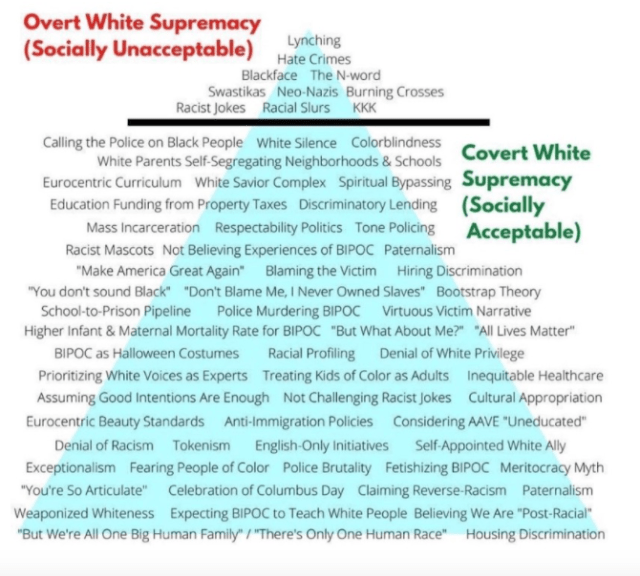
Christ’s admonition is to watch ourselves, to be vigilant of both overt and covert sins against the unseen and forgotten amongst us. The pyramid below concerning racism is just one example of many other forms of causing others to stumble and fall:

Even though I write this warning, dear friends, I am confident of better things in your case—the things that have to do with salvation, deliverance, and liberation for all persons.God is not unjust; he will not forget your work and the love you have shown him as you have helped others and continue to help them.

Continue to show this same diligence so that what you hope for may be fully realized; and, imitate those who through faith and patience are doing good work. May the Lord be with you.

For those deprived of their human needs and their human rights: Just God, may they may be given the dignity by others which you confer on all his people.

For all who are forgotten and unseen, especially the poor, the sick, and the aged: All-seeing God, may you move us to love them as the image of Christ.

For all who are lonely or afraid, for teenagers on the street, the elderly in nursing homes, prisoners with no one to visit them, and all whom the world has forgotten: Lord Christ, may you lead us to them.

For those who suffer mental illness or disorder: Attentive God, may we cherish the gifts you have given them, and in their lives hear the voice of your love.

For each human life: Creator God, may we value every person as you do.
We pray in the name of Jesus Christ, our Savior. Amen.