The Way of Love (Song of Songs 3:1-11)

Song of Songs III, by Marc Chagall, 1960

Night after night on my bed
I looked for the one I love.
I looked for him but did not find him.
I will get up now and roam around the city,
in the streets, and in the squares.
I will look for the one I love.
I looked for him but did not find him.
The watchmen making their rounds in the city found me.
I asked,
“Have you seen the one I love?”
I had just left them when I found the one I love.
I held on to him and would not let him go
until I had brought him into my mother’s house,
into the bedroom of the one who conceived me.

Young women of Jerusalem, swear to me
by the gazelles
or by the does in the field,
that you will not awaken love
or arouse love before its proper time.

Who is this young woman coming up from the wilderness
like clouds of smoke?
She is perfumed with myrrh and incense
made from the merchants’ scented powders.
Look! Solomon’s sedan chair!
Sixty soldiers from the army of Israel surround it.
All of them are skilled in using swords,
experienced in combat.
Each one has his sword at his side
and guards against the terrors of the night.
King Solomon had a carriage made for himself
from the wood of Lebanon.
He had its posts made out of silver,
its top out of gold,
its seat out of purple fabric.
Its inside—with inlaid scenes of love—
was made by the young women of Jerusalem.
Young women of Zion, come out and look at King Solomon!
Look at his crown,
the crown his mother placed on him on his wedding day,
his day of joyful delight. (God’s Word Translation)

Song of Songs III, by Marc Chagall, 1960

Eastertide is a celebration of new life through exploring the implications of living a resurrected life. A significant dimension to that life is a new awakening and awareness of love. Being raised to a new life of love means that we can dispense with old ways of looking at love that were unhealthy for us.

King Solomon’s Song of Songs has been viewed throughout the history of biblical interpretation in various ways. It’s been seen as a celebration of sexual love between a man and a woman. Others view the Song as a description of the mutual love between God and Israel or Christ and the Church.

With whatever approach we examine this unique book of Holy Scripture, I believe it’s helpful for us to avoid looking at it too literally, as if it were a sex manual for spiritually minded newlyweds.

For most of church history, the book has been viewed allegorically and metaphorically, not literally. So, it seems to me, this warrants the interpreter to walk mindfully and wisely through its wonderful prose, and not like some arrogant and supposed Romeo who believes they are God’s gift to scripture interpretation.

The Song of Songs, at its heart, is really an ode to Love itself. Love is the force that binds us together as humans, and comes from the One who is pure Love. As such, Love is perhaps the most potent strength in the universe. Thus, Love needs to be respected. Love must be handled with care, because its power can harm us if we are careless with it.

Longing for love is a universally understood feeling. The need for love is so great that the woman in today’s Old Testament lesson will put herself at considerable risk in order to seek and find her beloved in the middle of the night on the city streets.

“You have to keep breaking your heart until it opens.”

Rumi, 13th century Persian poet

Love, however, is not to be awakened before its proper time. Certainly, to love is to risk, for we choose to put ourselves out there for the sake of giving and receiving love. Yet, there are to be limits on that pursuit. Seeking love can put one in a hazardous situation. It’s best, therefore, to allow some patience with love, to not rouse love with blind desire.

Love will have its way; we need not force it before its true readiness.

The woman longs for her beloved. The pain of separation is almost too much for her to bear. Love hurts. There is, however, good pain and bad pain. The pain of waiting and wondering has a purpose which we need to submit to, and follow. It is an opportunity for careful reflection, mindful contemplation, and healthy introspection.

Without these spiritual disciplines, the problem of fear arises – not love – and begins to gnaw at us, that perhaps we are unloved. Thoughts and feelings of insecurity can creep in and dog us with incessant and obnoxious barking.

But we must trust in Love. Love cannot be domesticated, nor fully defined, and that is a good thing – because Love is much bigger than any of us. And it’s also good that we cannot precisely interpret nor explain all of the contents within the Song of Songs. The book is a good reminder that Holy Scripture stands above us, and not the other way around.

God is Love. And Love is God. True human love serves as a symbol of divine love. We not so much come to understand the ways of God and Love, as we discover it, describe it, and then determine to live it.

People never fully connect to God, at least this side of heaven, in much the same way as the desired rendezvous of the lovers in the Song never explicitly occurs. The God we seek is the God who corresponds to our needs and desires, our loves and our fears.

And yet, God is also wholly other than us; God is revealed to humanity by means of Scripture. God issues decrees and commands that may not seem as if they sync with our perceived needs. From this perspective, people must obey, regardless of any feeling.

God is, therefore, both approachable to us and completely apart from us, at the same time, all the time. God engages with us in intimate personal spiritual experiences; and God also reaches out through Scripture in human/divine encounters. Both ways are approaches of love, initiated by the One who loves us.

No matter what the question is, Love is always the answer. This is the way.

Creator God, by the mercies of your son, our Lord, Jesus, compel us to turn our hearts to the way of Love, so that we may follow Christ as your faithful people. Guide us, we pray, to Love. Amen.

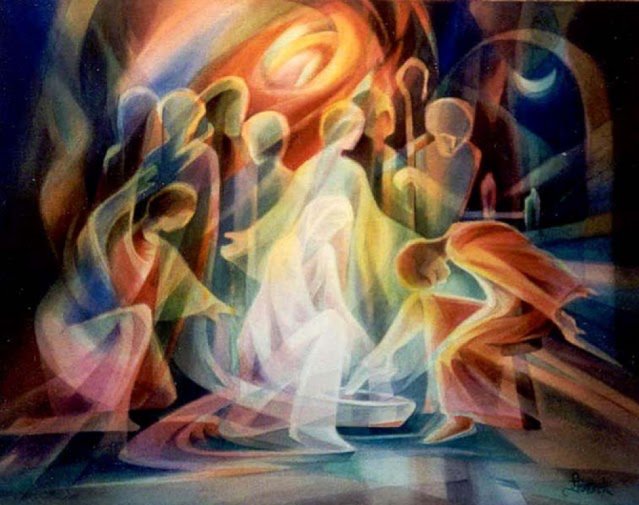
Maundy Thursday (John 13:1-17, 31b-35)

Jesus Washing the Disciples’ Feet, by Leszck Forczek (1946-2019)

Now before the festival of the Passover, Jesus knew that his hour had come to depart from this world and go to the Father. Having loved his own who were in the world, he loved them to the end. The devil had already decided that Judas son of Simon Iscariot would betray Jesus. And during supper Jesus, knowing that the Father had given all things into his hands and that he had come from God and was going to God, got up from supper, took off his outer robe, and tied a towel around himself. 

Then he poured water into a basin and began to wash the disciples’ feet and to wipe them with the towel that was tied around him. He came to Simon Peter, who said to him, “Lord, are you going to wash my feet?” Jesus answered, “You do not know now what I am doing, but later you will understand.” Peter said to him, “You will never wash my feet.”

Jesus answered, “Unless I wash you, you have no share with me.” Simon Peter said to him, “Lord, not my feet only but also my hands and my head!” Jesus said to him, “One who has bathed does not need to wash, except for the feet, but is entirely clean. And you are clean, though not all of you.” For he knew who was to betray him; for this reason he said, “Not all of you are clean.”

After he had washed their feet, had put on his robe, and had reclined again, he said to them, “Do you know what I have done to you? You call me Teacher and Lord, and you are right, for that is what I am. So if I, your Lord and Teacher, have washed your feet, you also ought to wash one another’s feet. For I have set you an example, that you also should do as I have done to you. Very truly, I tell you, slaves are not greater than their master, nor are messengers greater than the one who sent them.If you know these things, you are blessed if you do them….

“Now the Son of Man has been glorified, and God has been glorified in him. If God has been glorified in him, God will also glorify him in himself and will glorify him at once. Little children, I am with you only a little longer. You will look for me, and as I said to the Jews so now I say to you, ‘Where I am going, you cannot come.’I give you a new commandment, that you love one another. Just as I have loved you, you also should love one another. By this everyone will know that you are my disciples, if you have love for one another.” (New Revised Standard Version)

Today is Maundy Thursday. It is a time in Holy Week to reflect upon the great love of Christ for humanity, as well as much of humanity’s great resistance to that divine love.

The word “Maundy” is the Latin word for “commandment.” It’s a reference to Christ’s mandate for his followers to love one another. And Jesus gave his disciples an example of this love in a way they would never forget.

The jaw-dropping illustration of love for each other is preceded by setting the stage. It is the Last Supper, the final meal of Jesus with the disciples. Christ’s imminent crucifixion is very much tied to the Jewish Passover. Just as the festival is about to happen, dominating the spiritual landscape of Jerusalem, so the cross of Christ looms heavy in the Upper Room. The hour is nearly upon them.

Washing of the Feet, by John August Swanson, 2000

And only Jesus seems to know the brevity of the moment. He knows that Judas is about to betray him. Events that were prophesied centuries earlier are about to be set in motion. Every word and action of Jesus at this Supper is formed and informed by what is about to take place in the next few days.

We are meant to understand, as observers to this Upper Room meal, that Jesus not only knows what is happening, but that he also has control over the unfolding events. Satan may believe that he knows what’s going on and can influence Judas for diabolical purposes; but Jesus is really the One in charge. Even the workings of the devil are used for the divine agenda. Every event – whether meant for good or for ill – shall be bent toward the will of God.

The example, the capstone of all Christ’s teaching, is now divulged and acted out. The disciples themselves are participants in the drama; and they are aghast at what Jesus is doing. Christ proceeds to divest himself, humble himself, and serve them all by washing their feet.

Jesus intends his actions to be followed. Whereas the disciples likely believed that, over the past three years, they were being groomed for ruling in God’s new government, Christ was informing them that they will be servants in that new rule and reign of God. Yes, they will be leaders; but it will be a servant-leadership that uses its authority to love others.

Not everyone was immediately on board with this type of leadership and service. That’s because there were those who found it extremely hard to accept such a love as this.

Peter had serious difficulties with this foot washing thing. Maybe Peter thought that the roles should be reversed; he should be serving Jesus, and not the other way around. It could be that Peter was simply clueless or confused. Or perhaps he believed this action to be socially inappropriate and foolish. Yet, no matter what was going through Peter’s mind, he blatantly resisted the love of Christ.

Jesus would have none of this resistance to his loving service. Sharing in Jesus involves being served by him, even in so lowly and intimate a form as foot washing. Bottom line: the disciples of Jesus must be washed by him.

Peter (bless his extrovert mouth and heart) totally changes from rejection to the foot washing, to wanting a complete bath. Even in this, however, Jesus brings the zealot spirit down a few notches. He brought Peter to where he needs to be, and not where Peter wants to be.

Jesus Washing the Feet of His Disciple by Japanese artist Sadao Watanabe (1913-1996)

The whole washing of feet is an act of love and service that Jesus performed for them. Judas is there, too, getting his feet washed, as well. The example Jesus set was not simply one of service to an elite group of believers. The love of disciples for one another includes even those people we might prefer to forget.

Slaves were the ones who performed the service of washing feet whenever guests arrived at the master’s house. For the Christian, since our own Master initiated this practice, we ought also to love one another through meeting even the most mundane and stinky of needs. After all, we are not above our Master.

Yet, Christ considers us friends, and not necessarily as slaves, and even grants us an inheritance with him. Meeting needs requires the utilization of love.

It seems that Peter wanted to make the symbolic practice of washing feet something it was not meant to be. He asked for a lavish display of cleanliness for his entire body. Perhaps Peter thought that if you’re going to make a mark and a statement, then really go all out and do it!

For sure, Peter didn’t really know what he was saying. Jesus told Peter as much. But later, Jesus assured Peter, and all the disciples, that they indeed would, in time, understand all that he was opening up for them.

Of utmost value to Jesus was to have his disciples be driven by what drives he himself: love. Being a Christ follower is only secondarily about what one knows, and primarily about how one loves.

Christians have been profoundly loved by God through Jesus Christ. And what we do with that received love is of great importance to Jesus. As the Apostle Paul would say later to a young Corinthian Church, “Knowledge puffs up, but love builds up.” (1 Corinthians 8:1)

On this Maundy Thursday, it is more than appropriate to contemplate the incredible love shown to the original disciples, and toward us, all these centuries later. Let this contemplation compel us to put a great deal of thought and conversation into the best ways of loving the people in front of us with actions that have real meaning for them.

O God of love,
giver of concord,
through your only Son
you have given us a new commandment
that we should love one another
even as you have loved us,
the unworthy and the wandering,
and gave your beloved Son for our life and salvation.
Lord, in our time of life on earth
give us a mind forgetful of past ill-will,
a pure conscience and sincere thoughts,
and hearts to love one another;
for the sake of your Son, Jesus Christ our Lord.
Amen. – A Prayer of St. Cyril of Alexandria, 5th century

The Call (Psalm 118:1-2, 19-29)

Call to Worship, by Darrell Black

Confess Yahweh, because he is good,

            because his commitment is permanent.

Yisrael is pleased to say,

            “His commitment is permanent”…

Open the faithful gateways to me;

            when I come through them, I shall confess Yahweh.

This is Yahweh’s gateway;

            faithful people come through it.

I will confess you because you answered me

            and became deliverance for me.

The stone that the builders spurned

            became the head cornerstone.

This came about from Yahweh;

            it’s been extraordinary in our eyes.

This was the day that Yahweh made;

            so that we would celebrate and rejoice in it.

Oh, Yahweh, will you deliver us, please?

            oh, Yahweh enable us to succeed, please.

Blessed be the one who comes in Yahweh’s name;

            we are blessing you from Yahweh’s house.

Yahweh is God; he has shone light to us

– tie the festal offering with cords to the horns of the altar.

You are my God and I will confess you;

            my God, I will exalt you.

Confess Yahweh, because he is good,

            because his commitment is permanent.

(The First Testament, A New Translation by John Goldingay)

This psalm is the last of the Hallel (praise) psalms (Psalms 113-118) used at the Passover meal. It includes a summons for the entire community to praise God; an individual thanksgiving to the Lord; and a communal speech.

The Call to Confession

We are invited and called upon to recognize and confess Yahweh’s enduring steadfast love, which is a lasting and permanent commitment toward God’s people. Why? Because it is through a tenacious love that never gives up that brings healing, wholeness, and health to the community. Our relatedness to God makes all the difference in life.

“The unrelated human being lacks wholeness, for he can achieve wholeness only through the soul, and the soul cannot exist without its other side, which is always found in a ‘You.’ Wholeness is a combination of I and You, and these show themselves to be parts of a transcendent unity.”

Carl Jung, The Psychology of Transference

When it comes to healing – whether it be physical, emotional, or spiritual – love must be involved. The need for healing implies brokenness. And love is relational. Therefore, in order to experience the wholeness of healing, there needs to be another.

Love extended to one who requires mercy creates the opportunity to see light in the other, and to feel it in your own. And that energy brings the healing wholeness of both body and soul.

Every divine/human encounter, and each gracious intervention of God to people, is the chance to bring wholeness through the power of love by means of relationship. Communal worship affords us the opportunity to experience the steadfast love and commitment of God – as well as to steward that love well, for others who need it.

The Call to Thanksgiving

Everyone is on board for thanksgiving, right? Well, not so much. Like most things, it’s complicated. On the one hand, we have those persons who seem to never express gratitude for anything; it appears they are only capable of cynicism and sarcasm. And, on the other hand, are those who are incessantly positive, always thankful, no matter the circumstance; for them, it seems they are never living in the reality of a messed up world.

A reflexive response of gratitude to everything is merely a cheap thanksgiving. And a constant stream of ingratitude is simply taking the easy road of complaint. Thanksgiving ought to be thoughtful and well-placed. Gratitude is really a spiritual discipline that requires constant practice until it becomes a solid life skill.

The psalmist pictures the king, David, leading a procession of worshipers as they approach Yahweh. It’s as if the king is teaching the people how to go about entering God’s presence, and what role thanksgiving has in this relationship between God and humanity.

Central to that relationship are offerings of praise and thanksgiving for divine deliverance. Specifically, it is acknowledging gratitude from the place of a spiritual cornerstone. This is the foundation from which an individual’s and an entire community’s faith is rested upon.

The New Testament locates this vital cornerstone as Christ. Jesus is,

“‘the stone you builders rejected,
    which has become the cornerstone.’

Salvation is found in no one else, for there is no other name under heaven given to mankind by which we must be saved.” (Acts 4:11-12, NIV)

Consequently, you are no longer foreigners and strangers, but fellow citizens with God’s people and also members of his household, built on the foundation of the apostles and prophets, with Christ Jesus himself as the chief cornerstone. (Ephesians 2:19-20, NIV)

The Call to Commitment

The permanence of God’s steadfast love and loyalty toward people demands a response. In Christianity, because of the Lord’s commitment to us – through the person and work of Jesus Christ – there is opportunity for a reciprocal response of commitment to God in Christ through the Spirit.

This response of genuine worship and thanksgiving avoids the crush of the constant critic, on the one hand, and on the other hand, steers clear of ignoring suffering.

As you come to him, the living Stone—rejected by humans but chosen by God and precious to him—you also, like living stones, are being built into a spiritual house to be a holy priesthood, offering spiritual sacrifices acceptable to God through Jesus Christ. For in Scripture it says:

“See, I lay a stone in Zion,
    a chosen and precious cornerstone,
and the one who trusts in him
    will never be put to shame.”

Now to you who believe, this stone is precious. But to those who do not believe,

“The stone the builders rejected
    has become the cornerstone,”

and,

“A stone that causes people to stumble
    and a rock that makes them fall.”

They stumble because they disobey the message—which is also what they were destined for.

But you are a chosen people, a royal priesthood, a holy nation, God’s special possession, that you may declare the praises of him who called you out of darkness into his wonderful light. Once you were not a people, but now you are the people of God; once you had not received mercy, but now you have received mercy. (1 Peter 2:4-10, NIV)

Holy Week is nearly upon us. The celebration and praise of Palm Sunday is coming, along with the suffering and death of Good Friday. This all sets the scene for a victorious resurrection which solidifies the Christian’s faith with the mortar of God’s steadfast love in Christ.

As we enter the Week, let us be open to the full range of thoughts and emotions that arise because of God’s loyal and loving commitment to us, and our reciprocal commitment to Christ. Let us be receptive to the call of love.

God of compassion and love, you know our faults and yet you call us to forgiveness instead of leveling judgment upon us. Keep us in your gracious presence, and give us your wisdom. Open our hearts to gratitude and commitment, and restore to us the joy of our salvation. Amen.

“I Choose You!” (Ephesians 1:3-6)

Blessed is the God and Father of our Lord Jesus Christ, who has blessed us with every spiritual blessing in the heavenly realms in Christ. For he chose us in Christ before the foundation of the world that we should be holy and blameless before him in love. He did this by predestining us to adoption as his legal heirs through Jesus Christ, according to the pleasure of his will—to the praise of the glory of his grace that he has freely bestowed on us in his dearly loved Son. (New English Translation)

There is perhaps no greater sense of worth, security, and love, than stating with sincerity and conviction to another, “I choose you!”

That is exactly what God has done for us. In fact, the Lord chose us and included us before we were even born into this world. Our identity is secure in belonging to God because it isn’t based in any of the screw-ups I did yesterday or the bad decisions I made years ago. Christian identity is based solely and completely by the choice and action of God, in Christ, through the Spirit.

People tend to live up to how they view themselves, to how they self-identify. So, it is critical to our well-being how we truly understand self, others, and God.

If we see ourselves as never getting ahead and needing to lie, cheat, and steal to obtain anything in this life, then we will view ourselves as common thieves.

If we think the only way to have love and security in this life is to hustle for it – to make ourselves as presentable as we possibly can, then we will view ourselves as basically unlovely and search for love in all the wrong places by trying to keep up appearances.

If we look at ourselves as stupid, then we will tend to make poor decisions even when it’s in our ability to make good choices because we see ourselves as unable to compete with those smarter than us. 

The common theme in all these scenarios are people living apart from God. Without the Lord Jesus, we are like lost street children trying to survive from day to day. What we need, what we search for and long for, is to have a good, blessed life in a loving home, a place to belong in a world of disconnection.

To be “blessed,” to have “blessing” in the Holy Scriptures, is to have God’s stamp of approval on your life. It is to know, experience, and feel Divine favor resting upon you.

The picture being painted at the very beginning of Paul’s letter to the church at Ephesus is of wayward children roaming the streets as orphans. The Ephesians were ensconced in their idol worship of Artemis, the fertility cult goddess. They were going about life without a whim about the true and living God.

Out of sheer grace, God plucked them from their worthless condition and adopted them. God placed blessing upon them because of love and gave them a reason to rejoice and praise.

What’s more, the Ephesians were chosen and predestined for holiness and purity. God set them apart for divine blessing. It’s as if God brought them into the kingly palace, provided lavishly for them, and let them have the run of the place. They get to enjoy every privilege that comes with being children of the king.

The focus and orientation of today’s New Testament lesson is about how tremendously special the believer in Jesus really is. And it has nothing to do with how presentable we are to a holy God. Instead, out of the vast storehouse of blessed grace, God chose and adopted. The Lord looked upon you and me with googly divine eyes and said, “I choose you!”

God chooses from a place of divine pleasure. Yes, that’s right. God chooses, predestines, and adopts with a willing heart because it brings great pleasure and divine joy to do so!

There was no arm-twisting from the Father to the Son in securing redemption for lost humanity. And there was no persuasion necessary for the Father and Son to send the Spirit for our ongoing benefit and help in this life. Each redemptive event of Jesus was done out of the grace and love of God in Christ through the Spirit.

Do you see how God views you? Do you know how special you truly are?  Have you an understanding of the incredible position and majesty you have as a human being in God’s image and likeness?

As a child of the king, you live up to the position you know you possess. Freedom from worry and anxiety don’t come from willpower, but from an understanding that God owns all things, and we will never be in need. 

Deliverance from the power of darkness doesn’t come by trying to do better; it comes through the knowledge that God has redeemed us and chosen us to live in the gracious realm of divine love forever. There is no need to hustle for love with God because you and I already have it.

The believer has every spiritual blessing in Christ. God has your back. We belong to God. And to belong to Jesus Christ is to be blessed. It makes all the difference in the world. It is our reason for gratitude and praise, and for settled peace and glorious rest.

Gracious God, your loving activity has snatched me from the barren streets of sin and brought me into a realm of incredible blessing. Thank you for blessing me and giving me a place to belong forever; through Jesus Christ, my Lord and Savior, who with you and the Holy Spirit reign forever and ever in a celebration of redeeming love.  Amen.