Imitate the Right Use of Power (1 Corinthians 4:14-20)

I am writing this not to shame you but to warn you as my dear children. Even if you had ten thousand guardians in Christ, you do not have many fathers, for in Christ Jesus I became your father through the gospel. Therefore I urge you to imitate me. For this reason I have sent to you Timothy, my son whom I love, who is faithful in the Lord. He will remind you of my way of life in Christ Jesus, which agrees with what I teach everywhere in every church.

Some of you have become arrogant, as if I were not coming to you. But I will come to you very soon, if the Lord is willing, and then I will find out not only how these arrogant people are talking, but what power they have. For the kingdom of God is not a matter of talk but of power. (New International Version)

We need to talk about power.

And we need solid sacred examples of how to wield power rightly and justly.

Power is a lot like sex. Everyone wants it, but not everyone respects it and uses it well.

Humanity was created by God to exercise power. True human power has always been intended by our Creator as a means of giving love to others. Wherever you find love being extended by people in power to the powerless, there you will see that it works.

Yet, here’s the rub for many of us: This godly use of power may not (and likely will not) achieve instant results. That’s probably why we so often associate humanity’s possession of power with threats, bullying, and violence – because they usually work to get the immediate results of obtaining power and keeping others in subservience to that power.

The right use of power rarely gets rolled out smoothy without any wrinkles to it. Instead, wielding power through love makes its way by means of suffering. It comes from the humble servants like Mother Teresa, and from those who could throw their weight around, but instead choose to use their influence for self-giving love.

This sort of just and right authority is realized when we are aware of our own weaknesses and failures. Believing that “might=right” is merely a prescription for working out our own complexes on other people; it will only result in extending hate, not love, when others resist our authority.

The ones who hold true power are those who know they are unworthy of it, and incapable of using it without humility and divine help. Real power is like a shepherd looking after a flock of sheep – and not like pulling out a sword to kill the bad guys when they come to challenge authority.

Believers everywhere need awareness that the Christian message offers a profound reversal of what we think we know about power. All signs of real power lead us to the foot of the cross. National governments seems to think that power must be both achieved and sustained by the threat of violence. But the power of God’s kingdom is exercised through giving, serving, and loving.

And it is that sort of power which transforms the world in ways that probably won’t make headlines on the nightly news. The power of Christ is passed on throughout the generations of believers – learned by imitating people, like the Apostle Paul, who demonstrated humble service, instead of arrogant authority.

Faith is passed from person to person; and not just handed down from individuals reading their bibles in seclusion. Power and authority are given to those who are capable of handling it with justice and righteousness.

“You have heard me teach things that have been confirmed by many reliable witnesses. Now teach these truths to other trustworthy people who will be able to pass them on to others.”

The Apostle Paul to his protégé Timothy (2 Timothy 2:2, NLT)

Christians learn from leaders how the faith is lived out, and how power is used, by imitating what they see and hear. Therefore, an important question is this: Who do I imitate?

“Dear brothers and sisters, pattern your lives after mine, and learn from those who follow our example.”

The Apostle Paul to the Philippian Church (Philippians 3:17, NLT)

Our great desire is that you will keep on loving others as long as life lasts, in order to make certain that what you hope for will come true. Then you will not become spiritually dull and indifferent. Instead, you will follow the example of those who are going to inherit God’s promises because of their faith and endurance. (Hebrews 6:11-12, NLT)

Remember your leaders who taught you the word of God. Think of all the good that has come from their lives, and follow the example of their faith. (Hebrews 13:7, NLT)

Those who hold authority and power in the Christian Church must exemplify a proven character of persevering love in the face of pain and suffering. Such persons, having shown humility through it all, are worthy to imitate.

This does not necessarily mean that we emulate those who eruditely speak the Word of God, have superior gifts and abilities, and enjoy success in ministry. It does mean that we ought to imitate, and have as mentors, those persons who imitate Christ and are not self-promoting peacocks who go after being admired and praised.

A cocky Christian leader who has not focused on suffering love, and who has not experienced the purgative fiery trials of this life, may easily become seduced by their own importance. However, leaders who have seen their share of hard circumstances, pain, and suffering, and have come through it loving God and serving others out of grace and humility, are leaders worth imitating. 

Character shapes power, and never the other way around.

God of unchangeable and unending power: Look with mercy on your Church everywhere, and carry out your good and loving purposes through us your people. We trust that your power and love will have it’s way in this old fallen world – and that your plan of salvation shall be carried out, through Jesus Christ our Lord, in the strength of the Holy Spirit. Amen.

Encouragement to Be Faithful (2 Timothy 1:3-7)

Orthodox icon of St. Timothy
Orthodox icon of St. Paul the Apostle

Timothy, I thank God for you—the God I serve with a clear conscience, just as my ancestors did. Night and day I constantly remember you in my prayers. I long to see you again, for I remember your tears as we parted. And I will be filled with joy when we are together again.

I remember your genuine faith, for you share the faith that first filled your grandmother Lois and your mother, Eunice. And I know that same faith continues strong in you. This is why I remind you to fan into flames the spiritual gift God gave you when I laid my hands on you. For God has not given us a spirit of fear and timidity, but of power, love, and self-discipline. (New Living Translation)

Every individual person I meet is interesting. Everyone has a story. Each person has values which are important to them.  

The Apostle Paul had quite the story of conversion to Christianity. And so, he understandably had a high value of passing on the faith to reliable and competent persons who would then do the same. Timothy was one of those persons, a protégé of his mentor Paul.

Paul reminded Timothy of his identity, rooted in a faithful family, and encouraged him to tap into that robust spirit which resides within him. The Apostle encouraged him to fully express that spirit without fear or timidity.

For example, I care about kids. Children are a high value to both me and my wife. When meeting and engaging a family for the first time, we will inevitably talk to the child before addressing the parents. We care about any issue in the world which has to do with children – and we have a strong sense of morality concerning children because we love kids.

Be faithful to your calling, and to the values and ethics which undergird it. Whatever is important to us is where our sense of morality and ministry lie.

“Wherever your treasure is, there the desires of your heart will also be.”

Jesus (Matthew 6:21, NLT)

Everyone is moralistic because everyone cares about something. And we will live and die by our code of ethics, grounded in the values we most cherish.

In Holy Scripture, although there are hundreds of laws in the Bible, the highest standard of ethics and morality is contained in just a few chapters: The Ten Words (Commandments) found in the Old Testament chapter of Exodus 20; and Christ’s Sermon on the Mount found in the New Testament chapters of Matthew 5-7. 

These few chapters can be distilled into a few short ethical phrases:

“Love God with all your heart, soul, mind, and strength.” And “Love your neighbor as yourself.” (Matthew 22:37-39)

This means that every teaching found in the Bible comes down to love. (Mark 12:30-31)

Throughout the history of the church, the highest ethical values have always had to do with knowing and loving the Creator, Sovereign, and triune God – Father, Son, and Spirit – and the majesty of people who are created in the divine image and likeness.

The movement and trajectory of Holy Scripture is that a good and benevolent God makes and keeps promises to people. Even when they fall and try to create small petty worlds of their own, a gracious God is active, wooing lost people to return to the spirit which resides within them.

Therefore, the Bible is an unfolding drama of redemption in which a loving God goes out of the way to bring back straying, hurting, helpless people. (Luke 15)

Which is why, for me, attending to the inner soul, teaching people the words and ways of Jesus, and providing spiritual care to others is a very high value. I love God, and I love people. It’s easy to understand, then, why I treasure the following:

  1. Practicing solitude, silence, and other spiritual disciplines.
  2. Connecting with God daily in contemplative prayer and meditative Bible reading.
  3. Paying attention to hurting people and bringing them grace, mercy, faith, hope, love, and gentleness.
  4. Seeking to act with civility and respect toward others I disagree with, or just don’t like very well.
  5. Engaging others who don’t share my values of faith in God.
  6. Praying and hoping for people to be healed and whole.
  7. Pursuing the common good of all people, no matter who they are.

My deep conviction is that the care of the soul is just as important as the care of the body; that attention to exercising the mind with Holy Scripture is just as important to overall health and well-being as cardio workouts and sensible eating; and that the hope of the world resides with knowing Jesus Christ (and not with a lesser hope that wishes things will work out in the end if I’m sincere to my personal ethical beliefs).

Paul wanted Christians to engage in the care of souls, to fan into flame the spiritual gifts which already lie within us, even if they may seem dormant or non-existent.

So, be faithful to who you are, to what you have been called to, and especially to the good news:

For there is one God and one Mediator who can reconcile God and humanity—the man Christ Jesus. He gave his life to purchase freedom for everyone. This is the message God gave to the world at just the right time. (1 Timothy 2:5-6, NLT)

Great God and Father of all, remember the multitudes who have been created in your image but have not known the redeeming work of our Savior Jesus Christ; and grant that, by the prayers and labors of your Church, they may be brought to know and worship you as you have been revealed in your Son, who lives and reigns with you and the Holy Spirit, one God, now and forever. Amen.

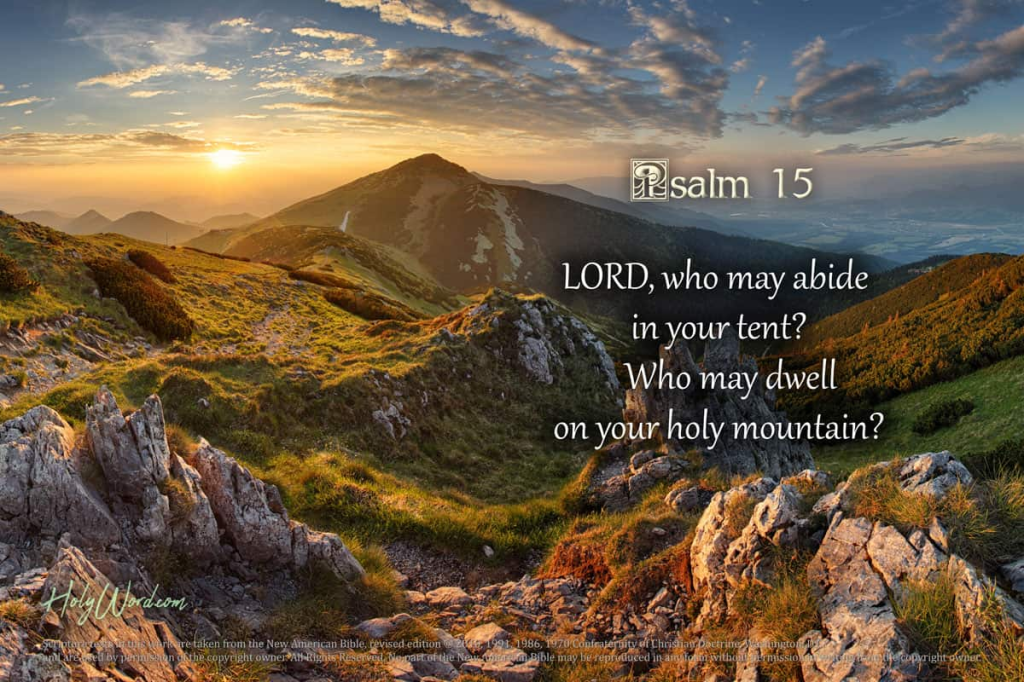
Obey with Integrity and Love (Psalm 15)

God, who gets invited
    to dinner at your place?
How do we get on your guest list?

 “Walk straight,
    act right,
        tell the truth.

“Don’t hurt your friend,
    don’t blame your neighbor;
        despise the despicable.

“Keep your word even when it costs you,
    make an honest living,
        never take a bribe.

“You’ll never get
blacklisted
if you live like this.” (The Message)

Nearly all of us had to work hard to get good grades in school. Each schoolyear began with a blank slate; then, what we did with learning the lessons determined the grade.

So, it’s unthinkable for many of us to consider that we all begin God’s school with A’s. We’re all 4.0 students. There’s only a lower grade if we neglect to do the things necessary as an A student. And, as it turns out, the most important things are a matter of basic human kindness and respect for others.

At the end-of-the-year banquet, awards are given. If we’ve done what’s expected, then the invitation to come to the front and receive the award is assured.

Yet, if anyone has gone out of their way to be deliberately stupid and ignore what’s right, then they aren’t going to show up at the banquet. They’ll dismiss it as a waste of their time and blabber about how they don’t be around a bunch do-gooder pricks and Abe Lincoln’s, blah-blah-blah.

Integrity, honesty, kindness, accountability, and commitment matter. Virtue shows itself through the practice of obedience.

We might get hung up on obedience for a few reasons:

  1. Many Westerners, especially Americans, have a strong anti-authoritarian strain; obedience smacks them as something negative. For some, they would rather stick-it-to-the-man than obey. Even Christians might sacralize their disobedience by linking obedience to law – as if gospel and obedience are antithetical.
  2. A lot of people have been personally hurt because they tried to do the right thing by obeying their authorities, but it ended badly. Now, they aren’t so sure about the whole obedience thing.
  3. We just plain don’t want anyone else telling us what to do and not do; and that includes not wanting to obey God. So, we focus on the freedom to do what we want, to the exclusion of obedience.

Yet, there’s no way to get around the pervasive reality of obedience to Torah, to Yahweh. Obedience is both the glue which holds a people together, as well as the major means of expressing love to God and others.

Jesus said, “If you love me, obey my commandments.” (John 14:15, NLT)

Love and obedience go together in Holy Scripture like a hand in a glove. Jesus insisted that upholding Torah and loving others is by obedience to divine commands.

When Jesus first began his teaching and healing ministry, he sat all the people down who were following him and gave them a summary of the Old Testament understanding of God’s righteousness. These are the things, Jesus explained, that characterize a person who loves God:

Blessed are the poor in spirit, for theirs is the kingdom of God. 

Blessed are those who mourn, for they shall be comforted. 

Blessed are the meek, for they will inherit the earth. 

Blessed are those who hunger and thirst for righteousness, for they will be filled. 

Blessed are the merciful, for they will be shown mercy. 

Blessed are the pure in heart, for they will see God.  Blessed are the peacemakers, for they will be called sons of God. 

Blessed are they who are persecuted for righteousness, for theirs is the kingdom of God (Matthew 5:12-17, NIV).

Obedient believers are characterized by their:

  • Authentic humility
  • Deep concern over sin, to the point of tears
  • Gentle and meek spirit toward others
  • Intense desire for personal righteousness and corporate justice
  • Daily life of mercy, purity, and peacemaking
  • Willingness to accept adversity as part of the spiritual life

“Love the Lord your God with all your heart and with all your soul and with all your mind. This is the first and greatest commandment. And the second is like it: Love your neighbor as yourself.”

Jesus (Matthew 22:36-40, NIV)

Humanity is meant for wholeness, integration, and alignment of head, heart, and gut – with the glue of obedient love. We are designed to have all of life in parity and balance – work, play, family, and faith – because God is Lord of it all, not just the spiritual parts.

Historic confessional Christianity acknowledges that obedience is both duty and delight – and they go together in perfect harmony.

Believers consider it a both a high charge and a wonderful privilege to love the Lord with a life devoted to obeying divine commands.

It’s just that sometimes we have our lives so planned and pre-determined that when God’s Spirit shows up to take us to a place of obedience, we struggle to realize what’s happening. And we miss what the Lord is doing in this world. 

At other times, we read scriptural commands and feel the gentle nudging of God’s Spirit, yet we either cannot or will not respond out of fear, busyness, or grief. 

Then there are times in which we are attentive to God’s Word and Spirit, seeking to obey – only to mess up and fail at it. It can leave us wondering if God could ever really do anything in or through us.

The truth is this: Love conquers all. Grace overcomes everything. Mercy never fails.

We are here on this earth because of how much the Lord is devoted to us. Even though we often walk the spiritual road in a three-steps-forward-two-steps-backward kind of way, God accommodates to our weakness. 

So, we keep learning the ways of the Lord under the tutelage of God’s Spirit – who patiently and powerfully works within us so that God’s kingdom breaks into this world and God’s will is done on earth as it is in heaven.

Blessed God, I seek not my own will but to fulfill your will in my everyday life. Enable me and strengthen me for this sacred duty and delight, in the power of your Spirit. Amen.

Believe, Love, and Obey (1 John 5:1-12)

Everyone who believes that Jesus is the Christ is born of God, and everyone who loves the father loves his child as well. This is how we know that we love the children of God: by loving God and carrying out his commands. In fact, this is love for God: to keep his commands. And his commands are not burdensome, for everyone born of God overcomes the world. This is the victory that has overcome the world, even our faith. Who is it that overcomes the world? Only the one who believes that Jesus is the Son of God.

This is the one who came by water and blood—Jesus Christ. He did not come by water only, but by water and blood. And it is the Spirit who testifies because the Spirit is the truth. For there are three that testify: the Spirit, the water and the blood; and the three agree. We accept human testimony, but God’s testimony is greater because it is the testimony of God, which he has given about his Son. 

Whoever believes in the Son of God accepts this testimony. Whoever does not believe God has made him out to be a liar, because they have not believed the testimony God has given about his Son. And this is the testimony: God has given us eternal life, and this life is in his Son. Whoever has the Son has life; whoever does not have the Son of God does not have life. (New International Version)

Faith, love, and obedience are words so tightly woven together, that to pull one of them out, is to unravel the whole bunch. 

To believe, love, and obey are the true marks of a Christian; and they are vital to living the Christian life and overcoming the dark forces of the world.

Let’s talk some grammar – because it will help us better understand the Apostle John’s message….

The main verb is the main thing

One of the dominant main verbs throughout these verses: “is.” And the verb tense is key, grammatically describing a past action of God which people need to receive. In other words, the grammar dictates that God has given us new birth. 

We do not give ourselves spiritual birth any more than we can tell our mothers that it was us who gave birth to ourselves.

The participles describe the main thing

God saves us from sin and grants us forgiveness. The action is from God to us; we are recipients of God’s good grace toward us.

There are three participles connected to the main verb, “is:”

  1. Believe
  2. Love
  3. Obey

A participle is a word which is connected to the verb’s action. 

Our actions are a result of God’s action toward us.

Simply put, a person born from God will believe, love, and obey.

Just as a newborn baby first breathes, then learns to eat, sleeps, grows-up, learns to walk, and over time develops into an adult just like their mother and father, so the Christian who is born again from God exhibits faith, learns to love, and grows up developing the skills of obeying Jesus and following him, learning to walk in his ways, becoming just like him.

Overcoming the world

In the same way a child must grow and mature to have the necessary skills for facing the world in all its trials and temptations, so the Christian must develop the requisite abilities of faith, love, and obedience, to overcome the world.

To “overcome” is to experience the victory the Lord Jesus has achieved on the cross. 

Through being spiritually born again by God, it sets us on a course requiring faith, love, and obedience in overcoming the world. As we learn to apply these three spiritual characteristics to our lives, we experience practical victory over the world.

The term “world” is used by the Apostle John as the patterns, systems, and operations of the world, which are in direct contrast to how God operates. For example:

  • The world engages in revenge and payback when wronged, whereas the Christian learns to believe God will be the Judge, loves the person who has offended them through prayer for their enemy, and obeys God through good works that seeks the welfare of the other. 
  • The world uses other people as either objects of their pleasure or to get ahead in life, whereas the Christian believes God will take care of their needs, will seek to love the other person instead of use them, and would rather obey God by cutting off their right hand off than being selfish. 
  • The world thinks nothing of lying, cheating, and stealing, if they can get away with it, whereas the Christian believes Jesus is the way, the truth, and the life, loves being a person of integrity, and obeys God even when it hurts.

This in no way suggests we avoid or belittle the world. In overcoming the world, we must have principled civility. Using faith, love, and obedience, we respect another’s viewpoint through allowing our spirits to grow in faith, expanding our hearts in love, and learning obedience through interaction with others for whom we disagree.

Faith, love, and obedience

We need faith in God:

Trust in the Lord with all your heart,
    and do not rely on your own insight.
In all your ways acknowledge him,
    and he will make straight your paths. (Proverbs 3:5-6, NRSV)

We need love for God and others:

Don’t love the world’s ways. Don’t love the world’s goods. Love of the world squeezes out love for the Father. Practically everything that goes on in the world—wanting your own way, wanting everything for yourself, wanting to appear important—has nothing to do with the Father. It just isolates you from him. The world and all its wanting, wanting, wanting is on the way out—but whoever does what God wants is set for eternity. (1 John 2:15-17, MSG)

We need obedience to the call of God:

The commandment that God has given us is: “Love God and love each other!” (1 John 4:21, CEV)

When faith, love, and obedience are working together, as intended, we overcome the world and all its crud; and keep ourselves from being polluted and stained by it.

Overcoming the world is a high calling from God. 

Faith means putting aside fear and taking the kind of risk God wants you to take.

Love means putting aside hate and serving others, even when it hurts.

Obedience means putting aside selfishness and choosing to do what is best for another person’s welfare.

Being characterized by these three Christian virtues will have the effect of overcoming the world. It is not a burdensome or heavy way to live. It’s the way of Jesus.

Blessed God – Father, Son, and Spirit – the Lord whom we serve: Sometimes our hearts and minds are flooded with fears. Sometimes we are paralyzed and overwhelmed and feel unable to go on. Yet, we hold onto the victory you have accomplished through the cross of Jesus Christ. You have told us not to fear, for you have overcome the world. In moments of crippling fear, we choose to hold your hand and believe; to love as we have been loved; and, to obey even in the most fearful places because we know that you have risen again.

Holy Spirit, we invite you and all your ministry within us. Holy God of all, we offer you our heart, mind, body, soul, spirit, hopes, plans and dreams. We surrender to you our past, present and future problems, habits, character defects, attitudes, livelihood, resources, finances, medical coverage, occupation and all relationships. We give you our health, physical appearance, disabilities, disorders, family, marriage, children, grandchildren, and friendships.

Loving Lord Jesus, we surrender to you all our hurt, pain, worry, doubt, fear and anxiety, and ask you to wash us clean. We release everything into your compassionate care. Open our ears to hear your voice. Open our hearts to commune with you more deeply. Open the doors that need to be opened and close the doors that need to be closed. Set our feet upon the straight and narrow road that leads to everlasting life. Amen.