I Am Among You As One Who Serves (Luke 22:24-30)

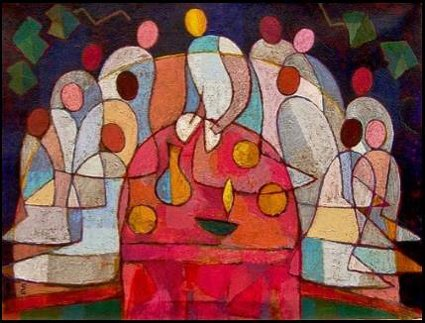
The Last Supper, by Mamdouh Kashlan (1929-2022)

A dispute also arose among them as to which one of them was to be regarded as the greatest. But he said to them, “The kings of the Gentiles lord it over them; and those in authority over them are called benefactors. But not so with you; rather the greatest among you must become like the youngest, and the leader like one who serves. For who is greater, the one who is at the table or the one who serves? Is it not the one at the table? But I am among you as one who serves.

“You are those who have stood by me in my trials; and I confer on you, just as my Father has conferred on me, a kingdom, so that you may eat and drink at my table in my kingdom, and you will sit on thrones judging the twelve tribes of Israel. (New Revised Standard Version)

Jesus and his disciples had prepared for the Passover meal. They ate and drank together. Christ gave them words which have endured throughout Christian history as the Lord’s Supper. He spoke of the bread as his body, and the cup as the new covenant in his blood. Jesus communed with them and communicated about his impending death.

It was a moving experience for all. The disciples received from their Lord an intense act of love; and a new humanity around Christ’s body and blood. Indeed, the essence of new life is self-sacrificial love.

And then… the disciples began quarreling with each other about positions, and titles, and honors, and who was better, and who would be top dog in God’s kingdom….

It was a moment that I think every parent can relate to, at some level. Sitting around a dinner table, enjoying a rich conversation, becoming close with one another as a family… and then the kids begin bickering with each other about the most mundane of things.

Just a minute ago, you believed you were getting somewhere, and experiencing a shared family bond of love, commitment, and purpose… and then, in a matter of seconds, it all crashes down in a ridiculous display of posturing and positioning of one sibling over another….

I admit, this has happened to me more than once, when my own kids were growing up. And I also admit that I lost my sanctification on more than one occasion, watching this crazy schizophrenic scene play out in front of me.

Which is why I have a lot of respect for Jesus in responding to his disciples with humility, calmness, and a forthright spirit. He addressed their puny questions in a way that rebuked them without making them feel like they just got a Dad lecture.

In the sort of table fellowship that Jesus practiced with his disciples throughout his earthly ministry, he consistently sought to undermine the existing systems of domination in all levels of society. Even the religious system of Christ’s day had a distinct stratifying of persons in an inequitable structure of power.

The kingdom of God, however, is different. God’s economy is characterized by equality, mutuality, diversity, and shared power. It’s all based in a communal, as well as individual, relational connection with the Creator God.

God almighty, Creator of heaven and earth, is gracious, merciful, and kind. The Lord brings rain on both the righteous and the wicked. Thus, any sort of claim to being greater or superior or better than another person or group of people, has no place around the table of Christ’s body and blood.

Catholics are no better than Protestants. Evangelical Christians have no superiority over Progressive Christians. The Coptic Church doesn’t have the high ground on Eastern Orthodoxy. Christians who observe the Lord’s Supper as a remembrance are not greater than those who discern the Table as a sacrament.

And if one has the ears to hear it, Christians really ought to know better than to believe they should have greater control over the world and its systems than Buddhists, Muslims, or Jews.

Puffing up one’s chest and insisting that “My Dad is better than your Dad” is the stuff of childish preoccupations, and not of God’s kingdom.
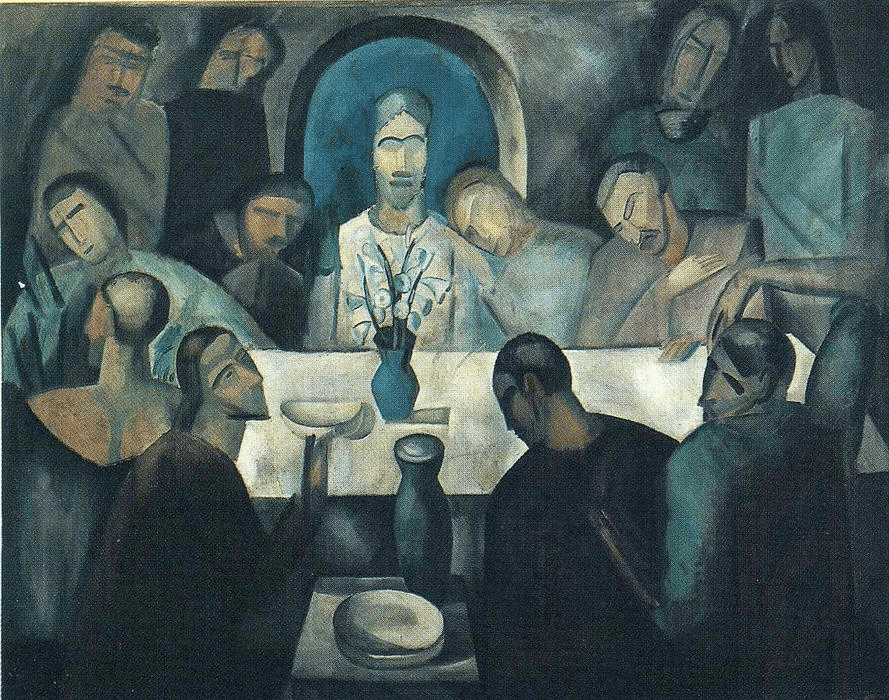
The Last Supper of Jesus, by André Derain (1880-1954)

There are plenty of people in this old messed-up world who lord their power and authority over others. If we take the words of Jesus seriously, Christians are not to be part of that structure and system.

And yet, here we are, in this contemporary time and place in history, having a chunk of the population thinking Christendom is the way to go, that a form of Christian Nationalism should be the political system – as if the kingdom of God and the kingdom of this world are what’s on the ballot.

Christians are the very folks who need to insist on serving, not leading; building up, not tearing down; loving, not hating; being integrated and connected, not fragmented and disconnected from others, as well as from reality.

Any sort of earthly power and authority the Christian has, must be used to include, help, and support, instead of excluding, ignoring, and destroying. The greatest among us must become like the youngest, and the leader like one who serves.

Christians must support and promote the idea of political office as a public service; and the concept of being a citizen as serving the common good of all persons, not just some persons.

Jesus came to this earth to serve. Therefore, his followers are also to serve. The words and ways of Christ centered in humble service, merciful justice, and prayer for one’s enemies. His followers must do no less.

Jesus Christ came to usher in a moral and ethical kingdom in which God’s gracious and benevolent will is done on this earth, as it is always done in heaven. He did not come to make sure Christians have lots of political power and authority over all the non-Christians.

Yes, indeed, we will be given power and authority – but not to baptize existing earthly structures so that the system serves the interests of Christians. We receive so that we can give. We give so that we might serve. And we serve because our Lord is a servant.

So, if Christians truly desire to bring change and transformation to this world, it will be through a compassionate and caring system of service to our fellow humanity – and not by imposing our beliefs and will upon others in a modern day form of the Inquisition.

Let us then, traffic in love; aspire to meekness; practice servanthood; and become the wait staff for the world’s needs.

That is what it really means to stand with Jesus in this time of trial.

Gracious and loving God, you work everywhere reconciling, loving, and healing your creatures and your creation. In your Son, and through the power of your Holy Spirit, you invite each of us to join you in your work.

I ask you to form me more and more in your image and likeness, through my prayers and worship of you; and through the study of Holy Scripture, so that my eyes will be fully opened to your mission in the world.

Send me into my family, church, community, workplace, and world to serve Christ with faith, hope, and love, through the power of the Holy Spirit. Amen.

The Lord of Life (John 6:56-69)

Bread of Life, by Kennedy Paizs

“Those who eat my flesh and drink my blood abide in me and I in them. Just as the living Father sent me and I live because of the Father, so whoever eats me will live because of me. This is the bread that came down from heaven, not like that which the ancestors ate, and they died. But the one who eats this bread will live forever.” Jesus said these things while he was teaching in a synagogue at Capernaum.

When many of his disciples heard it, they said, “This teaching is difficult; who can accept it?” But Jesus, being aware that his disciples were complaining about it, said to them, “Does this offend you? Then what if you were to see the Son of Man ascending to where he was before? It is the spirit that gives life; the flesh is useless. The words that I have spoken to you are spirit and life. But among you there are some who do not believe.”

For Jesus knew from the beginning who were the ones who did not believe and who was the one who would betray him. And he said, “For this reason I have told you that no one can come to me unless it is granted by the Father.”

Because of this many of his disciples turned back and no longer went about with him. So Jesus asked the twelve, “Do you also wish to go away?” Simon Peter answered him, “Lord, to whom can we go? You have the words of eternal life. We have come to believe and know that you are the Holy One of God.” (New Revised Standard Version)

This is a hard teaching – which is why a fair number of Christ’s disciples unfollowed him, literally, and not just socially and virtually.

Perhaps they believed they were following a great moral teacher, only to find Jesus prattling-on about being bread from heaven and divinely related to God.

The late great C.S. Lewis commented on Jesus, saying this:

“I am trying here to prevent anyone saying the really foolish thing that people often say about Him: I’m ready to accept Jesus as a great moral teacher, but I don’t accept his claim to be God. That is the one thing we must not say. A man who was merely a man and said the sort of things Jesus said would not be a great moral teacher. He would either be a lunatic — on the level with the man who says he is a poached egg — or else he would be the Devil of Hell. You must make your choice. Either this man was, and is, the Son of God, or else a madman or something worse. You can shut him up for a fool, you can spit at him and kill him as a demon or you can fall at his feet and call him Lord and God, but let us not come with any patronizing nonsense about his being a great human teacher. He has not left that open to us. He did not intend to.” C.S. Lewis, Mere Christianity

It seems Jesus cares little about whether we think of him as a moral teacher or some monstrosity. But he does care about moving people to a spirit-filled confession, a settled claim of faith, and a bold proclamation of his person and work.

Indeed, Jesus Christ, Son of Humanity, Son of God, leads us to hear his own confession, claim, and proclamation: “I Am.”

The crowd of people listening to Jesus were having a hard time wrapping their heads around his message. There were simply no existing categories of thought to which they could put Jesus neatly into. Everyone was rather puzzled with Christ’s words.

Jesus was in the Capernaum synagogue, a village on the Sea of Galilee, 30 miles from where he grew up in Nazareth. Any talk of eating and drinking and religion within any faith community is likely to be a charged discussion. Typically the politics of faith is not for the faint of heart.

We are to abide in Christ, to be in vital union with him. To have Jesus close, to have his words and ways within us, is akin to eating a satisfying meal that goes throughout our entire body and effects our being. Connecting and remaining with Jesus is true living and abundant life.

But the synagogue crowd wasn’t having any of this crazy talk of eating flesh and drinking blood. The lines between meat and metaphor were severely blurred for them. They did not accept the wedding of the spiritual and the material, of word and flesh, of God and Jesus together as Father and Son.

Jesus was causing the men to fold their arms in disgust, and the ladies to squirm in their pews with agitation. They looked upon this Jesus in front of them as causing a religious scandal of the first degree.

Rather than back off the scandalous words, Jesus stuck with them. Furthermore, he intensified what he was saying. At the heart of it was a claim to be the ladder between heaven and earth, the one who is manna from above, given for the life of the people.

His flesh is bread, and his blood is drink. He is life itself. He is even spirit, the one who breathes new life into people. At this point, Jesus was being as scandalous as it gets for his audience in the synagogue.

All of Christ’s talk is meant to bring people to consider him, to contemplate God, and to come to a point of response. Because nobody encountered Jesus without deciding if he is a liar, a lunatic, or the Lord who is life itself.

Many of Christ’s own disciples bailed on him. The scandal was too much. They didn’t sign up for this. To stay with Jesus means to really stay, to abide, to believe and know who he is.

Throughout the New Testament Gospels, Jesus honors people with questions and choices – and does not simply bypass human dignity and worth. He asked his closest twelve disciples if they also wanted to retreat from the scandalous message and messenger they’d been following.

Peter, of course, still had to learn this lesson of respect; he answered for the entire group. Jesus is where, and in whom, he found life, along with the rest of them. They didn’t know how all of the scandalous talk was going to shake-out specifically, although I think each of them had a pretty good idea.

But it didn’t matter. The twelve disciples were stuck on Jesus. Or, to be more accurate, the eleven disciples. Perhaps it was at this point that Judas Iscariot no longer had to wonder what was going to happen, and what exactly Jesus was up to.

Abiding in a movement that did not include a Roman takeover and a glorious wealthy kingdom was something Judas was unwilling to invest in. Maybe it was here that he began considering his exit plan.

Recognizing Jesus as Son of Humanity, Son of God, and the Word made flesh for us, requires both belief and knowledge – because you must have the one to have the other. C.S. Lewis discovered this. So did I. And may you, as well, my friend. For Jesus is the Lord of life.

Gracious God, although we once were strangers, you receive us as friends and draw us home to you. Set your living bread before us so that, feasting around your table, we may be strengthened to continue the work to which your Son commissioned us. Amen.

Living Bread from Heaven (John 6:51-58)

Art by Nigel Wynter (1957-2024)

I am the living bread that came down from heaven. Whoever eats of this bread will live forever, and the bread that I will give for the life of the world is my flesh.”

The Jews then disputed among themselves, saying, “How can this man give us his flesh to eat?” 

So Jesus said to them, “Very truly, I tell you, unless you eat the flesh of the Son of Man and drink his blood, you have no life in you. Those who eat my flesh and drink my blood have eternal life, and I will raise them up on the last day, for my flesh is true food, and my blood is true drink. Those who eat my flesh and drink my blood abide in me and I in them. Just as the living Father sent me and I live because of the Father, so whoever eats me will live because of me. This is the bread that came down from heaven, not like that which the ancestors ate, and they died. But the one who eats this bread will live forever.” (New Revised Standard Version)

To the religious leaders of Christ’s day, Jesus was making more noise than a couple of skeletons dancing on a tin roof. And they neither liked it, nor appreciated him drawing so much attention to himself.

Tensions had been escalating between Jesus and the religious establishment. The atmosphere was thick with grumbling leaders, as they tried to make some sense of Christ’s words to them.

Jesus offering his body for people to eat was causing far too much noise for the Jewish leaders. What in the world is this guy talking about?

Rather than making the meaning clear for them, Jesus added drinking his blood to the discussion. What’s more, Christ got up in their grill and confronted them with a choice, instead of a straightforward explanation.

Using some good old double negative language, Jesus flatly stated that there’s no life without any eating of his flesh and drinking of his blood. Then conversely, stated positively, Jesus affirmed that eternal life is found in those who eat his flesh and drink his blood.

This was next level communication of Jesus to the religious leaders. Earlier, Christ let them know that they needed to make the choice of coming to himself, of engaging in a life-giving relationship with him.

Yet now, it’s a matter of outright participation in Jesus, of eating and drinking the body and blood of Christ. Both the choice of relationship and of participation are radical decisions, which requires ditching some old traditions, and beginning some new ones.

Christ’s words are difficult, because they demand a change in thinking and behavior. Indeed, his words demand a change in our very way of being.

Christian discipleship requires that we stop the false ways of being in this world, and start a different way of being, according to the true self. In other words, Jesus was insisting on repentance and faith.

We are all on the hook to not just talk some theology and take some communion elements. It’s a lot more involved than that. Jesus demands our very lives, and not simply to sign off on some doctrinal statement about him. It’s about life itself, the power of life and death.

By eating and drinking Christ, there is meaningful relational connection, and ongoing participation in his life and ministry.

None of this is about literal cannibalism, and not even about actual bread and wine. This is deep metaphorical stuff which is meant to convey to us who Jesus is and how we can be related to him.

When we ingest food and drink, it goes into us and throughout our entire body. You cannot get much closer to something than by eating it and having it inside you. Just as eating bread goes to our very core and helps sustain life, so ingestingJesus is about allowing him to be as close to us as possible, into the very depths of our soul.

And by taking Christ into us, we will truly live and connect; and not be separated and die.

Art by Soiche Watanabe

We can no more spiritually live without taking Jesus into us, as we could live without eating on a regular basis. Christ is our breakfast, lunch, and dinner; our midnight snack and our birthday cake. Jesus is all that, and more.

Perhaps you are wondering why Jesus didn’t just state plainly who he is, why he came, and what will happen. Because it’s too much to handle.

We don’t simply accept Jesus into our heart, and then go on our merry way. Jesus Christ is someone to search for and discover, as if we were looking for fresh water or for the best baguette in the world.

Anyone can affirm a few belief statements, or do some good deeds. But it takes real courage to go hard after the spiritual life and find out what it’s all about:

It requires some solid bravery to explore the depths of your own true self and face the internal crud that’s been hiding in the shadows of your soul.

It demands identifying the bogus ways we prop up a false self for others to see – wanting to control how people view us and treat us.

It takes some real chutzpah to pursue the God life without worrying about where it will take you or who it will upset.

Jesus is a force to contend with. He is the Son of God, sent from above, to provide the world with real spiritual food and drink. Christ is the one who sustains life, and makes abundance possible. He is the Lord who speaks, calls out, and draws us to himself.

Jesus Christ helps us fit, even though we come from the island of misfit toys.

Even more pertinent than the question of “Who is Jesus?” is the probing question, “And what will you do with him?”

Christ cannot fit into your neat theological system, your tidy doctrinal statements, and on your nicely cleaned coffee table within the attractive Bible. Sooner or later, we all must contend with the divine force which gives life to everything. We cannot get away from him.

So, go after Jesus. Find out who he is. Determine how to deal with a mercy so powerful that it melts away guilt and shame as if it were in a 500 degree oven. After all, it’s better to have a tasty loaf of bread than to become a hard slice of burnt toast.

But let’s not worry about how hot it is in here, but how noisy it’s getting.

Gracious Lord, move us, your people, to experience your love more deeply. Fill us with the energy that comes from a desire for service. Connect us with creation to care for your world. Engage us in the scriptures and increase our knowledge of you. Raise up your power and come among us. May your bountiful grace and mercy equip us. Amen.

All Saints Day (Psalm 34:1-10, 22)

I will praise the Lord at all times;
my mouth will continually praise him.
I will boast in the Lord;
let the oppressed hear and rejoice.
Magnify the Lord with me.
Let us praise his name together.
I sought the Lord’s help and he answered me;
he delivered me from all my fears.
Look to him and be radiant;
do not let your faces be ashamed.
This oppressed man cried out and the Lord heard;
he saved him from all his troubles.
The angel of the Lord camps around
the Lord’s loyal followers and delivers them.
Taste and see that the Lord is good.
How blessed is the one who takes shelter in him.
Fear the Lord, you chosen people of his,
for those who fear him lack nothing.
Even young lions sometimes lack food and are hungry,
but those who seek the Lord lack no good thing…

The Lord rescues his servants;
all who take shelter in him escape punishment. (New English Translation)

In all times and every place throughout history God has specialized in taking imperfect and broken people and transforming their lives. On the Christian Calendar, November 1 is the day each year to remember the saints who have gone before us. This day is meant to be an intentional way of not forgetting the people, friends, and family – as well as long-dead historical saints – who made a significant impact in our spiritual lives.

All Saints Day is more than a focus on extraordinary persons; it highlights the work of ordinary Christians who faithfully lived their lives. We give thanks for the gift of how they lived their faith every day. We also remember that all believers in Jesus are united and connected through the cross.

Remembering is a prominent theme in Holy Scripture. Over one-hundred times we are told to remember God’s covenant and actions on behalf of people; to remember the needy and those less fortunate; and to remember the important people who influenced us in our journey of faith.

Remember your leaders, who spoke the word of God to you.  Consider the outcome of their way of life and imitate their faith. (Hebrews 13:7, NIV)

We are to be inspired now in the present with the actions of faithful saints of the past. They serve as a model of faithfulness, so that we will persevere in our Christian lives and not give up. Through biblical stories of very human persons being used of God, as well as reading biographies of godly people, we can gain motivation for patience and perseverance until Jesus returns.

Who were the people in your life that went out of their way to communicate God’s love to you with both words and actions? Who were those persons who labored behind the scenes in prayer so that you and others would know Jesus? 

If any of those persons are still around, and you know where they are, remember them. Drop them a note. Express to them a simple thank you for their influence in your life. You will not only encourage that person – it will help you remember and re-engage with something in your life you may have forgotten or have just taken for granted for too long.

We are not to live our Christian lives in isolation from others, as if we do not need them. You and I are here today because someone influenced us in the way of Jesus. And we will continue to persevere and thrive in the faith when we remember those who have gone before us and allow those here in the present to journey with us along this road of faith.

Today is all about remembrance. We remember answered prayer and salvation. We recollect the people who gave us the life-giving gospel message in both word and deed. We remember the death of Christ and recall that he said he is coming back.

The psalmist recalled his rescue and pulled it forward into the present so that all God’s worshipers could taste and see that the Lord is good. This is exactly what the Apostle Peter did for a church which needed to recall and remember the mighty acts of God:

Like newborn babies, crave pure spiritual milk, so that by it you may grow up in your salvation, now that you have tasted that the Lord is good. As you come to him, the living Stone—rejected by humans but chosen by God and precious to him—you also, like living stones, are being built into a spiritual house to be a holy priesthood, offering spiritual sacrifices acceptable to God through Jesus Christ. (1 Peter 2:2-5, NIV)

Our memories are accessed through symbols and with taste and sight. God uses symbols to reveal himself to us.  For example, when God wanted to show us the ugliness of sin and the cost of forgiveness, the Lord told the Israelites to kill an animal and sprinkle its blood on their clothing and on the altar.

That sounds awful. Yet, worshipers never walked away from the experience scratching their heads and wondering what it was all about. That’s because they encountered and tasted the drama of sin and redemption. Their senses saw it, felt it, smelled it, and tasted the meat from it. 

Symbols have power. We cannot know God with only our minds; we’re more than brains on a stick. People need ordinary events, like shared meals, that include symbols and rituals. 

Every year faithful Jews gather to remember and re-enact the Passover – the story of how they were enslaved in Egypt, oppressed by Pharaoh, and set free by God.  To this day pious Jews still remember the Passover by eating and drinking together and telling stories.

We need both words and sacraments. Therefore, holidays like Thanksgiving and Christmas involve both verbal expressions of gratitude and love, and particular actions of love in giving gifts and sharing food. Together, it all connects us to God, to one another, and to a history of God’s people. 

Jesus met his disciples in the Upper Room to celebrate Passover together. Jesus energized their time together by filling it with words and symbols of love and redemption. Christ told the disciples about his upcoming death and acted symbolically. “Take and eat – this is my body….  Take this cup – drink from it, all of you.” (Luke 22:7-20)

Rather than sitting around, analyzing the bread, and discussing the wine’s vintage, the disciples ate and drank.  They tasted real food and drink. They also tasted real spiritual food. It’s one thing to speak of God’s presence, and it’s another thing to experience that presence through an ordinary shared ritual of bread and cup.

God is good. Jesus is our Emmanuel, God with us. Christ is present with us through our ritual of fellowship and food. When the sixteenth-century Reformer John Calvin was asked how Jesus is present to us at the Lord’s Supper he explained: “Now if anyone asks me how this takes place I shall not be ashamed to confess that it is a secret too lofty for either the mind to comprehend or my words to declare….  I rather experience it than understand it.”

The taste of bread reminds us of the incarnation of Christ, and Christ’s humiliation and death. The taste of drinking the cup reminds us of the sacrifice of Christ, the drops of blood which Jesus sweated in Gethsemane, and the beatings, floggings, nails, and crown of thorns that caused the bleeding.

Tasting the bread and cup when we celebrate communion reminds us that our sins are forgiven, we are united to Christ, and we are united together. 

There are historical events which are just that. Then, there are past actions which linger with continual results into the present. The incarnation, life, death, resurrection, ascension, and glorification of the Lord Jesus are past redemptive events which continue to exert powerful force into the here and now.

Saints throughout church history have moved the message of Christ along and demonstrated for us that the past lives in the person of Jesus Christ.

Along with them, we proclaim that Christ has died, Christ has risen, Christ is coming again. And God has something planned for those who have gone before us, along with us, so that together we will experience the perfect righteousness of Christ forever. (Hebrews 11:39-40)

We are encouraged through word and sacrament to proclaim the good news of Jesus Christ until he comes again. Let us respond to God’s wooing invitation to eat and drink, to taste and see that the Lord is good through faith, hope, and love. Let us find in God our refuge and strength, our ever-present help.

Soli Deo Gloria