Revelation 3:14-22 – Here I Am!

To the angel of the church in Laodicea write:

“These are the words of the Amen, the faithful and true witness, the ruler of God’s creation. I know your deeds, that you are neither cold nor hot. I wish you were either one or the other! So, because you are lukewarm—neither hot nor cold—I am about to spit you out of my mouth. You say, ‘I am rich; I have acquired wealth and do not need a thing.’ But you do not realize that you are wretched, pitiful, poor, blind and naked. I counsel you to buy from me gold refined in the fire, so you can become rich; and white clothes to wear, so you can cover your shameful nakedness; and salve to put on your eyes, so you can see.

Those whom I love I rebuke and discipline. So be earnest and repent. Here I am! I stand at the door and knock. If anyone hears my voice and opens the door, I will come in and eat with that person, and they with me.

To the one who is victorious, I will give the right to sit with me on my throne, just as I was victorious and sat down with my Father on his throne. Whoever has ears, let them hear what the Spirit says to the churches.” (New International Version)

Christianity holds that the Lord Jesus is the rightful sovereign of the universe. Christ uses that power and authority to rule with justice and equity. He delivers people from guilt, shame, disobedience, and the realm of darkness. All of life hinges on God’s ability, not ours.

Yet, having said that, this does not mean we lack responsibility before God, as if whatever is going to happen is going to happen, and I’m just a passive spectator.

Today’s New Testament lesson is Christ’s words to the ancient church in the city of Laodicea. It seems the church folk in that city were less than zealous about their faith. Maybe they thought God was going to do whatever God was going to do and felt no compunction to act. Perhaps the Laodiceans believed that if they were “hot” that they’d have to go to Africa, be around snakes, and wear polyester all day.

So, likely out of some fear they might lose their wealth or livelihood, the church took a “Meh, whatever” kind of response to the Christian life. It appears the Laodiceans thought God wasn’t even noticing, resulting in a middle of the road approach of just getting by.

Well, of course, the Laodicean believers got noticed – enough to warrant a letter to them from Jesus. I’d say someone was watching! 

Whereas we might get frustrated with milquetoast responses and try to light a fire under the passive person’s behind, the response of Jesus to the Laodiceans was to calmly stand at the door and knock, waiting to be invited in. 

Jesus didn’t go full emergency response on them and break down their church door, forcefully going inside to assert his will. Rather than imposing himself on the Laodiceans, the Lord of all simply and persistently knocked, patiently waiting for a response. 

As it turns out, the ones not paying attention are us, not Jesus. Christ longs for meaningful fellowship and interaction with us. Jesus wants us to respond to divine overtures to meet with him. The Lord is at your doorstep exclaiming, “Here I am!”

Will you let him in today? Or are you afraid that he will take something away from you?

God is trying to get our attention. The Lord does it through all kinds of ways – adverse circumstances, other people (even and especially the ornery ones) – knocking on our door. Yes, God is the one knocking on our door – and not the other way around. 

This is anything but an aloof God who is unconcerned for what is going on in our lives. In fact, just the opposite is true. We seem a bit unconcerned, even “lukewarm” about God, not noticing the good purposes being worked out all around us.

Jesus stands at the door. We don’t get many post-resurrection accounts of Jesus standing. That’s because sitting is a sign and symbol that the work is finished. And, indeed, the work of the cross is done. We are the ones sitting in the recliner. We are the people who need to be standing because our work is not yet done.

So, amazingly, Jesus gets up from his throne, comes to us, standing at the door knocking, graciously meeting us when we aren’t moving.

The watershed issue of our day, from a Christian perspective, is our response, or lack thereof, to Christ’s overtures to let him in our house.

Maybe we can’t hear him because we are busy vacuuming. Perhaps we don’t hear because of the headphones we have on. It could be that we are just too deaf and dull to notice the racket going on at our front porch while we watch TV. Whatever it is, the only cure for being lukewarm is inviting Jesus into the house. 

If Jesus is on the outside, he wants to be on the inside. He could break your door down if he wanted to, but he chooses to respond to the invitation for hospitality. Jesus wants to meet with us.

For the times we neglect to care for our brothers and sisters in Christ, please forgive us, Lord. 

For the times we fail to welcome new people who look or act different from ourselves, please forgive us, Lord. 

For the times we neglect to notice and pay attention to the Spirit, please forgive us, Lord.

And for the times we pretend not to be home when you are knocking, please forgive us, Jesus.

Lord, have mercy. Christ, have mercy, Lord, have mercy upon us, and grant us your peace. Amen.

Revelation 1:4-8 – The One Who Is, Who Was, and Who Is To Come

John,

To the seven churches in the province of Asia:

Grace and peace to you from him who is, and who was, and who is to come, and from the seven spirits before his throne, and from Jesus Christ, who is the faithful witness, the firstborn from the dead, and the ruler of the kings of the earth.

To him who loves us and has freed us from our sins by his blood and has made us to be a kingdom and priests to serve his God and Father—to him be glory and power for ever and ever! Amen.

“Look, he is coming with the clouds,”
    and “every eye will see him,
even those who pierced him”;
    and all peoples on earth “will mourn because of him.”
So shall it be! Amen.

“I am the Alpha and the Omega,” says the Lord God, “who is, and who was, and who is to come, the Almighty.” (New International Version)

In my undergraduate college days, one of the required classes for my major was “Philosophy of History” taught by a crusty old professor who looked like he was one-hundred-and-ten-years-old. One day he came into the classroom and began his lecture by looking directly at me with those beady black eyes of his and said, as only he could say it, “Ehrhardt! Can God change history?”

The Apostle John was exiled to the island of Patmos. Late in the first century, all the other original disciples of Jesus were dead, having been martyred for their faith. Only John was left. The churches that the Apostle Paul established in Asia Minor were undergoing significant persecution. 

The trouble began with the church facing social ostracizing. Eventually, xenophobia took hold with many parts of the Roman Empire, and Christians began getting martyred. Misunderstandings of what the church is all about were rife.

If we were living during that time, we might seriously wonder if Christianity would survive, at all. Into this situation, the last Apostle, John, in exile, experienced a great vision (revelation) of Jesus concerning what is to come. While things looked awfully bleak, God graciously pulled back the veil between heaven and earth long enough for John to glimpse the great lordship of Jesus.

So, can God change history? You might be wondering about my response to the old professor. My answer was this: The question is only relevant if God were never in control and sovereign over history to begin with. There’s no need to change history if God is already actively working out divine purposes through history. Therefore, a more appropriate question is: Since God is Lord over all history, will we submit to the divine lordship? 

In difficult times, it’s only human to wonder if God is really sovereign over all the earth. With so much war, violence, and unrest in the world; with so many natural disasters and diseases all around; and whenever Christianity (and religion itself) is seen as a threat to many, we may sincerely ask ourselves, “Can God change history? Is God even in control of this present world?”

The revelation of Jesus to John, which he then shared with the struggling churches, was meant to encourage them – to give them hope that, even though Christ’s reign is invisible and seems limited and temporary, it will ultimately be visible, and is pervasive and permanent. 

Today’s New Testament lesson is meant to strengthen and bolster the believer’s faith with a vision of who Jesus is; what Jesus has done; and what Jesus will do.

Who Jesus Is

He is the faithful witness. The word “witness” is where we get our English word “martyr.” Faithful believers in the first centuries of the church witnessed to their faith and proclaimed the gospel of new life in Christ. They were effective enough to alter the social order, which brought persecution and, in some cases, death. 

These men and women died proclaiming their devotion to Jesus. They saw themselves as merely emulating and following the way of their sovereign Lord Jesus, who was himself a faithful martyr.

Jesus is the firstborn from the dead, that is, Christ has conquered death. Just as Christ rose from death, so also, we will be raised to life. Because Jesus is alive, Christians will live forever and experience bodily resurrection, as well.

Whatever happens to Jesus, happens to us. Jesus was persecuted, suffered, and died. We, too, shall suffer persecution and death. Jesus was raised from the dead and so shall we. The evil we experience in this life is very much known to God. Our solidarity with Jesus helps us to not grow weary and lose heart.

Jesus is the ruler, the king of kings and lord of lords. God reigns over the past, the present, and the future. Christ is in charge, presently now working out good plans and purposes. God bends events, situations, and hearts toward justice and righteousness. 

What Jesus Has Done

Jesus freed us from the power of sin by his blood. This is more than some nice information to know; it is truth designed for us to live a new life depending on King Jesus. Sometimes, we have horrible, no good, very bad days. We don’t respond to others well,  and then ask God’s forgiveness. Other days are wonderful, with bright sunshine and a spring in your step. We play well with others and express gratitude to God.

Jesus is Lord of both good days and bad days. Faith is not dependent upon our circumstances because it is the blood of Jesus which has freed us to live for God, no matter the situations we face. Christians overcome circumstances by the blood of Christ – and not because everything goes our way.  

We are never far from the cross of Christ. We overcome bad tempers, defeats, disordered love, fears, pettiness, and a host of other things by the blood of the Lamb. The daily goal is to not simply have a wonderful day without any adversity. Rather, the aim is to know Jesus Christ, and him crucified, dead, risen and ascended. 

Jesus has made us to be a kingdom of priests. Christians have continual access and unconditional acceptance of God through the blood of Jesus. We can intercede for others by going directly to God. Just as Jesus has unlimited access to the Father, so, the Christian has the privilege of coming to God at all times. 

Christians are a kingdom of priests where every believer intercedes for other believers, and even for the world which persecutes them. Jesus not only freed us from sin’s grip of evil for our own individual benefit, but also so that we can be agents of rescue for others. 

What Jesus Will Do

Jesus will come to judge the earth, the living and the dead. Moving deeper into Revelation, it truly becomes apocalyptic. It’s as if a group of trapped cave explorers choose one of the individuals to squeeze through a narrow flooded passage to get out to the surface and call for help. The point of the choice is more than personal salvation, it is the saving of the entire group. She is to bring help and equipment to ensure the rest get rescued.

Indeed, God elects, chooses, and calls us not only for our personal benefit but for the sake of many.

Conclusion

Jesus is worthy of our praise. He is the Alpha and Omega, the beginning and the end, the first and the last. His kingdom will never end. Since this is true, we are to faithfully serve God. In life and in death, we belong to God. We are not our own; we were bought at a price. 

“Can God change history?” is not the real question. Since God has changed history forever in the sending of the Son, the proper question is, “What will we do with the lordship of Christ over the world?”

Jesus is coming soon. When he returns, what will he find you doing?

Gracious God, we pray for Christ’s Church everywhere. Fill it with all truth and peace. Where it is corrupt, purify it; where it is in error, direct it; where anything it is amiss, reform it. Where it is right, strengthen it; where it is in want, provide for it; where it is divided, reunite it; for the sake of Jesus Christ, your Son, our Savior. Amen.

Philippians 2:5-11 – Descending Into Greatness

In your relationships with one another, have the same mindset as Christ Jesus:

Who, being in very nature God,
    did not consider equality with God something to be used to his own advantage;
rather, he made himself nothing
    by taking the very nature of a servant,
    being made in human likeness.
And being found in appearance as a man,
    he humbled himself
    by becoming obedient to death—
        even death on a cross!

Therefore, God exalted him to the highest place
    and gave him the name that is above every name,
that at the name of Jesus every knee should bow,
    in heaven and on earth and under the earth,
and every tongue acknowledge that Jesus Christ is Lord,
    to the glory of God the Father. (New International Version)

So, what kind of people (and what kind of church) would we be if we resembled these verses of Holy Scripture?  

The Apostle Paul said to the church in Philippi that their “attitude” or “mindset” should be the same as Christ Jesus. Their thinking ought to be like the mind of Christ. To think well, live well, and be well, we need the mind of Christ.

To relate to others in a godly way, to navigate this fallen world with integrity and truth, to make an impact on those around us, we must adopt the mindset and attitude of Jesus.  

Everything comes down to God – how we should think and how we ought to live. Within the life of the one true God, exists three persons: Father, Son, and Spirit. Within the Holy Trinity, there exists perfect love, absolute holiness, united harmony, and constant respect. 

Just as God is holy, we are to be holy.

Therefore, once you have your minds ready for action and you are thinking clearly, place your hope completely on the grace that will be brought to you when Jesus Christ is revealed. Don’t be conformed to your former desires, those that shaped you when you were ignorant. But, as obedient children, you must be holy in every aspect of your lives, just as the one who called you is holy. It is written, You will be holy, because I am holy. (1 Peter 1:13-16, CEB)

Just as God is love, so we are to love one another.

Dear friends, we should love each other, because love comes from God…. This is how God showed his love to us: He sent his one and only Son into the world so that we could have life through him. This is what real love is: It is not our love for God; it is God’s love for us. He sent his Son to die in our place to take away our sins. Dear friends, if God loved us that much, we also should love each other. (1 John 4:7-11, NCV)

Just as Jesus is a humble servant, so we are to practice humble service in all relationships.

Everyone must live in harmony, be sympathetic, love each other, have compassion, and be humble. Don’t pay people back with evil for the evil they do to you, or ridicule those who ridicule you. Instead, bless them, because you were called to inherit a blessing. (1 Peter 3:8-9, GW)

Humility is vital to Christian existence, and not optional. There is no place in the believer’s life for pride, posturing, and power-broking. Instead, we are to take the posture of lowliness, using any kind of influence for the benefit and encouragement of others – just like Jesus did while on this earth. 

In a world pre-occupied with power and control, safety and security, influence and throwing its weight around, there is Jesus. Christ did the opposite of engaging in upward mobility; he practiced downward mobility. In doing so Jesus Christ descended into greatness as Lord and Savior.

To have the mind and attitude of Christ happens through emulating our Lord’s example of humility. Jesus is God. Yet, despite that reality, the pre-incarnate Christ did not sit in heaven as the second person of the Trinity and hold onto his lofty position with tight fists. 

Jesus came to this earth with a humble willingness to open his hands and relinquish his rights and privileges as God. Christ divested himself of all his privilege. He became a slave. Jesus gladly emptied himself and held nothing back. Christ completely gave himself up for us.

Jesus became one of us, yet never ceased being the Lord of all. It’s just that he willingly put his kingly robe in the closet and put on Dickies and work boots. Jesus came among us and purposely limited himself to identify with us fully – and secured for us the greatest generosity imaginable: an answer to the problem of guilt and shame through forgiveness of sins.

Jesus became a servant, a bond-slave. Christ completely tied himself to us, not coming to this earth seeking to be served, but serving and giving his life as a ransom for many. 

What’s more, Christ kept going lower and lower to the point of descending to the greatest humiliation and shame of all – death on a cross. The King of the universe was killed by sinful humanity so that he might redeem and save those very same people from their terrible plight of bondage to the power of sin.

Therefore, we are to be humble, embracing the lowly status of being slaves to God and to one another. The Philippian church had a real problem with pride. Hear the exhortations given to the Philippian church so that they would practice humility in all their relationships: 

  • Live your life in a manner worthy of the gospel of Christ, so that, whether I come and see you or am absent and hear about you, I will know you are standing firm in one spirit, striving side by side with one mind for the faith of the gospel (Philippians 1:27, NRSV)
  • Don’t be jealous or proud but be humble and consider others more important than yourselves. (Philippians 2:3, CEV)
  • You must continue to live in a way that gives meaning to your salvation. (Philippians 2:12, ERV)
  • Do all things without murmuring and arguing. (Philippians 2:14, NRSV)
  • Brothers and sisters, imitate me, and pay attention to those who live by the example we have given you. (Philippians 3:17, GW)
  • Do not be anxious [tight-fisted control] about anything, but in every situation, by prayer and petition, with thanksgiving [open-handed humility] present your requests to God. (Philippians 4:6, NIV)

As a result of Christ’s humble obedience to the Father, he was exalted from the lowest place to the highest place. King Jesus is on the throne, above everyone and everything. Because of his descent to this earth, he ascended in glory and honor. We now see God in a new way, through Jesus – and it causes us to bend the knee and confess with the tongue that Jesus Christ is Lord.

In the ancient Roman world, Jesus as Lord was subversive language. Because if Jesus is Lord, Caesar is not, and ultimate allegiance does not belong to the Empire. And it is no different in our day. The issue of who we pledge our fealty to, still pertains to us. If Jesus is Lord, no earthly politician or religious figure is owed lordship status.

To follow Jesus, one must practice downward mobility and embrace humility.

Bowing the knee to Christ becomes second nature whenever we give our unflagging allegiance to him. We accept that we are the creatures and God is the Creator, that God is God, and we are not.

As we enter Holy Week, hear the prophet Isaiah’s words of humiliation and exaltation:

Just watch my servant blossom!
    Exalted, tall, head and shoulders above the crowd!
But he didn’t begin that way.
    At first everyone was appalled.
He didn’t even look human—
    a ruined face, disfigured past recognition.
Nations all over the world will be in awe, taken aback,
    kings shocked into silence when they see him.
For what was unheard of they’ll see with their own eyes,
    what was unthinkable they’ll have right before them.

Who believes what we’ve heard and seen?
    Who would have thought God’s saving power would look like this?

The servant grew up before God—a scrawny seedling,
    a scrubby plant in a parched field.
There was nothing attractive about him,
    nothing to cause us to take a second look.
He was looked down on and passed over,
    a man who suffered, who knew pain firsthand.
One look at him and people turned away.
    We looked down on him, thought he was scum.
But the fact is, it was our pains he carried—
    our disfigurements, all the things wrong with us.
We thought he brought it on himself,
    that God was punishing him for his own failures.

But it was our sins that did that to him,
    that ripped and tore and crushed him—our sins!
He took the punishment, and that made us whole.
    Through his bruises we get healed.
We’re all like sheep who’ve wandered off and gotten lost.
    We’ve all done our own thing, gone our own way.
And God has piled all our sins, everything we’ve done wrong,
    on him, on him.

He was beaten, he was tortured,
    but he didn’t say a word.
Like a lamb taken to be slaughtered
    and like a sheep being sheared,
    he took it all in silence.
Justice miscarried, and he was led off—
    and did anyone really know what was happening?
He died without a thought for his own welfare,
    beaten bloody for the sins of my people.
They buried him with the wicked,
    threw him in a grave with a rich man,
Even though he’d never hurt a soul
    or said one word that wasn’t true.

Still, it’s what God had in mind all along,
    to crush him with pain.
The plan was that he give himself as an offering for sin
    so that he’d see life come from it—life, life, and more life.
    And God’s plan will deeply prosper through him.

Out of that terrible travail of soul,
    he’ll see that it’s worth it and be glad he did it.
Through what he experienced, my righteous one, my servant,
    will make many “righteous ones,”
    as he himself carries the burden of their sins.
Therefore I’ll reward him extravagantly—
    the best of everything, the highest honors—
Because he looked death in the face and didn’t flinch,
    because he embraced the company of the lowest.
He took on his own shoulders the sin of the many,
    he took up the cause of all the black sheep. (Isaiah 52:13-53:12, MSG)

Lord Jesus, Son of God, you walked the earth with humility, despite being Lord of all. Your meekness confused the proud and arrogant. Your nobly attended to the needy and destitute. Teach me to model my life after you, to live with a humble spirit. Help us to never view ourselves as greater or better than others. Let our hearts always imitate your humility. Amen.

John 18:33-37 – Worship Christ the King

14th century painting of Jesus standing before Pilate by Italian artist Duccio di Buoninsegna

Pilate then went back inside the palace, summoned Jesus and asked him, “Are you the king of the Jews?”

“Is that your own idea,” Jesus asked, “or did others talk to you about me?”

Am I a Jew?” Pilate replied. “Your own people and chief priests handed you over to me. What is it you have done?”

Jesus said, “My kingdom is not of this world. If it were, my servants would fight to prevent my arrest by the Jewish leaders. But now my kingdom is from another place.”

“You are a king, then!” said Pilate.

Jesus answered, “You say that I am a king. In fact, the reason I was born and came into the world is to testify to the truth. Everyone on the side of truth listens to me.” (New International Version)

In Christianity, to worship God means we praise the person and work of Christ and are also spiritually formed through that adoration. Christ the King Sunday focuses our worship on Jesus Christ’s reign over the entire world. It is a proclamation that everything and everyone in all creation is subservient to King Jesus. Furthermore, it is an invitation to actively enjoy Christ’s gracious and benevolent rule over us.

Jesus came to this earth to bring connection and intimacy to God and humanity. We all have relationships in which we want to be closer.

  • A parent might be dissatisfied, and sad, that one of their children is estranged from them, because they want intimacy.
  • A spouse may want to have a more relationally intimate marriage, having been distant for too many years.
  • A teenagers or twenty-something might want to get closer to that special someone. 
  • A friend might be keeping their distance. And although you have conversations with them, they only let you in so far.

We want to go deeper, and it isn’t happening because the other party is not willing.

In this we reflect the image of God within us because God feels that same longing and desire to move deeper and closer to us. The Lord desires intimacy, yet we might keep treating him like he is some untouchable monarch like Queen Elizabeth – as if there is no chance of really getting close, and we wonder if there is any real power there to make a difference. 

However, God is not a ruling figurehead, and does not want a casual superficial relationship with us. Christ’s kingship moves closer to people, not further away. Everything Jesus did on this earth was to bring people closer to God because God wants a personal and familiar relationship with us. 

Jesus does not want us estranged from God, and he has gone to the greatest lengths possible to make that close relationship possible and real through the cross, resurrection, ascension, and a kingly reign which is near to us. The kingdom of God, with Jesus as King, is a kingdom of closeness and fellowship with the divine.

Christ the King Sunday appropriately challenges us to consider what it means to say that Jesus Christ is the Lord of our life. Jesus Christ, as our Lord and King, means much more than God calling the shots and issuing commands; it means Christ uses his lordship to satisfy his longing to be with us.

Our Gospel lesson for today plunges us into an event we associate with Holy Week. Christ has been arrested by the conniving of his enemies. Since the religious authorities could not put anyone to death, they bring Jesus to the Roman governor, Pontius Pilate, in the hope he will do their dirty work for them. 

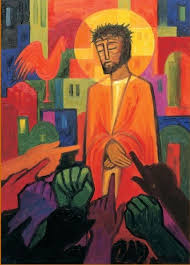
Jesus condemned to death, painting by the Benedictine Sisters of Turvey Abbey

The scene takes place early in the morning at Pilate’s palace. Pilate doesn’t like the Jewish authorities because they put a dent in his career plans through their constant complaints about him to his supervisors in Rome. For purely political reasons, Pilate decides he will satisfy their demand and interview this Jesus who they claim is an enemy of Rome.

The prisoner, Jesus of Nazareth, is brought to Pilate. He is a mess. Christ’s clothes are stained with dirt and blood. His face is bruised and haggard. He has not slept all night. Pilate has heard of Jesus, and so he’s curious to make a personal evaluation of him. Jesus looks nothing like a king to Pilate.

Pilate, in contrast, looks the image of a worldly leader with his power suit on and all the strength of Rome behind him. He hardly has time for this sideshow, this pathetic presentation of leadership in front of him. Jesus looks like nothing more than a kingly wannabe. There is nothing from Christ’s outward appearance that gives any impression he is qualified to be a leader of anybody. We can almost picture Pilate rolling his eyes, saying “so you are the King of the Jews?”

What follows is a strange, convoluted conversation about kingship and truth with a contrast between this world and a world to come. Repeatedly, Jesus makes it clear his kingdom is not of this world. Two thousand years have passed since that dialogue between Jesus and Pilate, yet the same issue remains.

The issue is this: Jesus is calling all of us to follow him – to put his Kingdom first in our lives. In Pilate, we have a symbol of worldly power, which is arbitrary, unprincipled, self-serving, and brutal. Pilate knows the right thing to do but chooses the path of least resistance. He caves to the political pressure, denying the truth which is right under his prominent Roman nose.

Earthly power seeks its own ends. It wants to hold onto control and call the shots. Conversely, Christ’s kingly power is used to serve, to wash feet and meet needs, to move closer to people. Earthly kingdoms use violence to conquer and maintain order and control its subjects. In stark contrast, Christ’s kingdom uses love to transform and unify people around Jesus so that the subjects are with the king and enjoy his rule and reign.

Christ’s kingdom is not of this world. It is counter-cultural and counter-intuitive to how every other leadership structure works on earth. It is an upside-down kingdom that seems like it won’t work or make sense: The way up is down; to be great is not to work for a high position, suck up to the boss, and climb the ladder of wealth and success. Rather, it is to embrace humility and be a servant.

In God’s kingdom, the way to pursue truth is not in forming original ideas and expressing opinions but is found in a person. Truth-seeking disciples will listen to this one voice of Jesus, and filter-out all others. It is a voice calling for submission to his lordship, and to do so because it brings us into an intimate relationship with God.

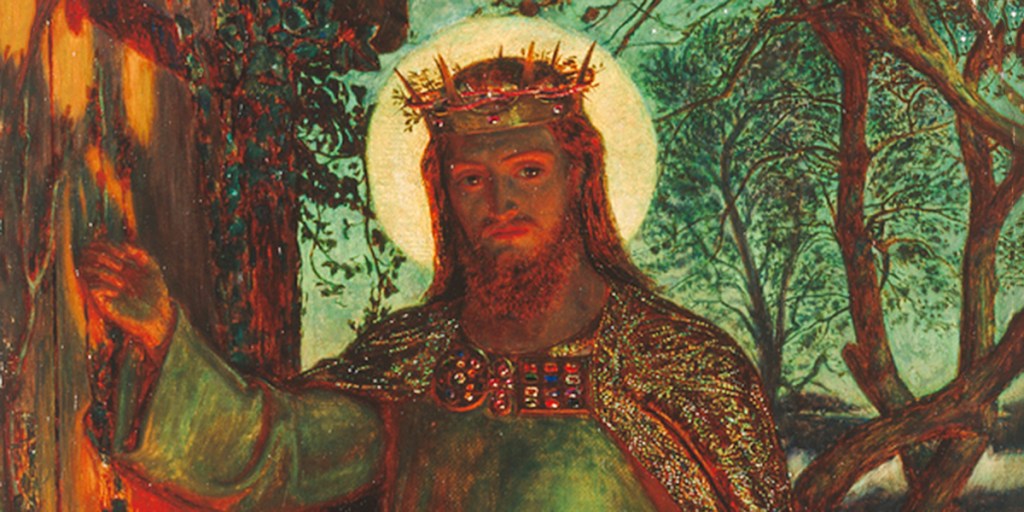
The Light of the World, by English artist William Holman Hunt, 1852

The message of our crucified Savior reigning as King in our lives is not that, having suffered for us, Jesus will somehow keep us from facing difficult times. Instead, Jesus faced a horrible death so that our own tough times can triumph with God’s power to save us and move deeper into our lives. God’s presence and promise is what sustains us, not the avoidance of suffering. Christ as our King means God is with us.

Black Friday and Cyber Monday are almost upon us. This season demonstrates a contrast between two kingdoms. The kingdom of this world calls on us to demonstrate our worth and gain meaningful relationship through grabbing control and obtaining stuff. The pressure in seeking the perfect gift at the perfect price in the hope that if we can bag it, wrap it, and get it under the tree, then we will be perfect, and the perfect family Christmas will happen, and relationships will be great, and everyone will act like I want. Right!?

In contrast, the kingdom Jesus describes assures us we don’t have to prove our worth through endless accomplishments and generous gifts. We don’t need to have the perfect Christmas experience to gain our deepest relational needs. Because, in our baptism, we have been accepted; we are sons and daughters of the living God; and we do not need to achieve greatness through financially and emotionally bleeding ourselves.

In his conversation with Pilate, Jesus said: “My kingdom is not of this world.” When Christians say Jesus Christ is our King, we acknowledge we are his subjects and that we march to the beat of a different drum. The heart of this relationship is our dependence on Jesus who came that we might have life and have it in abundance.

On this Sunday, followers of Jesus Christ boldly state our confidence that, at the end of time, Jesus will come again as King and Ruler of all. 

Blessed are those who see the truth by faith and not by sight. Blessed are those who say “Jesus is the King and the Lord of Life” without rolling their eyes or with a selfish agenda but with a sincere conviction that they belong to Jesus and want to be ever closer to him who is the Way, the Truth, and the Life.

Almighty God, everlasting heavenly Father, you break the power of evil and make all things new in your Son Jesus Christ, the King of the universe. Our confidence is firmly in you, Lord Jesus, knowing you will redeem all things and make all things new. 

We affirm that our security is not in personal abilities, clever plans, or lucrative jobs; our security is in you alone. Your creation still groans with the pain of living in a fallen world. But you have conquered sin through your love, and it is to your love we rely upon. May all things in heaven and on earth recognize the glory of your kingly rule and never cease to praise you. We ask this through our Lord Jesus Christ, your Son, who lives and reigns with you and the Holy Spirit, one God, now and forever. Amen.