Longing For God (Psalm 63)

O God, you are my God; I seek you;
    my soul thirsts for you;
my flesh faints for you,
    as in a dry and weary land where there is no water.
So I have looked upon you in the sanctuary,
    beholding your power and glory.
Because your steadfast love is better than life,
    my lips will praise you.
So I will bless you as long as I live;
    I will lift up my hands and call on your name.

My soul is satisfied as with a rich feast,
    and my mouth praises you with joyful lips
when I think of you on my bed
    and meditate on you in the watches of the night,
for you have been my help,
    and in the shadow of your wings I sing for joy.
My soul clings to you;
    your right hand upholds me.

But those who seek to destroy my life
    shall go down into the depths of the earth;
they shall be given over to the power of the sword;
    they shall be prey for jackals.
But the king shall rejoice in God;
    all who swear by him shall exult,
    for the mouths of liars will be stopped. (New Revised Standard Version)

David, the psalmist, had a great longing for God.

This sort of longing has nothing to do with lustful desires which want something specific under the Christmas tree. To long for God is to have a deep inner wish for fulfillment and connection.

People have all sorts of longings in their lives, because they miss someone or are missing something important.

A parent longs for an estranged child to return, or at least to talk to them.

A spouse wishes to be with their loved one without the ravages of dementia.

A teacher has a deep longing to impact her students in a positive and profound way that will change their lives.

A person longs to see their friend realize the dream they have been seeking.

An individual has been living with chronic pain for years, and longs to be at least pain-free enough to enjoy the simple pleasures of taking a walk, visiting family, or going to a restaurant for a nice meal.

These longings, and thousands more, make up the future hope which keeps us going day after day. And they are all, in one way or another, related to the ultimate longing for divine connection.

Many types of longing come from a place of relationship, of love and support for another. It is this kind of longing that the psalmist had for God. The deep longing to experience a divine/human contact, to commune with the living God, is what motivated and fueled David throughout much of his life.

Like a person looking to satiate their thirst in a hot dry desert, is the one who actively seeks and goes after the longing they have. I believe that every person on planet earth has a deep abiding desire and need for something transcendent in this life, to encounter a power which is higher and greater than us – knowing that the basic nature of this power is loving and good.

My need for communion with God is on the same level as my daily need for water. I cannot survive without either of them.

Spiritual survival requires being watered and fed by an intimate relationship with our Creator. The presence of God is just as necessary and life-sustaining as food. Along with the psalmist David, God’s words are the spiritual food I need to live and survive.

Longing involves memory. Our various longings are often a remembrance of special events, seasons, or people. Deep hope activates those memories, and drives us to prayer, because God has the strength and the ability to honor those honest longings.

The greatness of God, and the divine purposes for this world, are heavy laden with longing. God’s heart longs for humanity to realize a renewed and revitalized relationship with God.

So, the Lord serves humanity in a myriad of ways, bringing deliverance from all that hinders us in a relationship with God, so that we might associate meaningfully and purposefully with what is good, right, and just.

We are invited by God to unpack the gift of faith, and the various spiritual gifts given to us, for the benefit of the church and the world.

God’s steadfast love is indeed better than life itself, because it is beyond what we humans can even conceive of as to what a good life truly is.

God is Love, and Love is God. Love transcends life and brings us to a place of connection beyond what our minds can imagine, and our hearts can only long for.

Since God is always gracious, loving, and good within God’s basic character, God always does what is good and loving. And that makes praise and adoration of God always open season.

Praising God reminds us of what God has done. The Lord is personally invested and involved in God’s big world. Thus, praise is quite appropriate whenever one is going through difficult times; because it accesses memories of God’s help in times past, enabling divine help in the present.

God’s gracious actions are both communal and personal. God not only helps others; God helps me. The Lord’s faithfulness endures throughout all generations. And God is big enough to notice me, and to help me in my own time of need.

Therefore, any occasion is appropriate in coming to God.

Are you in need of rest? Do you need encouragement? Are you in need of some help?

Then, come to God. Praise the Lord. Remember God. Consider the works God has done throughout history for God’s people. Do it during the day while working. Do it at night with your head on the pillow. Do it anytime, anywhere. Because God is there.

The Lord will provide – perhaps not on your timetable, yet God will nonetheless help, often in a way you may not expect.

Faith in God isn’t about trying to avoid God’s anger or wrath; faith is about syncing my wishes and my longings with the heart of God. That is called “repentance.” And it’s the way of finding our great inner longings satisfied.

We must tend to our relationship with the Lord; for God has made it possible to do so.

Receive this blessing from author John O’Donohue in his book, To Bless the Space Between Us: A Book of Blessings…

Blessed be the longing that brought you here
And quickens your soul with wonder.

May you have the courage to listen to the voice of desire
That disturbs you when you have settled for something safe.

May you have the wisdom to enter generously into your own unease
To discover the new direction your longing wants you to take.

May the forms of your belonging—in love, creativity, and friendship—
Be equal to the grandeur and the call of your soul.

May the one you long for long for you.

May your dreams gradually reveal the destination of your desire.

May a secret Providence guide your thought and nurture your feeling.

May your mind inhabit life with the sureness with which your body inhabits the world.

May your heart never be haunted by ghost-structures of old damage.

May you come to accept your longing as divine urgency.

May you know the urgency with which God longs for you.

Amen.

The Beauty of Love (Song of Songs 1:1-17)

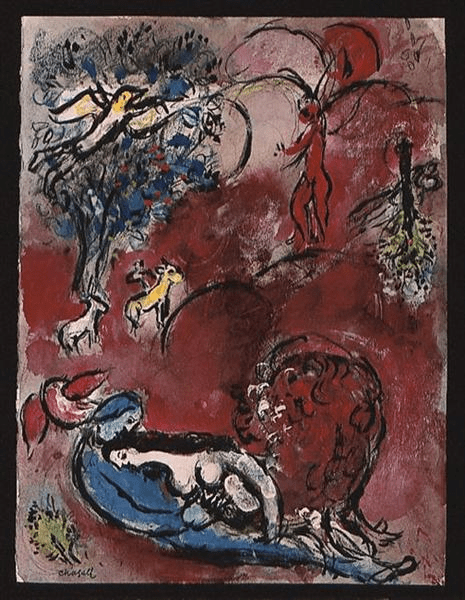
Song of Songs I, by Marc Chagall, 1960

The Song of Songs, which is for Solomon.

[Woman]

If only he would give me some of his kisses . . .

Oh, your loving is sweeter than wine!
Your fragrance is sweet;
        your very name is perfume.
        That’s why the young women love you.
Take me along with you; let’s run!

My king has brought me into his chambers, saying,
“Let’s exult and rejoice in you.
Let’s savor your loving more than wine.
        No wonder they all love you!”

Dark am I, and lovely, daughters of Jerusalem—
        like the black tents of the Kedar nomads,
        like the curtains of Solomon’s palace.
Don’t stare at me because I’m darkened
        by the sun’s gaze.
My own brothers were angry with me.
        They made me a caretaker of the vineyards—
        but I couldn’t care for my own vineyard.

Tell me, you whom I love with all my heart—
        where do you pasture your flock,
        where do you rest them at noon?—
            so I don’t wander around with the flocks of your companions.

[Man]

If you don’t know your way,
    most beautiful of women,
        then follow the tracks of the herds
            and graze your little goats
            by the tents of the shepherds.

I picture you, my dearest,
        as a mare among Pharaoh’s chariots!
Lovely are your cheeks, adorned with ear hoops;
        your neck, with beads.
Let’s make hoops of gold beaded with silver for you!

[Woman]

With my king close by,
        my perfume filled the air.
A sachet of myrrh is my love to me,
        lying all night between my breasts.
A cluster of henna flowers is my love to me
        in the desert gardens of En-gedi.

[Man]

Look at you—so beautiful, my dearest!
        Look at you—so beautiful! Your eyes are doves!

[Woman]

Look at you—so beautiful, my love!
        Yes, delightful! Yes, our bed is lush and green!
The ceilings of our chambers are cedars;
        our rafters, cypresses. (Common English Bible)

The Song of Songs is an unabashedly sensuous biblical book. It is, throughout its contents, an erotic paean to love. In eight chapters, a man and a woman pursue each other through verdant fields and lush valleys. The excitement they have, being together, is palpable.

For most of church history, the Song of Songs has been viewed as an allegory, a love poem between Christ and the Church. And in the case of Hebrew Scripture, the covenant love which exists between God and Israel, has been the predominant interpretive lens.

Seen from this perspective, the Song of Songs reflects that we ought to love the Lord with overpowering commitment, as if we were love-sick for our Beloved. Our thoughts are constantly on the object of our love – how we can please our beloved one.

And yet, there still seems to be room to read the Song in the very down-to-earth realness of physical love between two lovers. Since we are embodied people, such love ought to be celebrated, and is anything but base or to be refused. Sex is a gift from the Creator, and encouraged by God.

I think that the Song of Songs is not an either/or; it is a both/and; it’s both literal and allegorical. That’s not a weird thing. On the allegorical level, the Song is a beautiful poem describing the Divine Eros for God’s people, and the faithful’s heartfelt love for the God whose very name is Love.

Concerning a literal view, the Song celebrates the sanctity of human love, seeing within it the symbol of God’s love for us. Our very real bodies are themselves sacred, just as much as our souls.

Yet, however one chooses to look at the Song of Songs, it remains a statement of mutual admiration, of committed love and affection. It is indeed a poetic lifting of love above all else.

Indeed, if love isn’t the answer, we are not asking the right question.

Believe it or not, the Song of Songs was once viewed as an important key, capable of unlocking the entirety of Holy Scripture.

In fact, C.H. Spurgeon, the Prince of Preachers, in the nineteenth century, preached 59 sermons from this book; in Victorian England, no less. Spurgeon discerned the Song as central to the whole of the Bible. Reflecting on Song of Songs 1:7, he said:

“These words express the desire of the believer after Christ, and his longing for present communion with Him…. Tell me where Thou feeds, for wherever Thou stands as the Shepherd, there will I lie down as a sheep; for none but Thyself can supply my need. I cannot be satisfied to be apart from Thee. My soul hungers and thirsts for the refreshment of Thy presence….

“Satan tells me I am unworthy; but I always was unworthy, and yet Thou hast long loved me; and wherefore my unworthiness cannot be a bar to my having fellowship with Thee now. It is true I am weak in faith, and prone to fall, but my very feebleness is the reason why I should always be where Thou feeds Thy flock, that I may be strengthened, and preserved in safety beside the still waters.

“Why should I turn aside? There is no reason why I should, but there are a thousand reasons why I should not, for Jesus beckons me to come. If He withdraw Himself a little, it is but to make me prize His presence more. Now that I am grieved and distressed at being away from Him, He will lead me yet again to that sheltered nook where the lambs of His fold are sheltered from the burning sun.” Charles Haddon Spurgeon

The Song, in history past, once functioned as a beautiful path to deep intimacy with God. Methinks it behooves us to recover this.

The two lovers in the Song see beauty everywhere. They see it in each other, in the fields where the sheep are pastured, in the orchards where love is consummated, in the seasons, in the animals, trees, and hills. Beauty is all around them, and it is they themselves.

All things which God has created are lovely. Nothing is too small or too insignificant when the eyes of love look upon them. Beauty is designed to be noticed, celebrated, and praised. Love is meant to be expressed out loud, with flavor.

Each time love is stated, every exhalation of adoration, and all of the instances when beauty is acknowledged and affirmed, the ones who speak bind themselves more deeply to God and God’s big world. Together, they call all of it good.

Today’s Old Testament lesson is a wondrous reminder that beauty and love will have its way. Regardless of class, race, family, or societal norms, lovers will continue to seek and find one another and claim their relationship.

While the daughters may stare, and the brothers may be angry, the lovers will yet affirm the beauty of their love. And they will find contentment with each other.

You and I are no accident on this earth; we were created by a loving Creator who has an eye for beauty. And no matter how separated we may get from our divine source, God will seek us out; and if we seek the Lord, he will be found.

O God, you have prepared for those who love you such good things as surpass our understanding: Pour into our hearts such love towards you, so that we, loving you in all things and above all things, may obtain your promises, which exceed all that we can desire. Amen.

The Lord Is My Shepherd (Psalm 23)

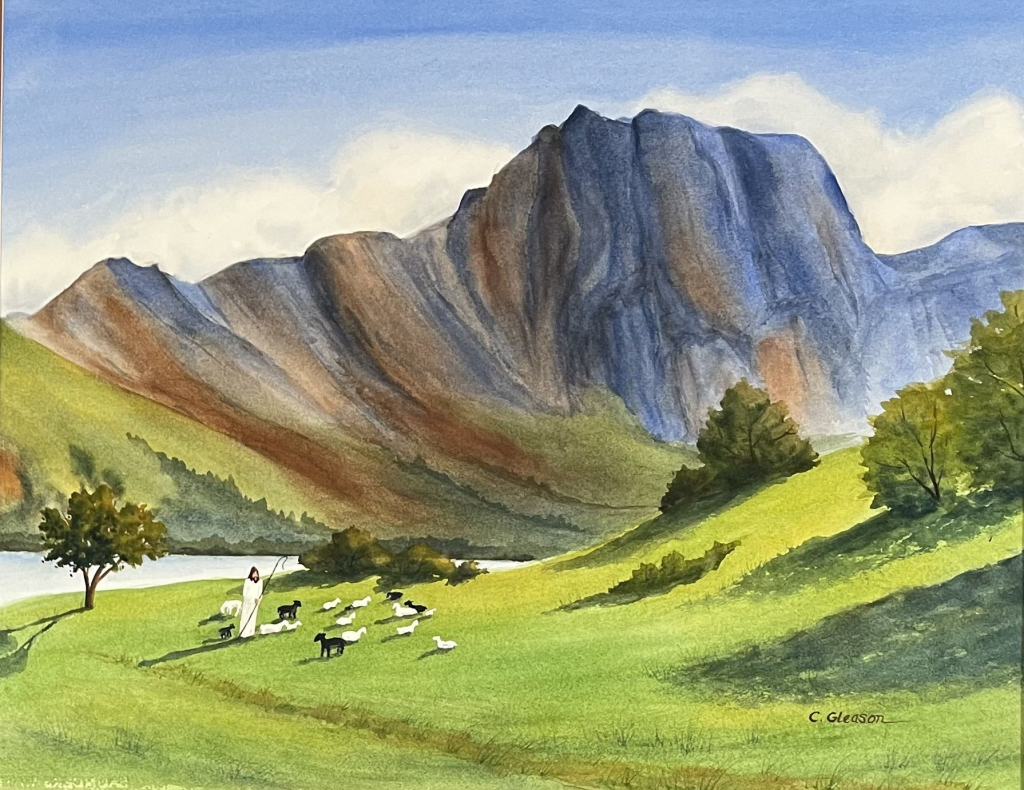
Psalm 23, by Cliff Gleason

The Lord is my shepherd;
    I have all that I need.
He lets me rest in green meadows;
    he leads me beside peaceful streams.
    He renews my strength.
He guides me along right paths,
    bringing honor to his name.
Even when I walk
    through the darkest valley,
I will not be afraid,
    for you are close beside me.
Your rod and your staff
    protect and comfort me.
You prepare a feast for me
    in the presence of my enemies.
You honor me by anointing my head with oil.
    My cup overflows with blessings.
Surely your goodness and unfailing love will pursue me
    all the days of my life,
and I will live in the house of the Lord
    forever. (New Living Translation)

This is one of the best known places in the Bible – even for people who are not religious. And that is for good reason. The psalm is timeless in it’s relating to us in our human condition. It taps into our human need for a compassionate presence, secure protection, and abundant provision. I believe that, most of all, Psalm 23 effectively goes to our inner selves and reminds us of our greatest need: God.

My underlying conviction concerning this wonderful psalm is that the reason we adore it so much is because we humans have an innate primal desire for God. Whether we are consciously religious or not, our deepest longing is for connection with the Divine.

Much of humanity, it seems to me, have repressed this desire. Many people bury this longing underneath multiple layers of other interests and competing desires. Others experience the primal desire for God as a yearning for wholeness, completion, or fulfillment.

Yet, regardless of how particular individuals or groups may frame it, humanity’s basic need is to love and be loved – to move ever closer to the source of love. This inner craving is the essence of the human spirit, and it is captured well in a biblical psalm which pictures a person who settled into the God who is Love.

“Our hearts are forever restless until we rest in God.”

St. Augustine

With Psalm 23, our human longing is spelled out in a mere 50 or so words – we can imagine not only being transported, but also being actually transformed into an enjoyable divine/human relationship, set within an idyllic landscape of settled peace, safety, and strength.

Serenity for our anxious racing thoughts becomes a real hope, for there is a shepherd who protects the human flock and ensures that they have everything they need.

It is understandable that the relationship between God and humans is likened to that of a shepherd and sheep. In reality, sheep need a shepherd. They require someone to look out for them and provide for them. Sheep, in my opinion, are not stupid and clueless; they are skittish animals who only function well if they are non-anxious and at peace.

The presence of a caring shepherd makes all the difference. And, more than that, the shepherd does a myriad of needed things for the sheep that they are not able to do themselves, such as protecting them from wolves, finding adequate pasture to feed upon, and relieving them of the intestinal gas from eating all that grass which would literally kill them without the shepherd’s intervention.

Whereas human shepherds may or may not be faithful in their duties and extend genuine care to the flock, God is always present and loving. Moving to the rich pasture of the New Testament, Jesus is described as the Good Shepherd who will care for and preserve the sheep in every way needed. (John 10:1-21)

Psalm 23, by Cliff Gleason

Indeed, with Jesus as the consummate shepherd, people want for nothing and have everything they need. No wolf can snatch them out of his hand, and the mundane tasks of washing their feet is lovingly done for them. With Jesus, the deep yearning of the inner person becomes satisfied; the soul is restored.

Even the implements of a rod and a staff are used for good, and not for ill. An unfaithful shepherd will likely beat the sheep and berate them, only concerned for fleecing them to sell their wool on the market. But Jesus uses the rod to guide and direct in the way we ought to go, for our benefit and well-being. And the staff – the shepherd’s crook – is benevolently used to rein in the strays who don’t realize how in danger they’re in.

Truly, discipline and encouragement are not mutually exclusive concepts; they instead go together as two forms of loving leadership and care. Only those who take the time and effort to correct another are the ones who really care enough to do so.

In the shepherd’s presence, we can exist with a sense of security, even though there is danger all around us. Our longing for peace, and to be secure within oneself, is not a pipe dream, but a real possibility. To be provided for by God in the face of hard circumstances strengthens faith, awakens hope, and fosters love. It becomes an overflowing feast of the soul.

And this goodness is not fleeting. It can be a continuous present reality. Since God is good, all the time, and there is never a time when God is not good, we are continually and actively pursued and shepherded by goodness and not by harm, all the days of our lives.

The threat of death – and even death itself – cannot thwart the avenues of righteousness from being available to us. We can walk the true path toward inner peace and fulfillment, of genuine connection with God and others, without moral or spiritual harm.

There are good and right paths of life. Those avenues are guarded by a gracious God; they will never be destroyed or damaged. If the psalm is correct, and if my core convictions are right, then there is no longer any reasonable or justified basis for fear.

A good care-taking Shepherd is protecting the flock, and providing the sheep with everything they need. We can live a morally strong, ethically sound, and eminently happy life, without being constantly afraid.

Blessed and Good Shepherd of all, by laying down your life for the flock, you reveal your love for all. Lead us from the place of death to the place of abundant life, so that guided by your care for us, we may rightly offer our lives in love for you and our neighbors. Amen.

Psalms 42 & 43 – Longing for Another World

As a deer gets thirsty
    for streams of water,
I truly am thirsty
    for you, my God.
In my heart, I am thirsty
for you, the living God.
    When will I see your face?
Day and night my tears
    are my only food,
as everyone keeps asking,
    “Where is your God?”

Sorrow floods my heart,
    when I remember
leading the worshipers
    to your house.
I can still hear them shout
    their joyful praises.
Why am I discouraged?
Why am I restless?
    I should trust you, Lord.
I will praise you again
because you help me,
    and you are my God.

I am deeply discouraged,
    and so I think about you
here where the Jordan begins
at Mount Hermon
    and at Mount Mizar.
Your vicious waves
    have swept over me
like an angry ocean
    or a roaring waterfall.

Every day, you are kind,
    and at night
you give me a song
as my prayer to you,
    the God of my life.

You are my mighty rock.
    Why have you forgotten me?
Why must enemies mistreat me
    and make me sad?
Even my bones are in pain,
    while all day long
my enemies sneer and ask,
    “Where is your God?”

Why am I discouraged?
Why am I restless?
    I trust you, Lord!
And I will praise you again
because you help me,
    and you are my God…

Show that I am right, God!
Defend me against everyone
    who doesn’t know you;
rescue me from each
    of those deceitful liars.
I run to you for protection.
Why do you turn me away?
Why must enemies mistreat me
    and make me sad?

Send your light and your truth
    to guide me.
Let them lead me to your house
    on your sacred mountain.
Then I will worship
at your altar because you
    make me joyful.
You are my God,
    and I will praise you.
Yes, I will praise you
    as I play my harp.

Why am I discouraged?
Why am I restless?
    I trust you, Lord!
And I will praise you again
because you help me,
    and you are my God. (Contemporary English Version)

Longing is a universal human experience. It is also an integral part of the human condition.

“If we find ourselves with a desire that nothing in this world can satisfy, the most probable explanation is that we were made for another world.”

C.S. Lewis

Before that statement, Lewis spoke of the nature of longing – how all that we experience in this life is not the ultimate object of our desire, of our longing. The beauty and satisfaction we seek:

“was not in them, it only came through them, and what came through them was longing. These things—the beauty, the memory of our own past—are good images of what we really desire; but if they are mistaken for the thing itself they turn into dumb idols, breaking the hearts of their worshipers. For they are not the thing itself; they are only the scent of a flower we have not found, the echo of a tune we have not heard, news from a country we have never yet visited.”

C.S. Lewis, The Weight of Glory

If we follow the path of any pain, any psychological or emotional wounding, it will lead us to this one primal pain: the pain of separation.

That’s because, having been born into this world, we are banished from Paradise and carry the scars of our Edenic estrangement – the separation from God.

Although it may sound counter-intuitive, if we will but embrace this suffering, if we allow it to lead us deep within ourselves, it will take us deeper than any healing this world can offer.

In other words, longing is itself the cure. It is when our hearts break that they become open for the love to come pouring out of it.

The grief we acknowledge and express draws us toward intimacy with the Divine and with others. It brings union, not separation. The problem itself becomes the cure.

“Do not seek for water. Be thirsty.”

Jalāl al-Dīn Muḥammad Rūmī (1207-1273)

The longing for love, belonging, and connection needs to be deeply felt, because it is really the only way of actually loving another. It is in hungering and thirsting – that is, in longing – which leads us to pray and seek to end our separation.

Prayer is the voice we give to our longings.

Naming our sadness for what it is, even our depression, is most necessary. Since we are emotional creatures, profound sadness even to the point of depression and/or despondency will happen.

Yet, despite the universal nature of discouragement, tears, and the longing for better and beauty, many Christians buck the feelings. Far too many believers focus so exclusively on victory in Jesus through his resurrection, ascension, and glorification that they use religion as their denial when unwanted emotions come banging at the doorstep of their soul.

Depression is not sin. To be discouraged is not the Enemy. And our longings are the evidence that this is so. We must sit with our emotions and feel the breadth and depth of them. Both our spiritual and emotional health come through an awareness and robust engagement with our feelings. Refusing to feel is, in reality, putting the stiff arm to God.

The psalmist does anything but deny his feelings. He brings them before the Lord and spreads them out before the Divine. Why am I discouraged? Why am I restless? Why the sadness? Could it be that God has forgotten me? Where is the Lord? Is God angry with me? Are my troubles the result of divine wrath?

To blandly say we have never uttered or thought such questions is a telltale sign of denying our deep longings. The bottom line for many folks is that they do not want to feel discouraged or cry any tears because it complicates their lives. Besides, it hurts!. “Why feel,” we reason, “when it only brings pain?”

Ah, yes, the avoidance of pain. And there is no pain quite like emotional and spiritual pain of separation and longing for things to be different.

Much like an open wound which needs a liberal application of painful peroxide, so our spiritual wounds must sting with the salve of emotional feeling. Healing is neither cheap, easy, nor painless. It typically hurts like hell.

The psalmist’s own pain revolved around feelings of alienation from God, being cut off from fellow worshipers, and harassed by others around him. Understandably, he experienced despondency and loneliness. The psalmist wondered if anyone, including God, even cared what he was going through. In other words, he is desperate for God to show up. So, he prayed as if his life depended on it.

The psalmist did not get answers to his questions. But that was never the point of the asking.

Hope arises from holding the big picture of the past, present, and future together at the same time. When present circumstances are difficult, and it appears we are about to swallowed up into the now, we must hold the past and future along with it, in careful tension.

While we desperately search for a cure, none will be found in this life – at least not in full. We are occasionally and surprisingly graced with glimpses of our deepest longings whenever we experience the kindness of a stranger, an answer to a prayer we uttered years ago, or the peace of an unexpected rest.

Then, our trust reawakens, and we are encouraged to take another step in the long walk of life – a walk in which God is beside us, even if we cannot discern it.

Gracious God, help us to know wonder in our waiting, patience in our wonderings, and a vision of how life is supposed to be lived. May our deepest longing find its satisfaction in you and in the many ways you mercifully hold the world together, through Jesus Christ our Lord. Amen.