
Take the Long View (Deuteronomy 34:1-12)

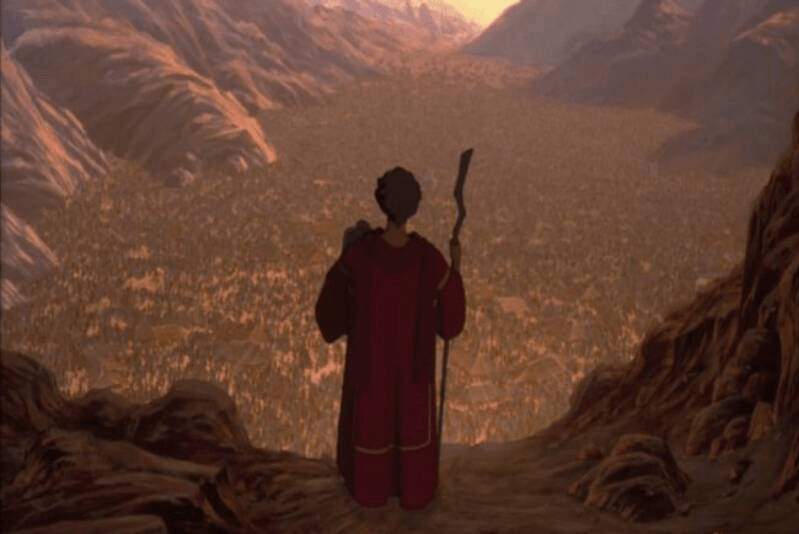
Moses looking from the mountain, from the movie “Prince of Egypt” (1998)

Then Moses climbed Mount Nebo from the plains of Moab to the top of Pisgah, across from Jericho. There the Lord showed him the whole land—from Gilead to Dan, all of Naphtali, the territory of Ephraim and Manasseh, all the land of Judah as far as the Mediterranean Sea, the Negev and the whole region from the Valley of Jericho, the City of Palms, as far as Zoar. Then the Lord said to him, “This is the land I promised on oath to Abraham, Isaac and Jacob when I said, ‘I will give it to your descendants.’ I have let you see it with your eyes, but you will not cross over into it.”

And Moses the servant of the Lord died there in Moab, as the Lord had said. He buried him in Moab, in the valley opposite Beth Peor, but to this day no one knows where his grave is. Moses was a hundred and twenty years old when he died, yet his eyes were not weak nor his strength gone. The Israelites grieved for Moses in the plains of Moab thirty days, until the time of weeping and mourning was over.

Now Joshua son of Nun was filled with the spirit of wisdom because Moses had laid his hands on him. So the Israelites listened to him and did what the Lord had commanded Moses.

Since then, no prophet has risen in Israel like Moses, whom the Lord knew face to face, who did all those signs and wonders the Lord sent him to do in Egypt—to Pharaoh and to all his officials and to his whole land. For no one has ever shown the mighty power or performed the awesome deeds that Moses did in the sight of all Israel. (New International Version)

A signpost stands at a fork in the road.

Pointing in one direction, the sign says “Victory.”

Pointing in another direction, the sign says, “Fulfillment.”

We must pick a direction.

Which one will we choose?

If we choose the path to Victory,

the goal is to win!

We will experience the thrill of competition,

as we rush toward the finish line.

Crowds gather to cheer for us!

And then it’s over.

And everyone goes home.

If we choose the path to Fulfillment,

The journey will be long.

There will be times in which we must watch our step.

There will be times when we can stop to enjoy the view.

We keep going.

We keep going.

Crowds gather to join us on the journey.

And when our lives are over,

those who joined us on the path to Fulfillment,

will keep going without us and

inspire others to join them, too. – Simon Sinek

It wasn’t all about Moses. The dream and vision of entering the Promised Land did not die with Moses. He was just one character, albeit an especially important character, along generations of Israelites who anticipated the fulfillment of God’s promises to the people.

In Christianity, the victory has already been won. In Christ, every good promise of God is and will be fulfilled. Therefore, we can choose fulfillment. We can live into Christ’s victory over sin, death, and hell by choosing to be fulfilled in our Christian lives and our Christian service.

Fulfillment of our godly dreams, good vision, and compassionate ministry requires looking beyond the short term. Long term sustainable thriving in Christian mission and flourishing as a Christian community requires an eternal perspective.

To have the end in mind, a future far ahead of us, demands systemic change. This alternative system will be inspirational, not fear-based. Rather than afraid of what might happen, a long term view is for the next generation – not the next budget crisis due to the next building need.

Maybe because I have been a pastor for so long and know my tenure in each place is only temporary, I know that my vision needs to look further down the road than my own time with a group of people. And a vision of any faith community needs to outlast our own mortal existence. If such a perspective and vision appear as if it will take the energy and will you do not have, then there is no shame in saying so and planning for a good death.

The church is resilient. It has lasted two millennia. She has weathered a lot of challenge and adversity.

Metaphors matter. The word pictures we use are important. I choose not to view the church as the first bite of the apple, which I believe is the best bite. Instead, I see the church as a fine cigar. It’s the last puff of a cigar which to me is the best of all. Christ’s Church is far from its last puff. Rather, I’m saying that the best is yet to come.

Your best years are not in the past; they are in the future. And that is exactly what the author of the New Testament book of Hebrews wanted his readers to see. Yes, it is difficult in the present. You might be tired and weary, feeling as if you cannot keep going with this whole church thing. Maybe you’ve even dropped out altogether. So, according to Hebrews, this is what we do:

You must encourage one another each day. And you must keep on while there is still a time that can be called “today.” If you don’t, then sin may fool some of you and make you stubborn. (Hebrews 3:13, CEV)

Since we have a great high priest who has ascended into heaven, Jesus the Son of God, let us hold firmly to the faith we profess. For we do not have a high priest who is unable to empathize with our weaknesses, but we have one who has been tempted in every way, just as we are—yet he did not sin. Let us then approach God’s throne of grace with confidence, so that we may receive mercy and find grace to help us in our time of need. (Hebrews 4:14-16, NIV)

Let us draw near to God with a sincere heart and with full assurance of faith…. Let us hold unswervingly to the hope we profess…. And let us consider how we may spur one another on toward love and good deeds…. So do not throw away your confidence; it will be richly rewarded. You need to persevere so that when you have done the will of God, you will receive what he has promised. (Hebrews 10:22-24, 35-36, NIV)

So then, with endurance, let’s run the race that is laid out in front of us, since we have such a great cloud of witnesses surrounding us. Let’s throw off any extra baggage, get rid of the sin that trips us up, and fix our eyes on Jesus, faith’s pioneer and perfecter. He endured the cross, ignoring the shame, for the sake of the joy that was laid out in front of him, and sat down at the right side of God’s throne. Think about the one who endured such opposition from sinners so that you won’t be discouraged, and you won’t give up. (Hebrews 12:1-3, CEB)

So, through Jesus we should never stop offering our sacrifice to God. That sacrifice is our praise, coming from lips that speak his name. And don’t forget to do good and to share what you have with others, because sacrifices like these are very pleasing to God. (Hebrews 13:15-16, ERV)

If you are united in a common cause; choose to collaborate with others; then, even if there is no clear end in sight; you are on a road of contributing to something bigger than yourselves; something with value that will last well beyond your own lifetimes. We can anticipate fulfillment.

This is a hard road. It requires counting the cost of discipleship. More important than your doing, is your way of being together, how you are with one another. For, in the end, relationships bring fulfillment because relationships are the only things we will take with us.

Blessed are you, O Lord God almighty, full of grace and mercy. How sweet are your words to the taste, sweeter than honey to the mouth. How precious are your commands for our life, more than the finest gold in our hands. How marvelous is your will for the world. Unending is your love for the nations. Our voices shall sing of your promises and our lips declare your praise. Praise be to you – Father, Son, and Spirit – blessed Holy Trinity, the God whom we serve and who reigns always and forever. Amen.

Take the Long View (Genesis 49:1-33)

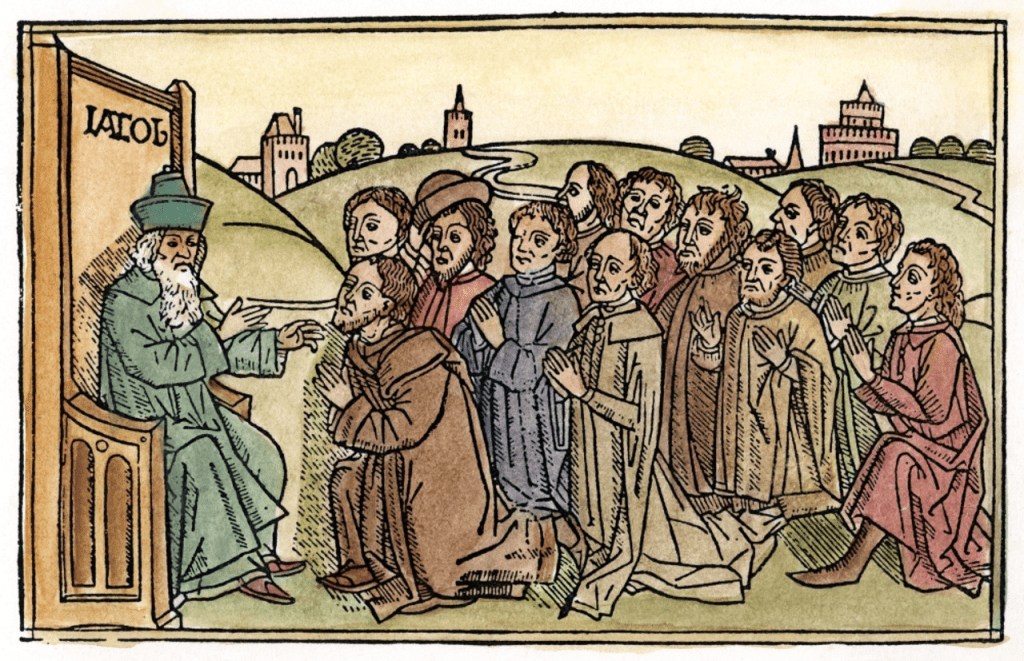
Jacob blesses his twelve sons, a woodcut from the Cologne Bible, c.1479

Then Jacob called together all his sons and said, “Gather around me, and I will tell you what will happen to each of you in the days to come.

“Come and listen, you sons of Jacob;
    listen to Israel, your father.

“Reuben, you are my firstborn, my strength,
    the child of my vigorous youth.
    You are first in rank and first in power.
But you are as unruly as a flood,
    and you will be first no longer.
For you went to bed with my wife;
    you defiled my marriage couch.

“Simeon and Levi are two of a kind;
    their weapons are instruments of violence.
May I never join in their meetings;
    may I never be a party to their plans.
For in their anger they murdered men,
    and they crippled oxen just for sport.
A curse on their anger, for it is fierce;
    a curse on their wrath, for it is cruel.
I will scatter them among the descendants of Jacob;
    I will disperse them throughout Israel.

“Judah, your brothers will praise you.
    You will grasp your enemies by the neck.
    All your relatives will bow before you.
Judah, my son, is a young lion
    that has finished eating its prey.
Like a lion he crouches and lies down;
    like a lioness—who dares to rouse him?
The scepter will not depart from Judah,
    nor the ruler’s staff from his descendants,
until the coming of the one to whom it belongs,
    the one whom all nations will honor.
He ties his foal to a grapevine,
    the colt of his donkey to a choice vine.
He washes his clothes in wine,
    his robes in the blood of grapes.
His eyes are darker than wine,
    and his teeth are whiter than milk.

“Zebulun will settle by the seashore
    and will be a harbor for ships;
    his borders will extend to Sidon.

“Issachar is a sturdy donkey,
    resting between two saddle packs.
When he sees how good the countryside is
    and how pleasant the land,
he will bend his shoulder to the load
    and submit himself to hard labor.

“Dan will govern his people,
    like any other tribe in Israel.
Dan will be a snake beside the road,
    a poisonous viper along the path
that bites the horse’s hooves
    so its rider is thrown off.
I trust in you for salvation, O Lord!

“Gad will be attacked by marauding bands,
    but he will attack them when they retreat.

“Asher will dine on rich foods
    and produce food fit for kings.

“Naphtali is a doe set free
    that bears beautiful fawns.

“Joseph is the foal of a wild donkey,
    the foal of a wild donkey at a spring—
    one of the wild donkeys on the ridge.
Archers attacked him savagely;
    they shot at him and harassed him.
But his bow remained taut,
    and his arms were strengthened
by the hands of the Mighty One of Jacob,
    by the Shepherd, the Rock of Israel.
May the God of your father help you;
    may the Almighty bless you
with the blessings of the heavens above,
    and blessings of the watery depths below,
    and blessings of the breasts and womb.
May my fatherly blessings on you
    surpass the blessings of my ancestors,
    reaching to the heights of the eternal hills.
May these blessings rest on the head of Joseph,
    who is a prince among his brothers.

“Benjamin is a ravenous wolf,
    devouring his enemies in the morning
    and dividing his plunder in the evening.”

These are the twelve tribes of Israel, and this is what their father said as he told his sons good-bye. He blessed each one with an appropriate message.

Then Jacob instructed them, “Soon I will die and join my ancestors. Bury me with my father and grandfather in the cave in the field of Ephron the Hittite. This is the cave in the field of Machpelah, near Mamre in Canaan, that Abraham bought from Ephron the Hittite as a permanent burial site. There Abraham and his wife Sarah are buried. There Isaac and his wife, Rebekah, are buried. And there I buried Leah. It is the plot of land and the cave that my grandfather Abraham bought from the Hittites.”

When Jacob had finished this charge to his sons, he drew his feet into the bed, breathed his last, and joined his ancestors in death. (New Living Translation)

The theme of confidence works its way through the patriarch Jacob’s deathbed prophecies and blessings – a resolute conviction in the promises of God, that he will accomplish what he said he would do.

Jacob expressed the hope and sure belief that God would bring the Israelites out of Egypt and into the land of Canaan as their inheritance – and, ultimately to the City of God, the eternal inheritance.

The Christian will find much in Judah’s blessing as the promise of the coming Christ, Jesus. Mentioning the implements of “staff” and “scepter” are symbols of authority. And, the reference to a donkey communicated a ruler was coming, as donkeys were the preferred mounts of royalty in ancient times.

What’s more, the washing of garments in wine, and eyes darker than wine, are allusions to the future blessing and abundance there will be through the tribe of Judah. In fact, the first miracle of Jesus was turning water into wine – a deliberate attempt by the Apostle John to connect Jesus with Old Testament messianic prophecies of abundance and blessing. (John 2:1-12)

It’s necessary to take a long view of life, keeping in mind that it took eighteen centuries for Jacob’s prophecy of Judah to occur. This long view is what gives us our confidence in life and provides the patience and perseverance we need right now. 

Keeping in mind the big picture of God’s work in this world is important, because if we do not, we will likely become discouraged with the circumstances we face right now.

The reason Jacob makes it into the great Hall of Faith in the New Testament book of Hebrews is not because he was squeaky clean and perfect in how he lived his life, but because he took the long view, the big picture, and saw that God was going to fulfill his promises to Israel:

By an act of faith, Jacob on his deathbed blessed each of Joseph’s sons in turn, blessing them with God’s blessing, not his own—as he bowed worshipfully upon his staff. (Hebrews 11:21, MSG)

Furthermore, when we string the following three verses together across both Testaments, we see the long view of God’s purposes:

It is true that you planned to do something bad to me. But really, God was planning good things. God’s plan was to use me to save the lives of many people. And that is what happened. (Genesis 50:20, ERV)

For I know the plans I have for you,” declares the Lord, “plans to prosper you and not to harm you, plans to give you hope and a future. (Jeremiah 29:11, NIV)       

And we know that all things work together for good to those who love God, to those who are the called according to his purpose. (Romans 8:28, NKJV)

In the Christian faith tradition, all God’s promises come together and are fulfilled in the person and work of Jesus. Christ is our salvation, our inheritance, and our hope. To give our lives to him in complete trust of faith is both our challenge and our privilege.

So, may you and I live by faith, and not by fear.

Be present, O merciful God, and protect us through these anxious times, so that we who are wearied by the changes of this life may rest in your eternal steadiness. Keep watch, dear God, with those who work, or watch, or weep this night, and give your angels charge over those who sleep. Tend the sick, Lord Christ; give rest to the weary, bless the dying, soothe the suffering, pity the afflicted, shield the joyous; and all for your love’s sake. Amen.

Psalm 92:1-4, 12-15 – Just Like a Cedar of Lebanon

It is good to give thanks to the Lord,
    to sing praises to your name, O Most High;
to declare your steadfast love in the morning,
    and your faithfulness by night,
to the music of the lute and the harp,
    to the melody of the lyre.
For you, O Lord, have made me glad by your work;
    at the works of your hands I sing for joy….

The righteous flourish like the palm tree,
    and grow like a cedar in Lebanon.
They are planted in the house of the Lord;
    they flourish in the courts of our God.
In old age they still produce fruit;
    they are always green and full of sap,
showing that the Lord is upright;
    he is my rock, and there is no unrighteousness in him.
(New Revised Standard Version)

The Lebanon Cedar tree is the national symbol of the nation of Lebanon, displayed on their national flag. Throughout history, this massive tree has served as a positive image of strength, stability, and uprightness.

Although the tree grows to about eighty feet, what is most impressive about the Lebanon Cedar is it’s large canopy, with branches stretching out to fifty feet. Thus, we have an apt metaphor for the spiritual life.

Whenever we engage in consistent rhythms of giving thanks for God’s steadfast love in the morning and expressing gratitude for the Lord’s great faithfulness at night, we not only grow up in our faith – stretching vertically toward God – we also grow horizontally, reaching out and being a canopy of righteousness for those who need safety, security, and sameness.

Human flourishing occurs deliberately, not by happenstance. It takes intentional work in attending to the development of the soul, the needs of the body, educating the mind, and feeling deeply about things so that the whole person thrives and enjoys life.

Yes, the body grows old and we all must die. Yet, although we might physically waste away, our inner selves can continue growing strong and spreading a wide canopy of righteousness that branches out with grace.

Unfortunately, the great forests of cedars in Lebanon have dwindled over the centuries to 13% of what they once were, due to over-harvesting its wood for shipbuilding, furniture making, and other uses. Even old King Solomon used Lebanon Cedars as the timber for the original Temple to God. Today, the oldest trees still surviving are 3,000 years old – which makes them truly biblical trees.

Indeed, in old age they are still producing cones and sap. The cedars are a testament to strength, resilience, and staying power. And that is exactly what the Lord wants to produce in us – a massive testimony of faith and patience, rooted in the soil of God’s grace, slowly but surely growing for the benefit of others.

This growth is a direct result of God’s activity. The Lord nourishes and sustains humanity, providing the right conditions of righteous soil, living water from heaven, and the warm sun of grace and mercy. We are then able to stretch both tall and wide, becoming an earthly manifestation of God’s goodness.

The Lord doesn’t keep us down but extends abundant grace so that we can extend to others that which has been extended to us. And if we keep maintaining this divine/human rhythm of grace, there is an ongoing and seemingly endless process of growth, even across three millennia.

The Lebanon Cedar is one of the most hardy trees on the planet. It’s thick trunk, expansive branches, resistance to worms and insects, and fragrance make it an apt emblem for the spiritual life. The righteous person is like this majestic unwavering tree, standing as a testimony to longevity, strength, beauty, and usefulness in the world.

I pray that out of his glorious riches he may strengthen you with power through his Spirit in your inner being, so that Christ may dwell in your hearts through faith. And I pray that you, being rooted and established in love, may have power, together with all the Lord’s holy people, to grasp how wide and long and high and deep is the love of Christ, and to know this love that surpasses knowledge—that you may be filled to the measure of all the fullness of God.

Now to him who is able to do immeasurably more than all we ask or imagine, according to his power that is at work within us, to him be glory in the church and in Christ Jesus throughout all generations, for ever and ever! Amen. (Ephesians 3:16-21, NIV)
