Are You In Need? (John 7:37-39)

On the last day of the festival, the great day, while Jesus was standing there, he cried out, “Let anyone who is thirsty come to me, and let the one who believes in me drink. As the scripture has said, ‘Out of the believer’s heart shall flow rivers of living water.’ ” Now he said this about the Spirit, which believers in him were to receive, for as yet there was no Spirit because Jesus was not yet glorified. (New Revised Standard Version)

Let’s take Christ’s words at the end of the Jewish Festival of Booths (or Tabernacles) at face value. Jesus said that if anyone is thirsty, they could come to him and drink. This is an unconditional statement with no caveats, qualifications, or fine print to it.

Jesus did not say that if anyone is spiritual enough, strong enough, or committed enough that then they could come to him.

The only qualifications one must have in coming to Jesus is to be needy. To be thirsty and want a drink is it, period. No interviews. No jumping through any hoops. No red tape. No having to go through one of the disciples to get to Jesus. No obstacles whatsoever.

Sheer need and want gets anybody an audience with Jesus.

“Thirsty” is Christ’s simple metaphor for need. Whenever we long to have our needs met, there is always the opportunity and possibility of going to Jesus. And all of us are thirsty because every single person has needs that aren’t getting met. These important and vital words of Jesus are encouraging. They help us admit whatever is going on, and say to him, “I need you, Lord.”

The Lord’s response to such a humble expression of need is this: “Please come here to me and drink till you are full.” No judgment. No condemnation. No big sighs. No snarky comments. No disappointed looks. Our confession of need accesses divine compassion and help.

Who will help us? The Holy Spirit will help.

Christ ascended and gave us the Spirit. On this day before the Christian celebration of Pentecost, we are reminded that Jesus delivered on his promise to give help. There is no better assistance in all the world than having a permanent live-in Guide, Helper, and Advocate who is continually alongside us, even in us.

Ask. Seek. Knock. That’s it. Help is just a call away.

We have a popular commercial figure in my city, a lawyer, whose one-liner is, “One call. That’s all!” And help will come. All we need to do is express our needs and wants.

And yet, that is so awfully hard for so many people. It seems weak or selfish to come right out and say what we need and what we want. Yet, if we are to embrace any sort of Christian discipleship, straight forward asking will be involved.

Believers can state their needs simply. They are breathed on by the Spirit. Then, we have our thirst satiated. If we make it more complicated than that, we lose the incredible simplicity of the gospel – good news for needy people. Yet, we sometimes make it complicated by not coming out and saying what we need.

Why, in tarnation, is it so hard for people to ask for what they need and want?

For many, it’s because they have never been given permission to do so. They were never encouraged to express their needs and wants. However, it is perfectly acceptable to state what you want, and what you really need. Ask for what you want, and you may be surprised at how often you get it.

The lack of asking goes much deeper than this. Our fear of vulnerability and being judged by God (and others) prohibits us from asking for what we really want.

Therefore, we must see and understand that vulnerability is crucial to having our needs met. Only through being open enough to share what you need will relational connection happen. A relationship with Jesus is based on humility and vulnerability. Without it, there is no relationship.

We also might be afraid of not getting what we ask for; so we don’t ask, at all. Or, conversely, we may be afraid of receiving our asking! On some level, it’s more comfortable to stay in a familiar situation. We think we want something different, but we’re worried about the downside of getting it. We fret and wonder about it, not trusting ourselves. So, we become paralyzed, unable to say what we really want or need.

All of this overthinking comes down to our own image of self. It’s as if we don’t believe we deserve to be treated well. But the reality is: This isn’t about whether you deserve to have something; it’s about your needing or wanting it. Plain and simple. There’s no shame, being in want or need.

Some folk are so used to putting others first and meeting another’s need that they become stymied by their own inability to state what they need. So, they try and feel better by meeting everyone else’s need. When they become bitter about being emotionally depleted, and when they are thirsty for someone to meet their needs, they end up not asking for help – because they feel they can’t.

But you can, and you must. Jesus says so. We don’t always get what we want in life. But we won’t get it if we don’t ask. It’s good to focus on what you want or need in life, instead of questioning whether you’re worthy to receive it. Jesus said:

“Keep on asking, and you will receive what you ask for. Keep on seeking, and you will find. Keep on knocking, and the door will be opened to you. For everyone who asks, receives. Everyone who seeks, finds. And to everyone who knocks, the door will be opened.” (Matthew 7:7-8, NLT)

So, what are you waiting for!?

The Blessing of Unity (Psalm 133)

How very good and pleasant it is
    when kindred live together in unity!
It is like the precious oil on the head,
    running down upon the beard,
on the beard of Aaron,
    running down over the collar of his robes.
It is like the dew of Hermon,
    which falls on the mountains of Zion.
For there the Lord ordained his blessing,
    life forevermore. (New Revised Standard Version)

In the ancient world, the temple in Jerusalem sat at the highest point of the city. In fact, Jerusalem itself sits relatively high in its geographic region – about 2,500 feet above sea level. A person walking literally goes up to Jerusalem, and up even higher to the temple mount. It was here, at the highest point, that the worship of God happened.

And as the worshipers made their pilgrimage to Jerusalem, and then to the temple, they sang the psalms, including today’s psalm, where they anticipated meeting with God. The Psalms of Ascent (Psalms 120-134) all express a joy of coming together in faith to worship Yahweh.

To meet with God is to experience an abundant life and joyous unity. It is to be blessed, having a settled peace in being with God and God’s people.

From the vantage of Christianity, the great high place for Christians is the Easter celebration of Christ’s resurrection. Since Jesus rose from death, he raises us up from unbelief to faith, and from death to eternal life.

Everything for the believer in Jesus flows from this infinite and powerful fount of resurrection grace. And everything unites and galvanizes around the center of the person and work of Christ. Because of the resurrection, believers are united into one spiritual family; we are all brothers and sisters.

It is a very good thing that Christ has united us, and it is a very pleasant thing when we consider one another as kindred and maintain the unity that we have been given. And not only are we joined by the gracious action of God, but today’s psalm calls all people to worship God and be united together.

The abundant blessing of unity with each other is maintained by allowing it to flow. The psalm lets us know that the two liquid elements of oil and dew help us to keep things moving and flowing in the right direction for our sense of family and working together. And when those elements flow from the top of Mount Calvary, the result is a world of blessing.

Oil provides the lubrication for our unity here on this earth. This sort of oil was used to consecrate a priest for service.

Moses poured some of the anointing oil on Aaron’s head and anointed him, to consecrate him. (Leviticus 8:12, NRSV)

The consecrated oil was special, to be used for the purpose of anointing the priests. It was both expensive and precious, yet God encouraged liberality with it in the consecration ritual. The oil is poured out so lavishly on the priest’s head that it ran down over the beard and onto the collar of the robe.

This was, indeed, symbolic that God is not stingy, but generous; and that unity with both God and others is pleasant, and not an onerous chore. For the Christian, this recalls the Gospel story of Mary liberally pouring out an entire bottle of perfume on Jesus:

Then turning toward the woman, Jesus said to Simon, “Do you see this woman? I entered your house; you gave me no water for my feet, but she has bathed my feet with her tears and dried them with her hair. You gave me no kiss, but from the time I came in she has not stopped kissing my feet. You did not anoint my head with oil, but she has anointed my feet with ointment.” (Luke 7:44-46, NRSV) 

The Lord has always been a generous God. And because of Christ’s resurrection, a new life of abundance and generosity is possible. It’s like the dew of Mount Hermon.

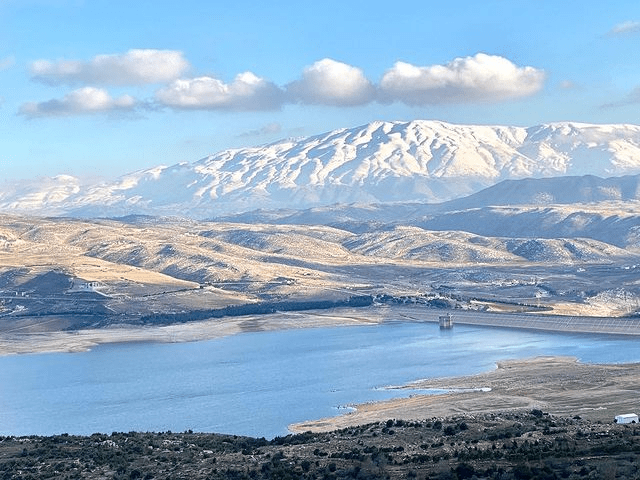
Mount Hermon is on the border between Lebanon and Syria

Mount Hermon is well north of the temple mount in Jerusalem. It too, is high up. Mount Hermon  rises to 9,232 feet and is the highest point on the east coast of the Mediterranean Sea. When the snow-capped ridge of the mountain melts, it liberally flows down and feeds the Jordan River, providing life for the valley.

Without Mount Hermon, there would be nothing and no one in the valley, which is why this water source is so important. Just like the oil flowing down Aaron’s beard, so the dew of Mount Hermon flows well beyond the mountain’s peak to provide abundant life. It enables us to come together united as one family in one place together.

Life and unity are not scarce. The resurrection of Christ opened the floodgates of heaven with life-giving grace, instead of death-dealing judgment, as in Noah’s day. Jesus is the wellspring of life who makes us one big family of faith by providing people with living water.

“Those who drink of the water that I will give them will never be thirsty. The water that I will give will become in them a spring of water gushing up to eternal life.” (John 4:14, NRSV)

No longer does life need to be quantified and measured in terms of years of time. Yes, we are mortal. But this will give way to immortality because a resurrected life is an everlasting life – made possible by Jesus.

My prayer and my hope is that our psalm for today will be like a glass of cold water on hot day when you are feeling parched. And this water will keep coming, as much of it as you need. The oil will keep flowing, with as much love and grace as you need for today. And there will be plenty more when tomorrow comes. It never runs out.

Perhaps you are encouraged with your own faith walk, but are awfully discouraged with the lack of unity in your family, neighborhood, church, workplace, nation, and world. Unity is not a piece of pie in which some get only a sliver, if any at all. In reality, there is plenty to go around. The power of the resurrection has made it possible.

In this present evil age, there are times of angry conflict and emotional distress, along with periods of great separation and sorrow. People everywhere who are divided and estranged from one another can hear God’s call to live together in unity. It is a call of love which beckons us to participate in the generous overflowing love of the Savior who has paved the way for an abundant life by bringing people together in faith.

Jesus prayed, “Holy Father, protect them in your name that you have given me, so that they may be one, as we are one.” (John 17:11)

Living Water and Real Food (John 4:5-42)

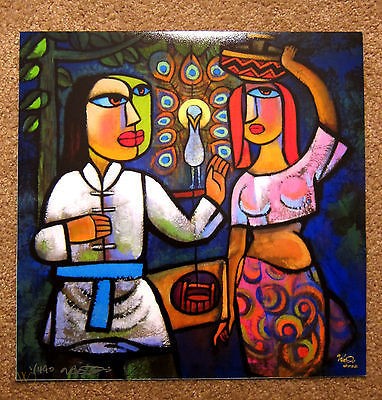
Jesus and the Samaritan Woman, by He Qi

So he came to a town in Samaria called Sychar, near the plot of ground Jacob had given to his son Joseph. Jacob’s well was there, and Jesus, tired as he was from the journey, sat down by the well. It was about noon.

When a Samaritan woman came to draw water, Jesus said to her, “Will you give me a drink?” (His disciples had gone into the town to buy food.)

The Samaritan woman said to him, “You are a Jew and I am a Samaritan woman. How can you ask me for a drink?” (For Jews do not associate with Samaritans.)

Jesus answered her, “If you knew the gift of God and who it is that asks you for a drink, you would have asked him and he would have given you living water.”

“Sir,” the woman said, “you have nothing to draw with and the well is deep. Where can you get this living water? Are you greater than our father Jacob, who gave us the well and drank from it himself, as did also his sons and his livestock?”

Jesus answered, “Everyone who drinks this water will be thirsty again, but whoever drinks the water I give them will never thirst. Indeed, the water I give them will become in them a spring of water welling up to eternal life.”

The woman said to him, “Sir, give me this water so that I won’t get thirsty and have to keep coming here to draw water.”

He told her, “Go, call your husband and come back.”

“I have no husband,” she replied.

Jesus said to her, “You are right when you say you have no husband. The fact is, you have had five husbands, and the man you now have is not your husband. What you have just said is quite true.”

“Sir,” the woman said, “I can see that you are a prophet. Our ancestors worshiped on this mountain, but you Jews claim that the place where we must worship is in Jerusalem.”

“Woman,” Jesus replied, “believe me, a time is coming when you will worship the Father neither on this mountain nor in Jerusalem. You Samaritans worship what you do not know; we worship what we do know, for salvation is from the Jews. Yet a time is coming and has now come when the true worshipers will worship the Father in the Spirit and in truth, for they are the kind of worshipers the Father seeks. God is spirit, and his worshipers must worship in the Spirit and in truth.”

The woman said, “I know that Messiah” (called Christ) “is coming. When he comes, he will explain everything to us.”

Then Jesus declared, “I, the one speaking to you—I am he.”

Just then his disciples returned and were surprised to find him talking with a woman. But no one asked, “What do you want?” or “Why are you talking with her?”

Then, leaving her water jar, the woman went back to the town and said to the people, “Come, see a man who told me everything I ever did. Could this be the Messiah?” They came out of the town and made their way toward him.

Meanwhile his disciples urged him, “Rabbi, eat something.”

 But he said to them, “I have food to eat that you know nothing about.”

Then his disciples said to each other, “Could someone have brought him food?”

“My food,” said Jesus, “is to do the will of him who sent me and to finish his work. Don’t you have a saying, ‘It’s still four months until harvest’? I tell you, open your eyes and look at the fields! They are ripe for harvest. Even now the one who reaps draws a wage and harvests a crop for eternal life, so that the sower and the reaper may be glad together. Thus the saying ‘One sows and another reaps’ is true. I sent you to reap what you have not worked for. Others have done the hard work, and you have reaped the benefits of their labor.”

Many of the Samaritans from that town believed in him because of the woman’s testimony, “He told me everything I ever did.” So when the Samaritans came to him, they urged him to stay with them, and he stayed two days. And because of his words many more became believers.

They said to the woman, “We no longer believe just because of what you said; now we have heard for ourselves, and we know that this man really is the Savior of the world.” (New International Version)

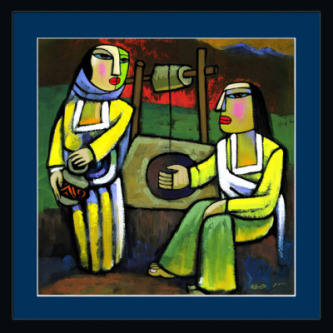
Samaritan Woman and Jesus at the Well, by He Qi

Samaria, back in Christ’s day, was viewed by many as an infamous place, full of untrustworthy people who were a mongrel mix of Jewish and ancient Assyrian blood. And their religion was most suspect of all – an unholy blend of Jewish and Gentile practices. So, no respectable Jewish person ever got near Samaria or even talked with a Samaritan.

Jesus, however, saw things differently. He did not avoid the territory but confidently walked through Samaria. Christ had no problem stopping to rest on his journey in a foreign area. That’s because Jesus didn’t class people into groups, nor did he attach adjectives to people, such as “those” Samaritans. He had no obstacles between himself and others.

Which is why an organic conversation happened between Jesus and a Samaritan woman. Christ simply saw a human being who happened to be a woman and a Samaritan. He acknowledged both her gender and her ethnicity without those being a problem. Not even Christ’s knowledge of her string of husbands was an issue in conversing with her.

Every time I read this narrative of Jesus interacting with the Samaritan woman, I imagine what all the non-verbal communication was like. I’m sure the conversation was as much about Christ’s affect, gestures, and tone of voice, as it was his well-placed words. I fully believe both his verbal and non-verbal communication was perfectly congruent with each other, giving the woman a compelling sense that her ultimate needs could be met with the living well of a person in front of her.

Water gives life. And Jesus, as living water, gives new life. A bunch of failed relationships testified to the woman’s dissatisfaction. Even though we hear no more about her after this story in the Bible, we as readers get the overwhelming sense that the woman finally found satisfaction. The love which kept slipping through her fingers now had staying power.

Jesus stood and said in a loud voice, “Let anyone who is thirsty come to me and drink. Whoever believes in me, as Scripture has said, rivers of living water will flow from within them.” (John 7:37-38, NIV)

We need the living water of Jesus as a river flowing straight from him to us — replenishing, renewing, sustaining, and breaking through every barrier in its path like a mighty flood overcoming and pushing everything out of the way that blocks its path so that our love can overflow onto all sorts of people, like a Samaritan woman.

The disciples come along, seemingly confused about this scene of Jesus and a Samaritan woman. So they blurt out something like the stereotypical mother concerned for her son saying, “Sit down and eat some of Mama’s pasta. You need some food!” As if preparing and serving a meal will make everything better.

Food has both the power to bring us together, as well as separate us. A meal can create the conditions for fellowship, acceptance, and enjoyment. On the other hand, sitting down to eat can also be a way to avoid painful emotions, and so, becomes an obstacle, keeping love at bay.

The disciples were uncomfortable and maybe a bit stressed. Looking to fill up with food instead of with God, their sense of unfulfillment was coming out sideways by opening the pantry and looking for comfort food. Jesus saw through the situation and put the focus on the disciples’ spiritual hunger.

Paying attention to our vocation and discovering humble work in the service of God, rather than a vacation to the fridge to cover unwanted feelings, is the essence of Christ’s interaction with his disciples.

People are much more ready for the gospel than we think. There are times we can become insular, lost within our own heads, that we are then unable to see the world as ripe for a harvest of people who are eager to be gathered into a community of redemption and love.

Jesus had a significant interaction with the Samaritan woman – despite the social prohibitions of the time. Shenanigans like this, by Christ, got a lot of people’s  undies in a bundle. The disciples, having a front seat to most of Christ’s ways, did a few too many palms to the forehead, believing their Rabbi’s behavior was going to make him unpopular. They feared no one would follow him.

Looks like the disciples didn’t quite get that one right.

The Samaritan woman received Jesus as Living Water, having her ultimate needs met by the Lord of all. The disciples hadn’t quite caught up to this, so fell back on their old ways of physical food and drink to assuage the awkward uncomfortable feelings happening inside them.

The woman became a wellspring of good news to her community. Whereas the disciples eventually became a fountain of the gospel after Christ’s death and resurrection, they are here only an annoying drip from the kitchen faucet. A non-descript ethnically suspect woman of dubious character coming to faith was meant by Jesus to open the disciples’ eyes to a new reality:

The good news of Christ is meant for the world, not just Jewish men.

The disciples were given the opportunity to participate a mission of bringing the love of God where love wasn’t present, of helping all kinds of people awaken to the deep spirituality within them, of lifting their downcast faces of guilt and shame to see the Living God bless the world with the body and blood of Jesus.

All of our work, no matter how big or small, is made possible by God, the great Chef of the universe. God has done all the preparations of chopping the onions, mincing the garlic, slicing the carrots, and peeling the potatoes so that we, his followers, can make a savory stew of diverse people sharing a common pot of God’s love and hospitality. It is, therefore, our privilege to be the wait staff who serves the meal to a whole host of persons.

O God, you made us in your own image, and you have redeemed us through your Son Jesus Christ: Look with compassion on the whole human family; take away the arrogance and hatred which infect our hearts; break down the walls that separate us; unite us in bonds of love; and work through our struggle and confusion to accomplish your purposes on earth; that, in your good time, all nations and races may serve you in harmony around your heavenly throne; through Jesus Christ our Lord. Amen.

Water Is Life (Ezekiel 47:1-12)

Now he brought me back to the entrance to the Temple. I saw water pouring out from under the Temple porch to the east (the Temple faced east). The water poured from the south side of the Temple, south of the altar. He then took me out through the north gate and led me around the outside to the gate complex on the east. The water was gushing from under the south front of the Temple.

He walked to the east with a measuring tape and measured off fifteen hundred feet, leading me through water that was ankle-deep. He measured off another fifteen hundred feet, leading me through water that was knee-deep. He measured off another fifteen hundred feet, leading me through water waist deep. He measured off another fifteen hundred feet. By now it was a river over my head, water to swim in, water no one could possibly walk through.

He said, “Son of man, have you had a good look?”

Then he took me back to the riverbank. While sitting on the bank, I noticed a lot of trees on both sides of the river.

He told me, “This water flows east, descends to the Arabah and then into the sea, the sea of stagnant waters. When it empties into those waters, the sea will become fresh. Wherever the river flows, life will flourish—great schools of fish—because the river is turning the salt sea into fresh water. Where the river flows, life abounds. Fishermen will stand shoulder to shoulder along the shore from En Gedi all the way north to En-eglaim, casting their nets. The sea will teem with fish of all kinds, like the fish of the Great Mediterranean.

“The swamps and marshes won’t become fresh. They’ll stay salty.

“But the river itself, on both banks, will grow fruit trees of all kinds. Their leaves won’t wither, the fruit won’t fail. Every month they’ll bear fresh fruit because the river from the Sanctuary flows to them. Their fruit will be for food and their leaves for healing.” (The Message)

Jesus said, “Let the one who believes in me drink. As the Scripture has said, ‘Out of the believer’s heart shall flow rivers of living water.’”

John 7:38, NRSV

The coming of the Lord is what Advent is all about. It means that God is about to show up. And when God shows up, there are rivers of blessing and an abundance of salvation.

We need water

Just as we need water to survive, so we also need the living water which grants us eternal life.

Every living cell of our body contains water. 65% of your body is water. Up to 90% of plant tissue is water. Water defines our environment and shapes our landscape. We need at least two liters of fresh water to drink every day to stay healthy.

Just as each person on earth ought to have clean, safe, fresh water each day, but don’t, so every person also should have the living water of salvation and blessing flowing from God, yet they don’t.

Water constantly moves around the planet – on, above and below the earth’s surface. The cycle from rainfall to evaporation to rainfall is powered by energy from the sun. Water falls as rain, snow, and sleet. It collects in ice, rivers, groundwater, and the oceans. The water cycle naturally cleans the water.

Just as the natural processes of the water cycle give life and health to the planet, so the unseen spiritual processes working above, below, and on the earth exist to provide the life that is truly life.

Water in the Bible

Water is mentioned 722 times in the Bible. Water flows throughout Holy Scripture, reminding us of its importance, both spiritually and physically. Water is such an essential component of life that God created it on the very first day (Genesis 1:2). And water shows up at the very end of the Bible:

The Spirit and the bride say, “Come!” And let the one who hears say, “Come!” Let the one who is thirsty come; and let the one who wishes, take the free gift of the water of life. (Revelation 22:17, NIV)

Naaman the Syrian was cured from his leprosy in the waters of Jordan River (2 Kings 5:1-14). Water is used as a sign and a seal to purify and provide deliverance, as in Christian baptism (Romans 6:3-4; 1 Peter 3:18-22). And the power of water can also be a destructive force (Genesis 6:17; Exodus 14:1-15:21).

Living Water

Jesus, the source of Living Water, extends an invitation to all who thirst.

“But those who drink the water I give will never be thirsty again. It becomes a fresh, bubbling spring within them, giving them eternal life.” (John 4:14, NLT)

Christ uses water for redemptive purposes, to bring comfort and help.

Jesus got up from the meal, took off his outer clothing, and wrapped a towel around his waist. After that, he poured water into a basin and began to wash his disciples’ feet, drying them with the towel that was wrapped around him. (John 13:4-5, NIV)

“O Christ, He is the fountain,

The deep, sweet well of love;

The streams on earth I’ve tasted

More deep I’ll drink above.

There to an ocean fullness

His mercy doth expand,

And glory, glory dwelleth

In Immanuel’s land.”

The Sands of Time Are Sinking by Sam Rutherford and Anne Cousin

From a Christian perspective, the water flowing from the temple finds its fulfillment in the person and work of Jesus Christ. He is the living water that gives eternal life. We would do well to ensure that all people have access to clean physical water, as well as access to purified spiritual water.

Lord Jesus, Son of God, Savior of humanity, there is a river flowing straight from your heart into mine — replenishing, renewing, sustaining. 

May you, as Living Water, be persistent in me, breaking through every barrier in its path.

Send this hydropower through the dark crevices of my heart like a mighty flood overcoming and pushing everything out of the way that blocks its path.

I want my heart to be washed clean of any debris cluttering and blocking your life-giving flow.

May your love overflow onto your people — your grace, your mercy — into the lives of those we encounter, to your glory and honor, in spirit, and in truth. Amen.