Worship Is a Lifestyle (1 Chronicles 15:1-2, 16:4-13)

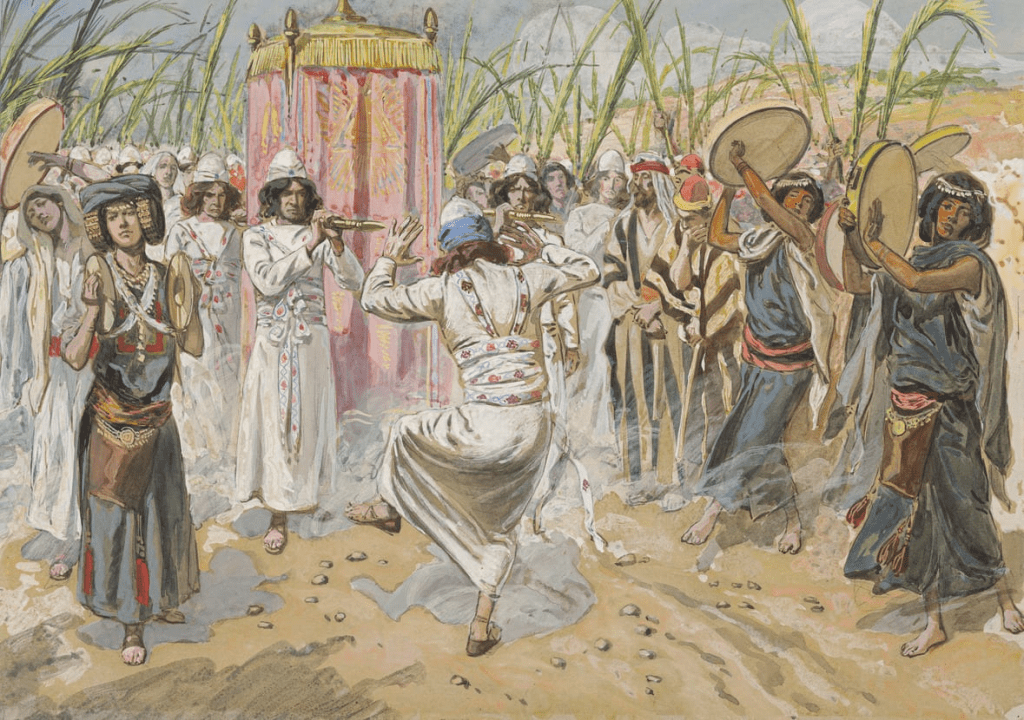
David Dancing Before the Ark, by James Tissot, c.1900

David built houses for himself in Jerusalem. Then he prepared a place for the Ark of God, and he set up a tent for it. David said, “Only the Levites may carry the Ark of God. The Lord chose them to carry the Ark of the Lord and to serve him forever….”

Then David appointed some of the Levites to serve before the Ark of the Lord. They had the job of leading the worship and giving thanks and praising the Lord, the God of Israel. Asaph, who played the cymbals, was the leader. Zechariah was second to him.

The other Levites were Jaaziel, Shemiramoth, Jehiel, Mattithiah, Eliab, Benaiah, Obed-Edom, and Jeiel. They played the lyres and harps. Benaiah and Jahaziel were priests who blew the trumpets regularly before the Ark of the Agreement with God. That day David first gave Asaph and his relatives the job of singing praises to the Lord.

Give thanks to the Lord and pray to him.
    Tell the nations what he has done.
Sing to him; sing praises to him.
    Tell about all his miracles.
Be glad that you are his;
    let those who seek the Lord be happy.
Depend on the Lord and his strength;
    always go to him for help.
Remember the miracles he has done,
    his wonders, and his decisions.
You are the descendants of his servant, Israel;
    you are the children of Jacob, his chosen people. (New Century Version)

Art by Sefira Lightstone

David was anointed as the future king by the priest and prophet Samuel, because God had rejected Saul as king. Yet, King Saul was still on the throne, still in power.

It’s a credit to David that he was faithful to the Lord, trusted God, and did nothing morally wrong or ethically suspect, such as trying to kill Saul. But King Saul certainly tried to kill David!

Saul’s jealousy morphed into murderous intent and evil machinations. Saul eventually died in battle, and David became king of Judah, then of all Israel. He did it the Lord’s way, and not his own.

So, it’s no surprise that once King David was securely on the throne, he paid attention to the Ark of the Covenant – the symbol of God’s presence with Israel – and made plans to have it in a protected and central place within the life of the Jewish people. What’s more, David sought to obey all of God’s laws and instructions which were graciously given to the people through Moses.

King David relocated the Ark from the house of Obed-Edom to Jerusalem – with the Levitical priests handling all of the sacred objects, as prescribed in the law of God.

The liturgical procession which moved the Ark of the Covenant was a grand and festive group, including military commanders, the elders of Israel, and the Levites. It was a celebration involving plenty of music, singing, and sacrifices. (1 Chronicles 13-14; 2 Samuel 6:12-19)

David prepared a tent for the Ark, in the tradition of the Tabernacle of Moses, to be located in Jerusalem at the heart of Jewish life.

After God’s Ark was moved and established in the new capitol, King David then organized the Levites for continued ministry around it. The work of the Levites was prayer, music, song, and praise, with Asaph as their leader.

Asaph along with Zechariah and eight other Levites, were responsible to ensure that musical instruments were played and trumpets blown before the Ark. (1 Chronicles 15:17-18)

All of the praise, singing, and music was to be a permanent ministry, because for David and the Jews, worship was a lifestyle, and not just an event.

So, we see that one of King David’s first initiatives in coming to power was to establish dozens of full-time Levites in the work of worship. David clearly knew where his royal position came from, and how he was supposed to rule. The king ensured that all of Jewish life was going to revolve around God, not himself. And he proved it both by his words and his actions as Israel’s leader.
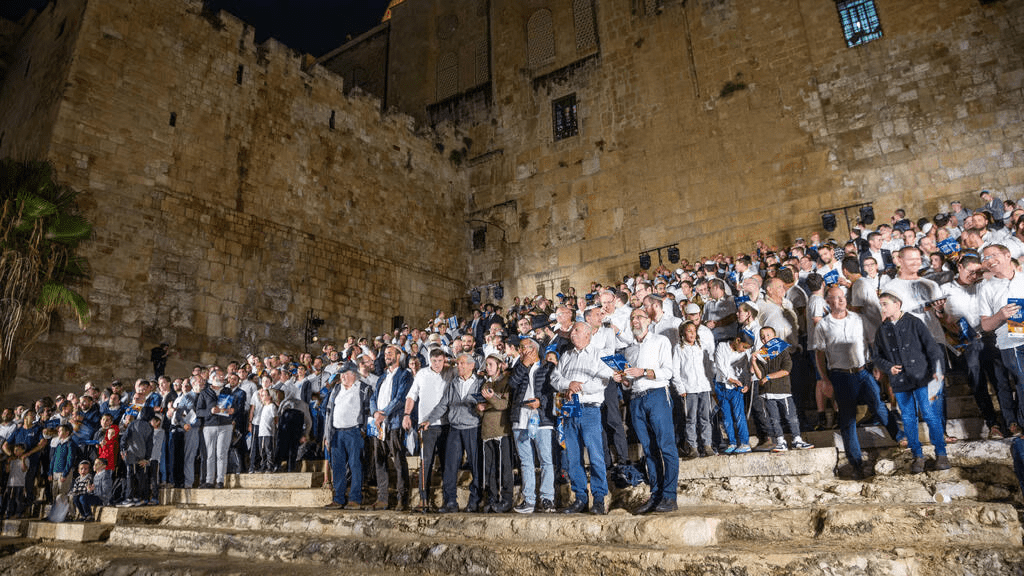
Levites singing chapters from Psalms in Jerusalem, photo by Dor Pazoelo

The approach and attitude of David makes sense, because he was the one, along with Asaph the musical director, who crafted songs of praise such as Psalm 96. We might imagine a great Levite choir singing out with lots of spiritual gusto:

Sing to the Lord a new song;
    sing to the Lord, all the earth.
Sing to the Lord and praise his name;
    every day tell how he saves us.
Tell the nations of his glory;
    tell all peoples the miracles he does,

because the Lord is great; he should be praised at all times.
    He should be honored more than all the gods,
because all the gods of the nations are only idols,
    but the Lord made the heavens.
The Lord has glory and majesty;
    he has power and beauty in his Temple.

Praise the Lord, all nations on earth;
    praise the Lord’s glory and power.
Praise the glory of the Lord’s name.
    Bring an offering and come into his Temple courtyards.
Worship the Lord because he is holy.
    Tremble before him, everyone on earth.
Tell the nations, “The Lord is king.”
    The earth is set, and it cannot be moved.
    He will judge the people fairly.
Let the skies rejoice and the earth be glad;
    let the sea and everything in it shout.
Let the fields and everything in them rejoice.
Then all the trees of the forest will sing for joy
before the Lord, because he is coming.
    He is coming to judge the world;
he will judge the world with fairness
    and the peoples with truth. (Psalm 96, NCV)

Amen.

Exodus 35:1-29 – Real Worship Isn’t Boring

Gathering to Build the Temple by Yoram Raanan

Moses gathered together the whole Israelite community and said to them: These are the things that the Lord has commanded you to do:

Do your work for six days, but the seventh day should be holy to you, a Sabbath of complete rest for the Lord. Whoever does any work on the Sabbath will be put to death. Don’t start a fire in any of your homes on the Sabbath day.

Moses said to the whole Israelite community, This is what the Lord has commanded: Collect gift offerings for the Lord from all of you. Whoever freely wants to give should bring the Lord’s gift offerings: gold, silver, and copper; blue, purple, and deep red yarns; fine linen; goats’ hair; rams’ skins dyed red; beaded leather; acacia wood; the oil for the light; spices for the anointing oil and for the sweet-smelling incense; gemstones; and gems for setting in the priest’s vest and in the priest’s chest pendant.

All of you who are skilled in crafts should come forward and make everything that the Lord has commanded: the dwelling, its tent and its covering, its clasps, its boards, its bars, its posts, and its bases, the chest with its poles and its cover, the veil for a screen, the table with its poles and all its equipment, the bread of the presence, the lampstand for light with its equipment and its lamps, the oil for the light, the incense altar with its poles, the anointing oil and the sweet-smelling incense, the entrance screen for the dwelling’s entrance, the altar for entirely burned offerings with its copper grate, its poles, and all its equipment, the washbasin with its stand, the courtyard’s drapes, its posts, and its bases, and the screen for the courtyard gate, the dwelling’s tent pegs and the courtyard’s tent pegs, and their cords, the woven clothing for ministering in the sanctuary, and the holy clothes for Aaron the priest and his sons for their service as priests.

The whole Israelite community left Moses. Everyone who was excited and eager to participate brought the Lord’s gift offerings to be used for building the meeting tent and all its furnishings and for the holy clothes. Both men and women came forward. Everyone who was eager to participate brought pins, earrings, rings, and necklaces, all sorts of gold objects. Everyone raised an uplifted offering of gold to the Lord. And everyone who had blue or purple or deep red yarn or fine linen or goats’ hair or rams’ skins dyed red or beaded leather brought them. Everyone who could make a gift offering of silver or copper brought it as the Lord’s gift offering. Everyone who had acacia wood that could be used in any kind of building work brought it. All the skilled women spun cloth with their hands and brought what they had spun in blue and purple and deep red yarns and fine linen. All the women who were eager to use their skill spun the goats’ hair. The chiefs brought gemstones and gems to be set in the priest’s vest and the chest pendant, spices and oil for light and for the anointing oil, and for the sweet-smelling incense. All the Israelite men and women who were eager to contribute something for the work that the Lord had commanded Moses to do brought it as a spontaneous gift to the Lord. (Common English Bible)

At first glance, today’s Old Testament lesson might seem a bit tedious, perhaps even boring. After all, being informed of all the details on the furnishings for building the tabernacle (the Ark of the Covenant, the utensils for worship and sacrifice, and the tent that houses it all) appears like some ancient engineer wrote it. It’s just downright laborious. 

But that’s the point. It took a great deal of planning, effort, and commitment to realize it all. Although Moses received the instructions and revelation from God on the mountain, he still had to communicate it to the people and solicit their help.

There is a wonderful synergy here, between God and the people, a kind of divine/human cooperative, a spiritual rhythm of revelation and response. 

The contributions and the work were done by people whose hearts were stirred to give of their resources and their labor. The people freely offered their things and themselves in order to realize the tabernacle’s construction. 

The epicenter of worship is a divine dialogue between us and God. That is, God speaks, and the people respond. God reveals the divine will, and the people’s hearts are stirred. 

Whenever worship becomes a mere duty and drudgery, it is cheapened. Worship that degenerates into mere obligation becomes dull and flat. Duty without delight is boring. Such worship has no impact or effect on us.

Contemporary problems of Christian worship are typically viewed as liturgical issues. Many modern worshipers disparage particular prayers, Scriptures, or readings said every week as being vain repetition. The Lord’s Table may be celebrated only occasionally, so as to not lose something of it’s specialness.

Yet, none of us looks down at eating every day, praying multiple times in a day, and using the same daily phrases of greeting and saying good-bye to others. We don’t create new shoe stores which have no shoelaces because tying our shoes every day is so boring and pedantic.

The real issue is us – not the form of worship. It’s about our own hearts. The ancient Israelites gave of their time and resources in worship because they wanted to, not because they had to. They weren’t looking to be highly entertained, emotionally captivated, or mentally stimulated. The people simply wanted to please their God and to truly connect with the Lord.

Worship isn’t a monologue. It’s not a one-way communication in which we, the people, passively sit and soak-in what’s in front of us. Worship is work. It’s active. It’s participative. And it’s a process which involves some tedious and sometimes slow patient effort. 

Moses and God’s people were genuinely enthused to participate in what God was calling them to do. Worship that comes from willing hearts is a beautiful thing, because encountering God and being stirred within by a Divine call is a wonderful and mystical thing – and it isn’t boring.

Gracious God, just as you laid it upon the hearts of people long ago to participate in the work of worship, so impress my heart with your mission in this world.  I give you my life along with my possessions so that my entire self will be dedicated to the worship of Jesus Christ. Amen.

The Christian Year

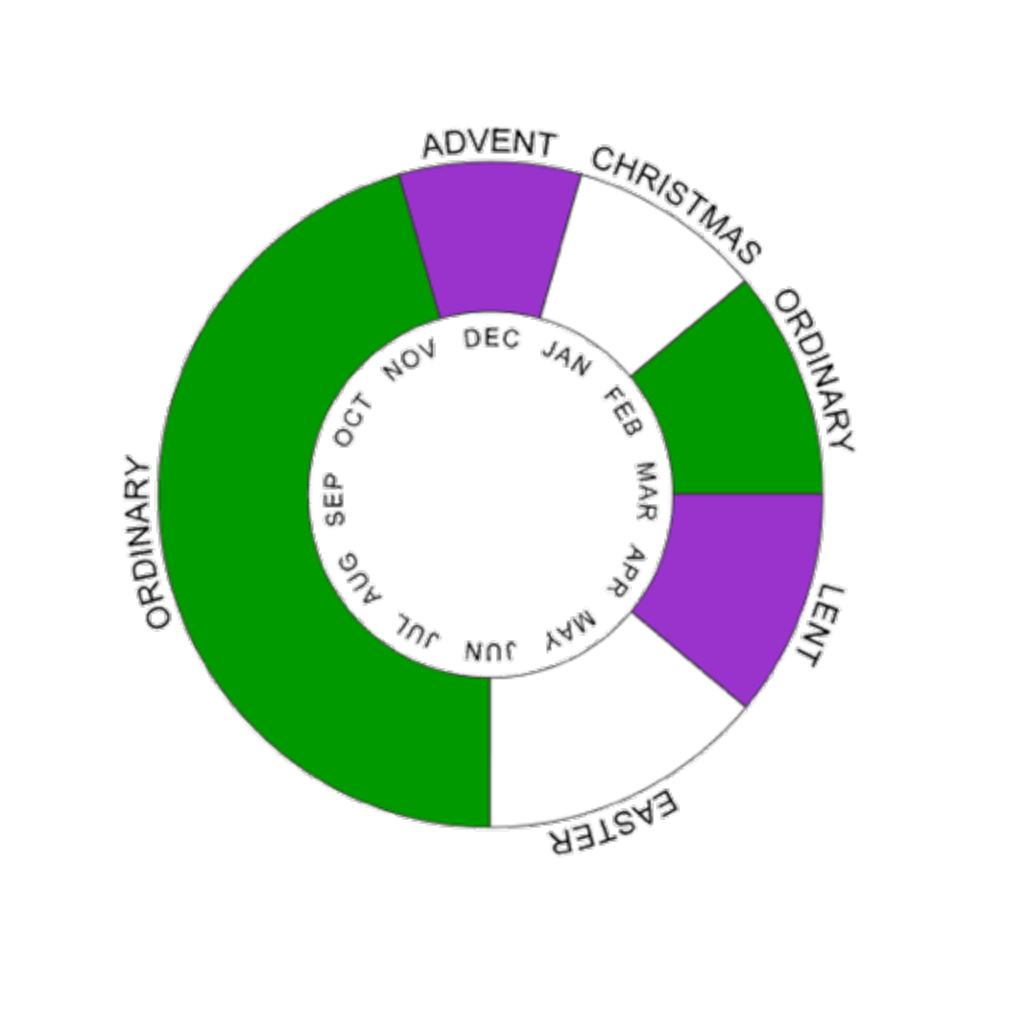
There are, in reality, two reasons to celebrate today. Not only is it right to say, “Happy Thanksgiving,” it’s also appropriate to say, “Happy New (Christian) Year!” That’s because, for the past two-thousand years, Christians have marked time differently than their secular culture.

The “Christian Year” (or “Church Calendar”) refers to a yearlong calendar that marks time according to God’s activities rather than ours. It is to live life in a rhythm with Christ at the center of worship.

Time is referenced in the Bible as both chronological (Chronos) and seasonal (Kairos). The Christian Year is a co-mingling of both these kinds of time. Liturgical Christians celebrate events in which God acted in history for the benefit of his people. In order to remember those moments, dates have been assigned on the Christian Calendar so that we will not forget these significant events and praise God for what he has done.

So, then, to observe The Christian Year helps Christians as God’s people to recall and retell the story of God, especially the redemptive events of Jesus. In doing so, it provides a guide for spiritual growth. The Christian Calendar is arranged in such a way as to proclaim the gospel of Jesus Christ over the course of a year. 

One of the ways this helps followers of Christ to remember distinct seasons is through the liturgical colors: 

  • Purple signifies a time for preparation and penitence.
  • White represents celebration, joy, and victory.
  • Green lets us know it is time to focus on spiritual growth and mission.
  • Red helps us recall the Passion of Christ and the fire of the Holy Spirit.

The Christian Year is organized and arranged with these seasons:

Advent The Christian Year begins not on January 1, but four Sundays before Christmas Day and up to Christmas Eve.  The purpose of Advent is to anticipate Christ’s incarnation and prepare Christians to celebrate the coming of Jesus.  We are also reminded that Jesus will return again at the end of the age.

Christmas Yes, Christmas is more than just a day on the Church Calendar and encompasses the twelve days from December 25 to January 5 (you may recognize the “12 Days of Christmas”).  Christmas is a celebration of the birth of Christ.

EpiphanyEpiphany follows Christmas from January 6 to the day before Ash Wednesday.  The term Epiphany means “manifestation.”  This is a celebration of God’s revelation, his manifestation to the entire world, not just to the Jews, but to the Gentiles, as well.  Epiphany emphasizes Jesus Christ’s earthly ministry of teaching, healing, and preaching.

Lent There are forty days in the season of Lent, from Ash Wednesday to Holy Saturday.  Lent is a time to recall Christ’s temptation, conflict, suffering, and death.  It is a season to contemplate Christian discipleship through the light of Christ’s Passion, engage in repentance, and put deliberate focus on spiritual disciplines that connect the penitent with Jesus.

EasterAs with Christmas, Easter is not just one Sunday; it is a season of fifty days up to the day of Pentecost.  Easter celebrates the resurrection of Jesus; helps believers recognize new life in Christ; and includes celebrating the Ascension of the Lord.

Pentecost This season runs from Eastertide to the Sunday before Advent.  Pentecost celebrates the gift of the Holy Spirit, the birth of the church, acknowledges personal and communal spiritual power, and calls Christians to rejoice in receiving God’s power.

Ordinary TimeThis is the same season as Pentecost.  Ordinary time (also known as Proper Time) refers to the ongoing work of the church to spread the gospel of Jesus Christ, which is the typical, expected, proper and ordinary work of ministry that Christ’s followers are to do.

God of all time, you make all things new, bring hope alive in our hearts, and cause us to be born again. Thank you for this new Christian Year of following Jesus and all the potential it holds. Come and kindle in us a mighty flame so that in our time, many will see the wonders of God and live forever to praise your glorious name. Amen.

2 Samuel 6:16-23 – Shameless Worship

As the Ark of the Lord came into the city, Saul’s daughter Michal looked out the window. When she saw David jumping and dancing in the presence of the Lord, she hated him.

David put up a tent for the Ark of the Lord, and then the Israelites put it in its place inside the tent. David offered whole burnt offerings and fellowship offerings before the Lord. When David finished offering the whole burnt offerings and the fellowship offerings, he blessed the people in the name of the Lord All-Powerful. David gave a loaf of bread, a cake of dates, and a cake of raisins to every Israelite, both men and women. Then all the people went home.

David went back to bless the people in his home, but Saul’s daughter Michal came out to meet him. She said, “With what honor the king of Israel acted today! You took off your clothes in front of the servant girls of your officers like one who takes off his clothes without shame!”

Then David said to Michal, “I did it in the presence of the Lord. The Lord chose me, not your father or anyone from Saul’s family. The Lord appointed me to be over Israel. So, I will celebrate in the presence of the Lord. Maybe I will lose even more honor, and maybe I will be brought down in my own opinion, but the girls you talk about will honor me!”

And Saul’s daughter Michal had no children to the day she died. (New Century Version)

“God wants worshipers before workers; indeed the only acceptable workers are those who have learned the lost art of worship.”

A.W. Tozer

A true celebration of God was underway, enjoying the blessing of God. The sacrifices before God were sweet smelling because they were done in a spirit of obedience and humility, and according to the specifications of worship with the Ark of God’s Covenant.

However, David’s wife, Michal, the daughter of the former king, Saul, did not worship. She critically observed David and the others and evaluated the worship service by how it appeared to her. Michal was not with everyone else giving herself to the true worship of God. She did not like how her husband went about worship. 

The acceptable worship of God was not acceptable to her, and she gave David an earful about it. Yet, David was undaunted. He had his focus where it ought to be.

We get a cryptic last note on Michal, describing that she was barren to the day of her death – it is a note on her meant to convey both a physical reality of her body, and a spiritual reality of her soul.

So, how are we to worship God? In the New Testament Gospels, Jesus said about worship: 

“Indeed, the time is coming, and it is now here, when the true worshipers will worship the Father in spirit and truth. The Father is looking for people like that to worship him. God is a spirit. Those who worship him must worship in spirit and truth.” (John 4:4:23-24, GW) 

Neither good intentions alone (in spirit) nor appropriate actions alone (in truth) constitute acceptable worship.  We must possess both. The worship Jesus talked about was literally “to prostrate oneself before God.”  In other words, it is to embrace both the disposition and the attitude of submission and humility toward God, seeking to obey the Lord as rightful Ruler, rather than superimpose our desires on him. 

Furthermore, God is both near to us and far away from us, all at the same time. God is close to us through the person and work of Jesus Christ, and now in the person of the Holy Spirit. God exists supreme and far above us, calling the shots of how we ought to be living our lives.

We must appreciate both divine transcendence and divine immanence.

The presence of God is both comforting and dangerous. God’s holiness is like a fire, giving us light and warmth – get too close to the flame and you will get burned, even destroyed. We do not get to tell God what we are to be doing and how to go about it. We have collective promises and blessings given to us as God’s people. Yet, at the same time, we have a responsibility to know God’s will and to do it in God’s way.

God cares about worship. If we worship any old way we want without consideration of how God wants it done, or if we just critically watch worship without engaging in it, then we ought not to expect blessing. However, if pay attention to God and are careful to do what God wants in God’s way, then we will enjoy God’s approval.

The Church is first and foremost a worshiping community of redeemed persons through the blood of Christ, which are given to the world in order to glorify God:

Everyone on this earth,
    sing praises to the Lord.
Day after day announce,
    “The Lord has saved us!”
Tell every nation on earth,
“The Lord is wonderful
    and does marvelous things!
The Lord is great and deserves
    our greatest praise!
He is the only God
    worthy of our worship.
Other nations worship idols,
but the Lord created
    the heavens.
Give honor and praise
    to the Lord,
whose power and beauty
    fill his holy temple.”

Tell everyone of every nation,
“Praise the glorious power
    of the Lord.
He is wonderful! Praise him
and bring an offering
    into his temple.
Worship the Lord,
    majestic and holy. (1 Chronicles 16:23-29, CEV)

The text in 1 Chronicles, a restatement of our Old Testament lesson for today, goes on to say:

David left Asaph and his coworkers with the Chest of the Covenant of God and in charge of the work of worship; they were responsible for the needs of worship around the clock.

He also assigned Obed-Edom and his sixty-eight relatives to help them. Obed-Edom son of Jeduthun and Hosah were in charge of the security guards. The priest Zadok and his family of priests were assigned to the Tent of God at the sacred mound at Gibeon to make sure that the services of morning and evening worship were conducted daily, complete with Whole-Burnt-Offerings offered on the Altar of Burnt Offering, as ordered in the Law of God, which was the norm for Israel.

With them were Heman, Jeduthun, and others specifically named, with the job description: “Give thanks to God, for his love never quits!” Heman and Jeduthun were also well equipped with trumpets, cymbals, and other instruments for accompanying sacred songs. The sons of Jeduthun formed the security guard. (1 Chronicles 16:37-42, MSG)

David exerted his kingly authority by instituting that in Israel the worship of God was to take place every day – not just one day a week. He hired hundreds of musicians, singers, and worship leaders to minister before the Lord every single day, twice a day. 

“I must take time to worship the One whose name I bear.”

Oswald Chambers

Many believers bemoan the morality and lack of spirituality in our world. Yet, if God’s people are not first and foremost a worshiping community, then we have nowhere else to look to institute the change which is needed.

In addition, every conceivable instrument and voice was used to praise God in worship. New songs were written continually by David, and arranged by Asaph, the worship leader. 

While we make plans and conceive of ideas for our lives, God is waiting for us to worship. It would be good to spend some time each morning when we arise, and each evening at bedtime, in worship following the example of David: remembering God, and who we are; singing to the Lord; confessing sin; claiming forgiveness; reading Scripture; and, praying. 

If we all devoted ourselves to worship without shame, then we might begin to imagine God opening to us blessing upon blessing.

*Above sketches of King David dancing before the Lord, by Rebecca Brogan