Be Patient – Third Sunday of Advent (James 5:7-10)

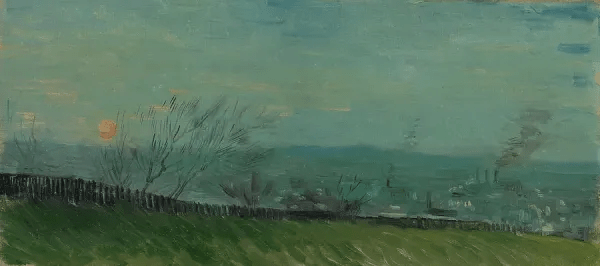
Sunset in Montmartre, by Vincent Van Gogh, 1887

Be patient, therefore, brothers and sisters, until the coming of the Lord.

The farmer waits for the precious crop from the earth, being patient with it until it receives the early and the late rains. You also must be patient.

Strengthen your hearts, for the coming of the Lord is near.

Brothers and sisters, do not grumble against one another, so that you may not be judged. See, the Judge is standing at the doors! 

As an example of suffering and patience, brothers and sisters, take the prophets who spoke in the name of the Lord. (New Revised Standard Version)

Patience is a wonderful virtue… unless you’re smack in the middle of circumstances you neither want nor asked for. Then, patience feels a whole lot more like a vice.

It’s easy to be impatient; it takes little to no effort at all. And praying for patience doesn’t help, because you’re prayer actually gets answered; God puts you in one of those unwanted situations.

The Jewish Christians for whom the Epistle of James was addressed were in that weird life-place of enduring hard circumstances. They were struggling with impatience, so much that the believers began cozying up to the rich and powerful to meet their ever-increasing needs. In their misery, they were looking to the very people who were using them and withholding wages from them. (James 2:1-7; 5:1-6)

It seemed as if God was shuffling his divine feet and not getting around to helping the Christians in their difficulty. They gave everything to Jesus and following him, to the point of being willing to suffer for the Name.

Their suffering led to outright persecution. The believers had to flee Judea for Gentile lands to the West (Acts 8:1-3). In their new homes they got double-trouble. Because they were Jews, they were looked at with suspicion. And because they were Christians, the Jewish community didn’t accept them. The believers were truly alone. All they had was Jesus.

It was enough, at least for a while. But it’s one thing to face difficulty, and quite another thing for the trouble to bleed into next week, next month, next year… When is this ever going to end?

Impatience doesn’t help. In fact, it only exacerbates an already agonizing situation. Grumbling and arguing and verbal fights begin to occur. The community starts to fracture. Blaming and shaming slowly replace the love and encouragement they once had together.

Every good thing in life takes time – lots of time! And the best things in life require a lifetime of endurance, perseverance, and patience. In order to keep going and hold onto our spiritual commitment, we need solid examples of patience, and reasonable ways to think about our situations.

I admit that it has been hard for me to be patient, as of late. I’m weary of American politics and the current administration. I’m tired of seeing my family members struggle with health issues day after day – many of them having to endure debilitating and heart-wrenching trials.

And there are some days when I’ve just had it with my own limitations. I can’t do many of the things I used to do, and it’s frustrating to tears to try and do some things that others do effortlessly.

Yet the Scripture reminds me of my days growing up on the farm. Planting and harvesting never happened in a week; it takes months to realize a return on all the hard work done through the Spring and Summer to get to Fall’s mature crop.
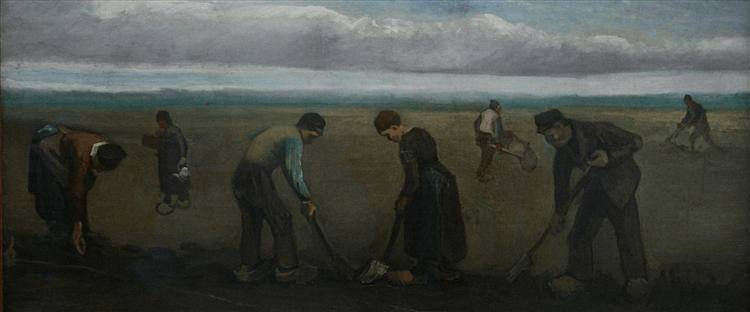
Peasants Planting Potatoes, by Vincent Van Gogh, 1884

I’m also reminded of the biblical prophets who suffered much for their message to the people. Lately, I’ve been reading the prophecy of Ezekiel in the Old Testament. If you have never read Ezekiel, or only read bits of it, you may not realize how incredibly difficult Ezekiel’s life was in serving Yahweh.

The prophet kept up a steady stream of very challenging situations to illustrate the message of judgment he was continually giving. Needless to say, Ezekiel was not always a popular guy. Proclaiming gloom, doom, and death all day every day tends to do that. In one encounter, for month after month, the prophet laid on his side and had to use excrement to light a fire and cook his food every day. God told him to, so that the people would see what was about to happen to them. (Ezekiel 4:1-17)

We have no record of Ezekiel grumbling or talking back to God. He faithfully did all that the Lord commanded him to say and do. He endured all the grumblers around him, and all the grieving people who had been displaced from their homes in Jerusalem.

In every generation, there are people in this world that undergo difficulties and troubles which others could never even imagine. And it’s been going on for millennia. Furthermore, terrible adversity will keep happening… until Christ returns.

Yes, there will be an end to all the suffering. But we may have to persevere to the end of our lives, remaining faithful to our spiritual commitment, and keeping up our love for one another. It won’t be easy to do.

I would be nothing but a hack preacher if I told you that everything will be bunnies and butterflies if you only look to Jesus and have faith. Although there can be joy, even in our mourning, there will always be the need for an agonizing form of patience that continually watches for help, healing, and hope in the return of Christ.

This is why it is so important not to let your own family, church, and faith community break down into fissures of impatience and grumbling.

We must keep our hearts strong. Ironically and paradoxically, that happens through our weakness.

In some ways, I’m weaker than I’ve ever been in my life. Yet, in other ways, I’ve never been stronger. The Trump administration can break me down and mess with my healthcare and my finances… my illness can keep me from ministry that I long to do… and the daily crud of life may redirect me in ways I don’t like… but I can truly say that God is good; God is the strength of my life.

I know that Christmas is coming. I’m looking for the birth of the Savior. I expect to see the angels rejoicing in the sky. I fully look forward to stepping in a few cow pies and horse apples in order to get a glimpse at the baby who changes the world.

Every good thing in life comes with a bit of manure on the shoes. And the best things in life are worth all the hardship one goes through in order to see the glory and majesty of the Divine.

I may not know you, my friend, but please know that I am praying for you. No matter what happens, I can always pray, always watch, always hope, always believe, and always love my neighbor, despite all the hate in this old fallen world.

Be safe. Be strong. Be spiritual. We are all in this life together.

God of joy and exultation, you strengthen what is weak; you enrich the poor and give hope to those who live in fear. Look upon our needs this day. Make us grateful for the good news of salvation and keep us faithful in your service until the coming of our Lord Jesus Christ, who lives forever and ever. Amen.


There Is a Behemoth In the Room (Job 40:1-24)

And the Lord said to Job:

“Shall a faultfinder contend with the Almighty?
    Anyone who argues with God must respond.”

Then Job answered the Lord:

“See, I am of small account; what shall I answer you?
    I lay my hand on my mouth.
I have spoken once, and I will not answer,
    twice but will proceed no further.”

Then the Lord answered Job out of the whirlwind:

“Gird up your loins like a man;
    I will question you, and you declare to me.
Will you even put me in the wrong?
    Will you condemn me that you may be justified?
Have you an arm like God,
    and can you thunder with a voice like his?

“Deck yourself with majesty and dignity;
    clothe yourself with glory and splendor.
Pour out the overflowing of your anger,
    and look on all who are proud and humble them.
Look on all who are proud and bring them low;
    tread down the wicked where they stand.
Hide them all in the dust together;
    bind their faces in the world below.
Then I will also acknowledge to you
    that your own right hand can give you victory.

“Look at Behemoth,
    which I made just as I made you;
    it eats grass like an ox.
Its strength is in its loins
    and its power in the muscles of its belly.
It makes its tail stiff like a cedar;
    the sinews of its thighs are knit together.
Its bones are tubes of bronze,
    its limbs like bars of iron.

“It is the first of the great acts of God;
    only its Maker can approach it with the sword.
For the mountains yield food for it
    where all the wild animals play.
Under the lotus plants it lies,
    in the covert of the reeds and in the marsh.
The lotus trees cover it for shade;
    the willows of the wadi surround it.
Even if the river is turbulent, it is not frightened;
    it is confident though Jordan rushes against its mouth.
Can one take it with hooks
    or pierce its nose with a snare? (New Revised Standard Version)

At various times throughout my life, and the life of my dear family, we have been referred to by others as “the family of Job.” Believe me, it’s not really a moniker you’d like to have.

It can be good to know that there are others who see you and affirm your undeserved suffering. Yet, suffering is not something I have ever asked for or wanted.

Suffering is like an uninvited guest who crashes life’s party. And there is no bouncer I can turn to in order to get this unwanted behemoth out of my life.

Speaking of behemoths, it just so happens that “Behemoth” is mentioned by God in today’s Old Testament lesson.

The word “behemoth” is simply an English transliteration (bəhēmōṯ) of the Hebrew word (בְּהֵמוֹת). This is because nobody really knows what the Behemoth is, or was.

This, however, didn’t stop some English translations from interpreting Behemoth, e.g. “hippopotamus” in the Contemporary English Version; and, the Easy-to-Read Version uses “behemoth” but inserts the footnote that “This might be a hippopotamus, a rhinoceros, or possibly an elephant.”

Whatever Behemoth actually was, it was very big and strong. And the fact that God can have one as a pet is meant to speak of how immense and powerful God is.

A big old Behemoth is something we may be awe-inspired by, or even admire from afar. But I don’t think any of us would want one in our living room, especially if the Behemoth is bigger than the room.

But that’s exactly where I too often find myself. I come home, and there is this great big behemoth that I cannot get around nor ignore. I have to deal with it.

The Behemoth makes me realize that I am rather puny and weak; I am therefore very limited in how I can deal with it. Compared to this Behemoth, I am nothing. My human limitations come annoyingly to the forefront as a pathetic display of ineffectiveness.

And that is precisely what I don’t like. I absolutely despise being limited. I keep holding to the ridiculous notion that in any and every situation, I feel that I should be able to handle it. I should be the smartest person in the room. I ought to be the best person for the job. I should be up to whatever job is in front of me.

I can easily “should” myself to death, believing that because I look like Clark Kent, I am really Superman. But the truth is that I am vulnerable, limited, and don’t have all the answers.

I have no problem whatsoever affirming God’s power, size, and ability. I have plenty of faith to believe that God’s plans and purposes will be accomplished in this world. And I have all kinds of trust that God is good for divine promises made.

But I have some serious problems with my own limitations. I hate having a lack of knowledge, awareness, and strength. I despise not being able to help. I want nothing to do with what my late aged parents described as “being a burden to my family.”

Yet, here I am. A human, with all the weaknesses, limitations, and ignorance that goes with it.

And this is the core of my problem: I cannot help God, be more like Jesus, and have the strength of the Holy Spirit. In other words, I am not God. I’m about as close to being like God as both ends of the universe are.

As big as that huge Behemoth is in my life – which for me, is actually my insipid and frustrating limitations – God is infinitely bigger than the biggest Behemoth there ever was.

It turns out that my not wanting to submit to anything but God, is really a lack of submission to God. The Lord wants to use my wife, my children, my colleagues, my neighbors, and even people I don’t know and/or don’t like to help me in my limitations.

When God shows up, it usually isn’t in a dramatic whirlwind; God typically comes in the form of the person right in front of me.

Almighty God, the Creator and Sustainer of the universe, you have no limits. Yet, I am quite limited. My body cannot do everything. My mind cannot know all things. My ability to feel and express emotion is too often suppressed and purposely limited. And my spirit is too often limited to the three dimensions of my physical existence. Help, Lord; I need you.

May your divine grace and peace surround me and fill me, so that even when I am weak in body, I am strong in faith. Help me to accept my human limitations, as well as help from others; and to embrace and pursue my spiritual possibilities; through Jesus Christ my Lord. Amen.

Questions Without Answers (Job 38:1-7, 38-41)

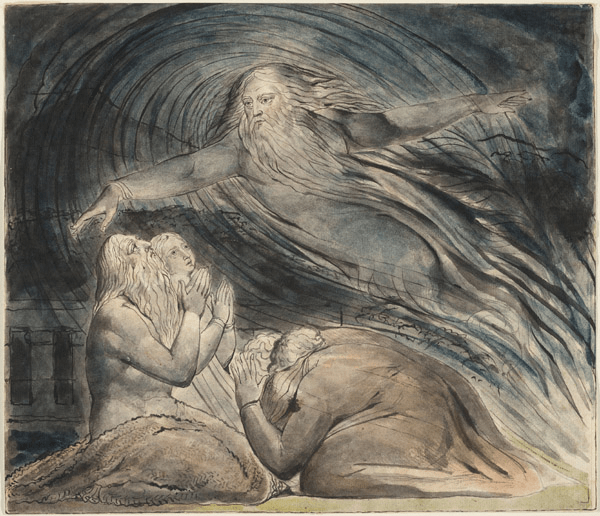
God Answers Job Out of the Whirlwind, by William Blake, 1805

Then the Lord answered Job out of the whirlwind:

“Who is this that darkens counsel by words without knowledge?
Gird up your loins like a man;
    I will question you, and you shall declare to me.

“Where were you when I laid the foundation of the earth?
    Tell me, if you have understanding.
Who determined its measurements—surely you know!
    Or who stretched the line upon it?
On what were its bases sunk,
    or who laid its cornerstone
when the morning stars sang together
    and all the heavenly beings shouted for joy?…

“Can you lift up your voice to the clouds,
    so that a flood of waters may cover you?
Can you send forth lightnings, so that they may go
    and say to you, ‘Here we are’?
Who has put wisdom in the inward parts
    or given understanding to the mind?
Who has the wisdom to number the clouds?
    Or who can tilt the waterskins of the heavens
when the dust runs into a mass
    and the clods cling together?

“Can you hunt the prey for the lion
    or satisfy the appetite of the young lions,
when they crouch in their dens
    or lie in wait in their covert?
Who provides for the raven its prey,
    when its young ones cry to God
    and wander about for lack of food? (New Revised Standard Version)

The Book of Job is rather long. After the initial two chapters which set the scene for Job’s awful suffering, we then get an extended and agonizing thirty-five chapters of speeches between Job and his companions. It’s a lot of words which generally go nowhere.

So, by the time we get to this point in chapter 38 of Job, we may likely say, “Finally, God speaks!” Indeed, this is the moment Job has anticipated.

Perhaps we are looking for something in Job’s story which may help us in our own story of suffering. Like Job, maybe we’re looking for vindication of our situation, a restoration to some semblance of life before the grief, or to have our reputation upheld.

But that is not what we get from God. For the next nearly four chapters, God only speaks in questions, and does not answer a single one of them.

If it’s answers to questions we’re searching for, it is unlikely you will get them, at least on this side of heaven. You are more likely to get even more questions than you started with. And then, imagine being questioned by God, and having no answers for God whatsoever.

Yet, that is the point. We humans know jack squat – absolutely nothing, in comparison to an omnipresent and omniscient God.

If it’s God’s voice you really want to hear, you may not know what you’re actually asking for. That was certainly true for Job and his friends. God’s questions are really rather rhetorical; there is no way any of us could really answer them with any sort of knowledge or understanding. It would be a bit like a parent asking their toddler to describe his own birth and how it happened.

God’s unanswerable questions revolve mostly around the workings of the universe. God is the Creator, and none of us were around when it all came into existence. So, of course, we have no answers.

Yet, with all of the questions, we quickly get the impression that humans have very little control over much of anything. And I think that perhaps God wants us to be aware of that reality.

It seems to me that with every question of God, we are led to believe that God is God, and is really big; and that we are not God, and are pretty dang small.

I don’t think any of this is meant to make us feel irrelevant or disposable. Rather, it gives us some needed perspective, that is, that our perspective on world issues, events, and problems is very narrow. But God sees the whole big picture and has a stellar full perspective of all things and all people.

The God in the Book of Job is no vending machine deity, in which we can pick-and-choose what we like and don’t like. There is no grand certainty that if we press the right buttons in prayer that we get what we want.

Therefore, God is not some automaton who predictably rewards the righteous, and punishes the wicked (according to our definitions of those terms). Yet this is the God that Job’s friends believed in – which is why they reflexively interpreted Job’s situation as Job himself being a sinful man.

Even Job believed in this sort of God, at least to some degree. Up to the point of his terrible trouble, he was good and righteous, and received due reward for his faithfulness. The divine system was serving Job well.

But then the system seems to have broken down. Job interpreted God as not doing the expected divine job of operating within the predictable divine structure.

Believers in every generation and era must come to grips with the reality that – although personal virtue and devotion are important – one’s piety does not necessarily lead to personal health nor wealth.

In other words, good guys don’t always win in this life, because having faith typically means we will actually suffer, rather than not.

This is, to me, good news. Why? Because it means, conversely, that persons victimized by violence, poverty, and loss are not necessarily to blame for their troubles. Frankly, there are times when bad things happen to us that are not our fault, and we don’t see any good reason for it happening.

Whenever God is silent, we might start to think that God is also absent. We may begin to entertain nihilist thoughts that nothing matters, that everything in this universe is just random chaos.

Yet, God’s response with all the questions lets us know that there is a solid structural foundation to this universe that we aren’t always aware of. In other words, there is meaning, purpose, and order to it all. We are not forgotten. God sees and remembers us.

I do believe there is a reason for everything. However, I do not believe that we are always privy to know what that purpose may be. Which means that oftentimes, like Job, we don’t have any answers to our existential questions of human tragedy and trouble. This line of thinking isn’t meant to be a cop out; it’s meant to help us accept that we are human.

Sometimes all we can do is affirm what we know to be true, and accept the limits of our own human understanding of things such as:

  • God is God. I am not.
  • God created the world. I didn’t.
  • God established order in the universe. I sometimes see order, and oftentimes see what looks like random chaos.
  • God is Love all the time. I love, but not always.
  • God is with us, even though I may not always sense or feel that divine presence.

Maybe what is most important is that we humans keep up our dialogue with God – our questions, musings, emotions, and expressions of faith and devotion. Because it is in the relationship that we discover the key to the universe.

O God, by whom the meek are guided in judgment, and light rises up in darkness: Grant us, in all our doubts and uncertainties, the grace to ask what you would have us to do, so that the Spirit of wisdom may save us from all false choices, and that in your light we may see light, and in your straight path may not stumble. Amen.

Nothing Makes Sense (Ecclesiastes 1:1-18)

Statue of “The Thinker,” by Auguste Rodin, 1880. Photo by Robert Reynolds.

When the son of David was king in Jerusalem, he was known to be very wise, and he said:

Nothing makes sense!
Everything is nonsense.
    I have seen it all—
    nothing makes sense!
What is there to show
for all of our hard work
    here on this earth?
People come, and people go,
but still the world
    never changes.

The sun comes up,
    the sun goes down;
it hurries right back
    to where it started from.
The wind blows south,
    the wind blows north;
round and round it blows
    over and over again.
All rivers empty into the sea,
    but it never spills over;
one by one the rivers return
    to their source.

All of life is far more boring
    than words could ever say.
Our eyes and our ears
are never satisfied
    with what we see and hear.
Everything that happens
    has happened before;
nothing is new,
    nothing under the sun.
Someone might say,
    “Here is something new!”
But it happened before,
    long before we were born.
No one who lived in the past
    is remembered anymore,
and everyone yet to be born
    will be forgotten too.

I said these things when I lived in Jerusalem as king of Israel. With all my wisdom I tried to understand everything that happens here on earth. And God has made this so hard for us humans to do. I have seen it all, and everything is just as senseless as chasing the wind.

If something is crooked,
    it can’t be made straight;
if something isn’t there,
    it can’t be counted.

I said to myself, “You are by far the wisest person who has ever lived in Jerusalem. You are eager to learn, and you have learned a lot.” Then I decided to find out all I could about wisdom and foolishness. Soon I realized that this too was as senseless as chasing the wind.

The more you know,
    the more you hurt;
the more you understand,
    the more you suffer. (Contemporary English Version)

There’s an awful lot of nonsense in this old world. Arguably, the wisest person who ever lived, King Solomon, said that everything is nonsense, and all things are meaningless.

That’s probably why the Book of Ecclesiastes isn’t at the top of most people’s reading list. Admittedly, in many ways, it’s a depressing read.

Yet, maybe we are being led to consider that it really isn’t our task or purpose to understand everything in this world. After all, if a wise guy like Solomon didn’t make heads nor tails of it all, why in tarnation would you or I try to do so?

This doesn’t mean we don’t understand anything; it just means that we don’t have the ultimate answers on the universe’s workings. And if we try to have perfect knowledge of all things, it will be a fool’s errand. That’s because only God has ultimate understanding and perfect knowledge of everything and everyone.

So then, what do we do? Glad you asked. We accept our limitations, and thereby, it is likely we will gain more understanding than any other way we try.

Meister Eckhart, a medieval Catholic monk, had some sage observations in this short poem:

What is the prayer

of a heart loosed

from all the things

that crowd our lives

and worry our minds

from day to day?

it is coming to that

place within us where

not knowing is the

mark of faith,

not wanting

the work of hope,

and not demanding

the gift of love.

Meister Eckhart talked of acceptance, and letting go of expectations. Learning to allow things to go as they will go, to be okay with not always having to have answers for everything, and refusing to control people and outcomes, is not only the path to acceptance, but is also the way of peace and less anxiety.

Likely, the best that we can do every day is to show up, pay attention, speak the truth in love, and don’t be married to the consequences.

If we can accept our limitations and weaknesses, and embrace the mysteries of life, then a whole world of discernment and wisdom can open to us within the narrow scope of our very mortal lives.

Indeed, we can find a sense of satisfaction and happiness in who we are, and what our place is in this very big world. Yet, this only comes with some significant struggle. Taking the easy path only results in cheap counterfeit contentment.

We will need to become comfortable with mystery and paradox, the knowledge that comes with not knowing, and upside-down theology. These are our keys to the secrets of life.

We must rid ourselves of the idea that Scripture is merely a life map that shows how and where to live. Holy Scripture may be a map, yet, it will point us in directions we may not want to go; and may even tell us to be in two places at once.

To try and make the Bible neat and tidy, with clear answers to modern day questions, is probably why such persons avoid the Book of Ecclesiastes as if it were the plague.

In reality, Ecclesiastes is a book that stands the orderly nature of life on its end. It is the scriptural place where playing by the rules and believing the right things won’t give you the good life you’re searching for.

Eventually, everyone encounters a dark night of the soul in which the death of a loved one, a failed relationship, or the loss of health turns our neatly ordered world upside-down to the point where we don’t recognize who we are, or what the world really is anymore.

These are times when our platitudes of simple faith are impotent to help us. Trust and belief are still important and vital, but they are no longer as understandable and intelligible as they once were.

It is imperative in these times that we doubt and question things; and even question God. A genuine robust faith is one that has been gained by plodding through the muck of anger, and even depression.

Authentic belief is neither cheap nor easy. It engages more than a few mental thoughts; it also goes to the heart and the gut, often with heart-rending emotions and gut-wrenching insights.

The Book of Ecclesiastes is a book for all of us. But it must not be read lightly nor flippantly. It’s contents need to be grappled with. Simply reading the last page of the book and making a faith declaration from that place will not only get you nowhere, it is also potentially damaging.

Only engage this material if you are brave enough, have some chutzpah within you, and are willing to reconsider and perhaps let go of all previous settled ideas about how the world is, or at least, how it should work.

So, if you want some quick answers to life’s meaning and purpose, Ecclesiastes is not the place to look. There are plenty of charlatans out there who would be happy to give you such information.

But if you are searching for something real and authentic, genuine and lasting, then be prepared for a tough, yet fruitful, slog through the “meaningless” meanderings of Ecclesiastes.

Only the courageous and the vulnerable should enter.

O God, I am very sorry that I have sinned against you and for all the wrongs I have done and the good I have not done. Forgive me, and grant me strength and wisdom to amend my life.

I offer you praise and thanksgiving, for creation and all the blessings of this life, for redemption, faith, and love; and for the means of grace and the hope of glory. Amen.