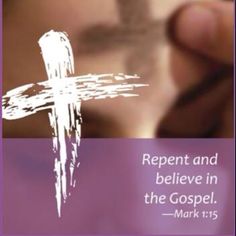
Lent and Repentance


            The Christian season of Lent encompasses the forty days before Easter.  This year it’s from February 10 (Ash Wednesday) to March 27 (Easter), 2016.  Lent is a season of the Christian Year where believers focus on simple living, prayer, and fasting in order to grow closer to God.  At the baptism of our Lord the sky opened and the Spirit of God, which looked like a dove, descended and landed on Jesus.  A voice from heaven said, “This is my Son, My Beloved, with whom I am pleased.” Jesus was then sent into the wilderness by the Spirit where he fasted and prayed for forty days (Matthew 4:1-11). During his time in the desert Jesus was tempted by Satan and found clarity and strength to resist temptation. Afterward, he was ready to begin his ministry.
 
            Lent is the ideal time of year to repent — to return to God and re-focus our lives to be more in line with Jesus. It’s like a forty-day trial run in changing your lifestyle and letting God change your heart.  Repentance is the key that unlocks the soul’s ability to connect with God.  To repent means to turn around, to stop going in one direction and start going in another one.  It is repentance that makes all the difference in the orientation of our souls in this life.
 
            Certainly, no one can really judge the heart of another.  Only God can rightly do that.  Yet, the New Testament lets us in on how to truly measure the sincerity of one’s repentance (2 Corinthians 7:2-12).  Worldly sorrow or grief does not lead to repentance, but only separation and death.  The person with worldly sorrow beats himself up but never really changes direction.  Like Judas Iscariot of old, he just metaphorically hangs himself instead of admitting his guilt to Jesus. 
 
            But godly sorrow leads to repentance, a real change of direction.  And here is the evidence from the Scriptures of the genuineness of the change:  owning up to the problem/sin; an eagerness to make things right; indignation over what has been done or said; seeing that there is more pain in avoiding the problem than there is in confronting it; a desire and energy to do what is best for the person whom we have wronged; and, a willingness to accept whatever consequences that might result from the offense.
 
            Crying and tears might occur and can even be necessary, but they can also be a cheap form of avoiding true repentance and might only be worldly sorrow.  Instead, there must be solid action that changes direction and seeks to rectify offenses, as much as it is within our control to do so.  Deliverance from the power of sin can only come through repentance.  There are no shortcuts or easy routes to the soul’s orientation to practical godliness.  There is nothing romantic about repentance; it is typically messy, usually ugly, and often painful.  Yet, there must be suffering before glory.  Trying to take repentance out of the equation is to eviscerate the Christian life and leave our souls vacuous and empty.
 
            Sometimes we do not even know we need to repent because we get caught up in the drama of school, relationships, family, and work. Our lives are filled with distractions that take us away from living a life with Christ. We might try to fill the emptiness inside us with mindless web-surfing, meaningless chatter, too many activities or other stuff that just keeps us busy without thinking too much. We run away from real life and from God.  But when we intentionally create a plan to connect with God, his Spirit begins to reveal the need for repentance.  That plan during Lent ought to include some form of fasting, prayer, and service.  For example, you could take the Christmas cards you received and pray for one of the people/families each day in the forty days, instead of eating the candy bar or drinking the soda; and, then send them a note of encouragement.  Or, get up ten minutes earlier than usual and spend those minutes in silence and prayer.


            To choose nothing is to give into worldly sorrow and feel guilty.  To choose something, whatever that something is, is to anticipate that God will work in your soul to thaw it out, warm it up, and form it to better discover Jesus Christ.

Ecclesiastes 3:1-8

            I think most people can resonate with the wisdom from Ecclesiastes:  “For everything there is a season, and a time for every matter under heaven.”  We intuitively know that there must be balance to life, and that there needs to be a sage approach to living-out all of the many responsibilities and duties of this present time.  The problem, it seems to me, is not that we don’t recognize the need for movement from one season to another; the issue is that we do not deliberately and intentionally stop one thing and start another – we just keep going.  We keep working when we should stop; we continue eating beyond what we know we should; we do not stop yelling, or being angry; we continue in abject furrow-browed seriousness with no end in sight; parents keep treating their adult children like little kids who need their constant guidance; and, churches ensconce a particular time in their history as normative even though it has outlived its shelf life.
 
            The Church Calendar is attentive to the movements and seasons of the Christian life.  We are now in the season of Lent.  This is the time for healthy soulful introspection, examination of the heart, and repentance which leads to the eventual new life of Easter.  It is the time to stop and question why we do what we do – why we cannot stop our compulsions and obsessive behavior.  It is the season to feel something of the suffering of Jesus Christ and discern that our salvation was obtained at a very steep cost.  It is the time to ponder why we even need deliverance in the first place, and what it is we need to be saved from.  Now is the moment for contemplation, fasting, and prayer.


            Eternal God, you are infinitely patient with my failings and foibles.  As I consider the cross of Jesus, and the power of the Holy Spirit, lead me to Calvary’s mercy and sacrifice.  Grace me with the repentance which leads to life.  Amen.

Psalm 51:1-17

            Today is Ash Wednesday, the first of forty days in Lent (six weeks) on the Christian Calendar which is designed to remind us of our mortality, God’s grace, and the great need for repentance and faith in Jesus.  There is perhaps no better place in Scripture to go than this psalm of David.  It is the consummate prayer of confession and repentance.
 
            If we struggle to know how to respond to our sin when we become aware of it, then this psalm is meant for us.  We are to use it and adopt it as our own.  The words of Holy Scripture are not simply ancient texts for a bygone era; they are living words to be read, prayed, meditated upon, memorized, and engrafted into the soul.  “Have mercy on me, O God, according to your steadfast love; according to your abundant mercy blot out my transgressions.”  Notice that David asked for mercy based upon God’s character, and not on the ground of the quality or intensity of his confession.
 
            If we trust only in our hearts, then our hearts will eventually condemn us because they can be desperately wicked.  But if we throw ourselves headlong into the vast ocean of God’s mercy, then we shall receive forgiveness of sins and assurance of pardon because God’s steadfast love never changes.  Ashes upon the forehead today are to be a reminder of our frailty and propensity toward sin; they are a symbol of repentance and desire for mercy.  Of all days, today is the day to set aside the pride of achievement and the pretense of appearing to have it all together, and humbly submit to God in repentance and faith.


            Create in me a clean heart, O God, and renew a right spirit within me.  Restore to me the joy of your salvation, and uphold me with a willing spirit.  In Jesus’ Name I pray.  Amen.

Ash Wednesday


Each year Ash Wednesday marks the beginning of the Christian season of Lent, a six week (40 day) period that climaxes in Holy Week and the great celebration of Easter Sunday.  These weeks on the Christian calendar are meant to remind us of a very important truth:  the grace of God in Christ forgives us of all our sins, and it came at great cost; there must be suffering before glory. 
 
            It is vital for us to never forget all God’s work for us as individuals – forgiveness, healing, redemption, love, compassion, and satisfaction.  This all has its fulfillment, for the Christian, in Jesus who accomplished this through his cross and resurrection.  It is by his stripes that we are healed; it is through his suffering that there is glory and praise.  Twenty-one years ago at this time of year, my wife was on total bed rest due to her pregnancy with our youngest daughter.  Having gone into labor only three months into her pregnancy, she was immediately confined to staying flat on her back for four months.  We lived every one of those days with the very real possibility of losing a child, having been told by doctors that we needed to brace for the worse, since our unborn girl was only given a 17% chance of making it to the outside world alive.
 
            In a very real sense my wife had to die to herself so that our daughter might live; and, the result of her months of suffering led to the glory of a beautiful and healthy baby girl.  We will not forget all of God’s benefits toward us, redeeming our suffering and replacing it with great joy.  Great praise arises out of great suffering.
 
            God remembers that we are dust, that we are mortal humans.  Sometimes we lose sight of our mortality.  We do not remember that death awaits us and that in some ways a good life is really preparing for a good death.  I once read that each morning a group of monks, when walking to breakfast, take one shovel-full of dirt and remove it from their potential graves.  The younger monks have shallow graves, and the older monks must take the time to get down into their graves and climb back out.  It is a daily reminder that life is to be lived to the full because it will not last.   God sees our mortality and is slow to anger, choosing to abound in love and compassion.  He acts by removing our transgressions completely, even though we do not deserve it.  Some day we will all die, but God’s love will still be here because God’s love is permanent.
 
In order to remember our mortality, and to offer our lives as a sacrifice of praise, in this season of Lent we are encouraged to prepare for the glory of the resurrection by feeling something of the suffering, however small it is, of our Lord Jesus.  In doing so, it is to be a daily reminder that Jesus gave his life for us so that we might have life.  The ash applied to the forehead on this day is symbolic of the thing or things that we are giving up.  Perhaps time is an idol for you; it is the thing precious to you and you want to hold on to it and serve it.  Perhaps there are possessions that you grasp and hold onto in such a way that you can’t imagine living without that certain thing.  Maybe there is an activity that you enjoy to the point of allowing that certain thing to shape and center your day.  This is the time to identify those things, and to make a choice to fast, to abstain from that thing or activity in order to remember Jesus and to worship him only.


The ministry of the church is to assist us in being aware of the movements, rhythms, and seasons of Christian time.  Now is the time of repentance.  Today is the day to be reminded of our sin and mortality, and God’s grace and immortality.  Let us experience death so that we will experience life.