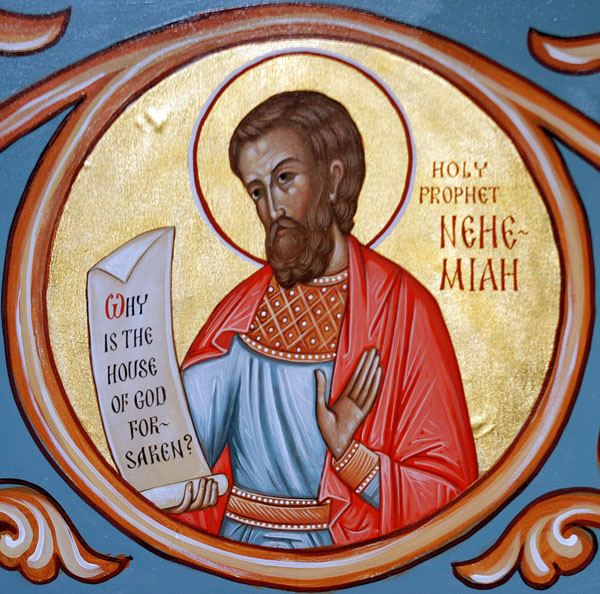
Now the men and their wives raised a great outcry against their fellow Jews. Some were saying, “We and our sons and daughters are numerous; in order for us to eat and stay alive, we must get grain.”
Others were saying, “We are mortgaging our fields, our vineyards and our homes to get grain during the famine.”
Still others were saying, “We have had to borrow money to pay the king’s tax on our fields and vineyards. Although we are of the same flesh and blood as our fellow Jews and though our children are as good as theirs, yet we have to subject our sons and daughters to slavery. Some of our daughters have already been enslaved, but we are powerless, because our fields and our vineyards belong to others.”
When I heard their outcry and these charges, I was very angry. I pondered them in my mind and then accused the nobles and officials. I told them, “You are charging your own people interest!” So, I called together a large meeting to deal with them and said: “As far as possible, we have bought back our fellow Jews who were sold to the Gentiles. Now you are selling your own people, only for them to be sold back to us!” They kept quiet because they could find nothing to say.
So, I continued, “What you are doing is not right. Shouldn’t you walk in the fear of our God to avoid the reproach of our Gentile enemies?I and my brothers and my men are also lending the people money and grain. But let us stop charging interest! Give back to them immediately their fields, vineyards, olive groves and houses, and also the interest you are charging them—one percent of the money, grain, new wine and olive oil.”
“We will give it back,” they said. “And we will not demand anything more from them. We will do as you say.”
Then I summoned the priests and made the nobles and officials take an oath to do what they had promised. I also shook out the folds of my robe and said, “In this way may God shake out of their house and possessions anyone who does not keep this promise. So may such a person be shaken out and emptied!”
At this the whole assembly said, “Amen,” and praised the Lord. And the people did as they had promised. (New International Version)
There is nothing pleasant about poverty – especially the circumstances and events which create it. Probably worse than being poor is feeling locked into poverty with no way out.
Nehemiah was a faithful follower of God. He was taken into exile, along with many of his fellow countrymen, when the Babylonians conquered Jerusalem and Judah. Yet, through his prayerful initiative, Nehemiah laid plans for a return to his homeland and rebuild the broken down wall which surrounded the city of Jerusalem.
Once Nehemiah arrived and arranged for work teams to busy themselves on the wall, he discovered there was a whole lot more to rebuild than just a physical wall. A wall of separation existed between fellow Jews based on economics. There were some very real class differences. The poor were being taken advantage of. Their fellow Jews were exacting usury from them.
The response of Nehemiah to such a sticky situation is instructive for us. Notice how he handled it:
Nehemiah did not ignore the people problems and only focus on the physical wall. He firmly and squarely addressed what was happening and was downright angry about the circumstance of Jewish families essentially living in a state of slavery.
Nehemiah was clear, concise, and direct about the nature of the problem. He threw himself into being part of the solution instead of only complaining about what was happening.
Nehemiah did not over-involve others in the process of handling the conflict but handled the issue by taking counsel with himself.
Nehemiah attacked the problem without alienating others, while holding people accountable for their actions and their promises.
Today’s Old Testament lesson is something of a leadership case study in how to engage significant problems and conflict. So, it’s a lesson for us not to quickly skim over but to ponder, examine, and absorb Nehemiah’s dealing with the situation.
We all need some guidance and direction when it comes to confronting the problems which surround us. Let this story serve us well in approaching issues with wisdom and sagacity.
Holy God, you have a special concern for those who are poor and needy. Enable us to live and speak wisely into the crucial needs which exist around us, so that justice is done, mercy is demonstrated, and humility is practiced, through Jesus Christ our Lord in the power of the Holy Spirit. Amen.
After Ehud died, the people of Israel again did what the Lord considered evil. So, the Lord used King Jabin of Canaan, who ruled at Hazor, to defeat them. The commander of King Jabin’s army was Sisera, who lived at Harosheth Haggoyim. The people of Israel cried out to the Lord for help. King Jabin had 900 chariots made of iron and had cruelly oppressed Israel for 20 years.
Deborah, wife of Lappidoth, was a prophet. She was the judge in Israel at that time. She used to sit under the Palm Tree of Deborah between Ramah and Bethel in the mountains of Ephraim. The people of Israel would come to her for legal decisions.
Deborah summoned Barak, son of Abinoam, from Kedesh in Naphtali. She told him, “The Lord God of Israel has given you this order: ‘Gather troops on Mount Tabor. Take 10,000 men from Naphtali and Zebulun with you. I will lead Sisera (the commander of Jabin’s army), his chariots, and troops to you at the Kishon River. I will hand him over to you.’”
Barak said to her, “If you go with me, I’ll go. But if you don’t go with me, I won’t go.”
Deborah replied, “Certainly, I’ll go with you. But you won’t win any honors for the way you’re going about this, because the Lord will use a woman to defeat Sisera.”
So, Deborah started out for Kedesh with Barak. Barak called the tribes of Zebulun and Naphtali together at Kedesh. Ten thousand men went to fight under his command. Deborah also went along with him.
Heber the Kenite had separated from the other Kenites (the descendants of Hobab, Moses’ father-in-law). Heber went as far away as the oak tree at Zaanannim near Kedesh and set up his tent.
The report reached Sisera that Barak, son of Abinoam, had come to fight at Mount Tabor. So Sisera summoned all his chariots (900 chariots made of iron) and all his troops from Harosheth Haggoyim to come to the Kishon River.
Then Deborah said to Barak, “Attack! This is the day the Lord will hand Sisera over to you. The Lord will go ahead of you.”
So, Barak came down from Mount Tabor with 10,000 men behind him. The Lord threw Sisera, all his chariots, and his whole army into a panic in front of Barak’s deadly assault. Sisera got down from his chariot and fled on foot. Barak pursued the chariots and the army to Harosheth Haggoyim. So Sisera’s whole army was killed in combat. Not one man survived. (God’s Word)
Deborah was a leader – and a darned good one. And, to state the obvious, she was a woman.
Women are the greatest and largest untapped resource in both the church and the world. Perhaps you wonder why I state such a thing, being that more women attend church than men, and that there slightly more women in the world than men. But I stick to my statement. The reality for many churches and untold institutions around the world is that only men can hold positions of authority.
Within some churches and Christian denominations, the reasoning goes something like this: “The Bible says women can’t serve over men.” That’s curious. So, in other words, in the West, a woman can serve as a CEO of a Fortune 500 company, can be elected as governor of a state, and can manage men on a factory floor, but that same woman cannot serve as an elder in many evangelical churches.
Those who are of the belief that a church office is based upon gender instead of just good old calling and gifting of the Spirit, then, methinks, it behooves us to ask these questions of the biblical text:
If women are not to exercise authority over men in the church, how do we account for actual women leaders in the Bible, such as Deborah, Huldah, Philip’s daughters, Priscilla’s role in Apollos’ life, not to mention the list of women leaders in Romans 16? If our impulse is to say that these are exceptions because there were no men to “step up,” then what does that say about our theology? That God isn’t big enough to find a man to put into a position of leadership?
If we insist that women ought not to teach and be silent based on Paul in the New Testament book of 1 Timothy, why do we ignore Paul’s instruction in 1 Corinthians that women are to publicly prophecy and pray?
Doesn’t the prominence of women in the ministry of Jesus and Paul suggest something different than just having women tag along to teach children?
Just when does a boy become too old for a woman to legitimately teach him? If women can’t teach men, why in the world would we ever think that they are the best teachers for boys?
How can we apply Galatians 3:26-28 as everyone else, besides women, are free to serve?
Does the Reformation doctrine of the priesthood of all believers only apply to men? Doesn’t the absence of women in church leadership go against this?
Isn’t it weird and confusing that women have an equal vote in congregational decisions, even when a male leader is being elected and/or disciplined, and they aren’t supposed to exercise authority?
I could go on, ad infinitum ad nauseum, but I think you get the picture. The absence of women in leadership is problematic because there are actual women leaders in the Bible. So, here is my unabashed, dogmatic, and biblical belief:
All individuals are equally created in God’s image, and, therefore, have equal worth, privilege, and opportunity in Christ’s Church without any limitation, including gender.
There are far too many wonderful Christian women who are exhausted and depressed because they are trying to live up to a certain expectation of being someone they are not. They suppress their gifts and calling. They think they have to prop-up the fragile male egos around them. They aren’t free to serve in leadership positions. And it’s eating them from the inside-out.
Some women think there is something wrong with them. But the reality is that there is something wrong with the whole system of male-only authority. What’s more, we are missing the blessing of God because of inequity. It’s high time we value all women, even those with gifts of leadership, by allowing them to serve without limitation.
I have a wife and three daughters. All four of them are more intelligent, more gifted, and better leaders than me, the lone family male who holds a range of authoritative positions in the church and the world. To have the ladies in my life using their superior talents in the church by leading and serving is the least threatening thing to me on this earth. I love it that they can outdo me; it is my joy!
Even more than that, I believe it is to the joy of Jesus, as well. We must be proactive in cultivating and nurturing the gifts and calling we see in women. They don’t need to be put in their place or dismissed as too emotional or weak. The good ol’ boy systems of the church and in the world need a swift kick in the rear. I, for one, am a man who believes in practicing a leadership that sacrifices on behalf of making women’s leadership a priority.
“But you, Bethlehem Ephrathah, though you are small among the clans of Judah, out of you will come for me one who will be ruler over Israel, whose origins are from of old, from ancient times.”
Therefore, Israel will be abandoned until the time when she who is in labor bears a son, and the rest of his brothers return to join the Israelites.
He will stand and shepherd his flock in the strength of the Lord, in the majesty of the name of the Lord his God. And they will live securely, for then his greatness will reach to the ends of the earth.
And he will be our peace. (New International Version)
An Awful Situation
In the prophet Micah’s day, there was no “peace on earth, goodwill to all.” After the reign of King Solomon, Israel was divided between north and south. Samaria was the capital of the northern kingdom of Israel. Jerusalem was the capital of the southern kingdom of Judah.
In the eighth-century B.C.E. the Assyrian Empire conquered the northern kingdom of Israel. They deported many of the Israelites and re-populated the cities with their own people. This is why the Jews in Christ’s day looked down on Samaritans. They pejoratively viewed them as “half-breeds,” a mix of Jewish and Assyrian descent.
The Assyrian takeover of Israel not only left the northern kingdom in shambles; it had a huge impact on the southern kingdom of Judah. Even though Judah had not been conquered, they were still forced to pay tribute to the Assyrians.
The problem was exacerbated with the leadership of Judah seeking to maintain their power and lifestyle. They did not look to God for help and ignored the needs of the people. Judah’s leaders expected the poor common folk to shoulder the burden of the tribute to the Assyrians. In addition, thousands of refugees from Israel were flooding into Judah and Jerusalem. They had lost their homes, their land, and had nothing but their lives. So, the already scant resources in Judah were pushed to the brink.
Those in authority and power, the ones with resources to make a difference, didn’t. Instead, they took advantage of the situation by buying fields and land at a fraction of its worth because people were just trying to survive. In some cases, the leadership leveraged their power by simply pushing people off their own land and taking it over.
There Is Hope
Into this awful situation, Micah prophesied judgment to the leaders oppressing the people – and hope for the poor and the displaced. Micah said a new kind of leader will come – one with humble origins, like the common oppressed people of Judah. The refugees, the displaced farmers, and the poor will have a champion. He will feed them and shepherd them, leading them to green pastures. This leader will serve the people.
Christians discern Micah’s prophecy as speaking of Jesus – which is why we look at Scriptures like this one during the season of Advent. Just as the ancient Jews needed hope and the promise of a different ruler, so today we, too, need hope and the anticipation of security, peace, and goodwill.
Christ’s leadership and power is different than earthly politicians and officials. Over the centuries, Israel and Judah were so filled with bad kings and self-serving leadership, that Christ’s disciples could barely conceive of anything different. So, Jesus said to them:
“You know that those who are regarded as rulers of the Gentiles lord it over them, and their high officials exercise authority over them. Not so with you. Instead, whoever wants to become great among you must be your servant, and whoever wants to be first must be slave of all. For even the Son of Man did not come to be served, but to serve, and to give his life as a ransom for many.” (Mark 10:42-45, NIV)
A Shepherd Leader Is Coming
The people of Micah’s day needed to see beyond their terrible circumstances and to realize hope – better days ahead with food, peace, and protection. We, too, feel the insecurity and the anxiety of living in today’s world. We want leaders to be wise and just toward the vulnerable, the poor, and the displaced. Yet, while we look to elections and politicians for hope, the prophet Micah is jumping up and down, pointing us to a different leader – a shepherd leader.
Micah says the shepherd leader will come from Bethlehem. When Micah gave his message, King David had been dead for nearly three-hundred years. The nation had strayed far from those days when David led the people with God’s covenant love and kindness. Yet, another shepherd leader is coming and will bring restoration, renewal, revival, and hope!
“Bethlehem” is two Hebrew words put together: beth is “house,” and, lechem is “bread.” Bethlehem means “house of bread.” God communicated to the people that the coming shepherd leader will provide food and care for them.
The Bread of Life
Jesus is the Bread of Life. He generously feeds us so that we will offer both physical and spiritual bread to others. Jesus satisfies all our hungers and cravings in this life. We may not wonder where our next meal is coming from, nor struggle with going to bed hungry. Yet, we hunger for security in our world, satisfaction in our daily activities, loved ones to know Jesus, and for peace. Our spiritual stomachs growl, hungering for spiritual food. Many are spiritually starving because they are searching for peace and goodwill in everyplace but Jesus.
“I am the bread of life. Whoever comes to me will never go hungry, and whoever believes in me will never be thirsty…. All those the Father gives me will come to me, and whoever comes to me I will never drive away. For I have come down from heaven not to do my will but to do the will of him who sent me. And this is the will of him who sent me, that I shall lose none of all those he has given me but raise them up at the last day. For my Father’s will is that everyone who looks to the Son and believes in him shall have eternal life, and I will raise them up at the last day.” (John 6:35-40, NIV)
Satisfaction, contentment, and peace have come from the most unlikely sources: Bethlehem and Nazareth. Can anything good come from villages in Judea that don’t even show up on most maps in the ancient world? Peace, hope, and goodwill can and do come from the least expected places and people.
Joni Eareckson Tada and Corrie Ten Boom are two women that changed their worlds, despite being ordinary people with weakness. The two of them once met many years ago. Joni remembers the encounter:
“I relive each moment of my visit with Corrie after she was paralyzed by a stroke. Helpless, and for the most part dependent, I felt our mutual weakness. Yet I am certain neither of us had ever felt stronger. It makes me think of the Cross of Christ–a symbol of weakness and humiliation, yet at the same time, a symbol of victory and strength…. A wheelchair may confine a body that is wasting away. But no wheelchair can confine the soul that is inwardly renewed day by day. For paralyzed people can walk with the Lord. Speechless people can talk with the Almighty. Sightless people can see Jesus. Deaf people can hear the Word of God. And those like Corrie, their minds shadowy and obscure, can have the very mind of Christ.”
The Good Shepherd
Jesus Christ is our peace. He was not born in the halls of power, did not attend the best schools, or make lots of money. Nothing on his earthly resume was remarkable enough for anyone to seek him for any leadership position. And yet, Jesus stands and shepherds the flock in the strength of the Lord, providing everything we need.
“I am the good shepherd; I know my sheep and my sheep know me—just as the Father knows me and I know the Father—and I lay down my life for the sheep. I have other sheep that are not of this sheep pen. I must bring them also. They too will listen to my voice, and there shall be one flock and one shepherd. The reason my Father loves me is that I lay down my life—only to take it up again.” (John 10:14-17, NIV)
Through Jesus there is peace – financial peace, emotional peace, relational peace, social peace, and spiritual peace. Jesus is the One who brings a full-orbed wholeness and wellness to our lives, no matter the situation. Jesus is the shepherd leader who brings peace amidst any and every situation this world throws at us.
He tends his flock like a shepherd: He gathers the lambs in his arms and carries them close to his heart; he gently leads those that have young. (Isaiah 40:11, NIV)
The prophet Ezekiel prophesied in a similar situation as Micah:
For this is what the Sovereign Lord says: “I myself will search for my sheep and look after them. As a shepherd looks after his scattered flock when he is with them, so will I look after my sheep. I will rescue them from all the places where they were scattered…. They will lie down in good grazing land, and there they will feed in a rich pasture on the mountains of Israel. I myself will tend my sheep and have them lie down. I will search for the lost and bring back the strays. I will bind up the injured and strengthen the weak, but the sleek and the strong I will destroy. I will shepherd the flock with justice.” (Ezekiel 34:11-16, NIV)
Conclusion
There is something yet we must do. Jesus said:
“The work of God is this: to believe in the one he has sent…. I am the living bread that came down from heaven. If anyone eats of this bread, he will live forever. This bread is my flesh, which I will give for the life of the world…. Unless you eat the flesh of the Son of Man and drink his blood, you have no life in you…. Whoever eats my flesh and drinks my blood remains in me, and I in him…. The person who feeds on this bread will live forever.” (John 6:29, 51-59, NIV)
We are to ingest Jesus. We must be filled with him. Jesus comes into the very depths of our lives to nourish us. Jesus is our food and drink, our peace, our shepherd, and our king. Believing in Jesus is not simply a matter of agreeing with him or being his fan. Faith in Christ means to give our lives to him. The greatest Christmas gift we can give this season is the gift of our lives to Jesus Christ, the promised Messiah.
Blessed Lord Jesus, many have strayed far from your flock – taking matters into their own hands and doing things their own way. Many have let their love grow cold and have chosen to feed in pastures that will never satiate their hunger. May they believe that you died on the cross for all the messed up things done, and good things left undone without you. You rose from death to give them life. Please forgive us all, change our lives, and show us how to know you. Amen.
Blessed is He Who Comes in the Name of the Lord, by José Luis Castrillo
At that time some Pharisees came to Jesus and said to him, “Leave this place and go somewhere else. Herod wants to kill you.”
He replied, “Go tell that fox, ‘I will keep on driving out demons and healing people today and tomorrow, and on the third day I will reach my goal.’ In any case, I must press on today and tomorrow and the next day—for surely no prophet can die outside Jerusalem!
“Jerusalem, Jerusalem, you who kill the prophets and stone those sent to you, how often I have longed to gather your children together, as a hen gathers her chicks under her wings, and you were not willing. Look, your house is left to you desolate. I tell you – you will not see me again until you say, ‘Blessed is he who comes in the name of the Lord.’” (New International Version)
King Herod of Judea, who was in the pocket of the Roman Empire, was issuing threats against Jesus. And those threats had some teeth behind them. Herod had recently beheaded Christ’s friend and cousin, John the Baptist (Luke 9:7-9). Yet, Jesus seemed unconcerned by the warnings. He made it clear that he was going to keep doing what he was doing, unfazed by Herod’s bluster.
Jesus had no intention of halting his travels, even because of a credible threat by the governing powers. Christ emphasizes his words by assuring his listeners that the work he is doing will be done today, and the next, and the day after that—building ultimately to his greatest work of securing redemption through his crucifixion and resurrection.
I hope to be always journeying towards Jerusalem with a heart full of compassion that will not waver in the midst of violent killing and injustice. That isn’t easy, yet I know that my humble pilgrimage with Jesus will be worth it all, in the end.
Yet, for now, I need to make a stop in Bethlehem. I must follow the star to the place where Christ the newborn king is lying in a simple stinky feeding trough. The juxtaposition of that reality could not be more pronounced. The rightful Lord of all, far more powerful than old King Herod or the Roman Emperor, comes to earth not to be served, but to serve, and give his life as a ransom for many. (Mark 10:42-45)
What’s more, Jesus deliberately donned the clothing and postured himself as a lowly servant throughout his earthly ministry. Whereas Herod acted the predictable part of a power hungry worldly ruler, squelching all rivals to the throne, Jesus shared his authority with others, along with a promise of continual presence. (Matthew 2:16-18, 28:16-20)
“Almighty God, give us grace to cast away the works of darkness and put on the armor of light, now in the time of this life, in which your Son Jesus Christ came to visit us in great humility; So that, at the last day, when he shall come again in his glorious majesty to judge the living and the dead, we may rise to the life immortal.”
Book of Common Prayer
Jesus is down for the struggle. He knows that injustice and systemic evil must be carefully rooted out. He understands that hearts and minds aren’t changed overnight. It will take time. Yet, Christ is in it for the long haul. The Lord is patiently, and sometimes imperceptibly, using divine power and authority to preserve the good and weed out the bad.
It will take a long time, and will be an extended process, because there are so many hard hearts. Jesus was ready, willing, and able to gather people together, as a mother hen gathers her chicks – yet there was an unwillingness to it. And Christ isn’t in the business of twisting arms and manipulating others, like Herod.
Jesus invites. He doesn’t squeeze people like an orange to get their juice. Christ carefully prepares a meal. He sets the table himself. He gives of himself. Like some wildly potent superfood, a bit of wine and morsel of bread is more than enough to fill the hungry soul and thirsty spirit.
There is always room at the Table.
There is room for you and for me. There is room for every kind of person – from every nation, race, gender, ethnicity, class – no matter the distinctions and no matter the past. It is the love of God in Christ, not the judgment, which brings people peace and salvation. It comes through a baby, not some wily old fox of a ruler.
Eventually, the phrase will be uttered, “Blessed is he who comes in the name of the Lord.” Jesus pulled this phrase from the Old Testament psalms. He did this, knowing quite well the context surrounding the verse:
The stone the builders rejected has become the cornerstone; the Lord has done this, and it is marvelous in our eyes. The Lord has done it this very day; let us rejoice today and be glad.
Lord, save us! Lord, grant us success!
Blessed is he who comes in the name of the Lord. (Psalm 118:22-26, NIV)
The chicks might scatter and refuse to be gathered. The builders may reject the crucial cornerstone and still try to build. Yet, it will not always be this way. As we celebrate the first advent of Christ in his incarnation, the second advent is continually in view. Christ is coming… again. The time is near….
Look! He comes with the clouds of heaven. And everyone will see him— even those who pierced him. And all the nations of the world will mourn for him. Yes! Amen! (Revelation 1:7, NLT)
The triumphal entry of Jesus on Palm Sunday is followed by a triumphal entry into my heart, and the hearts of many. And there is coming yet another triumphal entry, back to this earth. All things will made new….
“There will be no more death, no more grief or crying or pain. The old things have disappeared.” Then the one who sits on the throne said, “And now I make all things new!” (Revelation 21:4-5, GNT)







 Rev. Tim Ehrhardt