Psalm 19 – God Revealed

Yangshuo, China

The heavens proclaim the glory of God.
    The skies display his craftsmanship.
Day after day they continue to speak;
    night after night they make him known.
They speak without a sound or word;
    their voice is never heard.
Yet their message has gone throughout the earth,
    and their words to all the world.

God has made a home in the heavens for the sun.
It bursts forth like a radiant bridegroom after his wedding.
    It rejoices like a great athlete eager to run the race.
The sun rises at one end of the heavens
    and follows its course to the other end.
    Nothing can hide from its heat.

The instructions of the Lord are perfect,
    reviving the soul.
The decrees of the Lord are trustworthy,
    making wise the simple.
The commandments of the Lord are right,
    bringing joy to the heart.
The commands of the Lord are clear,
    giving insight for living.
Reverence for the Lord is pure,
    lasting forever.
The laws of the Lord are true;
    each one is fair.
They are more desirable than gold,
    even the finest gold.
They are sweeter than honey,
    even honey dripping from the comb.
They are a warning to your servant,
    a great reward for those who obey them.

How can I know all the sins lurking in my heart?
    Cleanse me from these hidden faults.
Keep your servant from deliberate sins!
    Don’t let them control me.
Then I will be free of guilt
    and innocent of great sin.

May the words of my mouth
    and the meditation of my heart
be pleasing to you,
    O Lord, my rock and my redeemer. (NLT)

I believe, along with the psalmist, that the bedrock reality of the world is God created the heavens and the earth.  Furthermore, God has given us very great and precious promises through a gracious law. All creation reflects the Lord’s wondrous character. The sun is a constant presence bringing light, warmth, and life to the earth – just like God. 

Everything in creation bears the mark of its Creator to such a degree that it is almost as if the creation itself speaks. Even at night, it’s as if our God keeps constant vigil over us, gently enveloping us in divine presence and protection.

If this were not enough, God has given people a perfect law with all its right precepts, clarity of commands, and truthful statutes. God’s law, like the Lord’s creation, reflects a gracious divine character. We were not left alone to fend for ourselves – to try and figure out everything about how-to live-in God’s big world. Like a caring and conscientious mother, the Lord has provided the Law, to provide us with sure footing and solid direction. The law of the Lord is so good that it is more valuable than gold, and more desirable than any food.

Since all this creation and law is freely available to us, it is a good thing to memorize and meditate on this very psalm. Perhaps take a few verses with you out for a leisurely walk in God’s good creation. Carefully reflect on them as you notice the grand scope of God’s vast sky, and the intricacies of God’s small details.  Let it all rise to a paean of praise and appreciation to the God who notices, has acted, and will intervene.

The laws of the Lord are true.

Different cultures have multiple words for things which are important to them. For example, in most Asian countries there are various words for “rice” depending upon which strain it is and in what manner it is cooked.  Rice is important to them. In America, we only have one word for “rice” no matter where it comes from or how it is prepared. Whereas the country of Indonesia might only have one generic word for “money,” we in the West have a plethora of terms for it: coins; bills; dollars; checks; debit accounts; stock; bonds; annuities, etc.  Americans have dozens of words for “money” because it is weaved into the fabric of our capitalistic way of life.

In today’s wonderful psalm, we encounter several words for “law:” testimony; precept; commandment; instruction; decree; and rule. So, a healthy way to approach God’s Holy Word is to pay careful attention to the various instructions and commands because they are important.

The law of God is to be as familiar to the Christian as Jesus and the Spirit. We need God’s guidance and direction to live rightly and with pleasure. When we look at the law with gratitude and seek to obey God through it, we will learn to avoid sin and lead a blameless life. Thus, to commit God’s Word to heart and to memory would be sage for every believer.

Most of life, as you well know, is lived in the mundane.  We drive and walk the same well-worn roads and paths; spend much time each day doing routine ordinary things; repeatedly say the same things to our kids, day after day; engage in ordinary chores; and, worship in predictable ways.  Excitement is certainly to be had, but it is more the exception than the rule, even in these days of pandemic and change. Patience, perseverance, and plodding comes with living wisely. It is the norm for realizing a thriving and flourishing spiritual life.

Psalm 19 is a celebration of God’s self-revelation.  Through both nature and law, God is made known to humanity. What is more, God’s moral and ethical teachings provide insight for living a good life for all persons everywhere.

Wisdom in the Old Testament is the combination of knowledge and practice. It is the application of God’s self-revelation to concrete situations in life.  We live wisely when we get to know the sovereign God of creation and use revealed mores and ethos as our guide in daily experiences.

We need God’s gracious revealed law. It is not just for theology nerds or spiritual eggheads; God’s law is for everyone – the learned and the unlearned.  Every one of us needs the guidance and direction of God’s Holy Word, and the careful application of it to all our circumstances.

You and I are shaped and formed as godly people as we allow God’s natural and written revelation to awash us and seep into our souls.  Reading this psalm out loud, slowly, and contemplatively, more than once, is an opportunity to let our common ordinary experiences transform us.


Psalm 19

Romans 7:7-20 – Facing Our Bundle of Contradictions

contradiction
“Humanity is an embodied paradox, a bundle of contradictions.”-Charles Caleb Colton, 1780-1832

What shall we say, then? Is the law sinful? Certainly not! Nevertheless, I would not have known what sin was had it not been for the law. For I would not have known what coveting really was if the law had not said, “You shall not covet.” But sin, seizing the opportunity afforded by the commandment, produced in me every kind of coveting. For apart from the law, sin was dead. Once I was alive apart from the law; but when the commandment came, sin sprang to life and I died. I found that the very commandment that was intended to bring life actually brought death. For sin, seizing the opportunity afforded by the commandment, deceived me, and through the commandment put me to death. So then, the law is holy, and the commandment is holy, righteous and good.

Did that which is good, then, become death to me? By no means! Nevertheless, in order that sin might be recognized as sin, it used what is good to bring about my death, so that through the commandment sin might become utterly sinful.

We know that the law is spiritual; but I am unspiritual, sold as a slave to sin. I do not understand what I do. For what I want to do I do not do, but what I hate I do. And if I do what I do not want to do, I agree that the law is good. As it is, it is no longer I myself who do it, but it is sin living in me. For I know that good itself does not dwell in me, that is, in my sinful nature. For I have the desire to do what is good, but I cannot carry it out. For I do not do the good I want to do, but the evil I do not want to do—this I keep on doing. Now if I do what I do not want to do, it is no longer I who do it, but it is sin living in me that does it. (NIV)

The Apostle Paul’s vulnerable expression of his dilemma resonates deeply with many people. There are times when we say things to ourselves such as, “I told myself I wasn’t going to be like my mother, and here I am responding just like she would;” “I know better than to drive by the liquor store on my way home and pick up a pint of vodka, yet, I still did it;” or, “I don’t want to die, but my thoughts keep racing about a plan for suicide.” And, there are many more situations in which we are both frustrated and befuddled by our doing the things we do not want to do, and not doing the things we want to do.

Yes, indeed, Paul’s existential angst is a timeless description of our common human condition. We all can relate to the seeming inability to do what is right in so many situations. It can really drive us nuts, even to a constant and never-ending low-level discouragement that underlies almost everything we do.

Paul’s prescription for dealing with this does not rely on law. He understood that putting our willpower and effort into obeying commands gets us nowhere because we will eventually fail. Neither our brains nor our spirits work that way. Our willpower was never designed to be the driver of what we do and do not do. If anything, willpower, and the lack thereof demonstrate just how much we are climbing the ladder on the wrong wall. People are a bundle of contradictions, doing good, then bad, and flip-flopping back and forth with great frustration.

God’s law was not crafted to transform us from the inside-out. The law has three solid purposes, none of which are meant to bring deep personal transformation: attention to the law works to restrain sin in the world; use of the law provides us with a helpful guide for grateful living in response to divine grace; and, it’s use here by Paul is to show us how bad off we really are in this world and in need of forgiveness.

We need a change of habits, and this is different than adopting a list of laws. Habits are developed from our desires, our affections. In other words, we do what we love – more specifically, our ultimate love(s) drive us to do what we want. To put it in a straightforward way: We sin because we like it. And the path to overcoming any besetting sin is to have an ultimate love trump the lesser sin which we like.

St Augustine quote 2

For example, I have developed daily habits or rituals of faith which enable me to commune with God. I love God with all my heart, soul, mind, and strength, and this ultimate love enables me to push out all competing gods who want my devotion. I also love my wife with all my heart. We work on developing habits of a marital relationship which reinforce our love for each other. Love is what drives me to do right and good by her.

So, what do we do when we mess up? For the Christian, no matter what the question is, the answer is always grace. God’s grace in the finished work of Jesus Christ applied to us by the Holy Spirit is the operative power that changes lives. The law has no power to do that kind of work. Freedom from the tyranny of our misplaced desires and disordered loves comes from Christ’s forgiveness through the cross. Like a lover enamored with his beloved, our desires become oriented toward Jesus for his indescribable gift to us. That is the strength of grace.

Saving God, I thank you for delivering me from sin, death, and hell through your Son, the Lord Jesus.  May your Holy Spirit apply the work of grace to my life every day so that I can realize spiritual healing and practical freedom from all that is damaging and destructive in my soul.  Amen.

Romans 7:1-6 – Becoming Holy

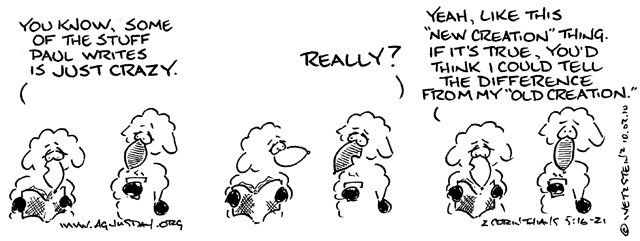
AgnusDay new creation

Do you not know, brothers and sisters—for I am speaking to those who know the law—that the law has authority over someone only as long as that person lives? For example, by law a married woman is bound to her husband as long as he is alive, but if her husband dies, she is released from the law that binds her to him. So then, if she has sexual relations with another man while her husband is still alive, she is called an adulteress. But if her husband dies, she is released from that law and is not an adulteress if she marries another man.

So, my brothers and sisters, you also died to the law through the body of Christ, that you might belong to another, to him who was raised from the dead, in order that we might bear fruit for God. For when we were in the realm of the flesh, the sinful passions aroused by the law were at work in us, so that we bore fruit for death. But now, by dying to what once bound us, we have been released from the law so that we serve in the new way of the Spirit, and not in the old way of the written code. (NIV)

Romans chapters 6-8 are the Apostle Paul’s pointed discussion of how we become holy in a real and practical way. The theological word we typically use for this is “sanctification,” which means “to become holy,” and “set apart” for God. To be delivered from sin, death, and hell through the person and work of Jesus Christ is not the end of the story; it is just the beginning of becoming a new creation.

Becoming holy and righteous in our everyday lives boils down to this: identity and belonging. One of the healthiest ways of looking at the entirety of the Bible’s message is that we belong to God. Our identities are thoroughly wrapped around Jesus. The process of realizing this and coming to grips with it is how we grow as people in holiness and righteousness.

Because of Christ’s finished work on the cross, we have been delivered from the realm of sin. Our change in status from condemned to accepted provides us the awareness to make daily affirmations of faith and live a new life. However, the sinful nature (flesh) or the old person is still there. Although it is now toothless, our past can and often does exert a powerful influence on us. Even though there is a medium-rare T-bone steak on the table for us to enjoy, there are times we go back to the old bologna sandwich with stale white bread.

Yet, we need no longer live falling short of our true humanity because we belong to God. We are adopted into God’s family, having been orphaned by sin’s cruel influence. Yet, just because we have been saved from the power of sin, sin itself has not become extinct. We still must deal with it. We are alive to God and need to take up this great spiritual reality and live into it, for the force of sin still exists in the world.

We deal with sin’s continued presence (the world, the flesh, and the devil) through embracing God’s grace versus trying to overcome it with the law. Paul used an illustration from marriage to expand our understanding of grafting grace into our daily lives. By law, a married woman is bound to her husband (keeping in mind this sense of belonging was the predominant view of marriage in Paul’s day). Yet, if the husband dies, the wife is released from the legal marriage. If she were to give herself to another man while her husband is still alive and they are married, then she becomes an adulteress. However, if she is a widow, then marries again, she is not an adulteress.

Paul applies this understanding to our relationship with the law. Death has separated us from the law. We died with Christ. Therefore, we have been set free from the law and have become alive to grace. As believers in Jesus, we “belong to another, to him who was raised from the dead” (Romans 7:4). “When Christ’s body hung upon the cross, when God spared not his own Son but gave him up for us all” (Romans 8:32); “when Christ took on himself for us all the curse of the law which inflicted all of us (Galatians 3:13); then, we died to the law. God’s grace has made the death of Jesus the death of all from the realm of sin (2 Corinthians 5:14).

Resized_20170617_114022

As a married man, let me use Paul’s illustration to get down to the gist of his teaching. Yes, I am legally married and belong to my wife. I made vows to my wife on our wedding day which bind me legally to do what I said I would do. Yet, if I fulfill those vows in a strictly legalistic manner, I can vouch for my wife that this would qualify as an acceptable situation for her. You see, my wife (and, me, too!) are freely bound to one another in love and grace. I care for my wife because I love her deeply, and not because it is my legal duty to do so.

The Christian life was neither designed nor meant to serve as a bare legal contract or covenant between us and God. God forbid such a thought! Jesus died to clear us from all the legality stuff so that we could freely love and serve God with joyful abundance and gratitude. You see, I am follower of Jesus because I love him deeply. What impels and motivates me is God’s grace. The law is there and has its place. However, it is not the law that causes me to be a Christian; it is the love of Christ which saved me from myself and compels me to live like Jesus.

We pray that God himself, the God of peace, will make you pure—belonging only to him. We pray that your whole self—spirit, soul, and body—will be kept safe and be blameless when our Lord Jesus Christ comes. The one who chose you will do that for you. You can trust him. (1 Thessalonians 5:23-24, ERV)

Galatians 5:2-6 – Faith Expressing Itself Through Love

The Sneetches

Mark my words! I, Paul, tell you that if you let yourselves be circumcised, Christ will be of no value to you at all. Again, I declare to every man who lets himself be circumcised that he is obligated to obey the whole law. You who are trying to be justified by the law have been alienated from Christ; you have fallen away from grace. For through the Spirit we eagerly await by faith the righteousness for which we hope. For in Christ Jesus neither circumcision nor uncircumcision has any value. The only thing that counts is faith expressing itself through love. (NIV)

Everyone needs the grace of faith expressing itself through love. I didn’t grow up committed to learning the Bible or following Christ. I pretty much went my own way throughout childhood, and especially the teenage years. I still remember what it felt like to not follow in the way of Christ. My view of the world was jaded, believing that most of humanity were basically uncaring self-absorbed creatures. I also knew the darkness of my own heart. When people, as I did long ago, view the world and self this way, there is a tragic loneliness where no one reaches out to the other, since everyone is guarded. A person and a world devoid of grace and reliant on law is, at best, a harsh place; and, at worst, a sort of dystopian nightmare.

It seems people who have a graceless past and only looked out for themselves often have a temptation to embrace strict rules when they become Christians. They know what it feels like to not have Jesus in their lives, so they sometimes, out of fear of returning to the old life, go beyond Scripture and impose standards on themselves, and then others, to keep on the straight and narrow to avoid sin.

If, or when, that happens, the Apostle Paul has something to say about it.  Embracing certain practices to obtain or maintain righteousness mean diddly-squat in God’s kingdom.  Here is how the Common English Bible version translates Paul’s words to the church who went down the path of strict outward rule-keeping:

“You people who are trying to be made righteous by the Law have been estranged from Christ. You have fallen away from grace! We eagerly wait for the hope of righteousness through the Spirit by faith. Being circumcised or not being circumcised doesn’t matter in Christ Jesus, but faith working through love does matter.” (Galatians 5:4-6, CEB)

A form of Christianity which ignores God’s grace in favor of controlling one’s own faith through certain rules is not Christianity at all, and Paul would have nothing to do with it. His position was clear and pointed:

“You were called to freedom, brothers and sisters; only don’t let this freedom be an opportunity to indulge your selfish impulses but serve each other through love.” (Galatians 5:13, CEB)

Grace is the currency of God’s kingdom, flowing freely through love. God has your back. With him we need not be guarded. God’s grace forgives, and never runs out. God’s love endures and never withdraws. When we get a hold of this essential and beautiful truth about God, the only rule we want to keep is Paul’s admonition to the Roman church:

“Let no debt remain outstanding, except the continuing debt to love one another, for whoever loves others has fulfilled the law.” (Romans 13:8, NIV)

So, are there any practices, rules, beliefs, or doctrines you impose on yourself which are burdensome to you?  Why do you do them? Do you expect others to do them, too? What would change if you threw grace and love in the mix?

It must continually be borne in mind that love does not foster an antinomian spirit of being against the law because love itself is the fulfillment of law. Paul, again, explained his reasoning:

The commandments, “You shall not commit adultery,” “You shall not murder,” “You shall not steal,” “You shall not covet,” and whatever other command there may be, are summed up in this one command: “Love your neighbor as yourself.” Love does no harm to a neighbor. Therefore, love is the fulfillment of the law. (Romans 13:9-10, NIV)

The Apostle Paul’s issue was not so much with circumcision itself as it was why the church wanted to practice it to begin with. Circumcision has always been an outward sign of an invisible reality – for the Jewish people – a truth which seemed lost on the Gentile churches. Paul’s agitation and frustration had to do with the church’s reason for considering circumcision. Much like the star-bellied Sneetches of Dr. Seuss’s classic story, the impetus behind wanting circumcision was to leverage power and superiority over others.

A vision of a new egalitarian society of redeemed persons based in the finished work of Jesus Christ (grace) was at risk, and Paul was going to address any imposed practices of exclusion (law) which would compromise and erode true community. Methinks the Apostle Paul and Dr. Seuss would have gotten along well together:

The day they decided that Sneetches are Sneetches

And no kind of Sneetch is the best on the beaches

That day, all the Sneetches forgot about stars

And whether they had one, or not, upon thars.

The Sneetches, by Dr. Seuss, 1961

Gracious God, your love has extended so far as to give your one and only Son on our behalf.  Through Jesus, I embrace the faith and love gifted to me through his redeeming work.  Help me to daily die to myself and my propensity for outward rule-keeping, and to live the gracious life you died to procure for me in the power of your Holy Spirit.  Amen.