Wednesday of Holy Week (John 13:21-32)

The Lord’s Supper, by Rubem Zevallos Técnica

After saying this Jesus was troubled in spirit and declared, “Very truly, I tell you, one of you will betray me.” The disciples looked at one another, uncertain of whom he was speaking. One of his disciples—the one whom Jesus loved—was reclining close to his heart; Simon Peter therefore motioned to him to ask Jesus of whom he was speaking. So while reclining next to Jesus, he asked him, “Lord, who is it?” 

Jesus answered, “It is the one to whom I give this piece of bread when I have dipped it in the dish.” So when he had dipped the piece of bread, he gave it to Judas son of Simon Iscariot. After he received the piece of bread, Satan entered into him. Jesus said to him, “Do quickly what you are going to do.” 

Now no one knew why he said this to him. Some thought that, because Judas had the common purse, Jesus was telling him, “Buy what we need for the festival,” or that he should give something to the poor. So, after receiving the piece of bread, he immediately went out. And it was night.

When he had gone out, Jesus said, “Now the Son of Man has been glorified, and God has been glorified in him. If God has been glorified in him, God will also glorify him in himself and will glorify him at once. (New Revised Standard Version)

In some Christian traditions, Wednesday of Holy Week is known as “Spy Wednesday.” It’s a reference to Judas Iscariot, and recalls his betrayal of Jesus to the religious authorities. Historically, the association of Wednesday with this betrayal of Jesus led to Wednesdays being observed as fast days in the church, a tradition still observed by some. 

Jesus was gathered with his disciples for the meal we know as the “Last Supper.” Jesus had just taken a towel and a bowl of water and washed the feet of those gathered with him. Peter, predictably, protested to Christ doing such a thing. Yet, Jesus told Peter that if there’s no foot washing, there’s no Christ. 

The Lord Jesus then went on to say that not all the disciples are clean. Christ knew he was about to be betrayed. Since Judas was there with the other disciples, that meant Jesus knelt to wash his feet, as well. Hence, the heightened reason why Jesus was so troubled in the moment.

The clueless men didn’t know what or who in the world Jesus was talking about. Nobody around the table suspected Judas as a betrayer. That’s how much Judas was a part of the group. He was trusted enough to be the purse holder who handled the common money account.

It appears that only Jesus and Judas know what’s going on when Judas is handed the piece of bread; then Jesus told him to do quickly what he must do. Sadly and unfortunately, Judas made his own free and deliberate choice, without any coercion – except perhaps with some satanic nudging.

The Last Supper, by Unknown artist, c.1400 C.E.

To betray the Son of God seems unthinkable. What could ever motivate a person to sell out Jesus? What reasoning is there behind such a foul decision? Why would anyone choose to be a turncoat toward an innocent man?

Although we may be interested in answers to such questions, and even though I myself have my own thoughts about the matter, the Apostle John gives us no motive for the decision of Judas. He simply did what he did, with no other comment than that.

With Judas out of the room, Jesus began speaking of glory – of the glorious relationship between the Father and the Son, and the divine love which comes tumbling out on Christ’s followers. And the divine choice is for love.

We also have a choice. We can choose to be self-aware, to be attentive to our emotions, to recognize the consequences of behaviors and choices, to avoid unhealthy and harmful patterns of living. These choices help us to have love tumble out of us when it’s needed.

Faith can, and ought, to play a leading role in life. It is when folks refuse to listen to their conscience and ignore their gut feelings, that questionable decision-making of the head and heart can take over.

There’s a lot that’s out of our control. Yet, we always have the choice of self-control concerning our words and actions. Things like kindness, empathy, and love are within our ability to choose. And we are always free to live into our spiritual identity as loved by Jesus and belonging to God.

It’s hard, though. Making such choices in the face of such betrayal. Christ was troubled in his spirit, not because of his upcoming humiliation and torture, but because he knew that one in his inner circle would betray him.

A mosaic of The Last Supper, in Monreale Cathedral, Palermo, Sicily, Italy

If you have ever had someone very close turn on you, then you well understand why this troubled Jesus and wounded him more than a physical cross. It is terribly disheartening to know that someone is not who they seem.

Remember, Jesus chose Judas as a disciple. And Judas chose to follow Jesus. As such, Judas was privy to all of Christ’s private explanations of parables and events. Judas was entrusted with the money; he knew everything on the event itinerary.

In other words, Judas was trusted to be a faithful follower. But instead, he sold out Jesus. It really must have been weird for Judas when Jesus brought up the matter before everyone – that he was going to be betrayed by one of them.

An outright naming of the scoundrel, however, was not the purpose of Christ’s raising the issue. This was no mystery game to be played around the table. A simple sharing of bread and wine was the only tip Jesus gave as to who it was. John caught on to what was happening, at least later, if not at the time.

The symbolism happening was packed with meaning. Bread, wine, and sharing them together symbolized the blood about to be spilled; a body about to be broken. And, ironically, Judas is the one who set it in motion. He did his part in making the blood flow and breaking the body.

There is, however, for the Christian, even more going on than that. These very symbols have become for us reminders of radical grace and forgiveness. The elements become the means of gathering together to remember and partake of that original event.

So, when Judas left to enact his betrayal, Jesus spoke not of the bad apple in the bushel, but of God’s glory. For it is soon to be revealed. And none of it will really be about Judas. It is now about demonstrating the purpose of God, the heart of Jesus, and the power of the Spirit.

Creator of the universe, you made the world in beauty, and restore all things in glory through the victory of Jesus Christ. We pray that, wherever your image is still disfigured by selfishness, greed, and betrayal, the new creation in Jesus Christ may appear in justice, love, and peace, to the glory of your name. Amen.


John 13:1-17, 31-35 – Maundy Thursday

Jesus Washes Peter’s Feet

It was before Passover, and Jesus knew that the time had come for him to leave this world and to return to the Father. He had always loved his followers in this world, and he loved them to the very end.

Even before the evening meal started, the devil had made Judas, the son of Simon Iscariot, decide to betray Jesus.

Jesus knew that he had come from God and would go back to God. He also knew that the Father had given him complete power. So, during the meal Jesus got up, removed his outer garment, and wrapped a towel around his waist. He put some water into a large bowl. Then he began washing his disciples’ feet and drying them with the towel he was wearing.

But when he came to Simon Peter, that disciple asked, “Lord, are you going to wash my feet?”

Jesus answered, “You don’t really know what I am doing, but later you will understand.”

“You will never wash my feet!” Peter replied.

“If I don’t wash you,” Jesus told him, “you don’t really belong to me.”

Peter said, “Lord, don’t wash just my feet. Wash my hands and my head.”

Jesus answered, “People who have bathed and are clean all over need to wash just their feet. And you, my disciples, are clean, except for one of you.” Jesus knew who would betray him. That is why he said, “except for one of you.”

After Jesus had washed his disciples’ feet and had put his outer garment back on, he sat down again. Then he said:

Do you understand what I have done? You call me your teacher and Lord, and you should, because that is who I am. And if your Lord and teacher has washed your feet, you should do the same for each other. I have set the example, and you should do for each other exactly what I have done for you. I tell you for certain that servants are not greater than their master, and messengers are not greater than the one who sent them. You know these things, and God will bless you, if you do them….

Now the Son of Man will be given glory, and he will bring glory to God. Then, after God is given glory because of him, God will bring glory to him, and God will do it very soon.

My children, I will be with you for a little while longer. Then you will look for me, but you won’t find me. I tell you just as I told the people, “You cannot go where I am going.” But I am giving you a new command. You must love each other, just as I have loved you. If you love each other, everyone will know that you are my disciples. (CEV)

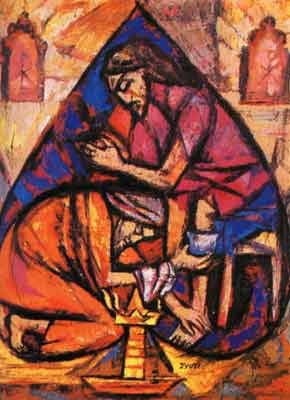
Jesus Washing the Feet of His Disciple by Japanese artist Sadao Watanabe (1913-1996)

We all need to receive love and to give love. Without love, there is little to live for. Apart from love, relationships devolve into silent standoffs and destructive triangles. Indeed, with an absence of love the world ceases to spin on its axis.

Yet, where love is present all things are beautiful. Personal relations have meaning and joy. All seems right and just in the world.

Love, however, comes at a cost. Because we live in a broken world full of pride and hubris, greed, and avarice, hate and envy, we are victims of loveless systems and unjust actions. We need love to rescue us, to redeem us from the sheer muck of existence. It’s as if we are constantly walking knee deep through sludge so thick, we can barely get anywhere. We need saving. We need Jesus.

Christians everywhere around the world are journeying through Holy Week, the most sacred time of the year for followers of Christ. When we think about Holy Week, we are familiar with Good Friday and certainly Easter, but Maundy Thursday? 

On this day, the Church remembers the final evening Jesus shared with his disciples in the upper room before his arrest and crucifixion. The experiences in the upper room were highly significant because this was the last teaching, modeling, and instruction Jesus gave before facing the cross. Jesus was careful and deliberate to communicate exactly what was important to him: to love one another.

Maundy Thursday marks three important events in Christ’s Last Supper with his disciples: 

  • The washing of the disciples’ feet (the action of loving service)
  • The instituting of the Lord’s Supper (the remembrance of loving sacrifice)
  • The giving of a “new” commandment to love one another (the mandate of a loving lifestyle). 

For Jesus, his last night with the disciples was all about love, God’s love. On that fateful night, having loved his disciples for the past three years, Jesus showed them the full extent of his love by taking the posture of a servant and washing each one of the disciples’ feet, including Judas. After demonstrating for them humble service, Jesus said,

“I have set you an example that you should do as I have done for you” (John 13:15, NIV). 

This was an incredible act of love. Jesus Christ loves me just as I am, and not as I should be. He loves me even with my dirty stinky feet, my herky-jerky commitment to him, and my pre-meditated sin. 

The Last Supper by Indian artist Francis Newton Souza (1924-2002)

Not only did Jesus wash the disciples’ feet, but he lifted the cup of wine and boldly asserted: 

“Take this and divide it among you.  For I tell you I will not drink again of the fruit of the vine until the kingdom of God comes.”  And he took the bread, gave thanks, and broke it, and gave it to them, saying, “This is my body given for you, do this in remembrance of me.”  In the same way, after the supper he took the cup saying, “This cup is the new covenant in my blood, which is poured out for you” (Luke 22:17-20, NIV). 

Because of these words, the church throughout the world, for two millennia, have practiced this communion so that we might have the redemptive events of Jesus pressed firmly into our minds and our hearts by means of the visceral and common elements of bread and wine. We are to not just know about Jesus; we are to experience being united with him.

Having washed the disciples’ feet, and proclaiming to them the meaning of his impending death, Jesus gave them a clear commandment: 

“A new command I give you: Love one another. As I have loved you, so you must love one another.  By this everyone will know that you are my disciples, if you love one another.” (John 13:34-35, NIV)

Love one another, insisted Jesus, by imitating his humble service. We represent Christ on this earth when we carefully, diligently, and persistently practice love. Although love was not a new concept for the disciples, in the form and teaching of Jesus love was shown with four distinctions: 

  1. Jesus is the new model of love.
  2. A new motive of love, that Christ first loved me.
  3. A new motivator to help us love, the Holy Spirit.
  4. A new mission, the evangelization of the world, utilizing the power of Christ’s love to accomplish it.

Maundy Thursday is a highly significant day on the Church Calendar – one which deserves to be observed, and an opportunity to remember the important words and actions of Jesus on our behalf.  Through Jesus Christ we are to live always in love, modeling our life and church ministry after him. 

In Christ, love is to characterize our life together as we proclaim God’s love in both word and deed. A watching world will only take notice and desire to be a part of our fellowship if we are deeply and profoundly centered in the love of God in Christ. This is the reality Maundy Thursday brings to us.

John 13:1-17, 31-35 – Maundy Thursday

Ethiopian Jesus washing feet
Ethiopian Orthodox Church icon of Jesus washing the disciples’ feet

It was before Passover, and Jesus knew that the time had come for him to leave this world and to return to the Father. He had always loved his followers in this world, and he loved them to the very end.

Even before the evening meal started, the devil had made Judas, the son of Simon Iscariot, decide to betray Jesus.

Jesus knew that he had come from God and would go back to God. He also knew that the Father had given him complete power. So, during the meal Jesus got up, removed his outer garment, and wrapped a towel around his waist.  He put some water into a large bowl. Then he began washing his disciples’ feet and drying them with the towel he was wearing.

But when he came to Simon Peter, that disciple asked, “Lord, are you going to wash my feet?”

Jesus answered, “You don’t really know what I am doing, but later you will understand.”

“You will never wash my feet!” Peter replied.

“If I don’t wash you,” Jesus told him, “you don’t really belong to me.”

Peter said, “Lord, don’t wash just my feet. Wash my hands and my head.”

Jesus answered, “People who have bathed and are clean all over need to wash just their feet. And you, my disciples, are clean, except for one of you.” Jesus knew who would betray him. That is why he said, “except for one of you.”

After Jesus had washed his disciples’ feet and had put his outer garment back on, he sat down again. Then he said:

Do you understand what I have done? You call me your teacher and Lord, and you should, because that is who I am. And if your Lord and teacher has washed your feet, you should do the same for each other. I have set the example, and you should do for each other exactly what I have done for you. I tell you for certain that servants are not greater than their master, and messengers are not greater than the one who sent them. You know these things, and God will bless you, if you do them….

Now the Son of Man will be given glory, and he will bring glory to God. Then, after God is given glory because of him, God will bring glory to him, and God will do it very soon.

My children, I will be with you for a little while longer. Then you will look for me, but you won’t find me. I tell you just as I told the people, “You cannot go where I am going.” But I am giving you a new command. You must love each other, just as I have loved you. If you love each other, everyone will know that you are my disciples. (CEV)

Love.  We need it.  Without love, relationships devolve into silent standoffs and destructive triangles. The world ceases to spin on its axis.  With love, however, all things are beautiful; personal relations have meaning and joy; and, all seems right and just in the world.

Yet, love comes with a cost.  Because we live in a broken world filled with pride and hubris, greed and avarice, hate and envy, we are victims of loveless and faceless systems doing unjust actions.  We need love to rescue us, to redeem us from the sheer muck of such an existence.  It’s as if we are constantly walking knee deep through sludge so thick we can barely get anywhere.  We need saving.  We need Jesus.

Christians everywhere around the world are journeying through Holy Week, the most sacred time of the year for followers of Christ.  When we think about Holy Week, we are familiar with Good Friday and certainly Easter; but Maundy Thursday?

On this day the church remembers the last evening that Jesus shared with his disciples in the upper room before his arrest and crucifixion.  The experiences in the upper room were highly significant because this was the last teaching, modeling, and instruction Jesus gave before facing the cross.  Jesus was careful and deliberate to communicate exactly what was important to him: to love one another.

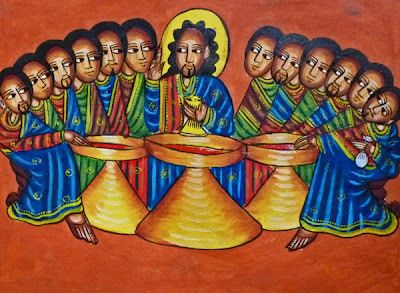
Ethiopian Jesus Last Supper
Ethiopian Orthodox Church icon of the Last Supper

Maundy Thursday marks three important events in Christ’s Last Supper with his disciples:

  • The washing of the disciples’ feet (the action of loving service)
  • The instituting of the Lord’s Supper (the remembrance of loving sacrifice)
  • The giving of a “new” commandment to love one another (the mandate of a loving system).

For Jesus, the last night with his disciples was all about love, God’s love.  On that fateful night, having loved his disciples for the past three years, Jesus showed them the full extent of his love by taking the posture of a servant and washing each and every one of the disciples’ feet, including Judas.  After demonstrating for them a totally humble service, Jesus said,

“I have set you an example that you should do as I have done for you.”  Jesus Christ loves me just as I am, and not as I should be.

He loves me even with my dirty stinky feet, my herky-jerky commitment to him, and my pre-meditated sin.

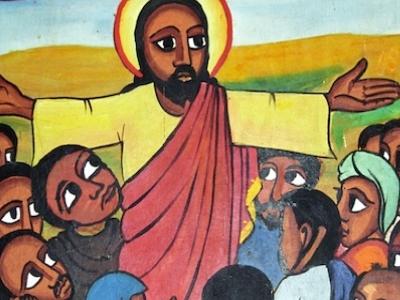
Ethiopian Jesus
Ethiopian artist depiction of Jesus teaching

Not only did Jesus wash the disciples’ feet; he also lifted the cup of wine and boldly asserted:

“Take this and divide it among you.  For I tell you I will not drink again of the fruit of the vine until the kingdom of God comes.”  And he took the bread, gave thanks and broke it, and gave it to them, saying, “This is my body given for you, do this in remembrance of me.”  In the same way, after the supper he took the cup saying, “This cup is the new covenant in my blood, which is poured out for you” (Luke 22:17-20, NIV). 

Because of these words from Jesus, the church throughout the world, for two millennia, have practiced this communion, this supper so that we might have the redemptive events of Jesus pressed firmly into both our minds and our hearts by means of the visceral and common elements of bread and wine.  We are to not just know about Jesus – we are to experience being united with him.

Having washed the disciples’ feet, and proclaimed to them the meaning of his impending death, Jesus gave them a clear commandment:

“A new command I give you: Love one another. As I have loved you, so you must love one another.  By this everyone will know that you are my disciples, if you love one another.”

Love one another, insisted Jesus, through imitation of his humble service.  We represent Christ on this earth when we carefully, diligently, and persistently practice love.  Although love was by no means a new concept for the disciples, in the form and teaching of Jesus love was shown with four distinctions:

  1. Jesus is the new model of love
  2. A new motive of love, that Christ first loved me
  3. A new motivator to help us love, the Holy Spirit
  4. A new mission, the evangelization of the world, utilizing the power of Christ’s love to accomplish it

Maundy Thursday is a highly significant day on the Church Calendar – one which deserves to be observed, and an opportunity to remember the important words and actions of Jesus on our behalf.  Through Jesus Christ we are to live always in love, modeling our life and church ministry after him.

In Christ we are to allow love to characterize our life together as we proclaim God’s love in words and deeds.  A watching world will only take notice and desire to be a part of our fellowship if we are deeply and profoundly centered in the love of God in Christ.  This is the reality that Maundy Thursday brings to us.

God of love, you have given us a new command to love each other.  Help us to show that love in our care of creation, to all nations and ethnic peoples, in our communities and neighborhoods, through the Church everywhere, and with the persons closet to us and their needs.  In all our thoughts, words, and actions may we be your servants and reflect your love; through our loving Savior, Jesus Christ, your Son, who lives and reigns with you and the Holy Spirit, one God, now and forever.  Amen.

To continue our remembrance of Christ’s loving service, click As I Have Done For You written by Dan Schutte.

Maundy Thursday


            We are journeying with Jesus through Holy Week, the most sacred time of the Christian Year.  When we think about Holy Week, we are familiar with Good Friday and certainly Easter; but Maundy Thursday?  On this day the church remembers the last evening that Jesus shared with his disciples in the upper room before his arrest and crucifixion.  The experiences in the upper room were highly significant because this was the last teaching, modeling, and instruction Jesus gave before facing the cross.
 
            Maundy Thursday, then, marks three important events in Christ’s Last Supper with his disciples:  the washing of the disciples’ feet; the instituting of the Lord’s Supper; and, the giving of a “new” commandment to love one another.  Let’s briefly unpack these three impactful words and actions from Jesus.
 
            For Jesus, this was all about and for love, God’s love.  On that fateful night, having loved his disciples for the past three years, Jesus showed them the full extent of his love by taking the posture of a servant and washing each and every one of the disciples’ feet, including Judas.  After demonstrating for them a totally humble service, Jesus said, “I have set you an example that you should do as I have done for you” (John 13:15).  This was an incredible act of love.  We need to rightly observe that Jesus Christ loves me just as I am, and not as I should be.  He loves me even with my dirty stinky feet, my herky-jerky commitment to him, and my pre-meditated sin. 
 
            Not only did Jesus wash the disciples’ feet, but he lifted the cup of wine and boldly asserted:  “Take this and divide it among you.  For I tell you I will not drink again of the fruit of the vine until the kingdom of God comes.”  And he took the bread, gave thanks and broke it, and gave it to them, saying, “This is my body given for you, do this in remembrance of me.”  In the same way, after the supper he took the cup saying, “This cup is the new covenant in my blood, which is poured out for you” (Luke 22:17-20).  Because of these words of Jesus, the church everywhere throughout the world, for two millennia, have practiced this communion, this supper so that we might have the redemptive events of Jesus pressed firmly into both our minds and our hearts by means of the visceral and common elements of bread and wine.  We are to not just know about Jesus, but are to experience being united with him.
 
            Having washed the disciples’ feet, and proclaimed to them the meaning of his impending death, Jesus gave them a clear commandment:  Love one another, using the same model he had showed them (John 13:34-35).  We represent Christ on this earth when we carefully, diligently, and persistently practice love.  Although love was by no means a new concept for the disciples, in the form and teaching of Jesus love was shown with four distinctions:  Jesus as the new model of love; a new motive of love, that Christ first loved me; a new motivatorto help us love, the Holy Spirit; and, a new mission, the evangelization of the world using the power of Christ’s love to accomplish it.


            So, you see, Maundy Thursday is a highly significant day on the Church Calendar – one which deserves to be observed, and an opportunity to remember the important words and actions of Jesus on our behalf.  Through Jesus Christ we are to live always in love, modeling our life and church ministry after him.  In Christ we are to allow love to characterize our life together as we proclaim God’s love in preaching and sacrament.  A watching world will only take notice and desire to be a part of our fellowship if we are deeply and profoundly centered in the love of God in Christ.  This is the reality that Maundy Thursday brings to us.