A Prayer of Confession (Ezra 9:5-15)

Ezra In Prayer, by Gustave Doré, 1866

Then, at the evening sacrifice, I rose from my self-abasement, with my tunic and cloak torn, and fell on my knees with my hands spread out to the Lord my Godand prayed:

“I am too ashamed and disgraced, my God, to lift up my face to you, because our sins are higher than our heads and our guilt has reached to the heavens. From the days of our ancestors until now, our guilt has been great. Because of our sins, we and our kings and our priests have been subjected to the sword and captivity, to pillage and humiliation at the hand of foreign kings, as it is today.

“But now, for a brief moment, the Lord our God has been gracious in leaving us a remnant and giving us a firm place in his sanctuary, and so our God gives light to our eyes and a little relief in our bondage. Though we are slaves, our God has not forsaken us in our bondage. He has shown us kindness in the sight of the kings of Persia: He has granted us new life to rebuild the house of our God and repair its ruins, and he has given us a wall of protection in Judah and Jerusalem.

“But now, our God, what can we say after this? For we have forsaken the commands you gave through your servants the prophets when you said: ‘The land you are entering to possess is a land polluted by the corruption of its peoples. By their detestable practices they have filled it with their impurity from one end to the other. Therefore, do not give your daughters in marriage to their sons or take their daughters for your sons. Do not seek a treaty of friendship with them at any time, that you may be strong and eat the good things of the land and leave it to your children as an everlasting inheritance.’

“What has happened to us is a result of our evil deeds and our great guilt, and yet, our God, you have punished us less than our sins deserved and have given us a remnant like this. Shall we then break your commands again and intermarry with the peoples who commit such detestable practices? Would you not be angry enough with us to destroy us, leaving us no remnant or survivor? Lord, the God of Israel, you are righteous! We are left this day as a remnant. Here we are before you in our guilt, though because of it not one of us can stand in your presence.” (New International Version)

God had made a covenant with the Israelites. The Lord graciously gave them laws and stipulations to live by before entering the Promised Land.

Yet, much of Jewish history during the times of the kings was characterized by a breakdown in morality. Cheating on workers and preying upon the weak became commonplace. The poor were fleeced for what little they had, and reduced to servitude.

Failing to obey God completely, the people intermarried with the surrounding nations. The worship of Yahweh was, at times, in severe neglect, due to worshiping the gods of other places. As a result, divine judgment brought a Babylonian captivity and an exile of the people to a foreign land.

But God, who is rich in mercy, brought many of the people back to Palestine and Jerusalem. The Babylonians were conquered by the Persians, who had a different philosophy about how to handle the nations within their empire. And they were open to Jerusalem being rebuilt and the temple restored.

Ezra was a scribe (a copier of Scripture) and one of the returning exiles. Ezra left Babylon in 458 B.C.E. with a considerable group of people. Because of Ezra’s position as a Jewish scribe, and as a descendant of Levi, the Persian king authorized him to reinforce the Torah (the Law) by reading it and setting up the necessary administrative systems to ensure it would be followed.

Under Persian rule, each subject people was allowed to live by its ancestral laws, which were enforced by the imperial government. Violations of the laws of the group to which one belonged constituted an offense against the state precisely because they led to instability.

Soon after Ezra arrived in Jerusalem, he learned of the spiritual state of the Jews there. They had intermarried freely with the non-Jewish women of the land, and had ceased to keep the Jewish holidays and other commandments.

This situation devastated Ezra. He tore his clothes and sat in mourning the entire day until evening. After the evening sacrifice was brought, he got up and began praying loudly to God, weeping for forgiveness for the sins of his people.

Ezra read the Torah publicly to the entire people. Indeed, this was a covenant‑renewal ceremony in the strict sense. To make the Torah understandable to them, he had it explained, because Hebrew was no longer in most people’s vernacular. (Nehemiah 8:1-18)

In today’s Old Testament lesson, we have Ezra’s prayer, his great confession of sin, and concern that the people not get into the same situation which brought God’s judgment and exile upon them to begin with.

It is a prayer laced with love for the covenant code, the Jewish people, and most of all, for God. A very complicated situation prompted Ezra’s prayer, and would take much courage and wisdom to confront and deal with.

Whenever things are awry, circumstances are less than desirable, and situations seem overwhelming, the place to begin is to pray. Admittedly, prayer is not everything; but it is certainly something – and something powerful – for which we have both the duty and the delight to engage in.

And in praying, there is perhaps no better way to begin, than with a heartfelt prayer of confession:

Gracious God, our sins are too heavy to carry, too real to hide, and too deep to undo. Forgive what our lips tremble to name, what our hearts can no longer bear, and what has become for us a consuming fire of judgment.

Set us free from a past we cannot change; open to us a future in which we can be changed; and grant us grace to grow more and more in your likeness and image; through Jesus Christ our Lord. Amen.

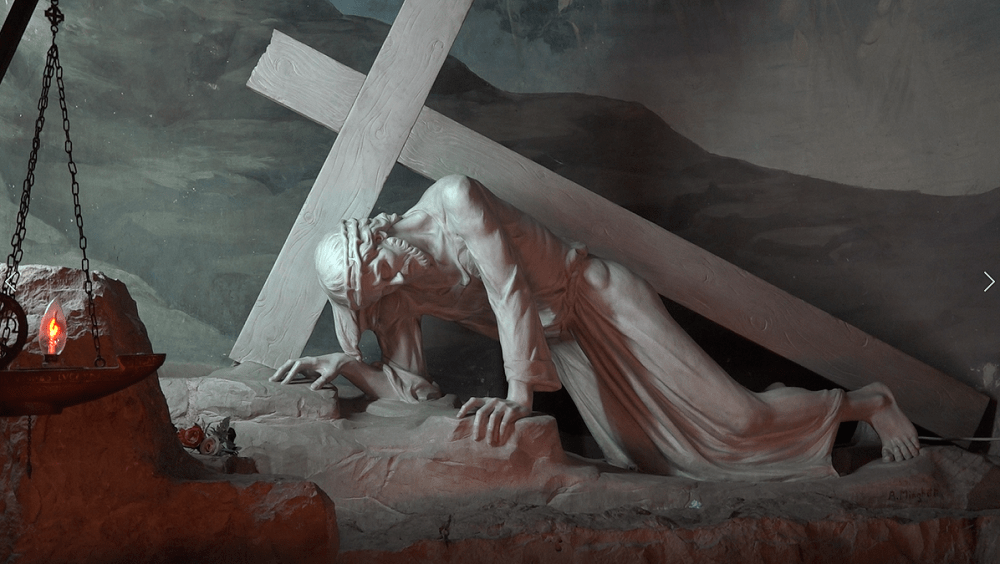
Tuesday of Holy Week (Psalm 71:1-14)

Station 3 of the Stations of the Cross, along the Via Dolorosa in Jerusalem

In you, O Lord, I take refuge;
    let me never be put to shame.
In your righteousness deliver me and rescue me;
    incline your ear to me and save me.
Be to me a rock of refuge,
    a strong fortress to save me,
    for you are my rock and my fortress.

Rescue me, O my God, from the hand of the wicked,
    from the grasp of the unjust and cruel.
For you, O Lord, are my hope,
    my trust, O Lord, from my youth.
From my birth I have leaned upon you,
    my protector since my mother’s womb.
My praise is continually of you.

I have been like a portent to many,
    but you are my strong refuge.
My mouth is filled with your praise
    and with your glory all day long.
Do not cast me off in the time of old age;
    do not forsake me when my strength is spent.
For my enemies speak concerning me,
    and those who watch for my life consult together.
They say, “Pursue and seize that person
    whom God has forsaken,
    for there is no one to deliver.”

O God do not be far from me;
    O my God, make haste to help me!
Let my accusers be put to shame and consumed;
    let those who seek to hurt me
    be covered with scorn and disgrace.
But I will hope continually
    and will praise you yet more and more. (New Revised Standard Version)

Christians take a decided interpretation of seeing Christ in the psalms. For us, we can envision Jesus saying these words of lament in the last days of his earthly life and ministry.

Why lament?

Lament is a significant piece of Lent, and is especially present in these final days of the season, Holy Week. To lament is to offer a public and passionate expression of grief. And it’s not optional but necessary and vital to the Christian experience, not to mention the human condition.

Without lamenting our great losses, our grief comes out sideways, inevitably harming others with our snarky vitriol. Lament gives expression to our deep grief. It enables us to come to grips with what has happened in the past, or happening to us in the present, and within us.

What does it mean to lament?

  • A lament is an expression of personal grief, due to any significant change or loss; it is the normal emotional, spiritual, physical, and relational reaction to that loss.
  • Lamenting is an intentional process of letting go. Relationships, dreams, plans, and people all die. We cannot get them back. Lament helps us find and live into a new identity after the loss or change.
  • Expressing grief through lament is intensely personal; there is no one-size-fits-all. No one else can do our lamentation for us.

How do I lament?

There are many psalms of lament, including our psalm lesson for today. They all have a typical structure to them, including:

  • Addressing God: Crying out for help. Some psalms of lament expand to include a statement of praise or a recollection of God’s intervention in the past. (Psalm 71:1-3)
  • Complaint: Telling God (said with some flavor!) about our problem or experience through a range and depth of emotional, relational, and spiritual reactions to the change or loss. (Psalm 71:4)
  • Confession of Trust: Remaining confident in God despite the circumstances. Beginning to see problems differently. (Psalm 71:5-8)
  • Petition: Proclaiming confidence in God. Appealing to God for deliverance and intervention. Keep in mind that petitioning is not bargaining with God or a refusal to accept loss. Rather, it is a legitimate seeking of help. (Psalm 71:9-13)
  • Words of Assurance: Expressing certainty that the petition will be heard by God. (Psalm 71:14a)
  • Vow of Praise: Vowing to testify in the future to what God will do with praise. (Psalm 71:14b-24)

I encourage and urge you to consider the following spiritual practice in this Holy Week: Set aside some time and craft your own psalm of lament.

Choose an event from your past which created grief for you. It can be recent or from years ago. Using the structure of lament psalms, thoughtfully write out each element as I have outlined it. Then, read it aloud to God. Perhaps even take another step by reading your lament aloud to a trusted family member, friend, or faith leader.

Our grief needs the outlet of lament. Grief which is not expressed ends up sitting heavily in the soul. Eventually, over time, if not acknowledged and spoken aloud, it can easily become putrid and rancid, poisoning our spirit, and compromising our faith.

Sharing your story through lament is biblical, practical, and I insist, necessary. I regularly craft psalms of lament whenever I have events or people who keep sticking with me in my thoughts and in my heart. Here is one example from a few years ago, after a mass shooting in my city:

Lord, in our shock and confusion, we come before you.

In our grief and despair, in the midst of hate,

in our sense of helplessness in the face of violence,

we lean on you. How long, O Lord, must we keep facing this!?

For the families of those who have been killed, we pray.

For the family of the shooter—help us to pray, Lord.

For the communities that have lost members—their anger, grief, fear—we pray.

For the churches striving to be your light in darkness, beyond our comprehension, we pray.

In the face of hatred, may we claim love, Lord.

May we love those far off and those near.

May we love those who are strangers and those who are friends.

May we love those who we agree with and understand,

and even more so, Lord, those who we consider to be our enemies.

Lord, have mercy. Christ, have mercy. Lord, have mercy.

Heal our sin-sick souls, and grant us your peace.

Make these wounds whole, Lord, for you can do it. Amen.

Expressing Grief (Lamentations 3:55-66)

An engraving of the prophet Jeremiah lamenting, 1937

I called on your name, Lord,
    from the depths of the pit.
You heard my plea: “Do not close your ears
    to my cry for relief.”
You came near when I called you,
    and you said, “Do not fear.”

You, Lord, took up my case;
    you redeemed my life.
Lord, you have seen the wrong done to me.
    Uphold my cause!
You have seen the depth of their vengeance,
    all their plots against me.

Lord, you have heard their insults,
    all their plots against me—
what my enemies whisper and mutter
    against me all day long.
Look at them! Sitting or standing,
    they mock me in their songs.

Pay them back what they deserve, Lord,
    for what their hands have done.
Put a veil over their hearts,
    and may your curse be on them!
Pursue them in anger and destroy them
    from under the heavens of the Lord. (New International Version)

Over the years of ministry, I’ve encountered a host of confessing Christians who did not know the book of Lamentations even existed in the Bible. Even more people, I have discovered, are unfamiliar with the word “lament.”

This anecdotal evidence is quite telling: It tells me that a large chunk of people in society don’t know what to do with themselves whenever they experience or encounter trauma, abuse, unwanted circumstances, death, or overwhelming situations.

It’s no wonder that so many of us are anxious, depressed, and emotionally struggling. To be overwhelmed means that we don’t have enough internal resources to match what’s going on with us externally. Being overwhelmed means being devastated or overpowered by several circumstances at once; and experiencing several emotions at once, including the feeling of estrangement from God and/or others.

The book of Lamentations is the prophet Jeremiah’s public expression of grief over the destruction of his home city of Jerusalem. King Nebuchadnezzar and the Babylonian army invaded the land, broke down the city walls, razed the temple, killed many people, and took most of the rest into captivity. The experience, along with the atrocities committed, were overwhelming.

On top of all that, Jeremiah had proclaimed a message of judgment, prophesying what would happen – and it did. And after the Babylonians took over, the remaining people put much of their misplaced anger and grief on Jeremiah, making his situation even worse.

Lamentations of Jeremiah, by Marc Chagall, 1956

What would you do if you were Jeremiah?

In whatever way you might respond, I believe Jeremiah did precisely what was most needed: He called on the name of the Lord, he expressed his lament, and it was all more than a private affair – because we are able to still read his lamentation all these many centuries later.

To lament is to express our feelings and story of grief to another. Without doing so, we are spiritually and emotionally stuck. And if we remain stuck for too long, our grief comes out sideways, either hurting others or ourselves.

The general populace of the people didn’t deal with their grief, and didn’t lament their loss. Instead, they mocked Jeremiah, plotted against him, and insulted him. That’s what happens when we don’t grieve and lament.

Jeremiah, however, left the people in God’s hands, and didn’t take matters into his own hands. He did what he was supposed to do instead of lashing out on others: Crafted this book of Lamentations, which we have access to, and can read.

So, why don’t we?

There’s lots of reasons we don’t examine the book of Lamentations (and explore our own lament). The primary reason is fear:

  • Fear of our own emotions – getting lost in them and afraid we’ll never get out of them – so we construct elaborate thoughts and words of positivity, believing that it will shoo the difficult feelings away. But the truth is, it won’t. It only makes it worse. We can choose to courageously tell our story, to whomever we want, in as much or as little detail as we want.
  • Fear of getting hurt. We’ve already experienced a level of hurt we never thought was possible. It’s only human to want to keep as far away from hurt as we can. So, we keep tight-lipped, tell others that we’re fine (when we’re not), all in the belief that if we can shut others out, we can keep any more hurt from touching us. The problem is that when we do that, we also keep the love out that could and would come to us.
  • Fear of connection. Examining myself and exploring relationships with others sounds too risky. It’s fraught with emotion. Besides, we might reason, I don’t want to put my burdens onto someone else. So, we don’t face our grief. The feelings get buried and, over time, become gangrene of the soul, poisoning us. Like a nasty boil, our grief needs to be lanced, and plenty of peroxide put on the wound. And the right medicine is doing what Jeremiah did: lament our loss.
  • Fear of losing control. I might cry in front of others. I may get really angry and yell. I could go absolutely ape and do weird stuff around people. If I open up, it will be a Pandora’s box of releasing myself. In reality, this is a fear of vulnerability, of letting others see the true self. And since we may not like our true self to begin with, this makes things quite complicated. However, there is not another way. Yet, if we go down the narrow path of lament, we will find many comforters who are able to empathize with us in our suffering.

“Sometimes you have to get your behind in the past before you can put your past behind you.”

Mit Tdrahrhe

The place to begin is in offering our feelings of grief, and our emotional words of lament, to the God who is always ready and available to hear it. And, from there, we reach out to a trusted friend, relative, or faith leader and tell them our story. Eventually, we discover enough healing that we can then comfort others with the comfort we ourselves have received. (2 Corinthians 1:3-11)

You can do this.

Almighty God, Father of mercies and giver of comfort: Deal graciously, we pray, with all who mourn; that, casting all their care on you, they may know the consolation of your love; through Jesus Christ our Lord. Amen.

Hope for the Grieving (Jeremiah 31:15-22)

Orthodox icon of Rachel weeping for the children

This is what the Lord says:

“A voice is heard in Ramah,
    mourning and great weeping,
Rachel weeping for her children
    and refusing to be comforted,
    because they are no more.”

This is what the Lord says:

“Restrain your voice from weeping
    and your eyes from tears,
for your work will be rewarded,”
declares the Lord.
    “They will return from the land of the enemy.
So there is hope for your descendants,”
declares the Lord.
    “Your children will return to their own land.

“I have surely heard Ephraim’s moaning:
    ‘You disciplined me like an unruly calf,
    and I have been disciplined.
Restore me, and I will return,
    because you are the Lord my God.
After I strayed,
    I repented;
after I came to understand,
    I beat my breast.
I was ashamed and humiliated
    because I bore the disgrace of my youth.’
Is not Ephraim my dear son,
    the child in whom I delight?
Though I often speak against him,
    I still remember him.
Therefore my heart yearns for him;
    I have great compassion for him,”
declares the Lord.

“Set up road signs;
    put up guideposts.
Take note of the highway,
    the road that you take.
Return, Virgin Israel,
    return to your towns.
How long will you wander,
    unfaithful Daughter Israel?
The Lord will create a new thing on earth—
    the woman will return to the man.” (New International Version)

The bereavement of losing someone you care about is awful. A parent experiencing the death of a child is next level grief. There is no bereavement like it.

As a hospital chaplain, I occasionally attend to a grieving mother who just lost her baby. I have shown up for premature and stillborn deaths, full term births, then death, sudden infant death, and more. The grief is indescribable.

On some level, there is no comfort – and never will be. I know that, for me, providing grief support to mothers who are enduring the death of a baby or young child has profoundly changed me and forever impacted my soul. So, I can only imagine what it’s like for a mother.

Many Christians will recognize the verse of Rachel weeping for her children as part of the early story surrounding Jesus:

An angel of the Lord appeared to Joseph in a dream. “Get up,” he said, “take the child and his mother and escape to Egypt. Stay there until I tell you, for Herod is going to search for the child to kill him.”

So he got up, took the child and his mother during the night and left for Egypt,where he stayed until the death of Herod. And so was fulfilled what the Lord had said through the prophet: “Out of Egypt I called my son.”

When Herod realized that he had been outwitted by the Magi, he was furious, and he gave orders to kill all the boys in Bethlehem and its vicinity who were two years old and under, in accordance with the time he had learned from the Magi. Then what was said through the prophet Jeremiah was fulfilled:

“A voice is heard in Ramah,
    weeping and great mourning,
Rachel weeping for her children
    and refusing to be comforted,
    because they are no more.”(Matthew 2:13-18, NIV)

It’s really hard to have hope when you’re in the throes of lamenting the death of children. We need hope. It’s necessary to life. We cannot survive, let alone thrive, without it.

It is possible to simultaneously experience hopelessness and hope. At the same time, we hold both despair and desire, anguish and anticipation, in our hearts. While we may never forget who we have lost, we make it through our days believing that another child can change the world for the better. We place our faith in the Christ child, in Jesus.

Wily old King Herod massacred innocent toddlers in order to ensure the destruction of Jesus. Behind his atrocity was the devil himself who knew that Jesus was the coming King who would one day bring salvation. But the old King’s sinister plan didn’t work. 

Reflecting on a vision of Christ’s birth, the Apostle John stated:

The dragon stood in front of the woman who was about to give birth, so that it might devour her child the moment he was born. She gave birth to a son, a male child, who “will rule all the nations with an iron scepter.” And her child was snatched up to God and to his throne. (Revelation 12:4-5, NIV)

Satan wars against God’s Son and God’s people, whose roots go all the way back to the first prophecy of Christ:

And I will put enmity
    between you and the woman,
    and between your offspring and hers;
he will crush your head,
    and you will strike his heel.” (Genesis 3:15, NIV)

There has been bad blood, ever since the Fall of humanity, between the serpent and the seed of the woman. The Old Testament Israelites were continually being threatened with extermination; they were constantly tempted to conform to pagan ways for handling their suffering and grief. 

Herod was just another in a long line of demonically animated men trying to perpetuate the kingdom of darkness. The devil knows that his time is short; and he uses twisted persons like Herod for his insidious schemes.

Many people experience hell on earth because Satan is on a rampage; mothers and their children are often the collateral damage.

The holiday season is a hard time of year for many people, filled with depression instead of joy, grieving over lost loved ones for whom you will not spend another Christmas with. And yet, there is a reunion coming, the hope of a bodily resurrection in which we will be with Jesus and God’s people forever.

Satan’s most powerful weapon, death, has lost its sting because of Jesus. Death does not have the last word; resurrection does. And this hope for the future helps us in the present to keep going and not give up.

The prophet Jeremiah was dealing with children lost in war to the invading Babylonians. His words are a lament in the context of the hope that captivity and exile will not be forever. 

Matthew wants us to see that the exile is over for us; Jesus has arrived, and the tears that were shed will shortly dry up. There may be a time of suffering that we must endure, but there is glory ahead.

Jesus is the Great Deliverer who brings us out of the grip of death, grief, and lament and into the promises of God. Christ is our hope. Amen, and amen.