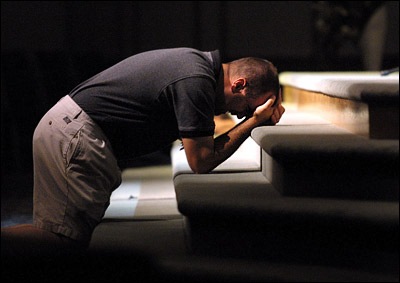
Lamentations 3:19-26

            Those who are regular readers of this blog know that I continually talk about the need to read and pray the Scriptures over and over again, slowly.  Reading our Bibles ought to be last thing we do in order to check it off our to-do list.  One of the reasons I believe so many Christians struggle today with how to cope with life in a difficult and changing world is that there is far too little contemplative and meditative readings of Holy Scripture.  Today’s poetry from the Old Testament is most certainly one of those Bible passages that really demands to be read several times with some thought, prayer, and flavor.  Here it is in the Contemporary English Version of the Bible:
 
19 Just thinking of my troubles
and my lonely wandering
makes me miserable.
20 That’s all I ever think about,
and I am depressed.
21 Then I remember something
that fills me with hope.
22 The Lord’s kindness never fails!
If he had not been merciful,
we would have been destroyed.
23 The Lord can always be trusted
to show mercy each morning.
24 Deep in my heart I say,
“The Lord is all I need;
I can depend on him!”
25 The Lord is kind to everyone
who trusts and obeys him.
26 It is good to wait patiently
for the Lord to save us.


Amen!

Lamentations 3:1-9, 19-24

            Even in the darkest of moments in time there is still the remote possibility of hope.  On this Holy Saturday while we remember the darkness in between Christ’s crucifixion and resurrection, one of the important angles to keep in mind is how the original disciples must have felt on this day.  We, of course, know the end of the story.  We know that Christ is about to be risen from death and that the tomb will be empty.  But Peter, James, John, and the rest of Christ’s followers had no idea this was going to occur. 
 
            Let’s take the thought even a bit further:  what was Jesus experiencing during this time in the grave?  I know it is a crazy thought, but Jesus completely and fully entrusted himself to the Father.  Did he ever have a doubt or wonder if things would shake out as we now know they would?  Sometimes we might lose sight of the reality that Jesus is quite fully a human with all of the limitations that go with it.  Christ knows full well how difficult it can be to live life on this earth surrounded by sin, evil, and trouble.  He knows what it feels like to be afflicted, to be forsaken, to be profoundly touched by the sin of others.
 
            But suffering does not have the last word.  “My soul continually remembers it [affliction] and is bowed down within me.  But this I call to mind, and therefore I have hope:  The steadfast love of the LORD never ceases; his mercies never come to an end; they are new every morning; great is your faithfulness.” These are not just words from the prophet Jeremiah; they are the thoughts of Christ himself.  Jesus placed his faith and hope in the Father.  The disciples placed their faith and hope in Jesus.  We, as well, must discover that darkness and death never have the last word.  The last word is always and forever GRACE.  It is the mercy of God that trumps death and every evil practice and each sinful agenda.  Wait for it… wait for it….


            Almighty God, grant that in your mercy I might obtain the result of your passion:  forgiveness of sins and new life in Jesus Christ, who loved me and gave himself for me.  Amen.

The Need for Lament, Part 2


We all accumulate a host of losses over the course of a lifetime.  Many of them are small losses; some of them are devastating losses.  The death of children, disability, rape, abuse, cancer, infertility, suicide, and betrayal are all examples of crushing loss – losses that need to experience lament.  All these losses are irreversible; we cannot return to how things once were.  We must push forward by grieving each loss.  And as we lurch ahead we cling to these words from Holy Scripture:  Because of the LORD’s great love we are not consumed, for his compassions never fail.  They are new every morning; great is your faithfulness (Lamentations 3:22-23).
 
            So, how do we lament our losses in a healthy way?  Here is what the prophet Jeremiah did in the book of Lamentations:
  1. Jeremiah remembered his afflictions and his losses.  We need to avoid superficial repentance and forgiveness.  We must own and feel the pain of the loss before we can begin to offer a mature forgiveness.
  2. Jeremiah paid attention to faith, hope, and love.  This can only be done if we are alert to the process of grieving.  Elizabeth Kubler-Ross was the person who identified the famous five stages of grief:  denial, anger, bargaining, depression, and resolution/acceptance.  We rarely move neatly through each stage.  The important thing is that we get to the place of seeing God’s committed love to us not just in spite of the suffering but because of it.
  3. Jeremiah did not minimize his pain and suffering.  We must sit with our pain.  Do not sluff off a loss by saying others have it worse, or that it is nothing.  Year after year many Christians do not confront the losses of life, minimizing their failures and disappointments.  The result is a profound inability to face pain, and has led to shallow spirituality and an acute lack of compassion.
  4. Jeremiah prophesied about how Jesus grieved.  His message predicted what Jesus faced in his passion.  The prophet Isaiah described the Messiah as a man of sorrows and acquainted with grief (Isaiah 53:3).  Peter Scazzero, in his book The Emotionally Healthy Church, points out what Jesus did not say, and what he did say at particular events in his ministry.  At the tomb of Lazarus, Jesus did not say “Come on everyone, stop all this crying” but wept with the people.  When entering Jerusalem, Jesus did not say “too bad guys, I’m moving on without you” but lamented over the city desiring to gather them as a hen does her chicks.  On the cross, Jesus did not say “Lighten up everyone; God is good; he will be victorious!”  But instead said, “My God, my God, why have you forsaken me?”  Hebrews 5:8 tells us that Jesus “learned obedience from what he suffered.”
Grieving is an indispensable part of a full-orbed spirituality and emotional health.  Life does not always make sense.  There is deep mystery to the ways of God.  The Lord is doing patient and careful work inside of each one of us.  While he is busy within our souls, we will likely feel lost and disconnected, not seeing the full tapestry of what he is creating.  Weariness, loneliness, a sense that prayers are not being heard, and a feeling of helplessness are all common experiences of God’s reconstruction of a broken spirit.
 
People who have truly lamented their losses are not hard to spot.  They have a greater capacity to wait on God and be patient toward others.  They are kinder and more compassionate.  They lack pretense and are liberated from trying to impress others.  They are comfortable with mystery, not having to be certain about every theological minutiae.  They are humble, gentle, and meek.  They are able to see God not only in the glorious and victorious, but in the mundane, banal, and lowly.  They are more at home with themselves and with God.  People transformed through the power of lament are equipped to live and love others as Jesus did.


            So, then, the church really ought to be the best place on planet earth for people to be open in their grief, find openness in love, and effectively move through a process of lament so that they become mature disciples able to help others with the comfort they have received.  Let us pray toward that end.

The Need for Lament

 
We all face situations at some point in our lives which cause us to grieve.  In fact, grief can and does attach itself to any significant change or loss.  Bereavement, divorce, major surgery, losing a job, bankruptcy, and a host of adverse circumstances are all, understandably, events that bring grief to our lives.  They are all events we would rather not face.  What is more, grief can also attach itself to the positive changes of life:  moving to a new house in a new area; the empty nest; getting married; having children; a beloved pastor leaving a congregation; or, beginning a new job.  These all result through some sort of loss, even if that loss were chosen and necessary.
 
            The worst possible way to approach any of these kinds of situations, for good or for ill is to ignore them, minimize them, say they are simply in the past, and just move on.  It is actually unbiblical to take such an attitude because Scripture discerns that we need to lament our losses.  We have an entire book of the Bible given to lamenting a grievous loss (Lamentations).
 
            The prophet Jeremiah was called by God to pronounce judgment against Jerusalem.  And not only was Jeremiah to proclaim a very unpopular message, he was given the promise that the people would not listen to him and that Jerusalem would be destroyed with the people being sent into exile.  The prophecy of Jeremiah is a long extended message of a melancholy messenger preaching exactly what the Lord wanted him to preach.  God’s words came true.  The people did not repent of their empty worship and wayward lifestyles.  They persecuted Jeremiah for speaking words of judgment.  The Babylonians came and tore down the walls of Jerusalem, decimated the city and the temple, and carried off the people into exile.
 
            Jeremiah, in his grief over the ruined city of Jerusalem, wept and lamented the loss of this once great city with its grand temple.  It was only after an extended lamentation that Jeremiah turned his attention toward the love of God, his compassions becoming new every morning, and the hope of a new existence without Jerusalem at the center of Jewish life (Lamentations 3:19-33).  Jeremiah lost everything but his own life.  He had much to grieve over.
 
            Without exception, none of us can have the hope of love, compassion, and new life apart from the need to first lament our losses.  There is a popular phrase in our culture that we need to use very sparingly in our conversations with others who have experienced loss: “Get over it!” is often used much too quickly and can short circuit the grief process and puts grieving people in the awkward position of not seeing the power of lament through to its end of acceptance, resolution, and fresh hope.  Far too many people in both the world and even the church remain stuck in some stage or level of grief, unable to effectively move on because others expect them to be joyful and triumphant when they really feel downright awful and now guilty on top of it for being sad.
 
            Embracing lament is the only pathway to knowing compassion and becoming a compassionate person like Jesus.  Wallpapering over our losses without lamenting them is at the root of many if not most of the emotional problems in the church today.  Jerry Sittser wrote an important book, A Grace Disguised: How the Soul Grows Through Loss.  He was driving his family’s minivan when a drunk driver crossed the road and hit them head on.  In an instant he watched three generations of his family die in front of his eyes:  his mother, his wife, and his daughter.  If anyone knows the need and the power of lament it is Jerry Sittser.  Here is what he says:  “Catastrophic loss by definition precludes recovery.  It will transform us or destroy us, but it will never leave us the same….  I did not get over my loved ones loss; rather I absorbed the loss into my life until it became part of who I am.  Sorrow took up permanent residence in my soul and enlarged it.”
 
Grieving is an indispensable part of a full-orbed spirituality and emotional health.  Life does not always make sense.  There is deep mystery to the ways of God.  The Lord is doing patient and careful work inside of grieving people.  While he is busy within our souls, we will likely feel lost and disconnected, not seeing the full tapestry of what he is creating.  Weariness, loneliness, a sense that prayers are not being heard, and a feeling of helplessness are all common experiences of God’s reconstruction of a broken spirit.


Maybe we are always running, working, and playing because we are constantly trying to keep grief from catching up to us.  Slow down and let it catch you.  Let it do its intense and powerful work within you.  Let the church be a place of deep healing where the need for lament results in a more compassionate congregation.