A Thunderous Beauty (Psalm 68:24-35)

Your solemn processions are seen, O God,
    the processions of my God, my King, into the sanctuary—
the singers in front, the musicians last,
    between them young women playing tambourines:
“Bless God in the great congregation,
    the Lord, O you who are of Israel’s fountain!”
There is Benjamin, the least of them, in the lead,
    the princes of Judah in a body,
    the princes of Zebulun, the princes of Naphtali.

Summon your might, O God;
    show your strength, O God, as you have done for us before.
Because of your temple at Jerusalem,
    kings bear gifts to you.
Rebuke the wild animals that live among the reeds,
    the herd of bulls with the calves of the peoples.
Trample under foot those who lust after tribute;
    scatter the peoples who delight in war.
Let bronze be brought from Egypt;
    let Cush hasten to stretch out its hands to God.

Sing to God, O kingdoms of the earth;
    sing praises to the Lord,
O rider in the heavens, the ancient heavens;
    listen, he sends out his voice, his mighty voice.
Ascribe power to God,
    whose majesty is over Israel
    and whose power is in the skies.
Awesome is God in his sanctuary,
    the God of Israel;
    he gives power and strength to his people.

Blessed be God! (New Revised Standard Version)
From psalm to psalm, the entire biblical psalter is consistent in praising God. Foremost among the praise is celebrating God’s inherent character, and for how that divine character acts with power and grace in the world.

Since God is an infinitely immense Being, our human language cannot begin to adequately contain or describe such incredible divinity. Yet, words are what the psalms have for trying to communicate the attributes of such an awesome God.

That’s why the use of metaphors is significant. Whenever we can picture something we are familiar with, then imaginatively place God alongside it, it helps give us at least a rudimentary idea and feeling of who God is, what God is all about.

To gain a glimpse of God’s majesty and sovereignty over the universe, the psalmist invites us to see with our spiritual eyes that God riding the sky; and to hear with our spiritual ears the thunderous shout that roars and reverberates throughout the cosmos.

Along with our eyes and ears, we are invited to respond by using our power of words and speech to proclaim God’s power. And, I must say, that power is well beyond our ability to describe.

With all of the powerful forces in this world, they are but a mere puff of breath to the God who reigns supreme over all powers, both in heaven and on earth. God’s power is a thunderous beauty. God’s splendor and strength rise larger than thunderheads.

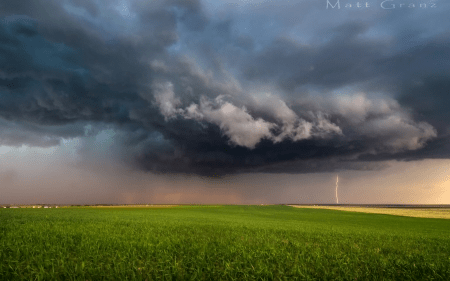
Having grown up in Midwest America, I’ve seen my share of large thunderheads (massive cumulus clouds which form just before a storm), thunderstorms replete with bright lightning and noise so awesome it shakes the farmhouse, and tornados with such force that they rip the roof off a barn as if it were a Lego building.

The appropriate response to such a great God is to make music for the One who strides the ancient skies in a heavenly chariot; and yet stoops to listen and care about puny humans.

The reasonable response to such a breathtaking God is to listen to the divine voice thundering in the world, and submit to the sound which seems like it might split the heavens open.

To gain a mere glimpse of God’s strength and power will inevitably result in a response of giving up our all to the Lord of the universe – everything we have, and all that we are.

To know, even a tiny smidgeon, of such a God will bring our own loud shouts of proclaiming God’s goodness, grace, and generosity to anyone who will listen to us.

To glimpse what the psalmist sees will consume us with awe, as we intuitively connect with the glory which is constantly streaming from heaven.

What’s more, God shares divine strength with people. God doesn’t have to do that. The Lord has no obligation to do so. Yet, it happens, despite our fickle praise and inconsistent devotion.

So, let’s give our highest praise to the God of the psalms. Let’s imbibe of God’s thunderous presence among us.

I guarantee that it will make us happier than a gopher in soft dirt; or a butcher’s dog; or a unicorn eating cake on a rainbow.

Eternal Trinity – blessed Father, Son, and Spirit – the awesome God whom I serve: The more I enter you, the more I discover, and the more I discover, the more I seek you. A massive thunderhead is but a small cloud next to you, the Godhead, the incredible Three-in-One.

Through you, almighty Lord, I shall come to know myself and my world. And that knowledge is a mighty love for humanity which spans longer and higher than the universe itself. May the love, unity, harmony, community, goodness, and power which is always present within yourself, mighty God, be present with me, your servant.

For just a molecule of You is enough to power me for eternity. Praise the Lord! Amen.

There Is No God? (Psalm 53)

Nietzsche, by Norwegian artist Edvard Munch (1863-1944)

Fools say in their hearts, “There is no God.”
    They are corrupt; they commit abominable acts;
    there is no one who does good.

God looks down from heaven on humankind
    to see if there are any who are wise,
    who seek after God.

They have all fallen away; they are all alike perverse;
    there is no one who does good,
    no, not one.

Have they no knowledge, those evildoers,
    who eat up my people as they eat bread
    and do not call upon God?

There they shall be in great terror,
    in terror such as has not been.
For God will scatter the bones of the ungodly;
    they will be put to shame, for God has rejected them.

O that deliverance for Israel would come from Zion!
    When God restores the fortunes of his people,
    Jacob will rejoice; Israel will be glad. (New Revised Standard Version)

In 1888, the German philosopher Friedrich Nietzsche published his book, “The Antichrist.” Nietzsche used the phrase, “God is dead,” to express his idea that the Enlightenment, with its thorough rejection of all things subjective and intuitive, and the embrace of everything objective and observable, had eliminated the possibility of God’s existence.

Nietzsche simply named what a modern progressive society had become: We “enlightened” people have drained and divested ourselves of all divine mystery. Nietzsche wrote:

“God is dead. God remains dead. And we have killed him. How shall we comfort ourselves, the murderers of all murderers? What was holiest and mightiest of all that the world has yet owned has bled to death under our knives: Who will wipe this blood off us? What water is there for us to clean ourselves? What festivals of atonement, what sacred games shall we have to invent? Is not the greatness of this deed too great for us? Must we ourselves not become gods simply to appear worthy of it?”

Friedrich Nietzsche, The Antichrist

This was the nineteenth century equivalent of making the psalmist’s observation that there is a philosophy extant which states, “There is no God.” God is gone; humanity has replaced God with themselves.

Unlike Nietzsche, however, the psalmist takes the perspective of God, not humans. The Lord looks about for someone wise, someone who truly takes notice to see with spiritual eyes, hear with spiritual ears, discern a spiritual touch, smell the aroma of God, and taste that the Lord is good – rather than relying solely on the five basic human senses.

So, where is God? In the grave? No, he has risen, just as he said.

Just because there appears to be a profound absence of good in this world, does not necessarily mean that good is not here – or that God has somehow gone away, and perhaps never existed at all.

Any common fool can make bold proclamations whenever they embrace an epistemology all to themselves.

From God’s perspective, anyone can use their five physical senses. To only use them, and completely ignore other ways of knowing, is well, plain stupidity.

So then, where is God? Not hanging out with fools, drinking cheap dandelion wine, and smoking nasty inexpensive cigars. Rather, the Lord is in the company of the righteous; God is with wise persons who discern the divine presence.

Things are not always as they seem. Violence and oppression in the world does not warrant the interpretation that God is on vacation, doesn’t care, or simply doesn’t exist, at all. We are invited to see beyond or through the world’s crud to a Divine Being who is there, reachable, and very much cares about the state of humanity.

All of our human posturing and preening to appear that we have it all together is nothing more than a poorly produced television reality show to God. So, if the Lord chooses to change the channel, that does not translate that God is not viewing the screen.

Only a fool believes no one is watching.

If we ignore God, perhaps we should not be surprised or upset when divine Skittles from heaven don’t come raining down on us to enjoy.

Instead, we have the opportunity and the privilege of paying attention to the spiritual life.

There are divine resources available if we will but acknowledge, receive, and use them. Though they are abundant and free, we still have to ask for them with the humility that comes from realizing we are not the center of the universe.

Nietzsche is not exactly a person that many Christians would typically acknowledge, let alone refer to, and, for good reason. And yet, Nietzsche understood that when God is removed from societal norms, it leaves us with a nihilist worldview (the belief that nothing has any inherent importance, and that life lacks purpose and meaning).

I believe that Christianity, and/or a focus on the spiritual life, is a powerful and needed antidote to the despair of meaninglessness which is all around us.

If God is truly the ground of moral reality, and gives real shape to human purpose, then we have an effective way to center ourselves. Yet, if God is ignored to the point of being “dead” then there is nothing substantial for humanity to orient their lives around.

Try as we might to create, as Nietzsche did, an Übermensch(superman) in the form of the radically independent and strong person to fill the enormous spiritual void of God’s death, it is merely a façade covering our weakness and our foolishness as creatures.

I suggest we consider the psalmist as a reliable source of knowledge – that God is a force for justice and for good in the world – and that we explore what this means for us in our respective lives, families, communities, as well as in our public discourse and personal philosophy.

Is God gone? No, not really. It’s just that we humans tend to give God the stiff arm.

Almighty God, you called your church to be one, holy, universal and missional people. By your grace you have given us new life in Jesus Christ, and by your Spirit you have called us to proclaim his name throughout the nations. Awaken in us such a love for you and your world that we may boldly proclaim Jesus Christ by word and deed. May all people everywhere come to know you, and Christ’s power to save. Amen.

A New Outlook on Life (2 Corinthians 5:17-22)

Therefore, if anyone is in Christ, the new creation has come: The old has gone, the new is here! All this is from God, who reconciled us to himself through Christ and gave us the ministry of reconciliation: that God was reconciling the world to himself in Christ, not counting people’s sins against them. And he has committed to us the message of reconciliation. We are therefore Christ’s ambassadors, as though God were making his appeal through us. We implore you on Christ’s behalf: Be reconciled to God. God made him who had no sin to be sin for us, so that in him we might become the righteousness of God. (New International Version)

Everyone sees things (and people) only in part. We all have our own unique perspective and take on life. And we interpret life from that particular angle.

God has brought us new life, and with it, a new outlook on life, made possible by the person and work of Jesus Christ.

The Apostle Paul gained a new orientation on his life because he encountered God’s love through Jesus Christ. And his experience of love caused Paul to live for Christ and not for himself. He gained a new perspective.

Conversion to Christ and following Jesus brings a new outlook on life that enables us to live a good and beautiful existence on this earth for the sake of the church and the world.

God brings a new outlook to us in three major ways. The way we look at ourselves, others, and God:

  • No longer do we need to compulsively demean ourselves, nor think of ourselves as better than we really are. Instead, encountering a new life in Christ, we see that we are truly loved by God and worthy of giving and receiving love. See what great love the Father has lavished on us, that we should be called children of God! And that is what we are!… This is how we know what love is: Jesus Christ laid down his life for us. (1 John 3:1, 16, NIV)
  • No longer do we view others as tools to take advantage of; and neither do we look merely at one’s outward appearance. Instead, experiencing new life helps us to see other people as spiritual persons, important to God and needing divine love, just like us. This is love: not that we loved God, but that he loved us and sent his Son as an atoning sacrifice for our sins. Dear friends, since God so loved us, we also ought to love one another. No one has ever seen God; but if we love one another, God lives in us and his love is made complete in us. (1 John 4:10-12, NIV)
  • No longer do we view Christ as merely a good teacher or a moral man. Instead, our new life gives us the lenses of seeing Jesus as Savior and Lord. This is how we know that we live in him and he in us: He has given us of his Spirit. And we have seen and testify that the Father has sent his Son to be the Savior of the world. If anyone acknowledges that Jesus is the Son of God, God lives in them and they in God. And so we know and rely on the love God has for us. God is love. Whoever lives in love lives in God, and God in them. This is how love is made complete among us so that we will have confidence on the day of judgment: In this world we are like Jesus. There is no fear in love. But perfect love drives out fear because fear has to do with punishment. The one who fears is not made perfect in love. (1 John 4:13-18, NIV)

With new life comes a new perspective that results in a new way of life. I was once walking with my late mother-in-law through an art museum. We came upon a piece of art that didn’t necessarily speak to me; and I really didn’t understand it. But my mother-in-law happened to know the artist who painted the picture. And she told me about the person, why she painted it, and what she was trying to convey with her art. This information completely changed the way I saw the painting.

As we progressively get to know God, it really ought to transform how we view the Lord and look at Holy Scripture. And when we discover God in Christ, we see a caring Lord who went out of the way to become one of us, become the pioneer of our salvation, and bring about redemption and reconciliation through an ignominious death on a cross.

God has deliberately sought us and brought us back into the divine dance through Christ – which is why we celebrate. And the highest form of celebration is imitation, that is, becoming ambassadors representing who Jesus is by being just like him.

We imitate Christ through our relationships. Whenever we act with humility, mourn over the world’s sin, deal with others according to grace and gentleness, seek right relationships and keep everything above board, are pure, merciful, and peacemaking in all our dealings, and love and pray for our enemies – then we are encountering God, imitating Christ, and living a new life from a new vantagepoint.

Because Christians have been reconciled to God through Jesus, it transforms how we see people and our desires in our relationships with them; and it changes our stance and perspective on the God who initiated and brought salvation and reconciliation to us. I want to:

  • Grow in a relationship with God through worship, prayer, and scripture reading
  • Grow in relationships with other Christians in fellowship, service, and love
  • Grow in relationships with my neighbors and everyone I encounter, to be an ambassador for Jesus, as if God were working through me to accomplish the compassionate loving of the world and demonstrating how to live a blessed and peaceful life.

In finding our true spiritual home, we find life. There’s nothing quite like being able to live a peaceful existence because of God’s reconciling work in Christ on our behalf.

Lord God, bring us together as one, reconciled with you and reconciled with each other. You made us in your likeness, and you gave us your Son, Jesus Christ. Enable us to know you and one another in the spirit of grace and love. Amen.

Known by God (Psalm 139:13-18)

You are the one
who put me together
    inside my mother’s body,
and I praise you because of
the wonderful way
    you created me.
Everything you do is marvelous!
    Of this I have no doubt.

Nothing about me
    is hidden from you!
I was secretly woven together
    out of human sight,
but with your own eyes you saw
    my body being formed.
Even before I was born,
you had written in your book
    everything about me.

Your thoughts are far beyond
    my understanding,
much more than I
    could ever imagine.
I try to count your thoughts,
but they outnumber the grains
    of sand on the beach.
And when I awake,
    I will find you nearby. (Contemporary English Version)

We don’t really know God, as much as we are known by God.

And God knows us intimately, down to each individual chromosome in our DNA strand.

For me, the incredible thing about this very detailed knowledge about each one of us is that God still wants to discover even more about us, as well as to be known by us.

Yes, the cosmic Ruler of the universe wants to share in a relationship with you and me – to be known and to know – and delights in the whole process of perceiving us.

Perhaps this is why my highest aspiration in life is to know Christ better. This has been true of me throughout the entirety of my Christian life across the decades. Which is why one of my favorite places in the Bible (which, by the way, is God’s self-revealing knowledge of the divine nature) is from a fellow believer who aims for the same thing:

“Nothing is as wonderful as knowing Christ Jesus my Lord. I have given up everything else and count it all as garbage. All I want is Christ and to know that I belong to him…. All I want is to know Christ and the power that raised him to life. I want to suffer and die as he did, so that somehow I also may be raised to life.” (Philippians 3:8-11, CEV)

This sort of knowing is much more than intellectual understanding or cerebral information; it’s an experiential knowledge that requires the dialogue and interaction of a lived relationship with another. Love is the glue which bonds this kind of reciprocal knowing of two persons. Sheer learning, without love – which fuels relational discovery – is counterproductive.

“All of us know something…. But knowledge makes us proud of ourselves, while love makes us helpful to others. In fact, people who think they know so much don’t know anything at all. But God has no doubts about who loves him.” (1 Corinthians 8:1-3, CEV)

What we know about ourselves is weird and conflicting. Many of us know we are good persons doing good work in the world. And yet, we also know many of the dark places in our hearts, and this knowledge is a source of shame to us.

This was also true of the psalmist. He knew that he was a bundle of contradictions within a single person. However, he was willing to be vulnerable before God, knowing that the Lord sees him completely for who he is – including all of those shadowy places within.

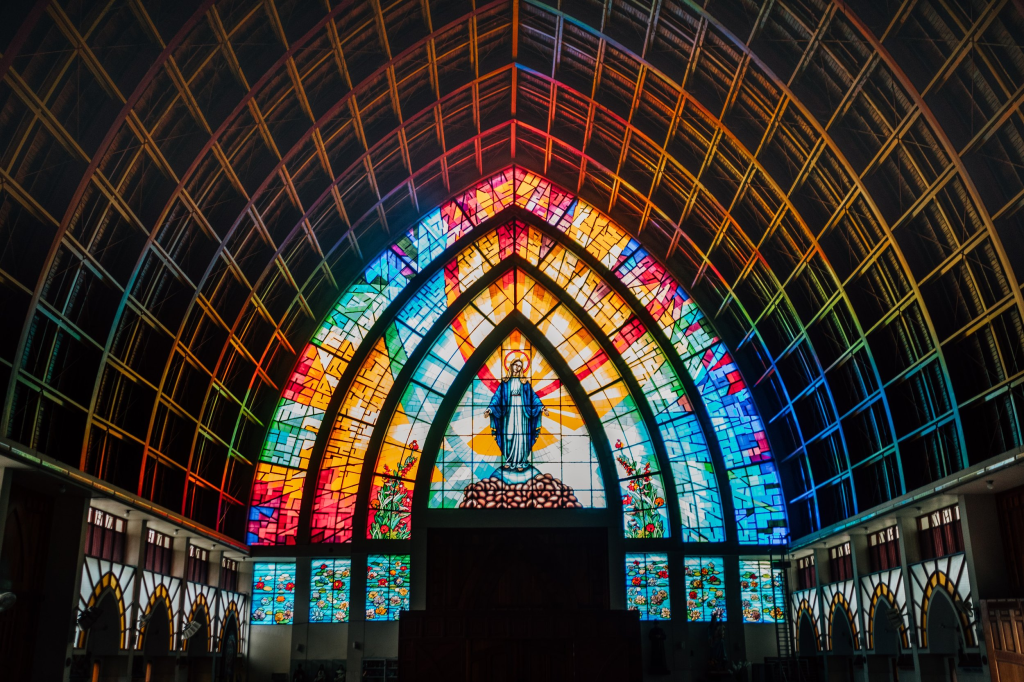
Immaculate Conception Cathedral in Pucallpa, Peru

In fact, God does some of the best divine work in the dark. A masterful weaving of your body and soul was done in the deepest part of your mother’s physical self. Life truly is a hand crafted one-of-a-kind gift, given to us by God.

There are, of course, parts of us we really like – and parts of us we don’t like and maybe even despise – which may cause us to question the goodness and/or care of God by the way we were formed. It’s easy to fixate on what’s wrong, as if we have the right to a particular body. Yet, none of us are owed anything from the Creator.

But, my friend, I ask, “Who do you think you are to question God? Does the clay have the right to ask the potter why he shaped it the way he did? Doesn’t a potter have the right to make a fancy bowl and a plain bowl out of the same lump of clay?” (Romans 9:20-21, CEV)

Today’s psalm suggests to us that each individual human person, you and me, are God’s best work of art. There is no beauty quite like that designed and made by God. Beauty takes our breath away and elicits awe and wonder from us. We are made in the image and likeness of a beautiful God – so beautiful that if we were to actually see God, the sheer beauty would undo us.

God even treasures us at our worst. Although spiritual growth and development is a lifetime project, we don’t engage in it in order for God to take notice and accept us. It isn’t a self-improvement plan. Rather, our spiritual growth is to help us be in a position to know Christ better – just as flower opens to the sun for energy. God delights in spiritually forming us, as well as the creative process in physically making us.

The Lord’s thoughts of us are continual. God is immanently near and close to us. And this is the bedrock foundation of our faith – that we are known by a good God who cares about every hair on our head, or in my case, every molecule of my being.

The psalmist’s God is a God worth getting to know. This is a God who is with us when we fall asleep at night, and who is there when we awake, having kept watch over us throughout the dark after-hours. “I am awake. I’m still with you!” says the Lord as we are greeted for each new day.

So, may you truly know this God who knows you deeply and intimately.

May you come to know and love yourself, just as you are known and loved by God.

And may the grace of Jesus Christ, the love of God the Father, and the abiding encouragement of the Holy Spirit be with you, now and forever. Amen.