The Parable of the Two Sons (Matthew 21:28-32)

Wheatfield with Crows, by Vincent van Gogh, 1890

“What do you think about this? A man had two sons. He went to the first and said, ‘Son, go to work in the vineyard today.’

“His son replied, ‘I don’t want to!’ But later he changed his mind and went.

“The father went to the other son and told him the same thing. He replied, ‘I will, sir,’ but he didn’t go.

“Which of the two sons did what the father wanted?”

“The first,” they answered.

Jesus said to them, “I can guarantee this truth: Tax collectors and prostitutes are going into God’s kingdom ahead of you. John came to you and showed you the way that God wants you to live, but you didn’t believe him. The tax collectors and prostitutes believed him. But even after you had seen that, you didn’t change your minds and believe him. (God’s Word Translation)

I once cheated on a college exam. It was a required class for which I was not much interested, so my grade was rather tenuous going into the final exam of the semester. When the professor stepped out of the classroom for a few minutes during the final, my fellow students began sharing answers. I gave in and went with the others.

I got an “A” on the exam and passed the class easily. However, I royally flunked God’s test. After a few days of misery, I went to the professor’s office and confessed what I had done. I was prepared to take a failing grade for both the exam and the class, yet I think the professor was so shocked that I would come and admit such a thing that he worked up my grade right there in front of me… I passed, but just barely.

I originally said “no” to what was right, but then said “yes” and made it right.  For those who practice repentance, there is a God of grace waiting for them. God has no tolerance for those who profess truth with a big “yes” on the outside but are passive-aggressive on the inside and say “no,” undermining the truth by how they live. 

The Sower, by Vincent Van Gogh, 1888

Today’s Gospel lesson highlights entrance into the kingdom of God – and the people entering might surprise us. Turns out, there are spiritual insiders on the outside of the kingdom, and spiritual outsiders as the ones who really inherit the kingdom.

Christ’s parable is a warning to all the spiritually serious: Beware, lest our insider energies be spent in correctness, conformity of belief, and cockiness rather than following Jesus. At the same time, the parable encourages outsiders with the wonderful possibilities of a changed life. 

Jesus was warning those who arrogantly assume they have the inside track by what they believe, and not by doing God’s will. It may be challenging for us to imagine how truly offensive Christ’s story was to the original hearers of the parable, so I restate it in a more contemporary form:

There was a man who was well respected in the community and had two sons. One son grew up and became a respectable member of the community, too. He was a successful businessman and gave lots of money to causes in his community, including new lights for the school football field – which was no small cost.  He only asked that appropriate and prominent recognition be given him with a plaque bearing his name on each of the light poles. 

The other son was not so successful.  He was the one in school who the teachers said, “Why can’t you be more like your brother?”  There was nothing spectacular about this son.  In fact, he lived an ‘alternate lifestyle’ and people murmured behind his back. 

One day the father said to this son: “Son, go and work at my place of business today; I am going away and need you to do some of the tedious paperwork I have gotten behind on.” “No way!” he answered, but later felt heartsick about the way he spoke to his father and decided to go and do all the grunt work his father needed done.

The father went to the well-respected son and said the same thing about needing him to do all the thankless paperwork that was piled up. That son answered, “Yes, sir, I will; anything you need I will do.” But that son did not go. Instead, he chose to go golfing with some people whom he was trying to coy favor with.

After telling the story, Jesus asked all the upstanding faith leaders and the people listening: “Which of the two did what his father wanted?” “The first,” they answered.

Jesus said, “I tell you the truth, folks with different sexual orientations, unemployed persons on the low rung of society, and the religiously different with esoteric beliefs are entering the kingdom of God ahead of you. For you have had heard thousands of sermons about grace and the way of righteousness, yet you did not believe by putting God’s Word into practice; but the others did. And even after you saw how God can change a person’s life from the inside-out, you yourselves did not repent and believe.

For Jesus to tell such a story was so scandalous that, frankly, it got him killed. Specifically, the scandal is this: Merely believing rightly and living as an upstanding citizen is not the way of salvation. Tax collectors and prostitutes were some of the most despised people in Christ’s time. It was assumed they were outside of God.

However, the proof of genuine belief is not lip service but actively obeying God when no one is looking:

My friends, what good is it to say you have faith, when you don’t do anything to show that you really do have faith? Can that kind of faith save you? If you know someone who doesn’t have any clothes or food, you shouldn’t just say, “I hope all goes well for you. I hope you will be warm and have plenty to eat.” What good is it to say this, unless you do something to help? 

Faith that doesn’t lead us to do good deeds is all alone and dead! Suppose someone disagrees and says, “It is possible to have faith without doing kind deeds.” I would answer, “Prove that you have faith without doing kind deeds, and I will prove that I have faith by doing them.” You surely believe there is only one God. That’s fine. Even demons believe this, and it makes them shake with fear. (James 2:14-19, CEV)

The Christian life comes down to obedience, not cheap talk. Jesus wants to bless a lost world in need of God’s love and grace.

If we have ears to listen, we can hear numerous lost souls crying in the dark. If we have eyes to see, there are people caught in addictions standing in front of us. If we have hands willing to labor, needy folks surround us who can neither help themselves nor ask for it.
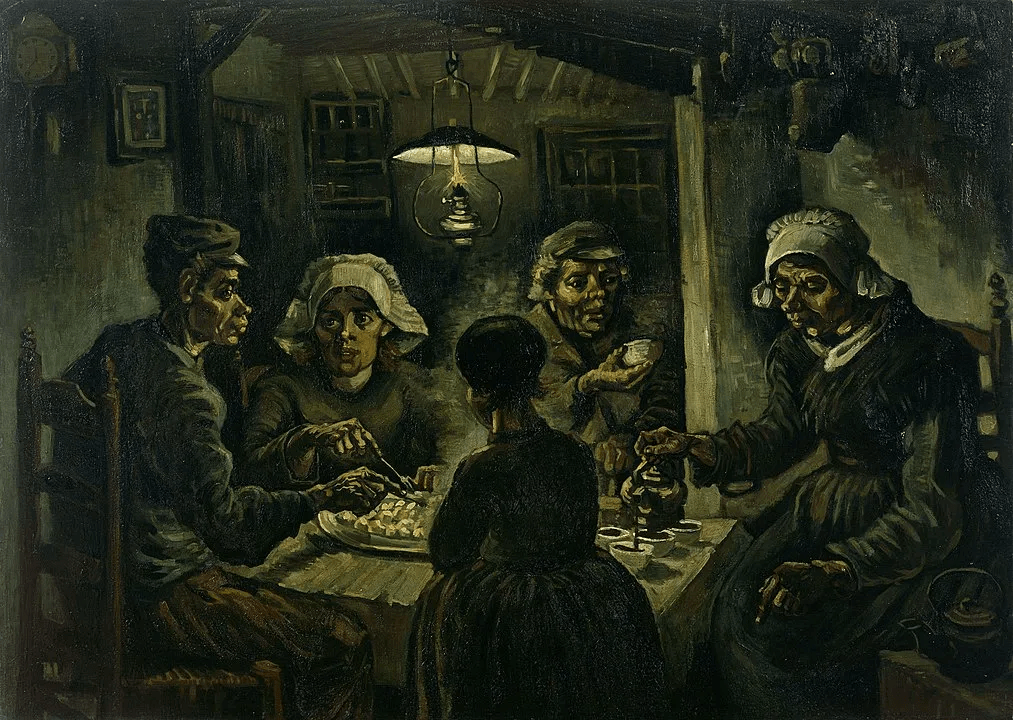
The Potato Eaters, by Vincent Van Gogh, 1885

Honestly, I am heartsick over the grinding loneliness of so many people; the boatloads of shame which thousands secretly carry; and the silent pain experienced by individuals everywhere. I feel this way because I genuinely believe my Lord feels the same. Jesus is looking to activate grace through his people to a world sinking in the depths of incredible human need.

Christ’s parable, however, is more than a warning; it is a story that opens the door of mercy for unlikely people seemingly far from God – people who ruined their lives by saying “no” to God. The parable is an invitation for all the screw-ups and those with little faith to come to Jesus.

There is a rather obscure Scripture reference, tucked away in the Old Testament. David was on the outside looking in. King Saul was on the inside trying to capture and kill him, even though David had done nothing wrong. Here is what happened:

David got away and escaped to the Cave of Adullam. When his brothers and others associated with his family heard where he was, they came down and joined him. Not only that, but all who were down on their luck came around—losers and vagrants and misfits of all sorts. David became their leader. There were about four hundred in all. (1 Samuel 22:1-2, MSG)

This rag-tag group of outsiders in Israel became Israel’s insiders as David eventually became king and these were the “mighty men,” the ones who helped bring Israel into prominence. 

Jesus Christ came into this world and identified himself as the Savior to the outsider when he quoted the prophet Isaiah:

Jesus went to the synagogue on the sabbath day, as was his custom. He stood up to read, and the scroll of the prophet Isaiah was given to him. He unrolled the scroll and found the place where it was written:

“The Spirit of the Lord is upon me,
    because he has anointed me
        to bring good news to the poor.
He has sent me to proclaim release to the captives
    and recovery of sight to the blind,
        to let the oppressed go free,
to proclaim the year of the Lord’s favor.”

And he rolled up the scroll, gave it back to the attendant, and sat down. The eyes of all in the synagogue were fixed on him. Then he began to say to them, “Today this scripture has been fulfilled in your hearing.” (Luke 4:16-21, NRSV)

In Christ, there are no lost causes and no persons too far on the outside to be redeemed. Therefore, now is the time to act on what we believe – to not only affirm right doctrine, but to live out that doctrine in obedience to God’s call.

May it be so, to the glory of God.

The Parable of the Tenants (Matthew 21:33-46)

Illustration of the parable of the vineyard workers, in the Codex Aureus of Echternach, c.1040 C.E.

“Listen to another parable: There was a landowner who planted a vineyard. He put a wall around it, dug a winepress in it and built a watchtower. Then he rented the vineyard to some farmers and moved to another place. When the harvest time approached, he sent his servants to the tenants to collect his fruit.

“The tenants seized his servants; they beat one, killed another, and stoned a third.Then he sent other servants to them, more than the first time, and the tenants treated them the same way. Last of all, he sent his son to them. ‘They will respect my son,’ he said.

“But when the tenants saw the son, they said to each other, ‘This is the heir. Come, let’s kill him and take his inheritance.’ So they took him and threw him out of the vineyard and killed him.

“Therefore, when the owner of the vineyard comes, what will he do to those tenants?”

“He will bring those wretches to a wretched end,” they replied, “and he will rent the vineyard to other tenants, who will give him his share of the crop at harvest time.”

Jesus said to them, “Have you never read in the Scriptures:

“‘The stone the builders rejected
    has become the cornerstone;
the Lord has done this,
    and it is marvelous in our eyes’?

“Therefore I tell you that the kingdom of God will be taken away from you and given to a people who will produce its fruit. Anyone who falls on this stone will be broken to pieces; anyone on whom it falls will be crushed.”

When the chief priests and the Pharisees heard Jesus’ parables, they knew he was talking about them. They looked for a way to arrest him, but they were afraid of the crowd because the people held that he was a prophet. (New International Version)

I once saw a guide dog gently pressing on his blind owner to go a certain way. But the man didn’t go that way. The dog kept pressing until the blind man kicked his dog. And then, the guy walked smack into a parked car on the street.

We can sometimes think too much of ourselves; and tend to believe that what we say and do and think are right – until we walk into a parked car, looking like a fool.  We need, of course, to listen to God. Yet, because we cannot see God, it’s too easy to treat the Lord as if he were an absentee landowner.

Today’s parable is about who will inherit the kingdom of God. The religious establishment of Christ’s day were not characterized by Christ’s Beatitudes. They thought they were okay. But they were really like a blind man kicking the guide dog, believing their way was right.

There are five truths illustrated in this parable that we need to grasp. The point of the parable is that Christ is looking for people who do God’s will and produce righteous fruit. Before we get into those truths, let’s get the cast of characters straight:

  • the landowner is God
  • the vineyard is Israel, God’s people
  • the tenants that the landowner put in charge are the religious leaders
  • the servants are the Old Testament prophets of God
  • the Son is Jesus

God is patient and longsuffering

God is like the guide dog who gently and lovingly keeps nudging, trying to get the person’s attention. In the parable, God’s people are likened to a vineyard. Jesus drew much of his teaching from the prophet Isaiah.

In Isaiah chapter 5, Israel is likened to a vineyard that God carefully takes care of, looking for fruit, but not getting any. For Jesus to tell the parable about a vineyard, gained the attention of people who knew the Scriptures.

Like Isaiah, Jesus pictured God as having a persistent, patient love for people, even when the tenants rebel and try and throw God out. The landowner, God, has:

  • planted
  • put in a wall
  • dug a winepress
  • built a watchtower
  • rented it out
  • sent the servants 

All these verbs describe a God who put a lot of time and energy into the vineyard. Even today, God still fusses over the vineyard and is looking for people to produce fruit in keeping with a genuine sense of righteousness. 

Humanity, especially the religious insiders, are sinful

In contrast to God’s love and care, is humanity’s persistent rebellion. The picture is of people who are hell-bent on rejecting the love of God. God’s patient love is met each time with a heightened hardness of heart on the part of the tenants. Jesus wanted the crowd to feel the situation of the landowner who goes beyond normal conventions in continuing to send servants; and the tenants’ violence in response.

God feels the weight of human sinfulness. Because the landowner is absent and we cannot see him, we may forget or not realize that God feels the full range of emotions. Each person who goes their own way and refuses God’s love; does not respond to God’s efforts to see fruit produced; and any system that is imposed contrary to God’s good order and care, all grieves God. Jesus later expressed his own grief and longing:

“Jerusalem, Jerusalem, you who kill the prophets and stone those sent to you, how often I have longed to gather your children together, as a hen gathers her chicks under her wings, and you were not willing.” (Matthew 23:37, NIV)

The Son was sent as the final act

Any “normal” landowner would throw the tenants out after the first sending of servants that didn’t go well. Yet God the landowner knew what he was doing. Jesus actually summarized the plot line of the Old Testament, and of our lives, as well. The history of salvation moves like this through Scripture:

  • God loves people
  • people keep rebelling against that love
  • God keeps pursuing peoiple
  • then, God does the unthinkable by becoming one of us 

Jesus, stepped into this messy, bloody and violent world, full of hatred and hardness of heart. Then, the Son was killed and thrown outside.

God’s judgment is awful

Jesus drew his listeners into the story, and invited a response to what the landowner would do after all of the overtures to the tenants. The listeners responded that “he will bring those wretches to a wretched end.” And in a sense Jesus says, “You are them.” 

Jesus invited them to remember and realize the Scripture by looking at it as the Son who was killed. He let the crowd know that rejection of the Son results in the Son becoming the most prominent person. Jesus wanted them to look at their bibles and see Christ. He was rejected by his own – which will result in a pulverizing judgment, like a stone falling on a person.

God replaces the whole crew

God is transferring the kingdom of God from the proud and hard-hearted religious insiders to the repentant, soft-hearted outsiders. The self-righteous people failed to accept Jesus because of their insistence on being right; the spiritual beggars accept Jesus and God’s love and are the true subjects of the kingdom. The supposedly spiritual people who had all the religious traditions failed to see what those traditions really point to. 

We don’t own the kingdom; God does. God calls the shots, and has every right to expect people to produce the fruit of mercy, purity, and peacemaking in keeping with a humble heart that desires genuine righteousness.

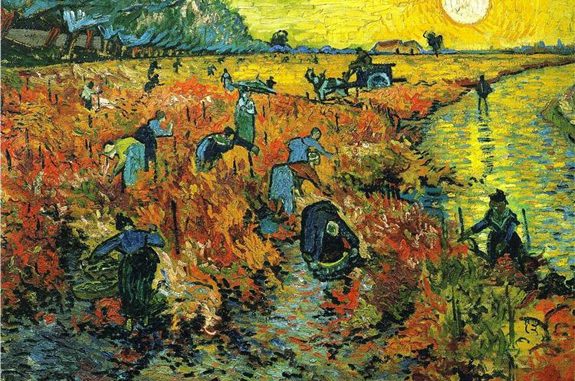
The Red Vineyard by Vincent Van Gogh, 1888

Maybe this parable seems a bit distant from us. To help us hear the story of Jesus as his original hearers heard it, I now restate the parable in a contemporary form:

Listen to another story about who is really a Christian. There was a landlord who built an upscale apartment building. The landlord spared no expense in creating apartments that were comfortable and homey. Everything he designed and built was with the care of someone who thought about what people would need and like most about a place to live. He included a host of amenities to his apartments because he really wanted the people to have as much joy living there as he did designing and building them. 

The owner put a gate around the complex so that the apartment community would be safe and secure. He hired a security firm to keep watch over the apartment complex. Then, when every detail was in place, the landlord rented out his apartments. But he didn’t just rent them out; he wanted to see the joy on the faces of the renters when he made a contract with them that included an entire year’s free rent. After that first year, when it came time for the first rent to be due, the landlord did not receive a single rent check. He was puzzled about this, so he decided to send some of his employees to collect the rent in person.

While the renters were in one of the large common lounges enjoying being together, they saw the landlord’s employees coming from a distance. So, they hatched a devious plan. Over their year of living in the beautiful apartments, they began to think they were especially special, and not like other people who lived in places that weren’t as nice as where they lived.  They gained such a twisted idea of their own importance that they believed they didn’t need to pay rent; and no one was going to tell them what to do. After all, they deserved to live where they did. They have a right to it. They don’t need to answer to anyone, including this supposed landlord who they have never seen in this last year, anyway.

Then the renters took the landlord’s employees and beat one, killed another, and took a baseball bat to a third. They took the bodies and threw them in the dumpster behind the building. Then the landlord, not wanting to evict his renters even after such a terrible experience, sent some other employees, more than the first time. But the renters had no guilt about what they had done, and did the very same thing to the second group of employees.  Even after this, the landlord was reluctant to let the law take over and decided to send his own son to collect the rent so that the renters could keep living in his apartments.

But when the renters saw the son, they said to each other. “Look! The guy sent his son. If we kill him, then we can forget about the old man and claim the whole apartment complex for ourselves.” 

After telling this story, Jesus asked all the church people listening, “When the owner of the apartment complex comes, what do you think he will do to those renters?” The crowd was into the story and replied, “He’s going to judge those ungrateful murderers, and replace the whole bunch of them with all new renters.” 

Jesus then said to them, “Have you never read in your bibles that the son who was rejected and killed has become the most important person of all? The Scriptures are all about the Son.”

“So, I am telling you that even though you have been in the Church all your life, it isn’t yours. I’m going to replace the whole lot of you with people who are humble and sensitive to sin; people who know they don’t deserve the nicest place to live in the world. If you persist in ignoring the Son, all you have to look forward to is God’s judgment.”

When all the important church people heard Jesus’ stories, they knew he was talking about them. And, even though they saw themselves in the story, they still wanted to do their own thing. They didn’t change one bit. Instead, they decided to be sneaky and try and do away with Jesus in their lives without getting in trouble. 

The kingdom of God and Christ’s Church is not an entitlement. And it does not inoculate us from God’s judgment. We must produce fruit in keeping with repentance. God is gently nudging us, like a guide dog. Will we respond in humility and turn where the Lord wants us to turn?

The Parable of the Mustard Seed (Mark 4:30-34)

Again he [Jesus] said, “What shall we say the kingdom of God is like, or what parable shall we use to describe it?It is like a mustard seed, which is the smallest of all seeds on earth. Yet when planted, it grows and becomes the largest of all garden plants, with such big branches that the birds can perch in its shade.”

With many similar parables Jesus spoke the word to them, as much as they could understand. He did not say anything to them without using a parable. But when he was alone with his own disciples, he explained everything. (New International Version)

Working with Seeds

I grew up on a rural Mid-West America farm. Working with seeds was our livelihood. Even though my farming father worried incessantly about the weather, there was one thing he was never anxious about: seeds.

My dad knew that when we planted seeds in the Spring, there would be a harvest in the Fall. That’s because he knew the seed already has within itself everything it needs to germinate, take root, grow, and produce a harvest. His role was simply to tend to it all by keeping the fields free of weeds, worms, and critters.

Since I was the youngest, I typically got the grunt work of our massive family garden. I was always excited when we planted things because I knew what was coming in a few months: some delicious veggies on my dinner plate which were fresh from the garden that I myself tended. I never wondered whether there would be food on the table, or not.

Seeds are, of course, small. If you think about it, they appear quite unimpressive. Yet, we know better. We understand that when planted, watered, and cultivated, those seeds turn into amazing plants. 

But it takes time. Even as dumb little kid, I clearly knew that my planting seeds would not result in seeing anything above ground the next day. I understood it would take a few weeks before new growth would break the ground.

Seeds and the Kingdom of God

The kingdom of God, Jesus told us, is like a mustard seed – a very small seed which can grow into a tree big enough for birds to nest. Unlike the mighty Roman Empire, or contemporary powerful national governments, the kingdom of God had humble beginnings. It grows, over a long period of time, to become a force greater than anything the world can produce.

While our world races forcefully on with the speed of the hare, Jesus is carefully and patiently building his Church at the pace of a tortoise. In the end, the kingdom of God will rule over all creation, while the kingdoms of this world shall no longer exist. 

Even though many of us now live in a society where quicker, faster, better, and stronger dominate everything, still the best things in life come as a result of tedious perseverance over an extended period of time. 

We are in such a hurry to accomplish our goals, make as much money as we can, and keep constant vigilance over our work. And for what purpose?

When we forget to slow down, or worse yet, believe slowness to be laziness and/or stupidity, there is a price to pay.

Lessons of the Seed

In graduate school, I typically read an average of 200 books per semester. Yes, you read that right. I had to keep up. I was on the clock with deadlines for papers and projects. In the factory, where I did a stent as a worker, I did piece work at the rate of 100 per hour for 8-10 hours. I had to go fast to survive and keep my job, let alone thrive. All of this, of course, impacted my mind, body, and emotions – in very uncaring ways. It was all done at the cost of my physical and mental health.

Indeed, our modern capitalist societies generate an unparalleled level of wealth and standard of living. But this has been achieved at the cost of devouring our planet faster than she can replenish herself. The stress we have put on mother earth we would never think of putting on our own mothers.

Even our attempts at leisure and self-care are anything but. We often end up racing to have as much fun and relaxation as we can cram into a few days or weeks of our “time off.” A return to the normal rat race has us telling each other, “I need a vacation from my vacation.”

There is such a thing as death by overwork. So, we desperately need to come back to the words and ways of Christ – to embrace the slow developing rhythms of grace. We need to age like a fine wine or an expensive bourbon, getting wiser as we get older.

Time is a precious gift given to us by a good and wise God. And that gift must be stewarded well. All the things that bind people together and make our lives worth living – family, faith, friendship, and community – all thrive on having copious amounts of time with each other (and God) in relational connection.

We are, I believe, in a pandemic of having no one to listen, of profound loneliness, and of incredible lostness of soul. The only real prescription for these debilitating maladies is slowing down and taking the time to be, and to be with each other.

Seeds are Slow

Instant gratification will not do the trick. We need to plant small seeds, and then take the time to nurture them and watch over them. While the rest of the world rages and roars on with their disease of speed, believers must carefully cultivate spiritual practices which foster healthy growth and development.

Whether we like it, or not, we serve a slow God. And what’s more, because slowness is built into the very nature of the world, decelerating our lives actually works. Life eventually becomes better, not worse.

You and I have the God-given right to determine our own pace and tempo – without anxious systems of power squeezing every ounce of speed and activity out of us, sucking our souls to serve a worthless idol.

I, for one, would not be opposed to creating a society known as “The Royal Order of Sloths,” or joining a group of slow walkers who label themselves as “Sauntering for Sanity,” or simply be straightforward with an organization known as “The Society for the Propagation of Slowness.”

That’s because the best things in life take time; and those things need us to slow ourselves enough to notice and enjoy them. Eventually, we shall find that the world is blessed because of our commitment to embracing the small and the slow.

Let us pray for all the world, and also for ourselves, knowing that what we ask in the name of the Lord, will be heard according to God’s mercy and patience.

Almighty God, we pray for faith, even as small as a mustard-seed, and for the love to nourish and nurture it, so that it may grow and flourish. We pray for the church throughout the world – that people of faith may work together in unity and in prayer to overcome evil and to promote true love among all people.

O Lord, you are the beginning of all our good, the wellspring of all our love and the source of all our freedom. Let your grace continue to work in us, that your will may be done through us, and that we may always rejoice in your presence. Lord, in your mercy, hear our prayer. Amen.

Justice for All (Matthew 12:15-21)

When Jesus became aware of this [a plot to kill him] he departed. Many followed him, and he cured all of them, and he ordered them not to make him known. This was to fulfill what had been spoken through the prophet Isaiah:

“Here is my servant, whom I have chosen,
    my beloved, with whom my soul is well pleased.
I will put my Spirit upon him,
    and he will proclaim justice to the gentiles.
He will not wrangle or cry aloud,
    nor will anyone hear his voice in the streets.
He will not break a bruised reed
    or quench a smoldering wick
until he brings justice to victory.
    And in his name the gentiles will hope.” (New Revised Standard Version)

Saying the words, “I love you” is important. And it’s also significant how we say it. If our tone of voice is monotone and our affect flat, then the incongruence between the words and the manner in which they are said will leave our love unrequited. If, however, our tone is soothing and excited and our face beaming as if starstruck, then the love expressed will likely be received, and stick.

Christians have a message of love to the world. It’s a message of Jesus Christ and his love for humanity. Both the content of our message and the way we communicate it are vitally significant.

For if the words we don’t match our tone of voice and affect, then love is not what we convey. Yet, if we have been profoundly and meaningfully touched by the love of God in Christ, then that love will not be constrained; it shall find a way to express itself with appropriate mannerisms.

The way in which Christ proclaimed his message, testified that he was, indeed, the promised Savior and the rightful Ruler for God’s world.

The message of Jesus was proclaiming justice to the nations. The disciple Matthew used a quote from the prophet Isaiah to explain the reason why Jesus withdrew, and told people not to make him known. This was a curious act for a Messiah, to say the least. 

After all, we might believe Jesus should loudly proclaim who he is and what he is doing. Human ingenuity might say he ought to be advancing, not retreating – getting his name out with some notoriety in a slick marketing message so that people will come running into the kingdom of God! 

But Jesus goes a different direction. Matthew (quoting the prophet Isaiah) made it clear who Jesus is and what he is all about. Jesus is God’s servant. Jesus is God’s beloved Son with whom he is well-pleased. The Holy Spirit came on him in his baptism. Jesus became a teacher of justice to the nations, that is, to gentiles, to all kinds of people – even the ones we do not like. 

I personally find it strange that some Christian folk think justice is something which is not part of the Gospel, as if it were nice, but optional. They might believe it’s important to engage in some sort of social justice toward the downtrodden, but want to put it on a secondary shelf. Speaking the message is primary to them, as if we could or should separate the message from the messenger.

Yet, we can no more divide the good news of forgiveness in Christ from social justice any more than we can neatly separate the cross and resurrection. All of it is redeeming work; it all goes together.

In the kingdom of God, all things and all people are to be redeemed and come under the Lordship of Christ. And the practice of justice is central to making redemption a reality for humanity.

He has told you, O mortal, what is good,
    and what does the Lord require of you
but to do justice and to love kindness
    and to walk humbly with your God? (Micah 6:8, NRSV)

Mercy and justice go together like corn on the cob and butter, and like pork ribs with barbeque sauce (I’m from Iowa, after all!). Kindness and mercy refers to God’s unconditional grace and compassion. Justice treats all people with equity, without any favoritism.

Biblical justice is not primarily punishment for wrongdoing; it gives people their rights – and this concept is overwhelmingly taught in Holy Scripture – over 200 times in the Old Testament alone. Jesus Christ’s back to the Bible movement rightly emphasized justice.

God loves and defends the weak, the poor, and the powerless:

He gives justice to the oppressed
    and food to the hungry.
The Lord frees the prisoners.
    The Lord opens the eyes of the blind.
The Lord lifts up those who are weighed down.
    The Lord loves the godly.
The Lord protects the foreigners among us.
    He cares for the orphans and widows,
    but he frustrates the plans of the wicked. (Psalm 146:7-9, NLT)

We, as God’s people, are to share the Lord’s passion for justice:

Speak out on behalf of the voiceless,
    and for the rights of all who are vulnerable. (Proverbs 31:8, CEB)

“Cursed is anyone who obstructs the legal rights of immigrants, orphans, or widows.” All the people will reply: “We agree!” (Deuteronomy 27:19, CEB)

Since believers are justified by faith in Christ, we bring justice to our communities, in both word and deed, by advocating for the least, the lost, the last, and anyone else without social or economic power in this world.

We are to use our voice for both us and for those who have no voice. The voice of justice is the voice of action.  To be concerned for the justice of God is to actively work for God’s rule and reign to enter every inch of this world, to penetrate every nook and cranny of our homes, neighborhoods, and schools. 

“If you are a Christian, and you refrain from committing adultery or using profanity or missing church, but you don’t do the hard work of thinking through how to do justice in every area of your life – you are failing to live justly and righteously” Tim Keller, Generous Justice

The Christian life is much more than avoiding sin; it’s about actively pursuing God’s will through words and acts of justice on behalf of the needy. Jesus came to this earth to proclaim justice, and, as his followers, he expects us to do it, too. For this to happen, we must overcome our prejudices toward anybody unlike us so that we will stand with the weak, the poor, the oppressed, the lowly, and the pained, all around us.

The probing question for all of us is: Am I able to see the image of God in someone different from me?

Jesus did. Christ will not quarrel or cry out; no one will hear his voice. That is, Jesus is gentle, humble, and meek. He did not look for dramatic confrontations with others, but instead went quietly about his Father’s business. 

Jesus was no bullhorn guy, loudly proclaiming his message on a street corner. Instead he interacted with and ministered to the lowliest people of society who had no power and nothing to give in return. Jesus did everything to connect with them, and not to avoid them.

Along the Jordan River in Israel, reeds grew by the millions, in Christ’s day. They had little value because there were so many of them. Reeds were used to make baskets, pens, flutes, and a variety of other things. A perfect reed is fragile, and a bruised one is useless. 

The reference that God’s servant will not break a bruised reed, means that Jesus will treat the weak with sensitivity. A smoldering wick is also not worth much; if it’s damaged, you just get another one. A contemporary example might be a paper clip; it’s not worth much to us, and a damaged one we simply discard and use another. 

The point is: Jesus handles hurting people with care. Society’s poor, disadvantaged, and struggling will not be callously overlooked and tossed aside by Jesus.

Jesus Christ discovered his own island of misfit toys. He then demonstrated to the world that are a needed part of society. Small wonder, then, that droves of the lowliest people throughout history have come to Jesus, placing their hope in him.

For we do not have a high priest who is unable to sympathize with our weaknesses, but we have one who has been tempted in every way, just as we are – yet was without sin.  Let us then approach the throne of grace with confidence, so that we may receive mercy and find grace to help us in our time of need. (Hebrews 4:15-16, NIV)

Our help is in the name of Lord who made heaven and earth. May you find Christ, God’s servant, as your anchor and hope in the world. Amen.