1 Samuel 24:1-22 – How to Handle An Enemy

David and Saul in the Cave by James J. Tissot (1836-1902)

After Saul returned from pursuing the Philistines, he was told, “David is in the Desert of En Gedi.” So, Saul took three thousand able young men from all Israel and set out to look for David and his men near the Crags of the Wild Goats.

He came to the sheep pens along the way; a cave was there, and Saul went in to relieve himself. David and his men were far back in the cave. The men said, “This is the day the Lord spoke of when he said to you, ‘I will give your enemy into your hands for you to deal with as you wish.’” Then David crept up unnoticed and cut off a corner of Saul’s robe.

Afterward, David was conscience-stricken for having cut off a corner of his robe. He said to his men, “The Lord forbid that I should do such a thing to my master, the Lord’s anointed, or lay my hand on him; for he is the anointed of the Lord.” With these words David sharply rebuked his men and did not allow them to attack Saul. And Saul left the cave and went his way.

Then David went out of the cave and called out to Saul, “My lord the king!” When Saul looked behind him, David bowed down and prostrated himself with his face to the ground. He said to Saul, “Why do you listen when men say, ‘David is bent on harming you’? This day you have seen with your own eyes how the Lord delivered you into my hands in the cave. Some urged me to kill you, but I spared you; I said, ‘I will not lay my hand on my lord, because he is the Lord’s anointed.’ See, my father, look at this piece of your robe in my hand! I cut off the corner of your robe but did not kill you. See that there is nothing in my hand to indicate that I am guilty of wrongdoing or rebellion. I have not wronged you, but you are hunting me down to take my life. May the Lord judge between you and me. And may the Lord avenge the wrongs you have done to me, but my hand will not touch you. As the old saying goes, ‘From evildoers come evil deeds,’ so my hand will not touch you.

“Against whom has the king of Israel come out? Who are you pursuing? A dead dog? A flea? May the Lord be our judge and decide between us. May he consider my cause and uphold it; may he vindicate me by delivering me from your hand.”

When David finished saying this, Saul asked, “Is that your voice, David my son?” And he wept aloud. “You are more righteous than I,” he said. “You have treated me well, but I have treated you badly. You have just now told me about the good you did to me; the Lord delivered me into your hands, but you did not kill me. When a man finds his enemy, does he let him get away unharmed? May the Lord reward you well for the way you treated me today. I know that you will surely be king, and that the kingdom of Israel will be established in your hands. Now swear to me by the Lord that you will not kill off my descendants or wipe out my name from my father’s family.”

So, David gave his oath to Saul. Then Saul returned home, but David and his men went up to the stronghold. (New International Version)

Sometimes reconciliation is neither possible nor wise.

King Saul was unstable. Although initially appreciative of David’s service, Saul became jealous. And that jealousy eventually grew into suspicion, then paranoia.

It became so bad that David had to flee and went on the run. Saul was convinced David wanted his kingship, so he hunted him like an animal. He wanted him out of the limelight and out of the way – permanently.

There are times in everyone’s life that another person actively and intentionally seeks to do us harm. How do we handle such a situation? How might we respond in a way that gives us peace of mind?

David continually had enemies throughout his life. And the vast number of those who opposed him, did so despite the fact that David didn’t deserve it.

“We retaliate instead of reflect, and we burn hot in the flames of revenge rather than cool our heels in the pool of patience.”

Craig D. Lounsbrough

Saul came looking for David with an army five-times the size of David’s rag-tag group of men. Yet, Saul had no idea that he had ambled into being a sitting duck.

What would you do in that kind of situation?

Picture the person who gives you the most grief. Maybe they purposely speak bad about you or try and oppose you at any opportunity. Perhaps there is a boss or someone in authority who seeks to undermine you every chance they get.

And now, the tables are turned. You have the chance to publicly put them in their place. You can put an end to the madness. What are you going to do?

In David’s situation, his men made the logical assumption that God ordained the turn of events. So, go ahead and off Saul. Become the king. After all, God already told you that you would be king. Now he’s giving you the opportunity. It’s right there. Take it, man.

“Retaliation is a dog chasing its tail.”

Libba Bray

But David didn’t take advantage of having the upper hand. He didn’t kill Saul because he was convinced it wasn’t the right thing to do. In fact, David felt terrible for even considering the idea. He wasn’t going to take matters into his own hands.

So, David left it in the hands of God. Since God anointed him as the next king, David reasoned, then God would make it happen. He didn’t need to do God’s job for him. David’s theological perspective was this: God is my defender; God will take care of me; God will judge another’s sinful behavior.

Today’s Old Testament lesson is a story in the importance and necessity of non-retaliation. What’s more, it’s a lesson in treating all people with respect, even if they don’t seem to deserve it, at all.

This lesson in no way infers that we sit idly by and refuse to hold another accountable for their actions. It just means we aren’t the judge, jury, and executioner.

Once Saul realized he had been a sitting duck, he repents… or does he? He admits to his wrong, even emotionally reacts to it. But here’s the bottom line to all overtures of repentance: It must result in a change of attitude and behavior. And Saul didn’t offer that.

So, the story ends pretty much as it began. There’s no reconciliation because there’s no true repentance on the part of Saul. The disturbed and paranoid king ends up continuing his murderous pursuit of David. *Sigh*

Folks like Saul have no intention of changing. They only want to hold onto their power and control. They’re only happy if others are giving them accolades and kudos. And if they’re not getting recognition, there’s hell to pay.

Beware of false repentance. Don’t be fooled by a person who has a pervasive pattern of self-interest, then, all of a sudden, feels sorry. It’s likely they’re doing that because they don’t have the upper hand – and they desperately want it back.

More importantly, don’t play their game. Instead, live by the ethics of God’s kingdom. You’ll be glad you did.

O God: Give me strength to live another day. Let me not turn coward in the face of its difficulties. Let me not lose faith in other people. Keep me sweet and sound of heart, in spite of ingratitude, treachery, or meanness. Preserve me from harm and keep me from harming others. Help me to keep my heart clean, and to not become disheartened by the evil of others. Open wide the eyes of my soul that I may see the good in everything. Inspire me with the spirit of joy and gladness and make me a conduit of your blessing to others, in the name of the strong Deliverer, our Lord and Savior, Jesus Christ. Amen.

1 Samuel 31:1-13 – Warning Signs from a Tragic Life

The Philistines made war on Israel. The men of Israel were in full retreat from the Philistines, falling left and right, wounded on Mount Gilboa. The Philistines caught up with Saul and his sons. They killed Jonathan, Abinadab, and Malki-Shua, Saul’s sons.

The battle was hot and heavy around Saul. The archers got his range and wounded him badly. Saul said to his weapon bearer, “Draw your sword and put me out of my misery, lest these pagan pigs come and make a game out of killing me.”

But his weapon bearer wouldn’t do it. He was terrified. So, Saul took the sword himself and fell on it. When the weapon bearer saw that Saul was dead, he too fell on his sword and died with him. So, Saul, his three sons, and his weapon bearer—the men closest to him—died together that day.

When the Israelites in the valley opposite and those on the other side of the Jordan saw that their army was in full retreat and that Saul and his sons were dead, they left their cities and ran for their lives. The Philistines moved in and occupied the sites.

The next day, when the Philistines came to rob the dead, they found Saul and his three sons dead on Mount Gilboa. They cut off Saul’s head and stripped off his armor. Then they spread the good news all through Philistine country in the shrines of their idols and among the people. They displayed his armor in the shrine of the Ashtoreth. They nailed his corpse to the wall at Beth Shan.

The people of Jabesh Gilead heard what the Philistines had done to Saul. Their valiant men sprang into action. They traveled all night, took the corpses of Saul and his three sons from the wall at Beth Shan, and carried them back to Jabesh and burned off the flesh. They then buried the bones under the tamarisk tree in Jabesh and fasted in mourning for seven days. (The Message)

Life is a process. Rarely does anything happen instantly. Human growth, maturation, life, and death unfold over years. So, a major life issue is attending to what process are we given to – a process which allows for human thriving – or a process that causes a failure to thrive.

King Saul sadly gave himself to a downward spiral of jealousy, paranoia, and poor decisions. His end was tragic. Yet perhaps we might learn some lessons in the form of warnings. Let’s consider the life of Saul as a cautionary tale, heeding us to avoid his foibles and pitfalls.

Unfortunately, Saul made deliberate choices in his life which led to his ignominious death. In fact, Scripture makes it plain that Saul died because of unfaithfulness:

Saul died because he was unfaithful to the Lord; he did not keep the word of the Lord and even consulted a medium for guidance and did not inquire of the Lord. So, the Lord put him to death and turned the kingdom over to David son of Jesse. (1 Chronicles 10:13-14, NIV)

Premeditated, deliberate, conscious wrongdoing can only expect a predictable process of moral failure and divine judgment. Consider some observations from Saul’s life so that we will be kept from going down his path of destruction:

  • Saul made decisions which solely benefited himself, and not the entire community. He deliberately disobeyed orders from the prophet Samuel and tried to justify his behavior with a godly veneer (1 Samuel 13:1-14; 15:1-26). Later, King David engaged in some deliberate acts of sin and disobedience. Yet, David did not share Saul’s outcome because he humbled himself before God, admitted his guilt, and turned away from disobedience (2 Samuel 12:1-13). There always remains the opportunity to turn to God, as long as we are alive.
  • Saul never owned his bad decisions, and it led to his paranoia and warped thinking. Saul kept believing he was okay – and that everyone else was wrong or against him. If we ever get to the point of living with our sin as if it’s acceptable, then we need a prophet to come along and show us the error of our ways and beliefs. Saul had a prophet in his life: Samuel, who was one of the best. Yet, Saul often altered Samuel’s advice or dispensed with it altogether.
  • Saul’s wrongdoing did not always lead to immediate negative consequences. That is the typical nature of sin. It bites, but the pain isn’t felt until later. Saul was rejected by God as king. In reality, this rejection did not occur until Saul’s death. Whenever Saul made poor decisions, he felt gratification in the immediate moment. Later, however, he was tormented by an evil spirit (1 Samuel 16:14). Conversely, the righteous person understands the principle of delayed gratification.
  • It wasn’t just Saul who suffered because of his own jealousy and paranoia. Other people suffered, as well. David clearly suffered emotional and spiritual duress because of Saul’s jealousy. The priests and the people of Nob were mercilessly murdered because of Saul’s paranoia (1 Samuel 22:6-19). We must be quite careful to avoid being shortsighted about our decisions. Just because we might neither anticipate nor see any negative consequences to others doesn’t mean there aren’t any. Sin destroys, period, whether we know it, or not.
  • Saul’s identity and worth as a person was dependent on his title and position as king. So, when that position was threatened, Saul thought his very personhood was in grave danger. The truth is that our worth as humans is not tied to whether we have a lofty position, or a particular pedigree. Our dignity as people is forever tethered to bearing the divine image.

A healthy life process of decision-making which includes consulting wise voices and collaborating with people of integrity will surely result in good things, not bad. So, let us walk in the narrow path of wisdom, while continually forsaking the broad road that leads to destruction.

Gracious God, our sins are too heavy to carry, too real to hide, and too deep to undo. Forgive what our lips tremble to name, what our hearts can no longer bear, and what has become for us a consuming fire of judgment. Set us free from a past that we cannot change; open to us a future in which we can be changed; and grant us grace to grow more and more in your likeness and image, through Jesus Christ, the light of the world. Amen.

*Above: woodcut of King Saul’s death by George Wigland, 1860

1 Samuel 18:6-30 – Saul’s Deep Anxiety

When the men were returning home after David had killed the Philistine, the women came out from all the towns of Israel to meet King Saul with singing and dancing, with joyful songs and with timbrels and lyres. As they danced, they sang:

“Saul has slain his thousands,
    and David his tens of thousands.”

Saul was incredibly angry; this refrain displeased him greatly. “They have credited David with tens of thousands,” he thought, “but me with only thousands. What more can he get but the kingdom?” And from that time on Saul kept a close eye on David.

The next day an evil spirit from God came forcefully on Saul. He was prophesying in his house, while David was playing the lyre, as he usually did. Saul had a spear in his hand, and he hurled it, saying to himself, “I’ll pin David to the wall.” But David eluded him twice.

Saul was afraid of David because the Lord was with David but had departed from Saul. So, he sent David away from him and gave him command over a thousand men, and David led the troops in their campaigns. In everything he did he had great success, because the Lord was with him. When Saul saw how successful he was, he was afraid of him. But all Israel and Judah loved David because he led them in their campaigns.

Saul said to David, “Here is my older daughter Merab. I will give her to you in marriage; only serve me bravely and fight the battles of the Lord.” For Saul said to himself, “I will not raise a hand against him. Let the Philistines do that!”

But David said to Saul, “Who am I, and what is my family or my clan in Israel, that I should become the king’s son-in-law?” So, when the time came for Merab, Saul’s daughter, to be given to David, she was given in marriage to Adriel of Meholah.

Now Saul’s daughter Michal was in love with David, and when they told Saul about it, he was pleased. “I will give her to him,” he thought, “so that she may be a snare to him and so that the hand of the Philistines may be against him.” So, Saul said to David, “Now you have a second opportunity to become my son-in-law.”

Then Saul ordered his attendants: “Speak to David privately and say, ‘Look, the king likes you, and his attendants all love you; now become his son-in-law.’”

They repeated these words to David. But David said, “Do you think it is a small matter to become the king’s son-in-law? I’m only a poor man and little known.”

When Saul’s servants told him what David had said, Saul replied, “Say to David, ‘The king wants no other price for the bride than a hundred Philistine foreskins, to take revenge on his enemies.’” Saul’s plan was to have David fall by the hands of the Philistines.

When the attendants told David these things, he was pleased to become the king’s son-in-law. So, before the allotted time elapsed, David took his men with him and went out and killed two hundred Philistines and brought back their foreskins. They counted out the full number to the king so that David might become the king’s son-in-law. Then Saul gave him his daughter Michal in marriage.

When Saul realized that the Lord was with David and that his daughter Michal loved David, Saul became still more afraid of him, and he remained his enemy the rest of his days.

The Philistine commanders continued to go out to battle, and as often as they did, David met with more success than the rest of Saul’s officers, and his name became well known. (New International Version)

Anxiety can warp our thinking, cause pain in our gut, and darken our heart. Maybe that statement seems a bit harsh. After all, everyone becomes anxious, at some time or another. Anxiety is endemic to the human experience; it is something we all have in common. Whenever anxiety takes root in the life of a person, it bears the fruit of irrational fear and deep insecurity. 

King Saul was jealous of David’s success in battle. Behind Saul’s personal anxiety was the concern that David was stealing the limelight. It made Saul angry, David getting all the attention. Since Saul was the leader in charge, he continually put David in overwhelming situations where it seemed likely he would fail. But instead of failure, David was wildly successful in everything he did. 

Today’s Old Testament lesson makes it clear David’s achievements were because the Lord was with him. This made Saul even more anxious and afraid, possessing malevolent motives behind everything he did toward David. Even though it might not have looked evil on the outside, in reality, the interior life of Saul was a mess. And it made him plain stupid.

When Saul observed God was with David, it only reinforced his fear and led him down a dark path. In contrast to Saul, David had godly character, developed in the lonely place of the pasture. It led him on a lighted trail toward the will of God.

Genuine integrity is always forged in the secret place where no one is looking. If we are merely concerned for outward performance and/or perfectionism, all sorts of anxieties can develop and twist our sense of reality. Yet, if we pay attention to the inner person, and allow God to create a deep faith within, then we can stand strong, even when there are those who have ill will against us.

Search me, O God, and know my heart.  Test me and know my anxious thoughts.  See if there is any offensive way in me and lead me in the way everlasting.  Amen.

*Above painting by Chinese artist He Qi

**Above statue of King Saul at the University of North Carolina Art Museum

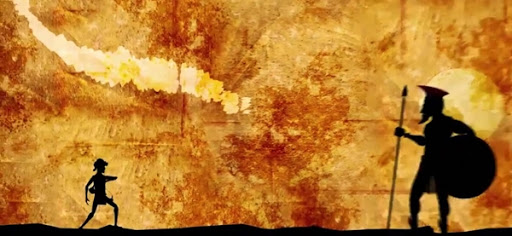
1 Samuel 17:1-49 – Faith in Action

The story of David and Goliath is one of the best known stories in the entire Bible. It’s a classic example of what can be accomplished through one person who chooses to exercise faith. Puny David taking on giant Goliath has served as one of the greatest inspirations for believers through the centuries – seeing God give victory to people against dramatically overwhelming odds.

Whereas the New Testament exhorts us to live by faith, this Old Testament narrative demonstrates what can happen when a person of faith decides to put that faith into action.

Old Testament stories are framed in a way to help the reader or listener discern the differences between the characters of the story – to understand the contrasts between good and bad. So, then, the account of David and Goliath revolves around four character contrasts so that we will learn the lessons of faith God wants to teach us.

First Contrast: David and Saul

David is brave. Saul is fearful. In the ancient world, a typical tactic of warfare, when the battle lines were drawn, was to choose a champion from each side. They would fight together, just the two of them, on behalf of the entire army. It was a fight to the death, and the losing side would submit to the winning side. 

This was a way of preventing the terrible carnage of war. It also created some incredible individual champions.  A champion would be selected not only for his ability to fight, but also for his impressive stature so that there was an intimidation factor to it all.

Saul was the King of Israel. He was the logical choice for the combat since he was a head taller than all the other Israelites and a rather impressive looking soldier. But compared to Goliath, Saul looked like a midget.  The intimidation factor worked. Saul was downright afraid and not about to put himself out there to face a giant.

David is brave because he has faith in God. Saul is fearful because he is not a man of faith in God. The opposite of faith is not unbelief, but fear. As the muscle of faith grows through trusting God in the daily stresses of life, fear is better confronted and managed. The development of faith is a process, and it takes time.

Considering this story in light of Father’s Day, Dads have the daily opportunity of being a hero to their kids through faith in God. That means dealing with two great fears: being found inadequate; and, being controlled by another person or circumstance.

Those two fears were evident in Saul. He felt inadequate because he compared himself to Goliath. He felt controlled by the situation because the Philistines were picking a fight. So, he froze. There are many men who would rather do nothing than be labelled as inadequate or controlled.

David, in contrast, had plenty of practice facing down foes as a shepherd – the bear and the lion – who threatened the sheep. David was often out in the countryside all by himself, guarding the sheep, and his skills were improved in a place where no one was looking.

The way to progress our faith is to be assertive in owning our relationship with God through prayer and Bible reading (or listening on a Bible app) on a daily basis. It’s something everyone can do.

Second Contrast:  David and the Israelites

It was not only Saul who was intimidated by Goliath; the entire army of Israel was hiding behind the battle lines cringing in fear. David, however, discerned no reason to avoid this bullying blowhard. It appears he is the only person able to see Goliath as a small person in comparison to a big God. By faith, David understands Goliath is no match for God.

So, we see that one person full of faith can accomplish the impossible – whereas an army full of fear cannot accomplish a thing. 

We might tend to believe everything has to be large with a big splash to it – that only then can we accomplish big things for God. But really, if we want to achieve something for God, we need to step out in faith and do it – instead of recruiting an army of people or hiding in the group, nursing our fears and anxieties.

No one can do your personal faith work for you; you must do it. The Beaver Cleaver philosophy of life says, “Gee, Wally, if I get in trouble or in a pickle, I’ll just ignore it and hope it goes away….” But Goliath is not going anywhere. He will still be there tomorrow.

Third Contrast: David and Goliath

Goliath represents the other extreme to the fear of Saul and the Israelites. He had absolutely no fear, including any fear of God. Goliath trusted in himself, his abilities, and his stature. David, however, trusted in God alone.

The story gives a detailed description of Goliath’s weapons and physical appearance because Goliath trusted in his aptitude and the ancient technology of his day to face down the Israelites. Conversely, David was small and too young to even be considered for military service. He was too small to wear anybody’s armor. But David did not need any of that – he just needed his faith.

Humanly speaking, David appears insignificant; there is nothing about him that caused anyone to think there was something special or different about him. Goliath, however, was the Arnold Schwarzenegger of his day, ready to terminate anybody who got in his way.

It can be easy to trust in ourselves, another person, or our technology to accomplish something in the face of insurmountable odds, instead of looking to God. The battle is not ours; it is the Lord’s.

Most things in life take a great deal of bravery – especially parenthood! It takes more than copious Dad speeches (and I had a lot of speeches for my kids). Fatherly courage requires modeling for boys what they are expected to become and modeling for girls what they should expect from males.

Children need to observe men who have courage to do the right thing, even when it has personal cost. They need to see them bravely shouldering responsibilities – even when they don’t feel like it. Kids need to see men who demonstrate the courage to be vulnerable, as well as strong and self-disciplined. They need to experience fathers and men with courage to pay attention to them – even, and especially, when those men are angry or disappointed with their own choices.

Fourth Contrast:  David and Eliab

Eliab was David’s big brother. Eliab was a soldier in the army. David was just a kid. It did not matter he was a kid; David was concerned for God’s name and glory. In contrast, Eliab was concerned about his little brother being an embarrassment and superseding him.

When we choose to step out in faith and act, there will likely be opposition, even among family and fellow believers. But David did not let a little criticism stop him. Criticism and opposition will inevitably happen. David was determined to please God, not his brother. He did not wilt and was not deterred from his concern to face down Goliath.

Conclusion

If we want to be brave in the Christian life; if we desire to live a life full of faith in Christ that deals with problems; then, the story of David and Goliath will serve as an inspiration in those times we feel less than mighty for God. 

Goliath was defeated and fell because David trusted God. The issue is not how much faith we have, but in whom our faith is placed. David trusted God. Saul did not even acknowledge God. Goliath trusted in himself. Eliab was too busy quibbling about things that didn’t matter. 

What is your response?