Jesus the King (Mark 11:1-11)

Entry Into the City, by John August Swanson (1938-2021)

As they approached Jerusalem and came to Bethphage and Bethany at the Mount of Olives, Jesus sent two of his disciples, saying to them, “Go to the village ahead of you, and just as you enter it, you will find a colt tied there, which no one has ever ridden. Untie it and bring it here. If anyone asks you, ‘Why are you doing this?’ say, ‘The Lord needs it and will send it back here shortly.’”

They went and found a colt outside in the street, tied at a doorway. As they untied it, some people standing there asked, “What are you doing, untying that colt?” They answered as Jesus had told them to, and the people let them go. When they brought the colt to Jesus and threw their cloaks over it, he sat on it. Many people spread their cloaks on the road, while others spread branches they had cut in the fields. Those who went ahead and those who followed shouted,

“Hosanna!”

“Blessed is he who comes in the name of the Lord!”

“Blessed is the coming kingdom of our father David!”

“Hosanna in the highest heaven!”

Jesus entered Jerusalem and went into the temple courts. He looked around at everything, but since it was already late, he went out to Bethany with the Twelve. (New International Version)

We are presently in the 12 Days of Christmas (December 25–January 5), the annual celebration of Christ’s birth on the Christian Calendar. It may seem odd that the Revised Common Lectionary daily readings have included a text associated with Palm Sunday. However, this is reminder to us that Jesus was born a king – which is why old King Herod saw a little baby as such a threat. (Matthew 2:1-18)

“Christ” is not the surname of Jesus, but instead is a title, meaning “anointed one.” In other words, in the New Testament Gospels, Jesus is referred to as an anointed king. It was broadly understood, within the religious milieu of the ancient Jews, that the Messiah (the Hebrew term for Christ) would come and beat up God’s enemies, restore God’s people to their former glory, and usher in an everlasting state of peace.

Jerusalem had a history as the royal city – the place where ancient Jewish kings lived and ruled. So, most ancient Jews made a clear connection between the Messiah, the king, returning to reign in Jerusalem. They anticipated that the City of David would once again be the seat of power, without any meddling Gentiles to complicate things.

Nativity, by John August Swanson

So, when Jesus entered Jerusalem – in what turned out to be the final week of his earthly life – many people looked upon this as a triumphal entry. He was close to ascending the ancient throne. The disciples of Jesus were waiting for this, and ready for a future of greatness and glory alongside their Rabbi.

Not only did people lay their palm fronds on the road in front of him declaring the ancient refrain, “Blessed is he who comes in the name of the Lord!” (Psalm 118:26) but they also added an explicit reference to the days of King David stating, “Blessed is the coming kingdom of our ancestor David!” The city was awash in the messianic hope of no longer being subject to foreign rule.

Yet we know the tragic and ironic end of the week. Jesus knew it, too, even at the time. He knew what fate awaited him by entering Jerusalem (Mark 8:31; 10:33-34). And Jesus knew without a shadow of a doubt that he was not going to be a king who gains and keeps power through military might and the bloodshed of war. Instead, only his own blood would be offered, as a sacrifice for many. The power of Love will overcome any and every earthly power.

Those with the eyes to see and the spirit to discern could understand this Jesus riding on a humble donkey instead of the proud warhorse. It made complete sense. Jesus did not enter this world with the fanfare of the rich and powerful, but quietly slipped onto the earth in a non-descript and poor Jewish family. His birth, life, and ministry, were all counter cultural. So, why not also his eventual death, resurrection, ascension, and glorification?

Yes, Jesus is a king. But no, he is not a king in any conventional sense. It is Jesus, beginning with his incredible and unexpected incarnation, who helps us reimagine what power and authority can and ought to look like.

All the trappings of control we can get so enamored about, such as wielding influence through economic wealth, social status, political power, and religious weight, all get tossed aside as mere stuffed animals compared to the real deal of moral dignity, ethical love, and compassionate justice shown to people who had absolutely no ability to either pay back Jesus or prop up a throne for him to sit upon.

Jesus is a king who gives his life for the healing of humanity – all people everywhere – including the ones we don’t much like or care about. I have no problem calling Jesus a king, just as long as we understand what sort of kingship we are actually talking about.

I serve King Jesus because he throws a monkey wrench into oppressive systems that seek to keep other people under a heavy hand of injustice. My allegiance is with Christ the Lord because he uses his prodigious authority to bring peace, light, wholeness, and integrity to all the places of the world (and the human heart) that are dark and clueless.

Today I celebrate in this Christmas season the birth of a baby who was born to die to the world and for the world. I rejoice with the angels that Christ is born in Bethlehem, the king of kings and lord of lords, the prince of peace who himself became peace so that we might live in peace.

May you discover deliverance from guilt, shame, and regret, through the One who came and was wounded for us so that we might be healed. Amen.

Christ Is Born (Luke 2:1-20)

Nativity, by He Qi, 1998

In those days Caesar Augustus declared that everyone throughout the empire should be enrolled in the tax lists. This first enrollment occurred when Quirinius governed Syria. Everyone went to their own cities to be enrolled. Since Joseph belonged to David’s house and family line, he went up from the city of Nazareth in Galilee to David’s city, called Bethlehem, in Judea. He went to be enrolled together with Mary, who was promised to him in marriage and who was pregnant. While they were there, the time came for Mary to have her baby. She gave birth to her firstborn child, a son, wrapped him snugly, and laid him in a manger, because there was no place for them in the guestroom.

Nearby shepherds were living in the fields, guarding their sheep at night. The Lord’s angel stood before them, the Lord’s glory shone around them, and they were terrified.

The angel said, “Don’t be afraid! Look! I bring good news to you—wonderful, joyous news for all people. Your savior is born today in David’s city. He is Christ the Lord. This is a sign for you: you will find a newborn baby wrapped snugly and lying in a manger.” Suddenly a great assembly of the heavenly forces was with the angel praising God. They said, “Glory to God in heaven, and on earth peace among those whom he favors.”

When the angels returned to heaven, the shepherds said to each other, “Let’s go right now to Bethlehem and see what’s happened. Let’s confirm what the Lord has revealed to us.” They went quickly and found Mary and Joseph, and the baby lying in the manger. When they saw this, they reported what they had been told about this child. Everyone who heard it was amazed at what the shepherds told them. Mary committed these things to memory and considered them carefully. The shepherds returned home, glorifying and praising God for all they had heard and seen. Everything happened just as they had been told. (Common English Bible)

Nacimiento (Nativity), by Leoncio Saenz, 1983

It is of significance – and not by accident – that Jesus had a humble birth in a lowly setting. All around was the backdrop of a powerful Roman Empire. Whereas Christ could have been born as the mighty king that he actually is, he instead was born and then laid in a feeding trough for animals.

Caesar Augustus — whose name means revered or exalted one — ended a long period of war in the Roman Empire and was hailed as a prince of peace, the savior of the world. With his reign began the Pax Romana (Roman Peace). Under the rule of Augustus, the economy was booming; culture, religion, and infrastructure were developed and prospered. He was hailed by many with the title “Ceasar is Lord.”

Yet, as with many powerful rulers in history, Augustus ruthlessly suppressed his enemies and limited their human rights. It was peace by totalitarian rule – which is really no peace, at all.

It was in those days that Augustus proclaimed his decree for a census of the entire Roman world, so that taxes could be collected from all the conquered peoples of the empire. And so, despite being very pregnant, Mary and her fiancé Joseph made the arduous 90-mile trek from Nazareth in Galilee to Bethlehem, the city of David. That was the only way they could be properly registered, to return to the ancestral home.

It’s no surprise that Mary ended up giving birth to Jesus, far from their actual home, in less than ideal circumstances, for a delivery of a baby.

It appeared Ceasar Augustus was the absolute ruler, and much too powerful for anyone to challenge him. It also seemed that Jesus, a vulnerable little infant with even smaller resources, could do anything but just try and survive. But appearances can be, and are often, quite deceiving.

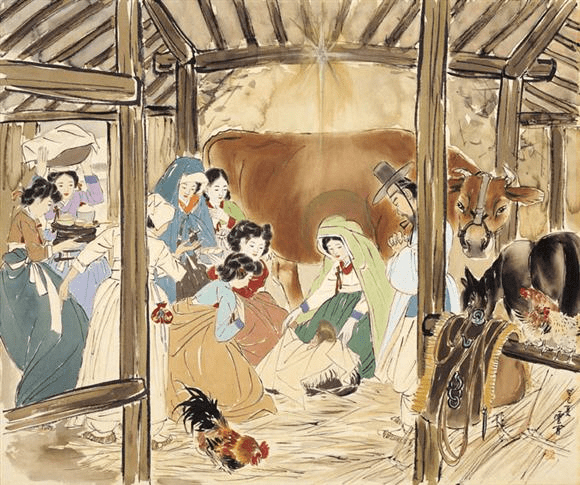
The Birth of Jesus Christ, by Woonbo Kim Ki-chang, 1952

In truth, Jesus is Lord, and Ceasar is not. Christ is the real Prince of Peace who brings God’s benevolent rule and reign to earth, as it is always done in heaven. And it will not be achieved through military power, but by the justice and mercy of God. Because, as it turns out, Love is a much greater force than any human authority or empire.

Considering God’s gracious kingdom – which turns all appearances on its head – it is quite appropriate that news of Christ’s royal birth comes first to a bunch of shepherds. They were among the lowliest of the emperor’s subjects.

Although we may tend to romanticize the shepherds keeping watch over their flocks by night, most people thought of shepherds as low class workers who nobody wanted to be around. They were poor, illiterate, and thought to be dishonorable drunks. Shepherds also had the reputation of being thieves because they grazed their flocks on other people’s property. In short, they were mostly the outcasts of society.

To this group of people the angel announces good news of great joy for all the people everywhere – and not just the powerful and the rich: To you is born this day in the city of David, a Savior, who is the Messiah, the Lord. The shepherds go to Bethlehem to find this baby, and become the first to share the good news of the Savior’s birth.

Today, we still live in a world dominated by people who desire power and privilege over others. We still live in a world enamored with wealth and resources, power and authority, military might and social control. In this world, much like the ancient world, the lowly still get trampled and the least among us get little if any attention.

Masters of both small and large worlds will eventually be toppled, not to mention our own personal petty empires we seek to build. All of our planning and scheming will never bring true peace and security. Jesus has arrived! Christ is born! All other empires are now on borrowed time.

Nativity, by Joseph Mulamba-Mandangi, 2001

The Savior is born for all the world, for us, even though we are separated from Christ’s birth by two millennia. Jesus still comes to bring peace on earth and goodwill to all humanity through the power of Love. He still casts out fear and relieves anxious hearts. And his reign will last forever and ever.

With Jesus Christ as Sovereign, outcasts are welcomed in; the hungry are fed; the poor are lifted up; captives are set free; enemies are reconciled. And wherever the good news is proclaimed, guilt and shame melts away, and lives are changed.

Today Christians all over the world celebrate the birth of Christ. And we also look forward to his coming again, when his reign of justice, mercy, and peace comes in all its fullness.

May God bless you this Christmas and always. May you be comforted by the Lord’s presence in your life, and always follow his guiding light. For Christ has come, the Immanuel, God with us. Amen.

Christ the King Sunday (Ephesians 1:15-23)

The 118 feet high Christ the King statue in Świebodzin, Poland

For this reason, ever since I heard about your faith in the Lord Jesus and your love for all God’s people, I have not stopped giving thanks for you, remembering you in my prayers. I keep asking that the God of our Lord Jesus Christ, the glorious Father, may give you the Spirit of wisdom and revelation, so that you may know him better. I pray that the eyes of your heart may be enlightened in order that you may know the hope to which he has called you, the riches of his glorious inheritance in his holy people, and his incomparably great power for us who believe.

That power is the same as the mighty strength he exerted when he raised Christ from the dead and seated him at his right hand in the heavenly realms, far above all rule and authority, power and dominion, and every name that is invoked, not only in the present age but also in the one to come. And God placed all things under his feet and appointed him to be head over everything for the church, which is his body, the fullness of him who fills everything in every way. (New International Version)

Christ the King Sunday is intended to help us see the cosmic reality that Jesus reigns over all creation as the only rightful Sovereign of the universe. This day always comes just before Advent so that we remember to anticipate both a baby and a king.

Christ as Lord of all exposes three problems humanity faces:

  1. Building our own petty kingdoms and setting ourselves up as masters over our own small worlds.  People who have been hurt may attempt to seize power for themselves in order to avoid ever being hurt again; or in the belief that if they had power, the could stop others from being hurt. Instead of submitting to Christ’s rule, they will seek to control their little end of the world, to protect themselves from pain.
  2. Bowing to other kings besides King Jesus. When distressed, some people may rely on another ruler to address their hard circumstances – thereby expecting another to give only what Jesus can provide.  Instead of running to God, they run to politicians or pastors to fix whatever is going on.
  3. Lacking awareness of the power possessed in Christ the King. Christians reign with Jesus Christ, and therefore can exercise authority over every dominion that exists, especially the dominion of darkness.

The Apostle Paul’s letter to the Ephesian believers provides God’s design for the church. It’s a plan for Christians to know their spiritual blessings and exercise the power they have being united to Christ. God wants us to understand this power and authority, and to actively use it.

We have a clear understanding in Ephesians of how to pray: To know Jesus better.  There is probably no higher prayer, according to the Apostle Paul, than to pray to know Jesus better – so that we will know the hope to which we have been called, and the incomparably great power for us who believe.

The word for “power” is where we get the English word “dynamite.” When I was a kid we had a neighbor who had a fondness for playing with dynamite (especially when he drank too much!). Even though he lived a mile down the road, when he blew up a tree stump or anything else on his property, it shook our house and felt like the windows were going to break. Yet, one stick of dynamite is nothing compared to God’s power.

This divine power is for us who believe in Christ the King. It’s the same power used to raise Jesus from death, and which exalted Christ as Lord of the universe. The rule and reign of Jesus is far above any other existing authority – including powers of the dark domain.

Concerning dealing with the powers of darkness, we possess the authority of Jesus Christ. Because of Christ’s resurrection, ascension, and glorification, Christians therefore have a vital and inseparable union with Jesus.  Jesus redeemed us; we belong to God as adopted children. 

Since all earthly and spiritual powers are subject to Christ, they are also subject to us. The imagery of Jesus as Head, and Christians as the Body, means that we have an inseparable union together. Since we are united with Christ, we share his authority over all spiritual powers.

It’s one thing to know this information; it’s another to use it. We are to experience Christ’s power through exercising our authority as believers. We can link faith and knowledge together in a confident use of spiritual authority because we have rights as blood-bought children of God.

All the pronouns used by Paul in Ephesians are plural. This means that tackling the forces of darkness needs to be a communal activity; going it alone is dangerous. The following is a prayer we can pray together, that boldly exercises our authority in Christ:

Almighty God, we bow in worship and praise before you, and thank you that the Lord Jesus Christ is King over all creation, and the rightful Sovereign of the universe. We are grateful that we have power together with Jesus.  We therefore surrender ourselves completely in every area of our lives to You. 

Since Christ’s authority extends over every dominion, including the dominion of darkness, we take a stand against all the work of Satan that would hinder us in prayer. We address ourselves only to the True and Living God, and refuse any involvement of Satan in our prayers.

Therefore, Satan, we command you, in the Name of the Lord Jesus Christ, to leave our presence with all your demons. We bring the blood of Jesus Christ between us.

Sovereign God, we recognize you are worthy to receive all glory, honor, and praise. We renew our allegiance to you and ask the Holy Spirit to help us pray. You have loved us from eternity past; and you sent the Christ into the world to die for us. So, we are thankful for complete forgiven; for adoption into your family; for eternal life; and for your daily help and strength.

Glorious God, open our eyes so that we will see how great you are, and how complete your provision is for today. The victory of Christ’s cross and resurrection has given us a seat in heaven. We take our place with Jesus, and recognize by faith, that all wicked spirits and Satan himself are under our feet.

Thank you, gracious God, for the spiritual armor you have provided. Therefore, we put on the belt of truth, the breastplate of righteousness, the sandals of peace, and the helmet of salvation. We lift up the shield of faith against all the fiery arrows of the enemy; and we take in our hands the sword of the Spirit, the Word of God. We use your powerful Word against all the forces of evil, living and praying in complete dependence upon you, Holy Spirit.

Lord Jesus, we are thankful that you disarmed all power and authorities, triumphing over them by the cross. So, we claim victory for our lives today by rejecting all the insinuations, accusations, and temptations of Satan; affirming that the Word of God is true; living in the light of God’s Word; and choosing to obey you. 

Open our eyes, blessed God, and show us the areas of our lives that do not please you. Cleanse us from anything that would give Satan a foothold against us. We stand into all that it means to be your adopted children; we welcome all the ministry of the Holy Spirit in our lives today.

By faith, and in complete dependence upon you, we put off the old sinful person and stand into all the victory of the crucifixion where the Lord Jesus Christ provided cleansing from the sinful nature. We put on the new person and stand into the victory of the resurrection and the provision Christ has made for us to live above sin. We put off the old sinful nature with its selfishness and put on the new nature with its love.  We put off the old nature with its fear and deceit; and instead put on the new nature with its courage and righteousness.

We are thankful, mighty God, that you have blessed us with every spiritual blessing in Christ; and with new life into a living hope by the resurrection of Jesus from the dead, so that today we can live filled in the Holy Spirit with love, joy, peace, patience, kindness, goodness, gentleness, and self-control. Since we recognize and affirm that this is your will for us, we therefore reject and resist all the attempts of Satan and his demons to rob us of God’s will.   

We are thankful, blessed Holy Trinity, that our spiritual weapons have divine power to demolish demonic strongholds, arguments, and every pretention that sets itself up against the knowledge of God. We therefore take captive every thought to make it obedient to Christ; we tear down the strongholds and smash the plans of Satan that have been formed against us; we affirm that you have not given us a spirit of fear but a spirit of power, love, and self-discipline; and we choose to make right decisions of faith. 

Powerful God, show us the ways Satan is hindering, tempting, lying, and distorting the truth in our lives. Help us to be aggressive in prayer and faith; and to think rightly, and actively practice Your Word. We cover ourselves with the blood of the Lord Jesus Christ and pray that you, Holy Spirit, would bring all the work of Christ’s crucifixion, resurrection, ascension, and all your work of Pentecost into our lives today.

In the name of Christ the King, we surrender ourselves to you, O God; and we refuse to be discouraged because you are the God of all hope. You have proven your power by resurrecting Jesus from the dead. Therefore, we claim this victory over all satanic forces in our lives, our families, our neighborhoods, our workplaces, and our faith communities; through the blood of the Lord Jesus Christ with thanksgiving, we pray. Amen.

A Vision of the End (Revelation 14:1-11)

The Great Day of His Wrath, by John Martin, 1852

Then I looked, and there before me was the Lamb, standing on Mount Zion, and with him 144,000 who had his name and his Father’s name written on their foreheads. And I heard a sound from heaven like the roar of rushing waters and like a loud peal of thunder. The sound I heard was like that of harpists playing their harps. And they sang a new song before the throne and before the four living creatures and the elders. No one could learn the song except the 144,000 who had been redeemed from the earth. These are those who did not defile themselves with women, for they remained virgins. They follow the Lamb wherever he goes. They were purchased from among mankind and offered as first-fruits to God and the Lamb. No lie was found in their mouths; they are blameless.

Then I saw another angel flying in midair, and he had the eternal gospel to proclaim to those who live on the earth—to every nation, tribe, language and people. He said in a loud voice, “Fear God and give him glory, because the hour of his judgment has come. Worship him who made the heavens, the earth, the sea and the springs of water.”

A second angel followed and said, “‘Fallen! Fallen is Babylon the Great,’ which made all the nations drink the maddening wine of her adulteries.”

A third angel followed them and said in a loud voice: “If anyone worships the beast and its image and receives its mark on their forehead or on their hand, they, too, will drink the wine of God’s fury, which has been poured full strength into the cup of his wrath. They will be tormented with burning sulfur in the presence of the holy angels and of the Lamb. And the smoke of their torment will rise for ever and ever. There will be no rest day or night for those who worship the beast and its image, or for anyone who receives the mark of its name.” (New International Version)

Throughout the book of Revelation (The Apocalypse of John) the Apostle John communicates visions of the end, of God’s wrath and human suffering. Yet John also pauses throughout his vision to offer encouragement for the faithful followers of Jesus in the present time who are undergoing suffering, even persecution.

The assurance believers have is that God sees their struggle, their devotion; the Lord will protect them – not from suffering and death – but from the effects of divine judgment and punishment on the earth. The Lord will not abandon the believers. Instead, they will share in God’s new realm.

The Lamb and the Redeemed

The ultimate destiny of Christ’s faithful followers is not in judgment but in triumph – even though many of them had to face extreme circumstances and died the martyr’s death. Christ, the Lamb of God, stands in the center of God’s kingdom with the 144,000, who sing a new song to God.

It could be that these 144,000 persons are representative and symbolic of all redeemed humanity. Or, they may likely be Christian martyrs, the ones who were the victims of evil (Revelation 13). Whoever they actually are, their description is figurative in order to convey that these faithful persons are morally and spiritually pure; they did not defile themselves with the wickedness of the world’s systemic and structural evil.

These redeemed persons are the first fruits, believers who have sacrificed their lives for God and maintained their witness to King Jesus, and not to Ceasar as Lord. In the Old Testament, every firstborn (both human and animal) belonged to the Lord. The first fruits (the initial yield of crops) were set aside specifically as a sacrificial offering to God.

In the New Testament, the concept and practice of first fruits is used as a metaphor for something given to God in advance. So, in the book of Revelation, this refers to the harvest at the end of the age; the first fruits are the 144,000, the ones who are the anticipation of Christian resurrection. In other words, there are many more converts to come – people redeemed by the Lamb and set aside for resurrection and new creation. A great harvest of souls comes; because of Christ’s resurrection, his followers shall also experience resurrection.

The Message of the Three Angels

The Apostle John spoke of three angels, each of whom proclaim a coming judgment of God. The first angel has a call to repentance and a warning of imminent judgment. The second angel announces the fall of Babylon (Rome). And the third angel pronounces judgment upon those who gave themselves to the powers of this fallen world, who participated in organizational wickedness through oppression, abuse, neglect, disrespect, and dishonor of others.

It is with the third angel that the “mark of the beast” upon a person’s forehead is the mark of judgment on them. Although the language and picture of this, and what happens to them, was (and still is for some) used to scare the hell out of people so that they would embrace heaven, we must very much distance ourselves from such disgraceful rhetoric.

Again, the vision is full of symbolism and is not to be taken literally; it is John’s attempt to convey an otherworldly experience he had, in terms which his readers could grasp. The big idea is that those who have become devoted members to the machinations of evil in its various forms on this earth will experience the judgment of God.

As they sought glory in this world by any means possible – including using people to keep and hold power – so, they will face an inglorious end when God holds them accountable for their wrongdoing and for letting their own hearts become shriveled and dry.

This is neither the time to participate in evil, nor to procrastinate in making things right – while you still have time to do so.

For those holding on to bitterness, it is time to forgive.

For the ones giving in to their anger through hating others, it is now time to humble yourself, repent, and turn to right and healthy ways of dealing with that anger.

For the persons allowing themselves to be used by others for perpetuating evil in their workplace, neighborhood, or church, it is high time to find your voice, renounce the damaging practices, and speak truth to power.

We all must suffer. What it is we suffer for, is up to us.

Almighty and everlasting God, the rightful Judge of all things and all people, help us, your people, to be rightly prepared for Christ’s coming, through a right confession and right practices in this life. Enable us to walk in a manner worthy of our calling so that we might cast the bright beams which radiate from the approaching day of glory into those dark days and nights of suffering.

Sovereign God, draw us, we pray, near to Christ and in union with him. May we taste and see the goodness of the Lord; be strengthened in faith for the trials and tribulations which lie before us; bask in the love of Jesus; and hold fast to divine promises, and our confession, especially since the end of all things is at hand. Amen.