Christ the King Sunday (Luke 23:33-43)

The 118 feet high Christ the King statue in Świebodzin, Poland

When they came to the place that is called The Skull, they crucified Jesus there with the criminals, one on his right and one on his left. Then Jesus said, “Father, forgive them, for they do not know what they are doing.” And they cast lots to divide his clothing. And the people stood by watching, but the leaders scoffed at him, saying, “He saved others; let him save himself if he is the Messiah of God, his chosen one!” The soldiers also mocked him, coming up and offering him sour wine and saying, “If you are the King of the Jews, save yourself!” There was also an inscription over him, “This is the King of the Jews.”

One of the criminals who were hanged there kept deriding him and saying, “Are you not the Messiah? Save yourself and us!” But the other rebuked him, saying, “Do you not fear God, since you are under the same sentence of condemnation? And we indeed have been condemned justly, for we are getting what we deserve for our deeds, but this man has done nothing wrong.” Then he said, “Jesus, remember me when you come in your kingdom.” He replied, “Truly I tell you, today you will be with me in paradise.” (New Revised Standard Version)

I’m glad that the Gospel text on this Christ the King Sunday is the story of Christ on the cross with the two criminals on each side also crucified. Why?

Because our cultural contexts tend to associate power and authority with high level earthly positions. But, in reality, Christianity is a paradoxical religion full of truths which seem antithetical to each other; yet they are not.

Many people (including many Christians) believe that, in order to influence the culture, Christians must have prominent positions in society. This leaves the majority of Christians feeling as if they have nothing to offer the world. After all, they have no important title at their job, in the government, or within the church.

But nothing could be further from the truth. Christ, in the lowest earthly position possible by being nailed to a cross, was a king who had the highest heavenly position in the universe. One will never come to grips with Jesus apart from understanding that Christianity is an inherently paradoxical religion.

The Sanctuary of Christ the King in Almada, Portugal

One of the criminals crucified with Christ discerned this reality well; the other criminal did not understand at all. One demonstrated the reality that humility is the powerful key to all things, whereas the other criminal remained full of himself.

The scene portrayed for us on Golgotha’s hill shows us what the kingly reign of Jesus Christ truly looks like: It is characterized by the power of humility and sacrifice. It highlights Christ’s authority by giving mercy to those hanging on a cross alongside himself.

True power is not found in the halls of earthly political power, but rather in the elevating power of God’s grace and Christ’s self-sacrifice. Therefore, Christians can best demonstrate their own power and authority by extending grace and mercy toward others, even when it’s hard to do.

It can be difficult to wrap both our heads and our hearts around this reality of possessing power without actually having positions and titles of authority in the world and the church.

Many a church pastor bemoans the fact that a number of their parishioners fail to be active servants in the wrongheaded notion that the clergy are supposed to do all the work. The laity may believe that the clergy are the ones with the educational, experiential, and positional power to influence culture and society.

What’s more, it can be even harder for those who once had positions of power to believe they themselves can no longer effectively work for the good, because they are now nobodies. They may ask, “Who would listen to me?”

The answer is: A lot of people. God uses all sorts of persons in all sorts of places and situations. What we all need, whether clergy or laity, is the willingness to be humble and to sacrifice one’s time or talent in showing mercy to another.

Christians must take their cues from the Lord Jesus. In the setting of the interaction between Christ and the other two crucified men in today’s story, Jesus is the innocent one sandwiched between two guilty persons. Christ’s humiliation is on full public display. The crowd of onlookers mock him, along with one of the criminals. Because of the apparent incongruence between being ‘King of the Jews’ yet not freeing himself from his awful situation.

Whereas most of us might avoid being humiliated in public at any cost, Jesus embraced the rejection and the suffering, knowing that he was offering a sacrifice for the benefit of the whole world.

Even though Jesus was extremely vulnerable, and in emotional, spiritual, and physical pain which we can only imagine, he nonetheless chose to use his kingly power and authority on behalf of others – including those who blatantly rejected and mocked him.

Grace and mercy were demonstrated by submitting to an ignominious death, and by willingly acting to be the bridge connecting others to God. Relationship is at the very heart of the divine will; God would do anything to restore broken relations with his fallen people. No one is beyond the reach of grace.

In a contemporary culture of polarized relations and angry vitriol toward one another, the ordinary Christian without earthly title or authority is in the best position to provide basic human kindness by extending mercy to “enemies” and demonstrating humility in all things.

Christ embodied love and forgiveness. He used his power for mercy, not judgment;  and for grace, not revenge.

Jesus demonstrated for us how grace is the greatest operative force in the universe.

To love and forgive another is the best demonstration of power and authority that anyone could ever show.

God’s action in Christ through the cross is what can move us to true acts of love and selflessness. We participate in Christ by giving grace through acts of mercy in comforting, encouraging, and helping others.

The only way we can give grace is to receive grace. It is God’s action in Christ through the Spirit that moves us to true acts of love and selflessness.

Personally, I am encouraged with the image of Christ as King – the One who is both sovereign over all creation, and yet is with me and knows my every need, giving grace and mercy and unconditional love.

For me, the idea of both God’s transcendence and God’s immanence is the perfect lead-in for the Advent season.

Earthly leaders can be capricious, petty, enamored with earthly power, and wield authority only in ways that serve themselves and not the common good of all. No wonder there is so much corruption and injustice in this old fallen world of ours.

Such hateful leadership has no problem leaving us beaten, bruised, and hanging on a cross. In our pain and our suffering, what will we do?

Hopefully, we will let Jesus transform our understanding of power and authority.

Ideally, in our worst situations of suffering and confusion, we will remember Jesus lifted-up on the cross, lifted-up as sovereign over all things. We will find our own true power in self-giving-love to a world which appears it has given itself to hate and selfish judgment of people they don’t like.

A participation in Christ’s rule and reign over all things means that his crucified power has given us grace and forgiveness, so that we might pass it on, pay it forward, and work for that which is just, right, and good.

May it be so, to the glory of God.

Almighty God, you rescue us from our enemies, so that we may serve you without fear. Strengthen us, that we might share in the inheritance of the saints in your kingdom of light. Amen.

The Holy Name of Jesus (Luke 2:15-21)

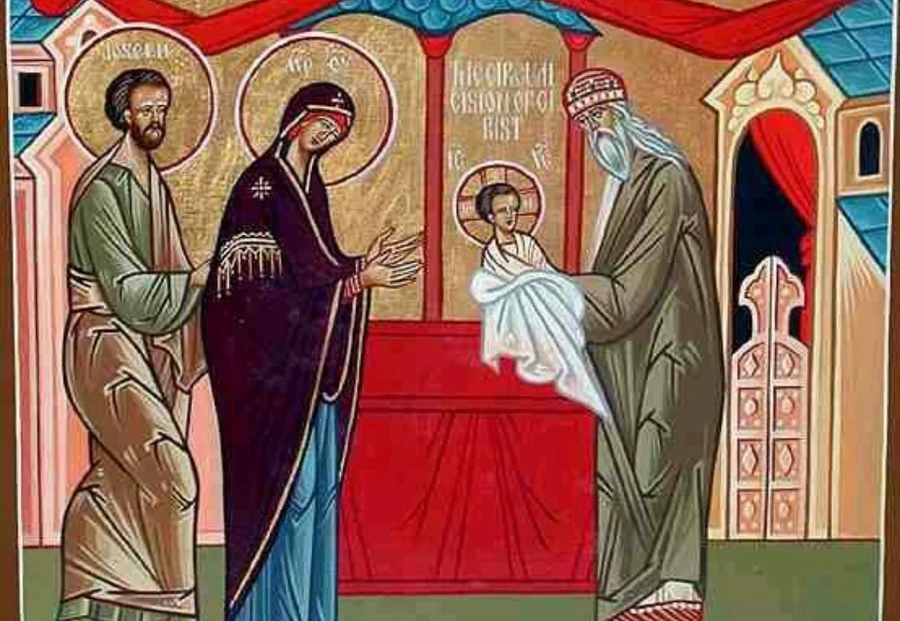
Orthodox depiction of the circumcision and naming of Jesus

When the angels had left them and gone into heaven, the shepherds said to one another, “Let us go now to Bethlehem and see this thing that has taken place, which the Lord has made known to us.” So they went with haste and found Mary and Joseph and the child lying in the manger. When they saw this, they made known what had been told them about this child, and all who heard it were amazed at what the shepherds told them, and Mary treasured all these words and pondered them in her heart. The shepherds returned, glorifying and praising God for all they had heard and seen, just as it had been told them.

When the eighth day came, it was time to circumcise the child, and he was called Jesus, the name given by the angel before he was conceived in the womb. (New Revised Standard Version)

“The Holy Name of Jesus” is a celebration, observed by some Christian traditions, each year on January 1 – which is the eighth day after the birth of Jesus, when he was named and circumcised at the temple in Jerusalem.

An angel of the Lord appeared to him in a dream and said, “Joseph, son of David, do not be afraid to take Mary as your wife, for the child conceived in her is from the Holy Spirit. She will bear a son, and you are to name him Jesus, for he will save his people from their sins.” (Matthew 1:20-21, NRSV)

In the Law of Moses, all male infants are to be circumcised on the eighth day after their birth (Leviticus 12:3). Throughout most of the history of the Christian Church, January 1 has been celebrated as a feast day devoted to the naming of Jesus.

The name “Jesus” comes from the Hebrew Yeshuah (Joshua) which means “Yahweh will save.” It is a name fitting for the person and work of Christ.

Therefore God exalted him even more highly
    and gave him the name
    that is above every other name,
so that at the name given to Jesus
    every knee should bend,
    in heaven and on earth and under the earth,
and every tongue should confess
    that Jesus Christ is Lord,
    to the glory of God the Father. (Philippians 2:9-11, NRSV)

Faith is always followed by obedience. So, the faith of Joseph and Mary in believing the words of the angel Gabriel, translated into the obedient naming of their son as “Jesus.” (Luke 1:31-32)

Jesus, bearing the name of savior, is holy in every way. Not only does the name of Jesus point to his divinity – because of his miraculous conception by the Holy Spirit – but it also directs us toward the special mission for which he entered this world.

Jesus Christ, the Son of God, and Son of Humanity, is God’s agent of deliverance for both Israel and the whole world.

“Do not be afraid, for see, I am bringing you good news of great joy for all the people: to you is born this day in the city of David a Savior, who is the Messiah, the Lord….” (Luke 2:10-11, NRSV)

The Gospel writer Luke provides us with a birth narrative “pregnant” with theological information and importance:

  • Jesus has divine sonship, and possesses the status of king (Luke 1:31-35)
  • Jesus comes from the city of David, which is Bethlehem, not Jerusalem (Luke 2:4, 11)
  • Jesus is described by the angel Gabriel as Son of the Most High, Son of God, Savior, Messiah, and Lord; each of these titles direct us to his identity and mission (Luke 1:32, 35; 2:11)

I like the collective response of the shepherds, after they received heavenly good news from a group of angels.

They could have dismissed the entire thing as having drunk too much brandy on a brisk winter night. They could have kept the whole affair to themselves, reasoning that nobody would believe a bunch of stinky shepherds.

Instead, much like Mary who hurried off to Elizabeth after receiving the angelic message, the shepherds dropped everything to go and see the feeding trough with a newborn baby wrapped in swaddling cloth.

In other words, the shepherds belief in what they heard and experienced, quickly translated into action. It was only appropriate that it was shepherds who discovered the newborn king, the Son of David, himself a shepherd who was anointed by God.

The shepherds went and followed the signs given to them by the angel. And they believed. A motley group of shepherds returned to their fields, kicking up their heels, praising and glorifying God. They knew that things would never be the same again.

The name of Jesus is holy, simply because the Lord Jesus Christ is the Holy One. Christians recognize Jesus as Savior, the fulfillment of all God’s promises. His singular birth, life, death, resurrection, and ascension is exactly, I believe, what this old fallen world is most in need of.

It is never too late to resolve knowing Jesus. At the beginning of this year, there is perhaps no better resolution to make, again and again, of knowing Jesus Christ and honoring his holy name.

Eternal Father, you gave to your incarnate Son the holy name of Jesus to be the sign of our salvation. Plant in our hearts the love of Jesus, truly God and truly human, and grant that we may praise and bless your Holy Name with our whole mind, heart, body, and spirit, that we may know your boundless compassion and mercy. In Christ’s name, we pray. Amen.

First Sunday of Advent – The Paradoxical Christ (Luke 21:25-36)

Christ Among the Doctors, by Paolo Veronese, c.1560

“There will be signs in the sun, the moon, and the stars and on the earth distress among nations confused by the roaring of the sea and the waves. People will faint from fear and foreboding of what is coming upon the world, for the powers of the heavens will be shaken. Then they will see ‘the Son of Man coming in a cloud’ with power and great glory. Now when these things begin to take place, stand up and raise your heads, because your redemption is drawing near.”

Then he told them a parable: “Look at the fig tree and all the trees; as soon as they sprout leaves you can see for yourselves and know that summer is already near. So also, when you see these things taking place, you know that the kingdom of God is near. Truly I tell you, this generation will not pass away until all things have taken place. Heaven and earth will pass away, but my words will not pass away.

“Be on guard so that your hearts are not weighed down with dissipation and drunkenness and the worries of this life and that day does not catch you unexpectedly, like a trap. For it will come upon all who live on the face of the whole earth. Be alert at all times, praying that you may have the strength to escape all these things that will take place and to stand before the Son of Man.” (New Revised Standard Version)

Do we understand the dire situation of humanity? Is there comprehension of the sinister road that many choose to walk? Or are we cut off from ourselves, fragmented and unable (or unwilling) to participate in becoming people who are wise and seek what is just?

Perhaps we are adrift, lost in our own hubris, believing that our beliefs and opinions are so right as to either force them on others; or either live and let live, as if nothing bad will ever happen.

But the Son of Man is coming. He has a lesson for us from a tree; and an exhortation to beware.

I just hope it’s not too late for many of us.

Today’s Gospel lesson is part of a longer discourse by Jesus, warning about coming persecution and impending destruction of the Temple. It’s apocalyptic stuff about famine, war, judgment, with exhortations in the midst of suffering.

This is how we are beginning the new Christian Year, and season of Advent. Dealing with judgment and cosmic cataclysm may seem out of sync with the month of December.

Advent helps us prepare our hearts in anticipation of Christ’s birth. It’s actually one of the best times to remember that just as Jesus came as a child in his first advent, a second advent is yet to come, in which Jesus returns as the judge.

The Coming of the Son of Man

The season of Advent, and Jesus himself, are paradoxical. In my estimation, all of Christianity is inherently paradoxical. A paradox brings two contrasting truths or images together. Jesus is God. Jesus is human. Both are true. Jesus is a paradox. Jesus came. Jesus is coming. His advent is a paradox.

Jesus and his teaching may seem self-contradictory. But it nonetheless shows us truth. That’s what a paradox does. It expresses things like Jesus being both a baby and a savior, an infant and a king, a servant and a sovereign.

Christ brings peace. And Christ brings division. To keep your life, you must lose it. In order to be first, you must be last.

The Lesson of the Tree

Trees are some of our greatest teachers, that is, if we will but listen to them and observe them. The tree teaches us the paradox that with the changing of the leaves, death can be beautiful. In using the tree’s wood, we learn there is new life through destruction.

The dormancy of the tree in winter appears as if it will last forever. Yet, when Spring arrives, we discover that the bare branches and lifelessness is temporary, not permanent. The tree blossoms, almost exploding with life and color.

Our earthly trials and tribulations will not last. God will vindicate the righteous. Redemption is near. There is the paradox of suffering that leads to glory, and tears which will give way to great comfort.

The Exhortation to Watch

But we must watch. Jesus tells us to beware. With paradox, and in the apocalyptic view of things, events that happen on this earth that we see are mere reflections of much greater workings on an unseen plane of existence.

Paradoxically, the struggle between good and evil is both earthly and celestial; it is playing out on multi-dimensional levels. There is always more going on than what meets the eye. Therefore, watch out, because you do not really know what’s happening unless you’re looking with both physical and spiritual eyes.

So, stay awake. Pay attention. Be prepared. Keep awareness of yourself and your situations.

As we move into the busyness and bustle of this month, let us not overprepare for something transitory and impermanent. Let’s remember to use our vision to see a large and expansive world in need of the paradoxical Christ.

If you are reading this, or listening to this, then there is hope. This present existence is not permanent; it won’t last forever.

For what is at stake is the coming of the kingdom of heaven, a realm of existence that is both already here, and not yet here. In allowing such a rule to come and take over our lives, we find freedom and peace and permanence.

Tying our hopes to earthly rulers and all of their construction of petty kingdoms and fiefdoms will only end in darkness and disappointment.

The Servant King, who rules through loving service, is coming. And the Universal Judge, who controls all things with a powerful gracious force, is also coming.

The paradoxical Jesus was here, is here, and is to come.

Almighty God, give us grace that we may cast away the works of darkness, and put on the armor of light, now in the time of this mortal life, in which your Son Jesus Christ came to visit us in great humility; that in the last day, when he shall come again in his glorious Majesty, to judge both the living and the dead, we may rise to life immortal; through him who lives and reigns with you and the Holy Spirit, now and forever. Amen.

Pray and Give Thanks (1 Timothy 2:1-7)

First of all, then, I urge that supplications, prayers, intercessions, and thanksgivings be made for everyone, for kings and all who are in high positions, so that we may lead a quiet and peaceable life in all godliness and dignity. This is right and acceptable before God our Savior, who desires everyone to be saved and to come to the knowledge of the truth. For

there is one God;
    there is also one mediator between God and humankind,
Christ Jesus, himself human,
    who gave himself a ransom for all

—this was attested at the right time. For this I was appointed a herald and an apostle (I am telling the truth; I am not lying), a teacher of the gentiles in faith and truth. (New Revised Standard Version)

In our extreme busyness, do any of us stop long enough to consider what is of upmost importance in our lives? Or do we scurry about, not considering why we fill every minute of the day with constant motion and activities which – if we are honest – only frustrate us?

Whether we know anything about William Shakespeare’s tragic play, Hamlet, or not, many a person lives out his centuries old words:

Life’s but a walking shadow, a poor player,

That struts and frets his hour upon the stage,

And then is heard no more. It is a tale

Told by an idiot, full of sound and fury,

Signifying nothing.

Writing to Timothy, a new and young pastoral leader of the Ephesian Church, the Apostle Paul made it clear what is, above all, the activity which the church and all believers in Jesus are to engage in: prayer.

Perhaps that sounds too trite or simple. Yet, there is really nothing easy about prayer. To pray is more like heading out on a wrestling mat with the Incredible Hulk. This is going to take some serious work.

The most important activity we can do is to keep persevering in prayer, never giving up, but continually getting back out there on the wrestling mat of prayer and putting all of your energy into it.

Everyone in leadership must be prayed for. Yes, each person who leads needs our prayers, without exception.

Christians are to be, first and foremost, people of prayer. And those prayers are to be for all sorts of various situations, and for all sorts of persons.

We are to pray for specific needs; general circumstances and situations; urgent and emergent requests; and, as the capstone to all prayer, expressions of thanksgiving and gratitude are most needed.

A weak and ineffective prayer is one that gives no thanks to God, nor offers gratitude to God for anyone.

Conversely, however, prayer filled with power and effectiveness is stuffed with thanksgiving to God, and liberally offers thanks to God for everyone, including the ones we don’t much care about.

Specifically, whenever we fail to pray for, and give thanks for, the very people we don’t much like, and would rather not pray for, at all, then we ought not expect any of our prayers to be heard nor answered by the God who is concerned for every human being on the face of this planet.

For the Christian, prayer is never optional nor merely occasional; prayer is necessary and vital, all the time. And prayer is a close relative to thanksgiving.

Pray in the Spirit at all times in every prayer and supplication. To that end, keep alert and always persevere in supplication for all the saints.

Ephesians 6:18, NRSV

Do not be anxious about anything, but in everything by prayer and supplication with thanksgiving let your requests be made known to God. (Philippians 4:6, NRSV)

In the ancient world of Paul and Timothy, much like our present contemporary world, prayers are needed so that we can live peaceably, with godliness and dignity.

We need religious tolerance and political stability, guaranteed by people in leadership positions. We need God’s sovereign and gracious enablement and direction of world leaders, so that God’s benevolent kingdom will come, and God’s ethical will be done, here on this earth, as it is always done in God’s heaven.

Christians recognize one God. The ancient Romans acknowledged many gods. In fact, veneration of the Roman Emperor as a god began after the assassination of Julius Ceasar in 27 B.C.E. He was proclaimed as divine, and added to the official pantheon of state gods in the Empire. Praying to divinized Ceasars became a real thing in the Roman world.

Paul clearly instructed Timothy to pray for Kings and Caesars, and not to them. Just like everyone else, rulers are dependent upon the mercy of God. Leaders are mortal, not divine; and ought never to be treated like gods.

So, when the Apostle stated that there is one God and one Mediator between God and humanity, he was clearly saying that Christ is King, and Ceasar is not. This was subversive language, at the time, and could get a Christian into some serious trouble.

For us today, it may seem silly to worship a ruler. Yet, we in our contemporary culture have a definite bent toward divinizing particular celebrities, politicians, sports icons, and music and movie stars. Some of what folks do certainly looks like worship of famous persons.

All of the celebrities of this world need God, and need our prayers for them (and not to them!) as people, like us, requiring deliverance from guilt and shame, just like we do.

I am a Calvinist, a person who holds to a Christian tradition from the Reformer John Calvin. I have encountered many people who believe that Calvinism is determinism, as if people are wholly bad, and cannot make choices because everything is already predetermined.

A Reformed Christian tradition simply places emphasis where (we believe) emphasis is due: upon God, and God’s sovereign decrees, commands, will, and decisions. Because ultimately, everything comes down to God, not us.

We worship God, not our choices, or anyone else’s. Before we ever chose God, God chose us.

Everyone needs deliverance, but not everyone receives it. The Reformed concept of “limited atonement” simply recognizes that not everyone will be redeemed. The atonement of Christ is unlimited in its scope for all people, but limited in its application to some persons.

The heart of God is that everyone would be saved and come to a knowledge of the truth. Yet, not everyone experiences this.

This, in no way, flies in the face of a Christian theological tradition like Calvinism. A human judge may pronounce a severe sentence upon the accused; but that does not necessarily mean that the judge desires it, or enjoys putting someone away.

Jesus, the Son of God, and Son of Humanity, gave himself as a ransom for all. This assumes we all carry a significant debt that cannot simply be canceled; it must be reckoned with and redeemed.

Statue of Christ the Redeemer, Rio de Janeiro, Brazil

Spiritual captives need freedom. Spiritual debtors need redemption. The spiritually oppressed need a champion, a warrior. Spiritual slaves need someone to pay for their release from bondage.

The death of Christ is the atoning act which provides new life for humanity. An existential exchange happened, in which Jesus vicariously took our place, and released us from the power of sin, death, and hell.

This is the good news which Christianity proclaims: In Jesus Christ, we are forgiven, and are now free to live a good, right, and just life. There is now nothing hindering our prayers. We have full access to God through Christ.

Thus, we are to use this incredible privilege of accessibility by praying to God on behalf of everyone; and giving thanks for all things, especially the deliverance which has been secured for us.

There are quite enough grumpy curmudgeons in this world. We don’t need any more of them. What we do need, and can never get enough of, are people who have heartfelt thanksgiving – and are grateful for both the good and the bad; those they don’t like, as well as the people they do like; those in an opposing political party, along with their own; their enemies, and their friends.

The good news of Jesus changes us to be people who exist in the world for good; and not for ill. And those who insist on hate speech and hateful actions, are evidencing that they are not people of prayer, and are ingrates who do not know God.

They shall find out the hard way that there is no unlimited atonement.

The Gospel is not a tale told by an idiot.

Lord Jesus Christ, Son of God, have mercy on me, a sinner.

Christ, have mercy, and grant me your peace. Amen.