Confronting the Evil in Front of Us (Mark 6:14-29)

St. John the Baptist rebuking Herod, by Giovanni Fattori (1825-1908)

King Herod heard of it, for Jesus’s name had become known. Some were saying, “John the baptizer has been raised from the dead, and for this reason these powers are at work in him.” But others said, “It is Elijah.” And others said, “It is a prophet, like one of the prophets of old.” But when Herod heard of it, he said, “John, whom I beheaded, has been raised.”

For Herod himself had sent men who arrested John, bound him, and put him in prison on account of Herodias, his brother Philip’s wife, because Herod had married her. For John had been telling Herod, “It is not lawful for you to have your brother’s wife.” 

And Herodias had a grudge against him and wanted to kill him. But she could not, for Herod feared John, knowing that he was a righteous and holy man, and he protected him. When he heard him, he was greatly perplexed, and yet he liked to listen to him. 

But an opportunity came when Herod on his birthday gave a banquet for his courtiers and officers and for the leaders of Galilee. When his daughter Herodias came in and danced, she pleased Herod and his guests, and the king said to the girl, “Ask me for whatever you wish, and I will give it.” And he swore to her, “Whatever you ask me, I will give you, even half of my kingdom.” 

She went out and said to her mother, “What should I ask for?” She replied, “The head of John the baptizer.” Immediately she rushed back to the king and requested, “I want you to give me at once the head of John the Baptist on a platter.” The king was deeply grieved, yet out of regard for his oaths and for the guests, he did not want to refuse her. 

Immediately the king sent a soldier of the guard with orders to bring John’s head. He went and beheaded him in the prison, brought his head on a platter, and gave it to the girl. Then the girl gave it to her mother. When his disciples heard about it, they came and took his body and laid it in a tomb. (New Revised Standard Version)

Feast of Herod with the Beheading of St John the Baptist, in the Museo del Prado, Madrid, Spain

The earthly life and mission of Jesus was connected to the social and political affairs of Judea and the Roman Empire. In truth, Christ’s impact is never only ethereal; rather, it smacks against every system and organization in this world.

John the Baptist’s death was closely connected to Christ’s mission and ministry; and it was also a result of the social and political forces John was subjected to. This would explain why Herod thought of Jesus as a resurrected John, after killing him. Both the messages of John and Jesus were met with resistance by the powers that be.

Marriages in the ancient world, especially among governmental officials, were primarily political affairs, and not love arrangements. The more authority and power a person had, the greater the political implications and impact there was. And marriage was one way of consolidating more power.

Herod’s marriage to Herodias may have been politically expedient, but was ethically repugnant, and John let him know about it. Herod was both a Jew and a Roman official, with his actual allegiance being to himself.

Herodias considered John as politically repugnant and found it unethically expedient to silence him once and for all when she had the opportunity. John the Baptist discovered first-hand that hell hath no fury like a woman’s scorn. Herodias hated him and waited for an opportune time to be rid of him once and for all.

But not only did Herodias orchestrate John’s demise, she did it in a way that sought to humiliate him. To die in battle at the hand of an enemy soldier was an honorable death; but to be executed because of a woman’s handiwork was a mark of shame.

Anyone who lives for God and speaks truth to power will nearly always suffer deep consequences. Hence, this is why a great many prophets ended up dead, often by tortuous methods – including Jesus and nearly all his original disciples.

Unfortunately, there are individuals in this world who are incapable of doing good.

Whenever such persons talk a good line, or do a good deed, it’s always in the service of a larger evil agenda. They often end up in positions of authority, simply because they have no scruples and will lie to you with a straight face.

And they will do anything to not only hold on to their power, but to acquire more so that they can be in control of everything around them. Of course, the people around such a person are miserable. They typically feel powerless to change the situation.

So, if there’s going to be transformation, there will need to be a prophet – someone like John the Baptist – who has the courage to speak truth to power and remind the world that God is the sovereign of the universe.

The Gospel writer Mark presents Herodias as a person with influence and power who only cares about her own interests. She had no scruples in using her daughter for malevolent purposes.

Whereas the young daughter of the synagogue ruler Jairus was (earlier in Mark’s account) raised to life by Jesus, in today’s story the young daughter of Herodias became the vehicle of a grisly murder. And, of all things, it’s this girl who brought the severed head of John the Baptist on a platter to her mother.

We are meant to see the impact and consequence when those in power have self-centered objectives and dark hearts. This is in direct contrast to both Jesus Christ and John the Baptist, both of whom gave their lives for that which is right, just, and good.

God’s mercy and redemption will eventually overwhelm all of creation. The cross and resurrection of Christ have won the victory over evil. Yet, until Christ returns, the dark forces of this old world know their time is short; and they are doing everything they can to throw a monkey wrench into the benevolent machine of grace, before the demonic forces themselves are thrown into the pit forever.

Christian mission and ministry was never designed to be easy nor pain-free. But it is meant to bring hope, love, redemption, peace, and satisfaction to all who believe.

Christ has connected himself to us. Let’s keep that gracious connection going by doing what is right and living a good and just life, and confronting the evil in front of us – to the glory of God. Amen.

Celebration and Lament (Matthew 2:13-18)

Coptic Church depiction of the holy family in Egypt

Now after they had left, an angel of the Lord appeared to Joseph in a dream and said, “Get up, take the child and his mother, and flee to Egypt, and remain there until I tell you, for Herod is about to search for the child, to destroy him.” Then Joseph got up, took the child and his mother by night, and went to Egypt and remained there until the death of Herod. This was to fulfill what had been spoken by the Lord through the prophet, “Out of Egypt I have called my son.”

When Herod saw that he had been tricked by the magi, he was infuriated, and he sent and killed all the children in and around Bethlehem who were two years old or under, according to the time that he had learned from the magi.Then what had been spoken through the prophet Jeremiah was fulfilled:

“A voice was heard in Ramah,
    wailing and loud lamentation,
Rachel weeping for her children;
    she refused to be consoled, because they are no more.” (New Revised Standard Version)

Smack in the middle of the great celebration of Christ’s birth is a great lament. That’s because not everyone views the birth of Jesus with joy; there are others who see it as a threat and want to stamp it out.

We are humans, with two ears, two eyes, two hands, two feet, two lungs, and two kidneys. Our paired organs exist because we need the two of them in order to function properly. Joy and sadness, celebration and lament, are emotionally paired so that our soul may serve us as it is intended to. We hold them both together – at the same time, all the time – in order to have a well-rounded and healthy way of life.

In this time of year, it can be easy to gravitate towards either one or the other. We might become engrossed in all the shiny things of the season; or we may get lost by all the sorrows which the season stirs up for us.

I invite you to approach the mundane and simple manger. Although it might seem dull and unattractive – the last place you may find wholeness and peace – it is truly the place where we find God. It is here that both our joys and our sorrows meet, because among the stinky animals and the lower class life we shall actually discover the real longing of our hearts.

The gracious and almighty God preserved and protected the child Jesus. Christ’s early life retraced the life of ancient Israel. Like the Jewish patriarchs, Jesus went down to Egypt (and would eventually go down and face hell for us in his crucifixion); and, like the ancient Israelites, Jesus was brought up out of Egypt (and would rise from the dead bringing freedom from sin and death once for all) in a New Exodus.

It is as if the disciple Matthew means to connect the two Testaments as a unified whole by saying, “Look, here is the Messiah, the coming King, the promised One of Israel and of all the nations. Jesus is our salvation, the fulfillment of all that we have hoped for.”

Jesus is the New Exodus

In the second of three dreams, Joseph is told to take Jesus to Egypt. Joseph obeyed the Lord and took responsibility for the role of protecting Jesus, as contrasted with Herod’s role in attempting to murder Jesus.

Yet, there is more to this story than Christ’s protection; this is the fulfillment of a biblical pattern, an identification of Jesus with the people of God. Matthew pulled forward the prophet Hosea to say that just as God brought the Israelites out of Egypt through a great deliverance, God brought up Jesus, the Great Deliverer, out of Egypt as the unique Son of God.

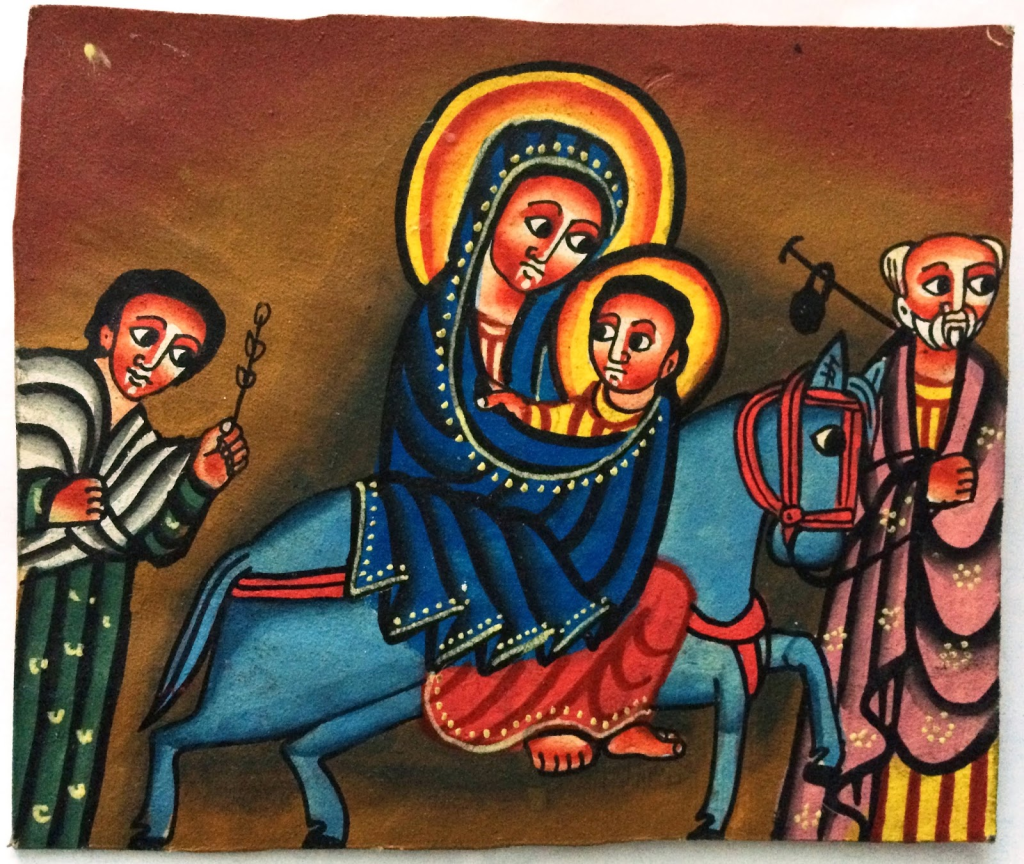
Ethiopian Orthodox icon of the holy family fleeing to Egypt

When we hold the pair of Testaments together in both hands, we feel the weight of Jesus as God’s divine Son; so therefore, Christ is the rightful Ruler in God’s kingdom.

Just as God preserved Israel from Pharaoh’s wrath, the Lord protected Jesus from Herod’s wrath. God’s kindness and loyalty extends to us as covenant people and preserves us from the wrath of the devil who seeks to keep as many people as possible in the realm of darkness.

Our hope is in the Lord Jesus, who conquered the devil by establishing a beachhead on this earth through an incarnation as the Son of God.

Jesus Brought Us Out of Exile

The scoundrel King Herod massacred innocent toddlers to ensure the destruction of Jesus. Behind his atrocity was the devil himself, who knew Jesus was the coming king who would one day bring salvation. Reflecting on a vision of Christ’s birth, the Apostle John identified the sinister plan and the divine deliverance:

The dragon stood in front of the woman who was about to give birth so that when she gave birth, he might devour her child. She gave birth to a son, a male child who is to rule all the nations with an iron rod. Her child was snatched up to God and his throne. (Revelation 12:4-5, CEB)

Satan wars against God’s Son and God’s people, whose roots go all the way back to the first prophecy of Christ after the Fall of humanity. God declared to Satan:

“And I will cause hostility between you and the woman,
    and between your offspring and her offspring.
He will strike your head,
    and you will strike his heel.” (Genesis 3:15, NLT)

There has been continual enmity ever since, between the serpent and the seed of the woman. It manifests itself with the Israelites constantly being threatened with extermination and tempted to conform to pagan ways.

King Herod was just another in a long line of demonically animated persons trying to perpetuate the kingdom of darkness. We must take this threat seriously because the devil knows that his time is short. A second Advent is coming which will be the final judgment.

Satan’s most powerful weapon, death, has lost its sting because of Jesus. Christmas is a hard time of year for many people, filled with depression instead of joy, grieving over lost loved ones for whom we will not spend another Christmas with.

Yet there is a reunion coming, the hope of a bodily resurrection in which we will be with Jesus and God’s people forever. Be encouraged to understand that there is no time in heaven; it will be only a moment and the people who have gone before us will turn around and see us; we will one day join them.

Matthew also used the prophet Jeremiah to communicate hope. Jeremiah’s prophecy dealt with children who were lost in war to the invading Babylonians. The prophecy is a lament with the hope that captivity will not be forever.

The disciple Matthew wanted us to see that the exile is over for us; Jesus has arrived, and the tears which were shed will shortly dry up. There may be a time of suffering we must endure, but there will be glory. Jesus is the Great Deliverer who brings us out of sin’s captivity and into the promises of God. He is our hope.

Jesus is the promised One who will deliver us from the tyranny of the devil. Christ is the hope of the nations, the Savior of the world. So, let us come back to the first Christmas which was the beginning of the end for evil on the earth.

Believers in Jesus are part of God’s victory, and they overcome the evil one by the blood of the lamb, acknowledging that Christ’s incarnation was essential for us. 

Just as Jesus made a radical break with his former life in heaven through the incarnation, we, too, must break with our old way of life.

God will save the people through this child Jesus. The greatest gift we can give in this season and throughout the coming year is the gift of grace, the presentation of the Christ child.

Loving God, help us remember the birth of Jesus so that we may share in the song of the angels, the gladness of the shepherds, and the wisdom of the wise men.

Close the door of hate and open the door of love across the world.

Let kindness come with every gift and good desires with every greeting.

Deliver us from evil through the blessing of the Christ child.

Teach us to be happy with pure hearts.

Grant us grateful thoughts, devoted hearts, and gracious hands, through Jesus our Savior in the might of the Holy Spirit. Amen.

The Example of John the Baptist (Matthew 14:1-12)

John the Baptist preaching, by George Maurice Cloud (1909-1973)

At that time Herod the ruler heard the news about Jesus. He said to his servants, “This is John the Baptist. He’s been raised from the dead. This is why these miraculous powers are at work through him.” Herod had arrested John, bound him, and put him in prison because of Herodias, the wife of Herod’s brother Philip.

That’s because John told Herod, “It’s against the law for you to marry her.”

Although Herod wanted to kill him, he feared the crowd because they thought John was a prophet. But at Herod’s birthday party Herodias’ daughter danced in front of the guests and thrilled Herod. Then he swore to give her anything she asked.

At her mother’s urging, the girl said, “Give me the head of John the Baptist here on a plate.” Although the king was upset, because of his solemn pledge and his guests he commanded that they give it to her. Then he had John beheaded in prison. They brought his head on a plate and gave it to the young woman, and she brought it to her mother. But John’s disciples came and took his body and buried it. Then they went and told Jesus what had happened. (Common English Bible)

John the Baptist’s murder is not only an ancient story; it’s also a story about our contemporary world – a world of power, sex, and intrigue. Times may change, but people across the ages do not. Humanity is fundamentally the same in every century. And the world is still the world, no matter the historical time. 

The contrast between King Herod and John the Baptist supply us with two types of people who exist throughout every age of humankind, offering us the choice of which way we will go with our lives. The story illustrates for us the reality of living in a fallen world as a devout person.

The Herod in today’s Gospel lesson was a son of Herod the Great, the one who killed all the male babies when Jesus was born in order to try and get rid of any rival king (Matthew 2:1-18). King Herod is displayed in the narrative as a tragic and pathetic figure who is ruled by his own lusts. He seems too proud and wimpy to admit he made a rash promise. He killed a man just to save face with his guests at a party.

This a Jerry Springer worthy family drama: The Herod family was rich, proud, and downright violent. They tended to marry within their own clan to hold their power and possessions for themselves. Herodias married her uncle Herod Philip; Salome was their daughter.

Later, Salome married Philip the tetrarch, half-brother to Herod Philip. Through marriage, Salome became both aunt and sister-in-law to her mother. Then the Herod in our story married Herodias, who had been married to Herod’s half-brother, Herod Philip. Having fallen in love with Herod Antipas, Herodias divorced Herod Philip to marry Herod Antipas.

Sheesh, nothing quite like complicated family drama.

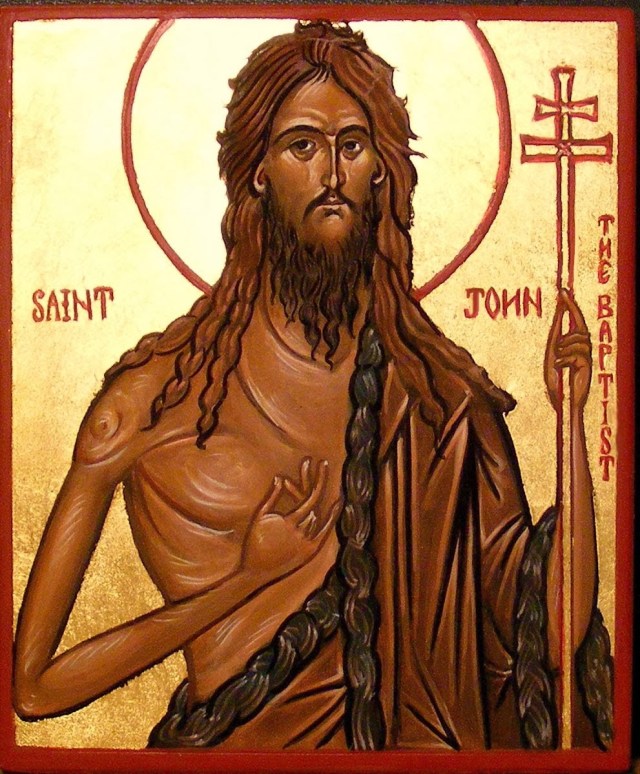
Orthodox icon of John the Baptist

Into this violation of Old Testament marriage laws (the Herod’s were Jewish) came John who made no bones about the fact this was not right (Leviticus 18:16, 20:21). Herodias nursed a grudge against John for speaking out against her and Herod’s choices.

Hell, hath no fury like a woman’s scorn, and when Herodias found an opportunity to get rid of John, she coached her daughter into asking for John the Baptist’s head on a platter. Herod, too insecure to take back his ridiculous promise and look like a fool, consented to the execution of John.

In contrast to all this tragic theater is John the Baptist. John was a messenger of God and a preacher of repentance. As one who was preparing the way for Jesus, his message was simple and to the point: Repent, for the kingdom of God is near.

John got into trouble and lost his life because he spoke truth to power by meddling in the life of King Herod and his family. The Herod’s were the political establishment of the day, and John did not temper his words when dealing with them.

There is a refreshing integrity about John. He was always the same, no matter where he was, and no matter who the people were around him. In contrast to Herod, John was bold, courageous, confident, unafraid, and secure enough in his relationship with God to engage in ministry without thought to the consequences. 

John was unconcerned for what others might think of him, if he proclaimed truth in the public square, and it ended up costing him his life.

John the Baptist Rebuking Herod, by Giovanni Fattori (1825-1908)

The story of John the Baptist’s death speaks about the hostility of this world. And it prefigured and foreshadowed the death of Jesus:

  • Like John, Jesus was executed by the civil authorities.
  • Herod, like Pilate after him, hesitated to execute and was swayed by the crowd.
  • Herodias, like the chief priests toward Jesus, finally got her way through scheming and manipulation.
  • John’s disciples came and took his body and buried it, just like Joseph of Arimathea and Nicodemus did for Jesus.

These stories, on the surface, appear to be only gloom and doom. Yet, there is a message of hope and joy. The absurd is working out itself in deliverance from sin, death, and hell. Through death, Jesus conquered death. We now have no fear of death; its sting has been taken away. Without fear of death, we have no reason to fear life with its troubles and tribulations.

The fork in the road is between the way of John or Herod. It’s a values-based decision. If worth is derived from what we do, what we have, and/or other’s opinion of us, we will likely identify more with Herod and his choices. If there is a preoccupation with hoarding power and control, this is the path of Herod. 

Conversely, if the ultimate value is in knowing Christ crucified and the power of his resurrection, then we identify with John as our spiritual ancestor. If security and worth is derived from being in Christ, then there is boldness to speak truth to power and give grace to the powerless.

Herod saw no further than his immediate needs and safety; he failed to discern his own heart. Because of his spiritual blindness, Herod did not look away from himself and look to God. Faith in Jesus comes when persons look away from themselves and look to Christ who holds the power to free all from spiritual bondage.

Consider the example of John the Baptist. He consistently sought to do the will of God as best as he understood it. Together with all God’s people past and present, we declare that God is with us, the kingdom of God is near, and the love of Christ brings faith and hope.

Almighty God, through your providence John the Baptist was wonderfully born and was sent to prepare the way of your Son, our Savior, by the preaching of repentance. Lead us to repent according to his preaching and, after his example, constantly to speak the truth, boldly to rebuke vice, and patiently to suffer for truth’s sake; through Jesus Christ your Son, our Lord, who is alive and reigns with you, in the unity of the Holy Spirit, one God, now and forever. Amen.

Epiphany of the Lord (Matthew 2:1-12)

After Jesus was born in Bethlehem in Judea, during the time of King Herod, Magi from the east came to Jerusalem and asked, “Where is the one who has been born king of the Jews? We saw his star when it rose and have come to worship him.”

When King Herod heard this he was disturbed, and all Jerusalem with him. When he had called together all the people’s chief priests and teachers of the law, he asked them where the Messiah was to be born. “In Bethlehem in Judea,” they replied, “for this is what the prophet has written:

“‘But you, Bethlehem, in the land of Judah,
    are by no means least among the rulers of Judah;
for out of you will come a ruler
    who will shepherd my people Israel.’”

Then Herod called the Magi secretly and found out from them the exact time the star had appeared. He sent them to Bethlehem and said, “Go and search carefully for the child. As soon as you find him, report to me, so that I too may go and worship him.”

After they had heard the king, they went on their way, and the star they had seen when it rose went ahead of them until it stopped over the place where the child was. When they saw the star, they were overjoyed. On coming to the house, they saw the child with his mother Mary, and they bowed down and worshiped him. Then they opened their treasures and presented him with gifts of gold, frankincense and myrrh. And having been warned in a dream not to go back to Herod, they returned to their country by another route. (New International Version)

The light exists; it’s there. But not everyone likes it.

While many celebrate the light, such as Christians on the day of Epiphany, others wrap themselves in the cloak of darkness. There are various responses to Jesus as the Light of the World; not all of them are the same.

King Herod responds with anger

Herod was distressed with the news of a potential King of the Jews being born; he saw this as a threat to his rule. Herod, ever the narcissistic person who always sought to wipe out any threat to his throne, went over the top in seeking destroy Jesus. 

At the time of Christ’s birth, Herod had been the reigning king for about 30 years. During that time, his paranoia about losing power led him to kill his wife and three of his own sons because he saw them as threats to his authority. Herod feigned a desire to worship Christ, but this was really a sinister façade in order to get rid of Jesus by any means possible.

Jerusalem responds with anxiety

The people of Jerusalem felt that Jesus was going to upset the status quo. He was, for them, a threat to their security; any change within the system might cause Herod to take it out on them (which he had done before). 

Although the people were looking for a deliverer, they did not want things to shake up too much and arouse the Romans to abuse them.

Whenever we get caught up in maintaining the status quo, out of fear, then we have no room in the inn for Mary and Joseph. 

Always trying to keep people happy and not upset them is a tenuous way to live. Such an agenda will typically result in missing Jesus when he shows up. That’s because we’re not really looking for him to start with. 

For example, if our task as parents is to just keep our kids out of trouble, they’re going to miss Jesus; and if they find him, it will be in spite of us and not because of us. Yet, if our truest desire for them is to know Christ, then our prayers, our words, and our actions will reflect the ethics of God’s kingdom.

Religious leaders respond with apathy

The chief priests and teachers of the law had all the right answers; and responded to Herod’s questions with the correct information.

The sad part is that the guys who knew the most about Scripture, who actually had a handle on God’s law, were simply satisfied with that knowledge and nothing more. They seemed  unconcerned with getting off their butts and getting on their knees to worship the Son of God.

If we know the truth, we must act on it. Jesus wants people to worship in spirit and in truth. He wants more than a mere recognition; Jesus desires us.

The Magi respond with adoration

The Three Wise Men by He Qi

The Wise men, or Magi, were Gentiles and pagan astrologers (not kings). They devoted themselves to studying the stars and discerning what was happening. Because of this, they were often advisors and counselors to kings.

Some may find it scandalous that God used such persons, but that’s okay. The Lord typically uses the folks we believe are (or should be) unusable. Turns out it is the people such as the Magi that demonstrate their devotion and adoration through actual worship and giving of costly gifts.

Epiphany

Each year on January 6 in the Church Calendar, after the twelve days of Christmas, is the celebration of Epiphany. Christ’s coming to this earth as a child and becoming like us is much more than a baby in a manger.  Epiphany of the Lord helps to bring a vision and understanding of God’s glory to all kinds of people of the world.

The word “epiphany” means “manifestation” or “appearance” – which is exactly what happened with the Magi in visiting Jesus. The season of Epiphany has a special emphasis on the teaching and healing ministry of Jesus. The focus of these weeks is that salvation is not limited to Israel but extends to the Gentiles, as well.

With Epiphany’s light, we see that one of the most scandalous truths of Christianity is that God graces common ordinary people, who seem far from God, with the gift of Jesus. 

God grants life for all kinds of people – no matter their race, ethnicity, gender, class, or background. It’s a wondrous and astounding spiritual truth that God’s gracious concern is not limited to a certain type of person or a particular group of people.

Grace

Grace is and ought to be the guiding factor in how we interact with people. 

Losing sight of grace leads to being critical and defensive. Like King Herod of old, a graceless person becomes enamored with earthly power and control. But embracing grace leads to the humility of seeing the image of God in people quite different from us. 

Like the Apostle Peter, who learned in a vision to bring the gospel to non-Jews, old legalisms begin to wear away so that people from all walks of life can have access to Jesus and his gracious saving and healing ministry. (Acts 10-11:18)

Grace topples barriers and clears away unnecessary distinctions between others. Our appropriate response to such a grace is to glorify God for this marvelous and amazing work.

Light

A light was provided to lead the Magi to Jesus. Apart from God’s gracious intervention, they would have remained in darkness. 

This old broken world is enveloped in spiritual darkness. All kinds of people have no light at the end of the tunnel of their lives for hope and new life. Christ brings that light to those unable to see. And Jesus, in his teaching ministry, exhorted his followers not to hide their light but to let it shine for all to see. (Matthew 5:14-16)

Sometimes, maybe oftentimes, the best way to bring resolution to our own troubles and problems is through helping others make sense of their lives through the gracious light of Christ. Then, they can see an appearance, an epiphany, of what their lives could be in the gracious and benevolent rule and reign of God. 

In this season of Epiphany, let us journey with Jesus through his earthly upbringing, walk with him in his gracious ministry to people; and keep watch with him so that our own light does not grow dim.

Merciful God of life and light, you have gifted the Church through the goodness of your grace to be your hands; to do your work; to be your voice; to share your words; and to bring healing for broken lives. You have graciously gifted your people with the blessings of your Spirit, the power to transform lives and make all things new.

Now may our hearts receive, our mouths proclaim, our hands prepare for compassionate service so that the love we have will overflow into the hearts of others. May they receive your grace, your renewing Spirit, and your love, through Jesus Christ our Savior. Amen.