Psalm 30 – Mourning Has Turned to Joy

I will exalt you, Lord, for you rescued me.
    You refused to let my enemies triumph over me.
O Lord my God, I cried to you for help,
    and you restored my health.
You brought me up from the grave, O Lord.
    You kept me from falling into the pit of death.

Sing to the Lord, all you godly ones!
    Praise his holy name.
For his anger lasts only a moment,
    but his favor lasts a lifetime!
Weeping may last through the night,
    but joy comes with the morning.

When I was prosperous, I said,
    “Nothing can stop me now!”
Your favor, O Lord, made me as secure as a mountain.
    Then you turned away from me, and I was shattered.

I cried out to you, O Lord.
    I begged the Lord for mercy, saying,
“What will you gain if I die,
    if I sink into the grave?
Can my dust praise you?
    Can it tell of your faithfulness?
Hear me, Lord, and have mercy on me.
    Help me, O Lord.”

You have turned my mourning into joyful dancing.
    You have taken away my clothes of mourning and clothed me with joy,
that I might sing praises to you and not be silent.
    O Lord my God, I will give you thanks forever! (New Living Translation)

Life is not only full of the tears which give way to joy; a great deal of life is learning to move through our grief and transform the pain into something beautiful.

Hard circumstances make us either better or bitter.

The psalmist, King David, had his share of adversity, difficulty, and distress. The youngest of seven sons, David was something like the runt of the litter. He was given the grunt work that nobody else wanted to do, since he was the lowest person in the household.

So, off to the fields he went, shepherding the sheep, dealing with hot days and cold nights, fighting off predators, and keeping the sheep healthy and safe. Yet out there where no one was looking, God was watching. And the Lord was developing within David the very qualities needed to one day rule over all Israel and Judah.

Even in-between becoming a member of the king’s court and becoming king himself, David’s life was mostly characterized by misunderstanding and being victimized. In other words, David had intimate first-hand experience of terrible sorrow, buckets of tears, and stress-filled anxiety. Through it all, he did not become bitter. Instead, David learned to transform his mourning to joy.

Many persons, having experienced the sort of things David of old did, come through their difficulties and adversity with a hard heart. They end up hurting people, just like they were hurt. Their verbal and physical acts of violence betray their inability to turn pain into something useful.

So, what makes the difference between those who experience the same sorts of painful events, yet go in the different directions of caring or harming?

I believe the twentieth-century Trappist monk, Thomas Merton, understood the true source of violence and non-violence…

“There is a pervasive form of contemporary violence to which the idealist most easily succumbs: activism and overwork. The rush and pressure of modern life are a form, perhaps the most common form, of its innate violence. To allow oneself to be carried away by a multitude of conflicting concerns, to surrender to too many demands, to commit oneself to too many projects, to want to help everyone in everything, is to succumb to violence. The frenzy of our activism neutralizes our work for peace. It destroys our own inner capacity for peace. It destroys the fruitfulness of our own work, because it kills the root of inner wisdom which makes work fruitful.”

Thomas Merton, Conjectures of a Guilty Bystander

Merton rightly discerned that the false self (the self we project to others and try to maintain as real) is in fact the source of violence – specifically, the false self’s need to gratify impulses for power and control, affection and esteem, security and safety, at all costs.

However, we do not find ourselves in those ways. The cultivation of solitude, silence, and contemplation are non-violent practices which organically produce non-violent ways of being in the world. Those were the very practices which characterized David’s early life as a shepherd.

It’s what we do when no one is watching, and nobody is around, that makes the difference. Our way of being in the world is determined by the way we are with ourselves when we are alone.

How you are, matters.

“If we do not transform our pain, we will most assuredly transmit it.”

Richard Rohr

We need to be present to our pain, to pay attention to it. Our hurts don’t simply vanish if we ignore them, try to go around them, or seek quick fixes to them. The pain is still there, and over time, becomes gangrene of the soul.

Instead, we must dare to go to the unexplored territory of the inner person, to confront and contend with our inner turmoil and be open to hearing from it.

“The endurance of darkness is the preparation for great light.”

St. John of the Cross

Today, like every day, we have the opportunity and even responsibility to bring our whole selves, pain included, to the relationships we have, the work we do, and everywhere we go. The world not only needs our skills and abilities; it needs us.

The path to joy isn’t through perfect circumstances and having all our wants satisfied; joy comes after a season of darkness with all it’s sobbing, tears, and wondering. As we become more comfortable with the shadowy places of our lives, the more open we become to transforming our pain to a beauty which blesses the world.

O God, you are my God, and I will praise you, whether at night’s inky blackness, or in the day’s bright sunshine of happiness. As I endure each difficult situation, help me to see it’s transformative power and it’s potential to make me a better and more godly person, through Jesus Christ my Lord, in the enablement of the Holy Spirit. Amen.

Psalm 59 – Victimization Needs a Voice

Oh, my God, deliver me from my enemies;
    put me out of reach from those who rise up against me.
Deliver me from evildoers;
    save me from the bloodthirsty.
Look at how they lie in ambush for my life!
    Powerful people are attacking me, Lord—
        but not because of any error or sin of mine.
    They run and take their stand—
        but not because of any fault of mine.

Get up when I cry out to you!
    Look at what’s happening!
You are the Lord God of heavenly forces,
    the God of Israel!
Wake up and punish all the nations!
    Grant no mercy to any wicked traitor!

They come back every evening,
    growling like dogs,
    prowling around the city.
See what they belch out with their mouths:
    swords are between their lips!
        Who can listen to them?
But you, Lord, laugh at them.
    You mock all the nations.
I keep looking for you, my strength,
    because God is my stronghold.
My loving God will come to meet me.
    God will allow me to look down on my enemies.

Don’t kill them, or my people might forget;
    instead, by your power
    shake them up and bring them down,
        you who are our shield and my Lord.
For the sin of their mouths,
    the words that they speak,
    let them be captured in their pride.
For the curses and lies they repeat,
        finish them off in anger;
        finish them off until they are gone!
Then let it be known to the ends of the earth
    that God rules over Jacob.

They come back every evening,
    growling like dogs,
    prowling around the city.
They roam about for food,
    and if they don’t get their fill,
    they stay all night.
But me? I will sing of your strength!
    In the morning I will shout out loud
    about your faithful love
        because you have been my stronghold,
        my shelter when I was distraught.
I will sing praises to you, my strength,
    because God is my stronghold,
    my loving God. (Common English Bible)

David was in a major pickle.

He was wildly successful as a member of King Saul’s court and a captain in his army. David fought Saul’s battles and won major victories. And this put him in the position of being the object of jealousy from Saul. So much so, that the king was ready to snuff out David’s life. David had done everything Saul had asked of him, and he was now about to be repaid by becoming a hunted man.

Today’s psalm was crafted by David in this awkward space between being at home but about to be on the run. It was a time of high anxiety and hypervigilance, of trying to come to grips with what was happening and about to happen.

Honestly, I really don’t like it when people poo-poo and invalidate other people’s emotions.

Every feeling which comes up for us is meant to be acknowledged and paid attention to.

Otherwise, if every feeling is tossed into some internal trash bin, those emotions eventually come out sideways,  looking like the stereotypical uptight and inflexible person who chronically complains and irritates others with their stone-faced tight-lipped sanctimonious policing of another’s feelings.

Such persons are aghast that psalms like today’s are even in the Bible. Biblical scholars identify these psalms as “imprecatory” psalms because they are curses, giving vent to the bitter anger and painful wonderings of the inner person.

A few years back, I was a chaplain in a large care facility. One of the residents was a retired Episcopal priest. He developed a brain tumor and had surgery to remove it. However, getting rid of the tumor damaged his ability to speak.

So, when I came to see him after his return to the nursing home, he labored intensely just to get a simple sentence out. And after each struggle to speak he would swear and utter some expletive, then apologize to me.

Finally, I said to him, “There’s no need to apologize. You have spent your life using words to bless and help others and now that has been robbed of you. You are angry. I am angry. Let’s just sit here and swear together about it.”

We raged together about disease. We swore like sailors about injustice. We cried out to God for vengeance on evil (and I was secretly praying that no one would walk into the room while we were doing this).

Whereas psalms of lament express deep sadness, imprecatory psalms rage with deep-seated anger.

With no cursing of disease, sickness, and death, it comes out sideways in this unkind sort of “snarky-ness” toward each other. In fact, one day I was speaking with someone at work, and she said to me, “Everyone was so mean to each other yesterday that I went home and cried.”

What I am proposing here is that our anger, our rage, even our vengeance needs recognition, just like our sadness does. Our bitterness must have an outlet, not directed toward one another, but toward the evil itself – and even toward God because God is big enough to handle our rage, whereas other humans are not.

Victimization needs a voice, and a bit of raging and cursing is the means to do it.

Giving voice to our deep anger is cathartic and therapeutic. Our speech needs to be congruent with the intensity of our pain because wherever there are no valued words of assault for victims, the risk of hurting each other is much higher.

Despair with no voice and no one to hear will eventually transition to harming others.

Holy One, you do not distance yourself from the pain of your people, but in Jesus bear that pain with us and bless all who suffer at another’s hands. Make our hurting holy! With your cleansing love, bring healing and strength; and by your justice, lift us up so that we may again rejoice in you, through Christ, my Lord. Amen.

2 Samuel 1:4-27 – Express Your Grief

“What happened?” David asked. “Tell me.”

“The men fled from the battle,” he replied. “Many of them fell and died. And Saul and his son Jonathan are dead.”

Then David said to the young man who brought him the report, “How do you know that Saul and his son Jonathan are dead?”

“I happened to be on Mount Gilboa,” the young man said, “and there was Saul, leaning on his spear, with the chariots and their drivers in hot pursuit. When he turned around and saw me, he called out to me, and I said, ‘What can I do?’

“He asked me, ‘Who are you?’

“‘An Amalekite,’ I answered.

“Then he said to me, ‘Stand here by me and kill me! I’m in the throes of death, but I’m still alive.’

“So, I stood beside him and killed him, because I knew that after he had fallen he could not survive. And I took the crown that was on his head and the band on his arm and have brought them here to my lord.”

Then David and all the men with him took hold of their clothes and tore them. They mourned and wept and fasted till evening for Saul and his son Jonathan, and for the army of the Lord and for the nation of Israel, because they had fallen by the sword.

David said to the young man who brought him the report, “Where are you from?”

“I am the son of a foreigner, an Amalekite,” he answered.

David asked him, “Why weren’t you afraid to lift your hand to destroy the Lord’s anointed?”

Then David called one of his men and said, “Go, strike him down!” So, he struck him down, and he died. For David had said to him, “Your blood be on your own head. Your own mouth testified against you when you said, ‘I killed the Lord’s anointed.’”

David took up this lament concerning Saul and his son Jonathan, and he ordered that the people of Judah be taught this lament of the bow (it is written in the Book of Jashar):

“A gazelle lies slain on your heights, Israel.
    How the mighty have fallen!

“Tell it not in Gath,
    proclaim it not in the streets of Ashkelon,
lest the daughters of the Philistines be glad,
    lest the daughters of the uncircumcised rejoice.

“Mountains of Gilboa,
    may you have neither dew nor rain,
    may no showers fall on your terraced fields.
For there the shield of the mighty was despised,
    the shield of Saul—no longer rubbed with oil.

“From the blood of the slain,
    from the flesh of the mighty,
the bow of Jonathan did not turn back,
    the sword of Saul did not return unsatisfied.
Saul and Jonathan—
    in life they were loved and admired,
    and in death they were not parted.
They were swifter than eagles,
    they were stronger than lions.

“Daughters of Israel,
    weep for Saul,
who clothed you in scarlet and finery,
    who adorned your garments with ornaments of gold.

“How the mighty have fallen in battle!
    Jonathan lies slain on your heights.
I grieve for you, Jonathan my brother;
    you were very dear to me.
Your love for me was wonderful,
    more wonderful than that of women.

“How the mighty have fallen!
    The weapons of war have perished!” (New International Version)

Character is revealed by both attitude and action. It seems likely the Amalekite would have lived if he had any, at all.

But instead, the Amalekite tried to act as if he knew David. It became very apparent, he didn’t really know David, at all.

By claiming responsibility for King Saul’s death, the Amalekite sealed his own. David spent months outrunning and outwitting Saul, trying his best to stay alive, while at the same time, carefully avoiding killing Saul. In assuming Saul’s death would be good news to David, the Amalekite went full braggadocio, looking to impress, as well as get a reward.

He got a reward, alright.

David’s attitude could not be any more different than the Amalekite’s. Whereas the Amalekite had a small and selfish attitude, David had a magnanimous attitude. David had suffered much because of Saul, and yet held firm in his commitment to God and to the king.

Our attitudes and our actions truly reveal what is in our hearts.

Because David had an attitude which reflected that he knew God, he therefore genuinely grieved and lamented the deaths of both King Saul and Saul’s son, Jonathan.

Bereavement, grief, and lament are, unfortunately, scarce words in the English language. But those words were not strange or stingy with David. He shows us the good path to follow in facing significant loss and change.

David’s grief was not only personal but public. He crafted a lament and had everyone learn it and say it. Indeed, grief may be intensely personal, yet it most definitely needs a public outlet.

Tears, questions, sorrow, anger, anxiety, and sadness are all the normal and necessary expressions of working through the death of someone close to us. The only bad grief is unexpressed grief. It sits idle, deep inside one’s personhood. Over time, it becomes gangrene of the soul.

Many deaths are bittersweet. It may be an end of suffering for the deceased, but it is also the beginning of suffering for those left behind. Sometimes Christians forget that death is a result of humanity’s fall. There is nothing to rejoice over with death; it is something to mourn over.

We need to become comfortable with talking about death, bereavement, and all the emotions that come with it. Methinks this is a chief reason for so many improper attitudes, like that of the ancient Amalekite with David.

Unexpressed grief neither disappears nor goes away. It eventually comes out sideways, usually harming both ourselves and others.

To grieve and lament simply means that we tell our story – which requires someone to listen without criticism or invalidating our feelings.

David was able to respond the way he did because of his closeness to God. For even and especially God grieves over significant losses. It is the proper and right attitude.

My God, my God, why have you forsaken me?
    Why are you so far from helping me, from the words of my groaning?
O my God, I cry by day, but you do not answer;
    and by night but find no rest….

He did not despise or abhor
    the affliction of the afflicted;
he did not hide his face from me,
    but heard when I cried to him….

To him, indeed, shall all who sleep in the earth bow down;
    before him shall bow all who go down to the dust,
    and I shall live for him. Amen.
(Psalm 22:1-2, 24, 29, NRSV)

2 Samuel 6:1-15 – Be Careful How You Celebrate

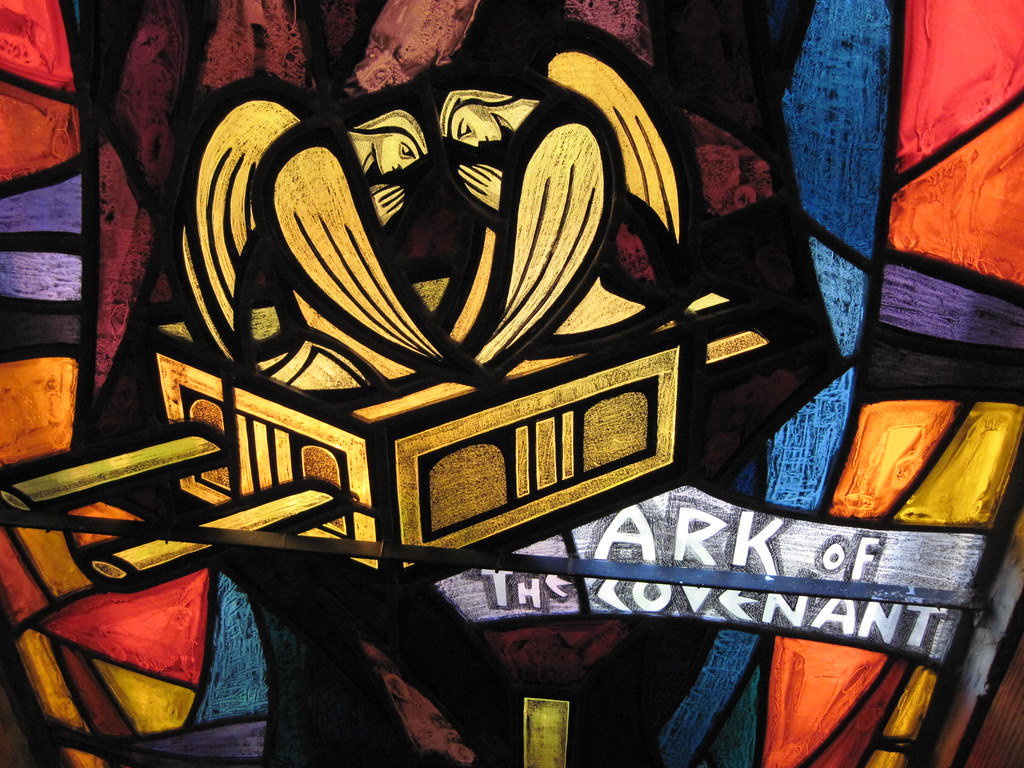
Ark of the Covenant by Isabel Piczek 1982, St. Norbert Catholic Church, Orange, California

David again assembled all the best men in Israel, 30,000 in number. David and all the men who were with him traveled to Baalah in Judah to bring up from there the ark of God which is called by the name of the Lord of Heaven’s Armies, who sits enthroned between the cherubim that are on it. They loaded the ark of God on a new cart and carried it from the house of Abinadab, which was on the hill. Uzzah and Ahio, the sons of Abinadab, were guiding the new cart. They brought it with the ark of God from the house of Abinadab on the hill. Ahio was walking in front of the ark, while David and all Israel were energetically celebrating before the Lord, singing and playing various stringed instruments, tambourines, rattles, and cymbals.

When they arrived at the threshing floor of Nacon, Uzzah reached out and grabbed hold of the ark of God, because the oxen stumbled. The Lord was so furious with Uzzah, he killed him on the spot for his negligence. He died right there beside the ark of God.

David was angry because the Lord attacked Uzzah; so, he called that place Perez Uzzah, which remains its name to this very day. David was afraid of the Lord that day and said, “How will the ark of the Lord ever come to me?” So, David was no longer willing to bring the ark of the Lord to be with him in the City of David. David left it in the house of Obed-Edom the Gittite. The ark of the Lord remained in the house of Obed-Edom the Gittite for three months.

The Lord blessed Obed-Edom and all his family.King David was told, “The Lord has blessed the family of Obed-Edom and everything he owns because of the ark of God.” So, David went and joyfully brought the ark of God from the house of Obed-Edom to the City of David. Those who carried the ark of the Lord took six steps and then David sacrificed an ox and a fatling calf. Now David, wearing a linen ephod, was dancing with all his strength before the Lord. David and all Israel were bringing up the ark of the Lord, shouting and blowing trumpets. (New English Translation)

The Christian season of Eastertide is a grand celebration of Christ’s resurrection and the new life we enjoy in Jesus Christ. Since God is the center of all things, celebrations need to be mindful. Nothing in life is a matter of doing whatever the heck we want to do.

Even celebration has its boundaries and limits.

The narrator who originally compiled, told, and wrote the today’s Old Testament lesson wanted to communicate something significant about God and how to relate to the Lord.

God put the big kibosh on David’s hoedown. At that time in the history of Israel, the ark was the foremost symbol of God’s presence with the people. Within the ark contained the tablets of the Ten Commandments (the symbol of God’s Word); the staff of the first priest, Aaron, (the symbol of God’s choice); and a pot of manna (the symbol of God’s provision). Thus, the ark was a holy object, pointing to a holy God.

The ark of the Lord was built during the time of Moses, when the ritual laws were established concerning offerings and how to approach God in worship. There were detailed prescriptions for how to construct all the sacred articles for worship. (Exodus 35:30-40:33) 

The ark was at the center of worship, representing the presence of God among the people. For nearly five-hundred years before David, the ark had become a familiar object in the life of Israel, always there, continually the symbol of God to the people.

I’ve been a Christian for many decades. One reason I refer to the seasons of the Christian Year in the present tense, is so that it doesn’t become old hat to me. Although I just presided over yet another Easter Sunday in my long tenure as a pastor, I am still in awe of Christ’s resurrection and am eternally grateful and full of joy over new life in Jesus Christ. I always want it to be fresh, as if I’m stepping up to the empty tomb for the first time.

Stained glass in the First Lutheran Church of
Washburn, North Dakota

Yet, we have all likely had the experience of something becoming so familiar, that we begin to lose sight of how important and valuable it really is. Not until we lose it, or something traumatic happens, do we wake up and take stock of its true significance. 

The Israelites had become lethargic and apathetic toward the worship of God, and it led to some disheartening and tragic circumstances. The people of God throughout the ages have always needed to be vigilant against the opiate of familiarity, dulling the senses to the importance of worship.

Moving the ark of the Lord to Jerusalem was one of the first acts David did as the king of Israel and Judah.  God was with David and brought him success against his enemies. David enjoyed a close relationship with God.  Even though David’s heart was in the right place, he made a huge miscalculation, which ended up offending God. 

David had the best of intentions in bringing the ark to Jerusalem and giving it a prominent place in the center of Jewish life. This was an exceptionally good plan. The problem, however, came in the manner the ark was carried from one place to another. 

God’s law laid out in careful detail how the ark was to be transported. Uzzah and Ahio were Levites charged with the ark’s care. Only the Levites could handle the ark and the holy objects of worship that went along with it.

Since it was the job of the Levites for hundreds of years, they knew better than to carry the ark of the Lord on a cart. God clearly told Moses that the ark was to have two long poles of acacia wood overlaid with gold inserted into four gold rings of the ark. The ark was to always be carried on the shoulders of the Levites with the two poles.

We are not told why Uzzah and Ahio were pulling the ark on a cart with oxen instead of carrying it in the prescribed way. Perhaps it was because the ark was incredibly heavy and no easy task to carry.  Maybe they decided it would be easier and more expedient to have the much stronger oxen pull the ark on a nice new cart; it would save a lot of energy transporting it over a long distance.

Or it could be that they were tired of moving the ark in the same old way they had always done it. Maybe it was old hat to them, and they were ready for something different.

For pragmatic people, Uzzah and Ahio’s approach makes a lot of sense. However, God was not okay with this arrangement. When the oxen stumbled and the ark was in danger of falling off the cart, Uzzah reflexively reached out to steady it.  That was the last act Uzzah ever did on this earth. God immediately put him down for his “irreverent act.”

So, here is the not so good idea: Evaluating the worship of God by common sense pragmatism, what we think will work best, and how we feel it ought to be done. Everything about worship is to pay attention to the holiness of God through our obedience. 

Whenever we avoid the prescriptions of Holy Scripture, however best the intentions might be, is not a good thing and people will get hurt. One can never justify an action that goes against God’s Word because people are praising God. Just because the heart is in the right place does not mean what is being done is okay.

David’s first response was anger, then fear. He gave his best effort, and it resulted in God’s disfavor. Perhaps David took for granted that the ark could be moved any old way he wanted to move it. 

Trouble with God happens whenever we value efficiency and expediency over obedience and submission.

The great error of Uzzah, resulting in his death, was trying to manage God. We do not take care of God; God takes care of us. God does not bow to us. The Lord doesn’t allow the creature to manage the Creator.

God wants a pure, unadulterated, and obedient worship celebration from people in the way God wants it to be done, period. It is not up for negotiation.

Holy God, we confess that we have too often forgotten we are yours. Sometimes we carry on our lives as if there was no God and we fall short of being a credible witness to you. For these things we ask your forgiveness and for your strength. Give us clear minds and open hearts so we may bear witness to you in our world. Remind us to be who you would have us to be regardless of what we are doing or who we are with. Hold us close and build our relationship with you and with those you have given us on earth, through Jesus Christ our Lord. Amen.