2 Samuel 6:12-19 – Acceptable Worship

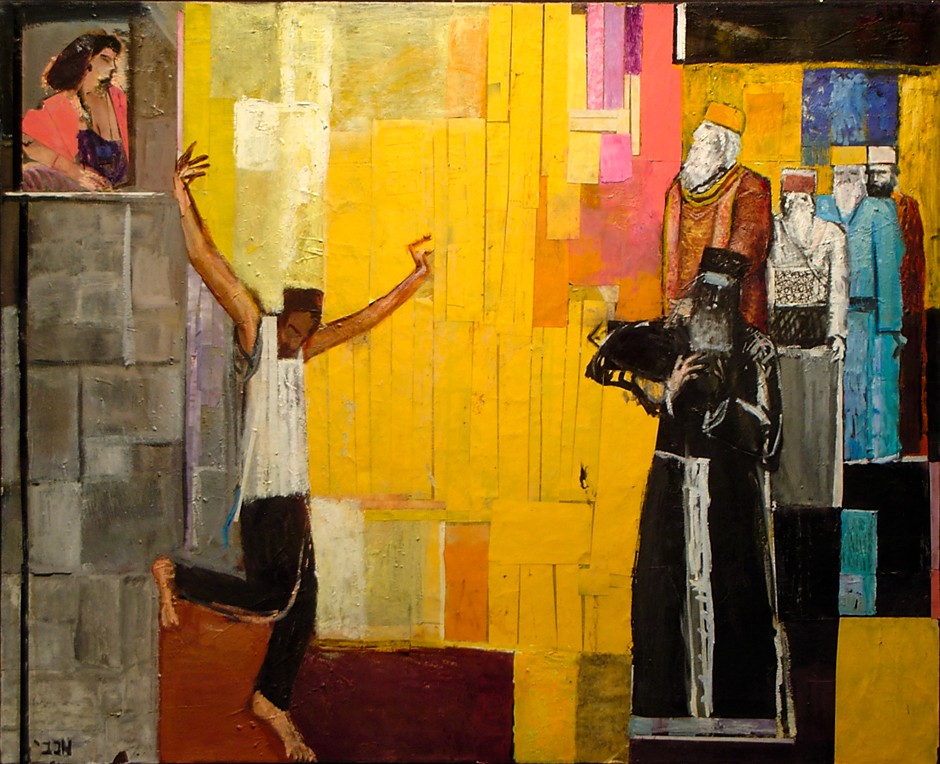
David Dancing by Richard McBee, 1998

Now King David was told, “The Lord has blessed the household of Obed-Edom and everything he has, because of the ark of God.” So, David went to bring up the ark of God from the house of Obed-Edom to the City of David with rejoicing. When those who were carrying the ark of the Lord had taken six steps, he sacrificed a bull and a fattened calf. Wearing a linen ephod, David was dancing before the Lord with all his might, while he and all Israel were bringing up the ark of the Lord with shouts and the sound of trumpets.

As the ark of the Lord was entering the City of David, Michal daughter of Saul watched from a window. And when she saw King David leaping and dancing before the Lord, she despised him in her heart.

They brought the ark of the Lord and set it in its place inside the tent that David had pitched for it, and David sacrificed burnt offerings and fellowship offerings before the Lord. After he had finished sacrificing the burnt offerings and fellowship offerings, he blessed the people in the name of the Lord Almighty. Then he gave a loaf of bread, a cake of dates and a cake of raisins to each person in the whole crowd of Israelites, both men and women. And all the people went to their homes. (NIV)

After the worship debacle earlier in which two of the Levites attending the ark of the Lord were struck down by God, King David took time to refocus and go about bringing the ark back to Jerusalem in a proper way. A true celebration was underway that enjoyed the blessing of God upon it.  The sacrifices before God were sweet smelling because they were done in a spirit of obedience and humility. 

However, David’s wife, Michal, the daughter of Saul, did not worship. She critically observed David and the others and evaluated the worship service by how it appeared to her. Michal was not with everyone else giving herself to the true worship of God. She did not like how David went about worship. The acceptable worship of God was unacceptable to her and she let David know it. Yet, David was undaunted and had his focus where it needed to be. We get a cryptic last note on Michal, describing that she was barren to the day of her death – a note meant to convey both a physical reality of her body, and a spiritual reality of her soul.

So, how are we to worship God?  Jesus commented about worship: 

“The hour is coming, and is now here, when the true worshipers will worship the Father in spirit and truth, for the Father seeks such as these to worship him. God is spirit, and those who worship him must worship in spirit and truth.” (John 4:23-24, NRSV)

Neither good intentions alone (in spirit) nor appropriate actions alone (in truth) constitute acceptable worship.  Both are necessary.  The worship Jesus mentioned is literally “to prostrate oneself before God.”  In other words, it is to have a disposition and attitude of submission and humility toward God, seeking to obey him as king rather than superimpose our desires on him. 

Furthermore, God is near to us and far away from us, at the same time.  God is close to us through the person and work of Jesus Christ, and now in the person of the Holy Spirit. God is also sovereign and far above us, orchestrating the universe. In worship, we appreciate both God’s transcendence and immanence.

The presence of God is both comforting and dangerous. Divine holiness is like a fire, giving us light and warmth; but get too close to the flame and you will get burned, even destroyed. We have collective promises and blessings given to us as God’s people; and at the same time, we have individual responsibilities to know the will of God and do it in the way prescribed for us.
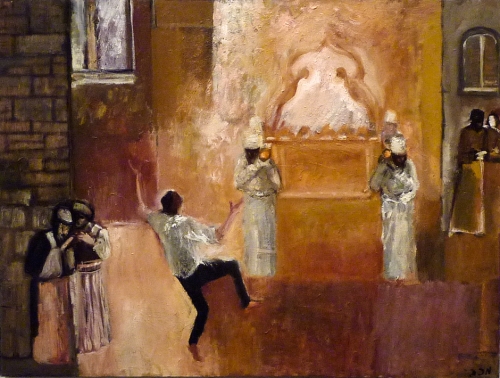
David Dancing by Richard McBee, 1986

The book of 1 Chronicles gives an additional account of David’s worship service in bringing the ark to Jerusalem, which includes a psalm of thanksgiving to God that he wrote himself to be sung by Asaph and his associates, the worship leaders.  Here is part of that psalm:

Sing to the Lord, all the earth!
    Share the news of his saving work every single day!
Declare God’s glory among the nations;
    declare his wondrous works among all people
        because the Lord is great and so worthy of praise.
He is awesome beyond all other gods
    because all the gods of the nations are just idols,
        but it is the Lord who created heaven!
Greatness and grandeur are in front of him;
    strength and joy are in his place.
Give to the Lord, all families of the nations—
    give to the Lord glory and power!
    Give to the Lord the glory due his name!
        Bring gifts! Enter his presence!
        Bow down to the Lord
        in his holy splendor! (1 Chronicles 16:23-29, CEB)

After the worship service, after the psalm had been sung by Asaph and the singers, the text goes on to say:

Then David placed Asaph and his relatives, together with Obed-edom and sixty-eight of his relatives, to minister there continually before the chest containing the Lord’s covenant, following the routines required on each day…. With them were Heman and Jeduthun and the rest of those chosen by name to give thanks to the Lord, because his faithful love lasts forever. With them were also the trumpets and the cymbals for the musicians and the instruments for God’s songs. (1 Chronicles 16:37, 41-42, CEB)

In Israel, King David instituted that the worship of God was to take place every day – not just one day a week.  What is more, David hired hundreds of musicians, singers, and worship leaders to minister before the Lord every single day, twice a day. Every conceivable instrument and voice were used to praise God in worship.  New songs were written continually by David, and arranged by Asaph, the lead worship person. 

God longs for our worship each day: to remember who we are and who God is; to sing; to confess sin; to claim forgiveness; to read the Holy Scriptures; and to pray. If we all devoted ourselves to worship in such a way, then we can begin to imagine God opening to us blessing upon blessing.

Blessed Lord, who caused all Holy Scripture to be written for our learning: Grant that we may hear it, read it, mark it, learn it, and inwardly digest it, so that we may embrace worship in body, mind, and spirit through our Savior Jesus Christ in the strength of the Holy Spirit. Amen.

2 Samuel 6:1-11 – Unacceptable Worship

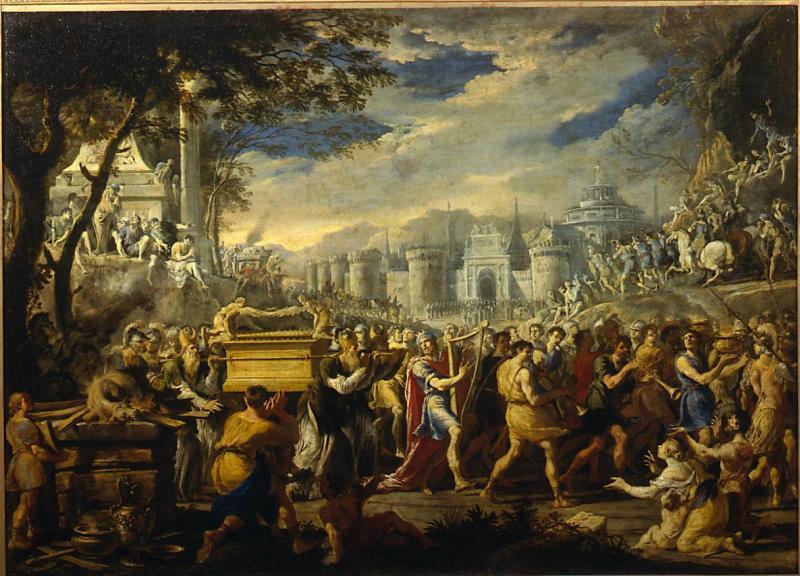
Transferring the ark of the Lord to Jerusalem by Domenico Gorgiolo (1609-1675)

David again brought together all the able young men of Israel—thirty thousand. He and all his men went to Baalah in Judah to bring up from there the ark of God, which is called by the Name, the name of the Lord Almighty, who is enthroned between the cherubim on the ark. They set the ark of God on a new cart and brought it from the house of Abinadab, which was on the hill. Uzzah and Ahio, sons of Abinadab, were guiding the new cart with the ark of God on it, and Ahio was walking in front of it. David and all Israel were celebrating with all their might before the Lord, with castanets, harps, lyres, timbrels, sistrums and cymbals.

When they came to the threshing floor of Nakon, Uzzah reached out and took hold of the ark of God, because the oxen stumbled. The Lord’s anger burned against Uzzah because of his irreverent act; therefore, God struck him down, and he died there beside the ark of God.

Then David was angry because the Lord’s wrath had broken out against Uzzah, and to this day that place is called Perez Uzzah.

David was afraid of the Lord that day and said, “How can the ark of the Lord ever come to me?” He was not willing to take the ark of the Lord to be with him in the City of David. Instead, he took it to the house of Obed-Edom the Gittite. The ark of the Lord remained in the house of Obed-Edom the Gittite for three months, and the Lord blessed him and his entire household. (NIV)

The narrator who originally compiled, told, and wrote this story wanted to communicate something significant about God and how to relate to the Lord.  God put the big kibosh on David’s hoedown. At that time in the history of Israel, the ark was the foremost symbol God was present with the people. Within the ark contained the tablets of the Ten Commandments (the symbol of God’s Word); the staff of the first priest, Aaron, (the symbol of God’s choice); and, a pot of manna (the symbol of God’s provision). 

The ark was a holy object, pointing to a holy God.

The ark of the Lord was built during the time of Moses, when the ritual laws were established concerning offerings and how to approach God in worship. There were detailed prescriptions for how to construct all the sacred articles for worship. (Exodus 35:30-40:33) 

The ark was at the center of worship, representing the presence of God among the people. For nearly five-hundred years before David, the ark had become a familiar object in the life of Israel, always there, continually being the symbol of God to the people.

We have all likely had the experience of something becoming so familiar to us that we begin to lose sight of how important and valuable it really is. Not until we lose it, or something traumatic happens, do we wake up and take stock of its true significance. 

The Israelites had become lethargic and apathetic toward the worship of God, and it led to some disheartening and tragic circumstances. The people of God throughout the ages have always needed to be vigilant against the opiate of familiarity, dulling the senses to the importance of worship.

Moving the ark of the Lord to Jerusalem was one of the first acts David did as the king of Israel and Judah.  God was with David and brought him success against his enemies. David enjoyed a close relationship with God.  Yet even though David’s heart was in the right place, he made a huge miscalculation which ended up offending God. 

David had the best of intentions in bringing the ark to Jerusalem and giving it a prominent place in the center of Jewish life. This was an exceptionally good plan. The problem, however, came in the manner the ark was carried from one place to another. 

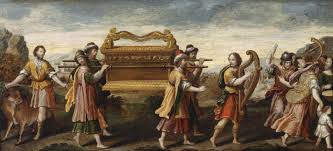
King David bringing the ark to Jerusalem by Unknown Italian artist, c.1500

God’s law laid out in careful detail how the ark was to be transported. Uzzah and Ahio were Levites charged with the ark’s care. Only the Levites could handle the ark and the holy objects of worship that went along with it. Since it was the job of the Levites for hundreds of years, they knew better than to carry the ark of the Lord on a cart. God clearly told Moses that the ark was to have two long poles of acacia wood overlaid with gold inserted into four gold rings of the ark.

The ark was to always be carried on the shoulders of the Levites with the two poles.

We are not told why Uzzah and Ahio were pulling the ark on a cart with oxen instead of carrying it in the prescribed way. Perhaps it was because the ark was incredibly heavy and no easy task to carry.  Maybe they decided it would be easier and more expedient to have the much stronger oxen pull the ark on a nice new cart; it would save a lot of energy transporting it over a long distance. 

As pragmatic people, Uzzah and Ahio’s approach makes a lot of sense. However, God was not okay with this arrangement.  When the oxen stumbled and the ark was in danger of falling off the cart, Uzzah reflexively reached out to steady it.  That was the last act Uzzah ever did on this earth. God immediately put him down for his “irreverent act.”

So, here is the not so good idea: Evaluating the worship of God by common sense pragmatism, what we think will work best, and how we feel it ought to be done.  Everything about worship is to pay attention to the holiness of God through our obedience.  Whenever we avoid the prescriptions of Holy Scripture, however best the intentions might be, is not a good thing and people will get hurt.  One can never justify an action that goes against God’s Word because people are praising God. 

Just because the heart is in the right place does not mean what is being done is okay.

David’s first response was anger, then fear.  He gave his best effort, and it resulted in God’s disfavor. Perhaps David realized that maybe he took for granted that the ark could be moved any old way he wanted to move it. 

Trouble with God happens whenever we value efficiency and expediency over obedience and submission.

The great error of Uzzah which resulted in his death was trying to manage God. We do not take care of God; God takes care of us. God does not bow to us and allow himself to be managed by creatures. The Lord wants pure unadulterated obedient worship from people in the way God wants it to be done, period. It is not up for negotiation.

So, David took some time to re-evaluate the whole approach to worship he was doing and left the ark with a Philistine. Then, he went back and did it right….

Holy God, we confess that we have too often forgotten we are yours. Sometimes we carry on our lives as if there was no God and we fall short of being a credible witness to you. For these things we ask your forgiveness and for your strength. Give us clear minds and open hearts so we may bear witness to you in our world. Remind us to be who you would have us to be regardless of what we are doing or who we are with. Hold us close and build our relationship with you and with those you have given us on earth, through Jesus Christ our Lord. Amen.

Psalm 63:1-8 – Divine/Human Connection

O God, you are my God; 
    I earnestly search for you. 
My soul thirsts for you; 
    my whole body longs for you 
in this parched and weary land 
    where there is no water. 
I have seen you in your sanctuary 
    and gazed upon your power and glory. 
Your unfailing love is better than life itself; 
    how I praise you! 
I will praise you as long as I live, 
    lifting up my hands to you in prayer. 
You satisfy me more than the richest feast. 
    I will praise you with songs of joy. 

I lie awake thinking of you, 
    meditating on you through the night. 
Because you are my helper, 
    I sing for joy in the shadow of your wings. 
I cling to you; 
    your strong right hand holds me securely. (NLT) 

Regular readers of this blog know I believe the book of Psalms to be a vast resource for devotion, worship, and prayer. In dark or distressing times when we don’t know what to pray, how to lament, or what to say to God; in the joyful and peaceful times when we want to proclaim praise, give thanks, or express our blessings and longings; and, in every season of our lives, the psalms offer us robust theology, human emotion and need in all its vulnerable reality, and a connected path between the two. 

Today’s psalm was originally uttered to God when David was roaming in the wilderness avoiding King Saul’s malevolent and murderous intent. David expressed his yearning desire and hope to connect with God and gain solace and guidance, step by step, by the Lord who sees and satisfies. David praised God within a life-and-death circumstance, longing to be satiated with spiritual food and drink. 

Whatever situation we find ourselves in, and wherever our path takes us, the psalms help form and shape a profound spirituality of deep connection with the God we long to know and experience. 

The psalms are so much more than ancient poems, prayers, and songs; they are words alive with the potential to bridge us to God. I often write my own translations and personally contemporize the psalms which helps me to approach God during my own wilderness experiences. So, here is my take on this psalm: 

O God, you are my God; I am putting all my effort into seeking you. 

            my soul is thirsty for you. 

my body is weak looking for you, 

            like in a desert where there is no water. 

I am no stranger to you because I have seen you work before, 

            and I have gotten a glorious glimpse of your power in the past. 

I have experienced that your steadfast love is better than life itself, 

            and I now bank on those times and praise you despite my trouble. 

I choose to keep on remembering you and blessing your holy name. 

            In the mighty name of Jesus, I will lift my hands in praise, even if it looks weird to others. 

I know that my soul will be satisfied in you, just like when I get a medium rare T-bone steak and corn on the cob. 

            And I will use my mouth to praise you with joy, no matter the circumstances, 

when I remember you on my bed and cannot sleep, 

            and meditate on your wonderful grace as I lie there with my eyes wide open. 

for you have always been my help, 

            and sitting on your lap I will be supremely confident and sing for joy. 

Oh, my soul clings to you through this trial, 

            and your mighty hand upholds me.  Amen. 

O God, You Are My God by Fernando Ortega

Psalm 28 – To Be, or Not to Be

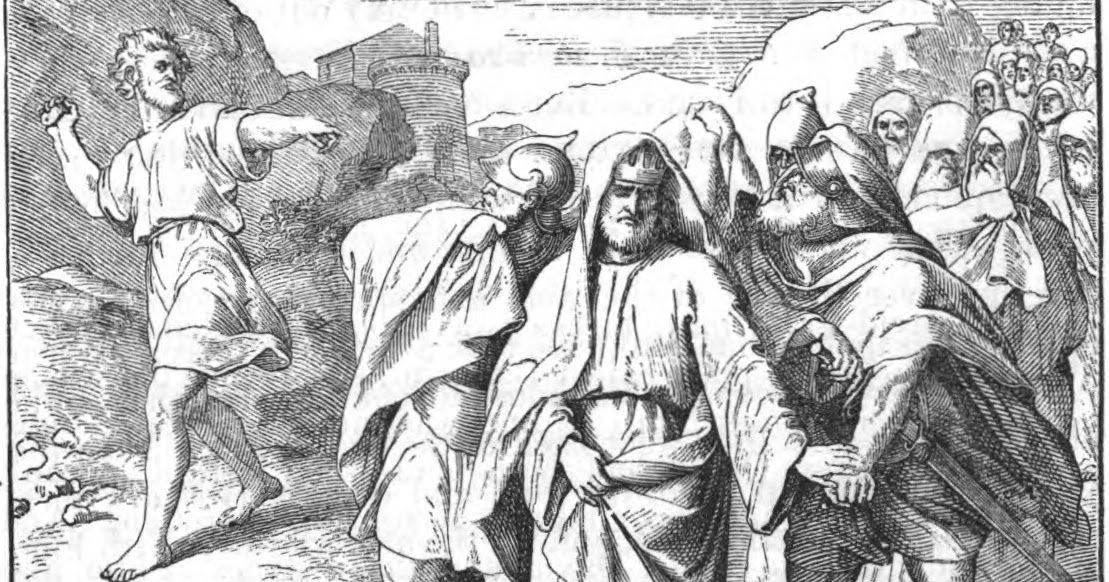
David pelted with stones
David being pelted with stones, by unknown Slovakian artist, 1937

I cry out to you, Lord.
You are my rock; don’t refuse to hear me.
If you won’t talk to me,
I’ll be just like those going down to the pit.
Listen to my request for mercy when I cry out to you,
when I lift up my hands to your holy inner sanctuary.
Don’t drag me off with the wicked and those who do evil;
the type who talk nice to their friends
while evil thoughts are in their hearts!
Pay them back for what they’ve done!
Pay them back for their evil deeds!
Pay them back for their handiwork!
Give back to them exactly what they deserve!
Because they have no regard for what the Lord has done,
no regard for his handiwork,
God will tear them down and never rebuild!

Bless the Lord
because he has listened to my request for mercy!
The Lord is my strength and my shield.
My heart trusts him.
I was helped, my heart rejoiced,
and I thank him with my song.
The Lord is his people’s strength;
he is a fortress of protection for his anointed one.
Save your people, God!
Bless your possession!
Shepherd them and carry them for all time! (CEB)

The biblical character David, in frustration and agony, cried out for help, for God to hear his prayers. And, when his prayer was heard, David gave exuberant praise to the Lord for listening to him. We are not told specifically of how that prayer was answered and what happened between the request and the response. It seems the juicy details are left out on purpose, so that maybe we would not get lost in the retribution but stick with the fact that there was a desperate need and the Lord stepped in and did something about it.

As I pondered this psalm and its lack of life-detail, I wondered about David’s situation: Could it be that David gave God praise just for being heard by him?  Was David cured in some way, or was he healed from the need to be healed?  Was there even any actual deliverance that occurred?  Did David come to praise God despite a lack of deliverance?  Was David’s joy in his relationship with God conditional, or unconditional?

Hamlet
Hamlet, played by actor Matt Amendt in the Pittsburgh Public Theater, 2018

William Shakespeare’s Hamlet (c.1601 C.E.) put the question this way: “To be, or not to be, that is the question.” Hamlet’s soliloquy went on to say:

“Whether ’tis nobler in the mind to suffer
The slings and arrows of outrageous fortune,
Or to take arms against a sea of troubles,
And by opposing end them? To die: to sleep;
No more; and by a sleep to say we end
The heartache and the thousand natural shocks
That flesh is heir to, ’tis a consummation
Devoutly to be wish’d. To die, to sleep;
To sleep: perchance, to dream: ay, there’s the rub;
For in that sleep of death what dreams may come
When we have shuffled off this mortal coil,
Must give us pause: there’s the respect
That makes calamity of so long life;
For who would bear the whips and scorns of time,
The oppressor’s wrong, the proud man’s contumely,
The pangs of despised love, the law’s delay,
The insolence of office and the spurns
That patient merit of the unworthy takes,
When he himself might his quietus make
With a bare bodkin (knitting needle)?”

Hamlet, much like David of old, was miserable and burdened with a profound lack of power to change his circumstances. So, he reflects on life and death in a morbid and melancholy way. It is not that Hamlet was contemplating suicide as much as he meditated on what life truly is and finding some meaning within it. Unlike David, Hamlet cannot find the courage to deal with his frustration and feels stymied with fear of the unknown.

If we are blatantly honest with ourselves, we must admit that far too often we have a particular outcome in mind for God to do.  Our hopes and expectations are tethered to God doing something extremely specific so that, if it does not come to pass (or does not come quickly!) we become discouraged and disillusioned. Like Hamlet, we become lost in the shadows of our thinking and ponder some sort of escape.

So, here is another set of questions I am asking myself: If my adverse circumstances do not change, can I praise God anyway?  Can I, like David, take joy in simply being heard?  Can I find gratitude in all situations?  Do I only express thanks and praise to God when things are going my way?  Am I open to whatever God wants to do in my life, even if it is not what I would choose?  Do I feel that I am above having to put up with the wickedness of this world?  Am I expecting heaven on earth, or am I willing to suffer as Jesus did?

I honestly believe the answers to those questions will determine the trajectory of our Christian experience. For the identity and meaning of all persons is found in the divine.

I praise you, O God, in the good and the bad, the easy and the difficult, the failures and the victories.  You are Lord over all things.  You are my strength and shield in every circumstance.  When I am weak, I am strong. I can do all things through Christ who strengthens me.  Amen.