2 Samuel 7:18-29 – A Model Prayer

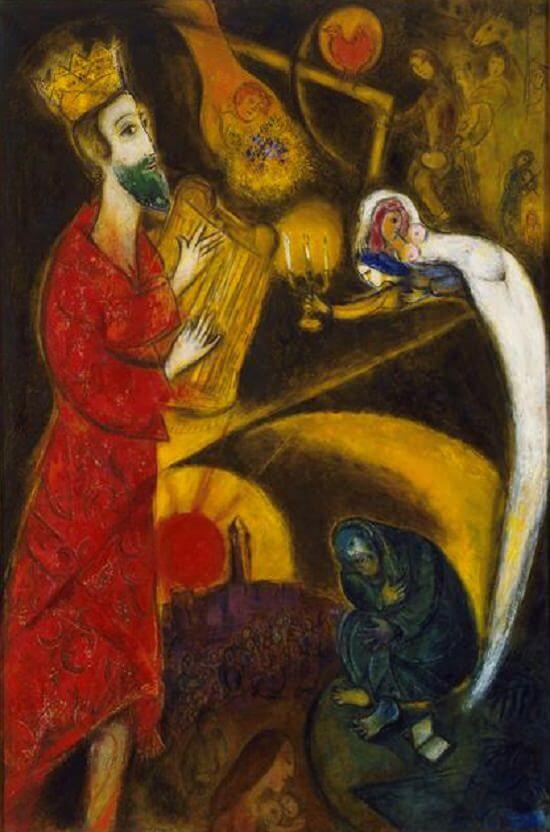
King David by Marc Chagall, 1962

Then King David went in and sat before the Lord, and he said:

“Who am I, Sovereign Lord, and what is my family, that you have brought me this far? And as if this were not enough in your sight, Sovereign Lord, you have also spoken about the future of the house of your servant—and this decree, Sovereign Lord, is for a mere human!

“What more can David say to you? For you know your servant, Sovereign Lord. For the sake of your word and according to your will, you have done this great thing and made it known to your servant.

“How great you are, Sovereign Lord! There is no one like you, and there is no God but you, as we have heard with our own ears. And who is like your people Israel—the one nation on earth that God went out to redeem as a people for himself, and to make a name for himself, and to perform great and awesome wonders by driving out nations and their gods from before your people, whom you redeemed from Egypt? You have established your people Israel as your very own forever, and you, Lord, have become their God.

“And now, Lord God, keep forever the promise you have made concerning your servant and his house. Do as you promised, so that your name will be great forever. Then people will say, ‘The Lord Almighty is God over Israel!’ And the house of your servant David will be established in your sight.

“Lord Almighty, God of Israel, you have revealed this to your servant, saying, ‘I will build a house for you.’ So, your servant has found courage to pray this prayer to you. Sovereign Lord, you are God! Your covenant is trustworthy, and you have promised these good things to your servant. Now be pleased to bless the house of your servant, that it may continue forever in your sight; for you, Sovereign Lord, have spoken, and with your blessing the house of your servant will be blessed forever.” (New International Version)

“The whole reason why we pray is to be united into the vision and contemplation of God to whom we pray.”

Julian of Norwich (1343-1416)

Perhaps you wish you had a better prayer life. To pray, as with most things in life, requires both motivation and how to do it. So, it’s appropriate to find answers about prayer by observing the biblical models of prayer contained in Holy Scripture.

Today’s Old Testament lesson is King David’s prayer in response to God’s revelation to him about fulfilling covenant promises. Looking at David’s prayer, there is a three-fold division which models for us a good way to approach God.

The Present: Gratitude for God’s Grace

David began his prayer with an attitude, posture, and words of humility, recognizing and affirming the relationship between himself and God. Although David is the king over all Israel and Judah, he repeatedly refers to himself as a servant (10 times).

God didn’t have to communicate anything to David about the future. Yet, the Lord graciously made known that it would be through David’s descendants that all of God’s good promises will be fulfilled. And David is overwhelmed with such gracious words. It comes tumbling out of him in a heartfelt prayer of gratitude and thanksgiving.

It is good for us to think about the spiritual blessings we have received from God. Not only can prayers of thanksgiving be uttered at any time to the Lord, but we can also write our gratitude in a journal as a prayer offering to God.

It’s also good to be specific about the circumstances and the praises. In the future, whenever there are discouraging situations, we can look back to what we wrote and remember the ways in which God showed up and encouraged us with very great and precious promises.

The Past: Praise for God’s Actions

David affirms there is no one and no god which can compare to Yahweh, the great I Am. It is the Lord God almighty who displayed divine power and presence in redeeming the Israelites out of Egyptian slavery and into the Promised Land.

Any greatness which arises from humans is the direct result of God’s greatness. Apart from God, there is no distinctive way of living. God’s presence makes all the difference:

Then Moses said to him [Yahweh], “If your Presence does not go with us, do not send us up from here. How will anyone know that you are pleased with me and with your people unless you go with us? What else will distinguish me and your people from all the other people on the face of the earth?” (Exodus 33:15-16, NIV)

The Lord specializes in bending hopeless situations to divine purposes, transforming people to new life, and turning systemic evil on its head so that the humble, meek, and penitent will be first, not last.

The Future: Prayer for God to Fulfill Divine Promises

King David already knew God’s promises to the Israelites. Now, however, David understands how he personally fits into the Lord’s plan.

Courage arises whenever God’s people know God’s promises and then discern how to fit into God’s plan. Confident assurance and settled peace cannot simply be ginned-up through positive thinking; bold faith needs a foundation of truth – a rock solid base which cannot be moved and is always there.

King David found his ultimate motivation in life in God’s revelation. His basis of prayer was God’s Word. Biblical prayers, like David’s, are there for us to model our own prayers.

Accept, O Lord, our thanks and praise for all that you have done for us. We thank you for the splendor of the whole creation, for the beauty of this world, for the wonder of life, and for the mystery of love. We thank you for the blessing of family and friends, and for the loving care which surrounds us on every side. We thank you for setting us at tasks that demand our best efforts, and for leading us to accomplishments that satisfy and delight us. We thank you also for those disappointments and failures that lead us to acknowledge our dependence on you alone.

Above all, we thank you for your Son Jesus Christ; for the truth of his Word and the example of his life; for his steadfast obedience, by which he overcame temptation; for his dying, through which he conquered death; and for his rising to life again, in which we are raised to the life of your kingdom. Grant us the gift of your Spirit, that we may know Christ and make him known; and through him, at all times and in all places, may give thanks to you in all things. Amen.

Psalm 18:20-30 – Vault the Highest Fence

God made my life complete
    when I placed all the pieces before him.
When I got my act together,
    he gave me a fresh start.
Now I’m alert to God’s ways;
    I don’t take God for granted.
Every day I review the ways he works;
    I try not to miss a trick.
I feel put back together,
    and I’m watching my step.
God rewrote the text of my life
    when I opened the book of my heart to his eyes.

The good people taste your goodness,
The whole people taste your health,
The true people taste your truth,
The bad ones can’t figure you out.
You take the side of the down-and-out,
But the stuck-up you take down a notch.

Suddenly, God, you floodlight my life;
    I’m blazing with glory, God’s glory!
I smash the bands of marauders,
    I vault the highest fences.

What a God! His road
    stretches straight and smooth.
Every God-direction is road-tested.
    Everyone who runs toward him
Makes it. (The Message)

I confess I’m tired a lot. Maybe it’s the rigors of pastoral ministry and hospital chaplaincy. It might be from the daily grind of household chores and family responsibilities. It could be because my mind is always a beehive of activity and doesn’t shut down easily at night. Perhaps it’s due to not enough self-care. More than likely, it is a bit of all that. 

I perked up, though, when I read today’s psalm and heard David say that by means of God he can vault the highest fences. Back in the day, I certainly did my share of hopping over high fences. But it’s been a long while since I’ve leapt over a fence. I’m old enough to know better than try something like leaping over anything. I can clearly imagine pulled hamstrings and a messed-up back doing a feat like that.

David was really no spring chicken himself when he wrote this. Psalm 18 is a psalm of praise to God for rescuing David from Saul and all his enemies. This deliverance did not happen overnight; it came over years of David running from the king and being pursued by others. Yet the day finally came, and David was not shy in proclaiming his praise to God.

If God’s deliverance from earthly enemies can energize David so much, how much more can I be invigorated by the reality that I’m delivered from sin, death, and hell through the blood of Jesus Christ? 

Maybe you, like me sometimes, think too much about adverse circumstances and ornery people – which makes the biblical Psalms a great place to go when fixating on personal injustice. They help give voice to our contemporary situations. 

So, today, I’m taking my own advice by reading and meditating on this psalm and getting a leg up on letting gratitude set the tone for my life and ministry. I probably won’t go out and vault myself over a fence, but I suspect my soul will be renewed and energized by contemplating the goodness and guidance of a loving God who always has my back.

Accept, O Lord, our thanks and praise for all that you have done for us. We thank you for the splendor of the whole creation, for the beauty of this world, for the wonder of life, and for the mystery of love. We thank you for the blessing of family and friends, and for the loving care which surrounds us on every side. We thank you for setting us at tasks that demand our best efforts, and for leading us to accomplishments that satisfy and delight us. We thank you also for those disappointments and failures that lead us to acknowledge our dependence on you alone.

Above all, we thank you for your Son Jesus Christ; for the truth of his Word and the example of his life; for his steadfast obedience, by which he overcame temptation; for his dying, through which he conquered death; and for his rising to life again, in which we are raised to the life of your kingdom. Grant us the gift of your Spirit, that we may know Christ and make him known; and through him, at all times and in all places, may give thanks to you in all things. Amen.

Psalm 28 – Prayer, Praise, and Possibility

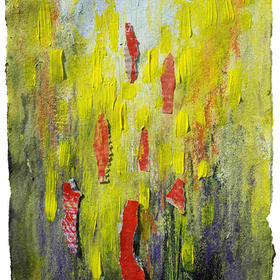
Psalm 28 by Dutch artist Wim van de Wege

I pray to you, O Lord, my rock.
    Do not turn a deaf ear to me.
For if you are silent,
    I might as well give up and die.
Listen to my prayer for mercy
    as I cry out to you for help,
    as I lift my hands toward your holy sanctuary.

Do not drag me away with the wicked—
    with those who do evil—
those who speak friendly words to their neighbors
    while planning evil in their hearts.
Give them the punishment they so richly deserve!
    Measure it out in proportion to their wickedness.
Pay them back for all their evil deeds!
    Give them a taste of what they have done to others.
They care nothing for what the Lord has done
    or for what his hands have made.
So he will tear them down,
    and they will never be rebuilt!

Praise the Lord!
    For he has heard my cry for mercy.
The Lord is my strength and shield.
    I trust him with all my heart.
He helps me, and my heart is filled with joy.
    I burst out in songs of thanksgiving.

The Lord gives his people strength.
    He is a safe fortress for his anointed king.
Save your people!
    Bless Israel, your special possession.
Lead them like a shepherd,
    and carry them in your arms forever. (New Living Translation)

The biblical character David, in frustration and agony, cried out for help, for God to hear his prayers. And, when his prayer was heard, David gave exuberant praise to the Lord for listening to him.

We are not told specifically of how that prayer was answered and what happened between the request and the response. It seems the juicy details are left out on purpose, so that maybe we would not get lost in the retribution but stick with the fact that there was a desperate need and the Lord stepped in and did something about it.

As I pondered this psalm and its lack of life-detail, I wondered about David’s situation:

Could it be that David gave God praise just for being heard by him? 

Was David cured in some way, or was he healed from the need to be healed? 

Was there even any actual deliverance that occurred? 

Did David come to praise God despite a lack of deliverance? 

Was David’s joy in his relationship with God conditional, or unconditional?

William Shakespeare’s Hamlet (c.1601 C.E.) put the question this way: “To be, or not to be, that is the question.” Hamlet’s soliloquy went on to say:

“Whether ’tis nobler in the mind to suffer
The slings and arrows of outrageous fortune,
Or to take arms against a sea of troubles,
And by opposing end them? To die: to sleep;
No more; and by a sleep to say we end
The heartache and the thousand natural shocks
That flesh is heir to, ’tis a consummation
Devoutly to be wish’d. To die, to sleep;
To sleep: perchance, to dream: ay, there’s the rub;
For in that sleep of death what dreams may come
When we have shuffled off this mortal coil,
Must give us pause: there’s the respect
That makes calamity of so long life;
For who would bear the whips and scorns of time,
The oppressor’s wrong, the proud man’s contumely,
The pangs of despised love, the law’s delay,
The insolence of office and the spurns
That patient merit of the unworthy takes,
When he himself might his quietus make
With a bare bodkin (knitting needle)?”

Hamlet, much like David of old, was miserable and burdened with a profound lack of power to change his circumstances. So, he reflects on life and death in a morbid and melancholy way. It’s not that Hamlet was contemplating suicide as much as he meditated on what life truly is and finding some meaning within it. Unlike David, Hamlet cannot find the courage to deal with his frustration and feels stymied with fear of the unknown.

If we are blatantly honest with ourselves, we must admit that far too often we have a particular outcome in mind that we want or expect God to do.  Our hopes become tethered to God doing something extremely specific so that, if it does not come to pass (or does not come quickly!) we become discouraged and disillusioned. Like Hamlet, we become lost in the shadows of our thinking and ponder some sort of escape.

So, here is another set of questions I am asking myself: 

If my adverse circumstances do not change, can I praise God anyway? 

Can I, like David, take joy in simply being heard? 

Can I find gratitude in all situations? 

Do I only express thanks and praise to God when things are going my way? 

Am I open to whatever God wants to do in my life, even if it is not what I would choose? 

Do I feel that I am above having to put up with the wickedness of this world? 

Am I expecting heaven on earth, or am I willing to suffer as Jesus did? 

I honestly believe the answers to those questions will determine the trajectory of our Christian experience. For the identity and meaning of all persons is found in the divine.

I praise you, O God, in the good and the bad, the easy and the difficult, the failures and the victories.  You are Lord over all things.  You are my strength and shield in every circumstance.  When I am weak, I am strong. I can do all things through Christ who strengthens me. Amen.

Psalm 55:1-15 – Pray as First Response

God, listen to my prayer;
    don’t avoid my request!
Pay attention! Answer me!
    I can’t sit still while complaining.
    I’m beside myself
        over the enemy’s noise,
        at the wicked person’s racket,
        because they bring disaster on me
        and harass me furiously.

My heart pounds in my chest
    because death’s terrors have reached me.
Fear and trembling have come upon me;
    I’m shaking all over.
I say to myself,
    I wish I had wings like a dove!
    I’d fly away and rest.
    I’d run so far away!
    I’d live in the desert.
    I’d hurry to my hideout,
    far from the rushing wind and storm.

Baffle them, my Lord!
    Confuse their language
    because I see violence and conflict in the city.
Day and night they make their rounds on its walls,
    and evil and misery live inside it.
Disaster lives inside it;
    oppression and fraud never leave the town square.

It’s not an enemy that is insulting me—
    I could handle that.
It’s not someone who hates me
    who is exalted over me—
    I could hide from them.
No. It’s you, my equal,
    my close companion, my good friend!
It was so pleasant when
    together we entered God’s house with the crowd.

Let death devastate my enemies;
    let them go to the grave alive
        because evil lives with them—
        even inside them! (Common English Bible)

We all likely know he modern day proverb, “The squeaky wheel gets oiled.” The saying is often used in reference to someone who is loud, even obnoxious, about what they want. 

In today’s psalm, David cannot avoid the squeaky wheel. There are people in his face and all up in his grill. The only thing we know about David’s enemies from the psalm is that they were nursing a grudge against him about something. David was hurt and betrayed.

So, David prayed. He pleaded with God to hear his prayer – to not hide from his plea for mercy. David desperately wanted the Lord to respond to his terrible plight. He couldn’t sleep. He had racing thoughts. He was hyper-vigilant. He was downright anxious. David felt the ache of people speaking against him. For whatever reason, they had an axe to grind and were determined to make David’s life difficult.

Although, like David, we sometimes feel like flying away and being at rest from the turmoil, we must deal with the insults, the false rhetoric, and half-truths of others. 

The way David confronted the problem was primarily through prayer. Whenever David prayed, it was never a quick on-the-run sort of prayer to God in the rush of dealing with all his kingly duties. Instead, David offered specific, agonizing, timely prayers, asking, even begging God to not let the violent speech and actions of his enemies prevail.

David was committed to maintaining peace, equity, and justice in the public square. In those times when injustice reared it’s ugly head, David’s first response was to pray.

Out of the range of possibilities we might do in response to slander, gossip, backbiting, threats, and general sins of the tongue against us, prayer needs to be the primary tool to face it all. Heartfelt, passionate, detailed, and pointed prayers can and must be offered to the God who hears the righteous in their grief. 

If you are in such a position of being oppressed by another, a sage way to begin addressing the situation is through praying the very same psalm that David did when he was under duress.

The biblical psalms are prayers which are meant to be prayed as our own. There is no such thing as praying them too often. It is always open season on praying the psalms for our own contemporary purposes.

The prayers are more than personal. They are public, as well. Violence, strife, iniquity, trouble, oppression, fraud, and injustice effect the entire community. Our prayers can and must include asking God to put an end to all this awful muck.

It’s one thing to have some schmuck we’ve never met make a disparaging social media comment against us, or some random persons spout baseless lies. And it’s quite another thing when it is someone close to us, a trusted friend who turns on us.

God cares about our adverse situations. Unlike fickle friends, the Lord is a faithful companion who will neither leave us nor forsake us. The New Testament affirms and encourages prayer to God in anxious times:

God cares for you, so turn all your worries over to him.

1 Peter 5:7, CEV

Jesus modeled a life of prayer in response to injustice, suffering, and belligerence.

“Into your hands I entrust my life.” (Luke 23:46, CEB)

“I don’t ask you to take my followers out of the world but keep them safe from the evil one.” (John 17:15, CEB)

May we know that loneliness is far from us. God is with us, always and forever. Amen.   

Listening God, you hear the cries of the righteous. Give ear to my plea. I cry out to you for respite from those allayed against me.  I ask for justice in my life and in the public square so that the wicked and the unrighteous do not have their way in this world, through Jesus Christ in the power of the Holy Spirit. Amen.