2 Samuel 3:1-12 – Which One Would You Follow?

The war between the house of Saul and the house of David lasted a long time. David grew stronger and stronger, while the house of Saul grew weaker and weaker.

Sons were born to David in Hebron: His firstborn was Amnon the son of Ahinoam of Jezreel; his second, Kileab the son of Abigail the widow of Nabal of Carmel; the third, Absalom the son of Maakah daughter of Talmai king of Geshur; the fourth, Adonijah the son of Haggith; the fifth, Shephatiah the son of Abital; and the sixth, Ithream the son of David’s wife Eglah. These were born to David in Hebron.

During the war between the house of Saul and the house of David, Abner had been strengthening his own position in the house of Saul. Now Saul had had a concubine named Rizpah daughter of Aiah. And Ish-Bosheth said to Abner, “Why did you sleep with my father’s concubine?”

Abner was incredibly angry because of what Ish-Bosheth said. So, he answered, “Am I a dog’s head—on Judah’s side? This very day I am loyal to the house of your father Saul and to his family and friends. I haven’t handed you over to David. Yet now you accuse me of an offense involving this woman! May God deal with Abner, be it ever so severely, if I do not do for David what the Lord promised him on oathand transfer the kingdom from the house of Saul and establish David’s throne over Israel and Judah from Dan to Beersheba.” Ish-Bosheth did not dare to say another word to Abner, because he was afraid of him.

Then Abner sent messengers on his behalf to say to David, “Whose land, is it? Make an agreement with me, and I will help you bring all Israel over to you.” (New International Version)

“Leadership is the capacity and will to rally men and women to a common purpose and the character which inspires confidence.”

World War II British Field Marshall Bernard Montgomery (1887-1976)

Our inner character is a combination of what we do, why we do it, and how we go about it. Personal character is seen in the reactions and responses of life events and situations. And Holy Scripture is concerned and attentive to all our attitudes and actions in the world.

Stories in the Old Testament are largely designed to help us, as readers and listeners, to compare and contrast the mindsets, motivations, and morals of the principal actors in those narratives. We are meant to understand the difference between godly and ungodly people through how the story shakes out.

Three leaders are paraded before us in today’s Old Testament lesson. The story is arranged so that we will take a look at their manner of life. The lesson begs us to implicitly ask: Which of the three characters would you follow?

David

King David was a true leader, having G-d’s calling, inquiring to G-d continually, and using his ruling authority to extend kindness, like G-d does. Because of David’s character, his reign became stronger and stronger. David neither planned to annihilate all of Saul’s heirs as rivals to this throne, nor did he set out to make their lives miserable – despite the fact that most people of the time would actually expect him to do that.

Ish-Bosheth

Whereas David was initially ruling only Judah, Ish-Bosheth was a son of Saul and king of Israel. He was a mere figurehead. Abner, the army’s general, was really calling the political shots in Israel. Ish-Bosheth was too fearful to challenge Abner, and so, never exerted a significant influence. Instructive for us as readers is the absence of this king’s prayers or efforts to do anything helpful or constructive for his people.

Ish-Bosheth’s name essentially means “Master,” a dignified word which is meant to communicate respect. The incongruence between Ish-Bosheth’s ascribed name, and his actual attitudes and lack of action, betrays a double-minded person, divided in decision-making, not knowing quite what to do, so doing nothing of substance which helps anyone.

Contrasting Ish-Bosheth with David, we clearly see that David is no figurehead but the leader of his people. Unlike Ish-Bosheth, David is no washrag and is no one’s puppet but takes charge of situations by inquiring of G-d, then acting.

Confidence comes from knowing the Lord and stepping out in faith, which is precisely what David’s pattern of kingship was like.

“God grant that men of principle shall be our principal men.”

Thomas Jefferson, 3rd President of the United States of America (1743-1826)

Abner

Israel’s general, Abner, was neither like David nor Ish-Bosheth. Although Abner had the qualities of confidence and taking charge, unlike David, he was a self-serving leader.

Abner used his position to gain for himself power and prestige. He was willing to quickly switch his loyalties when it was no longer helpful for him, personally. Although Abner did right by working toward uniting the kingdoms of Israel and Judah (a good thing) he did it for all the wrong reasons (a bad thing).

Compared to David, Abner has only self-interest, not the common interest of all citizens. He acts for what he can personally get out of it – which is just the opposite of David, who has an eye which scans the horizon to do what is best for the common good of all the kingdom’s subjects.

Conclusion

When we read today’s story, the guided narrative wants us to arrive at the conclusion of saying, “I don’t want to become or follow somebody like Ish-Bosheth or Abner. I want to become and follow someone like King David.”

David listened to G-d, prayed to G-d, and acted with justice and kindness because of G-d. There’s likely no better approach to the spiritual life than that.

Grant us, Lord G-d, a vision of our world as your love would make it: a world where the weak are protected, and none go hungry or poor; a world where the benefits of abundant life are shared, and everyone can enjoy them; a world where different races and cultures live in tolerance and mutual respect; a world where peace is built with justice, and justice is guided by love. And give us the inspiration and courage to build it, through Jesus Christ our Lord. Amen.

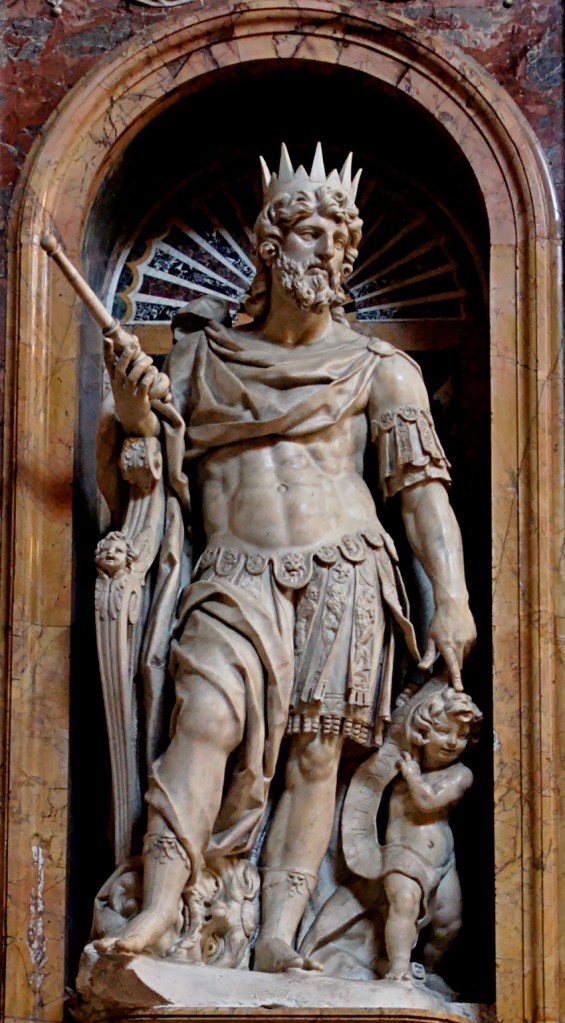
*Above statue of King David by French artist Nicolas Cordier, c.1610

Galatians 5:16-26 – Let the Spirit Guide You

“Be guided by the Spirit and you won’t carry out your selfish desires…. the fruit of the Spirit is love, joy, peace, patience, kindness, goodness, faithfulness, gentleness, and self-control. There is no law against things like this.  Those who belong to Christ Jesus have crucified the self with its passions and its desires.  If we live by the Spirit, let’s follow the Spirit.  Let’s not become arrogant, make each other angry, or be jealous of each other.” (Common English Bible)

I’m the youngest sibling in my family.  So, I know what it feels like to be a third wheel with things.  When I was a kid, it seemed as if everyone believed I was too young to do anything or engage any of the real fun stuff, like watching “Mannix,” “Sanford and Son,” or “Love American Style” past my bedtime. Although now, I understand why I couldn’t watch those shows, the fact remains, I was often a third wheel.

At times, we treat the Holy Spirit of God like some third wheel. We pray to Almighty God. We pray in Jesus’ blessed name. And what of the Holy Spirit? Seems the Spirit gets the short end of the stick, getting treated like a younger sibling in the Trinity family. In fact, I’ve been in some churches where it seems their understanding of the Trinity is Father, Son, and Holy Bible – the Spirit is nowhere to be found.

Truth is, we never quite know what the Spirit might do. Heck, we aren’t even sure what pronoun to use for the Holy Spirit. It? He? She? They?  Because the Spirit seems so mysterious and ethereal, because the Spirit is so unpredictable, we send he/she/it off to some metaphorical bedtime so that we can watch TV and do whatever we want. 

Or perhaps we really are diligent about the Christian life. We strive, work, and wrestle to live a good life. Yet, somehow, we far too often fall short and feel like a failure. Why is that?

Could be that we’ve looked at the Holy Spirit as the third wheel. We believe in the Spirit. We have faith the Spirit is there. Yet, we don’t have any idea how to relate. God is big and sovereign. And Jesus has a real body and blood. But the Spirit? Well, the Spirit’s out there, man – like, too cool for school, or like one of the characters on “The Mod Squad,” or something. 

How do you have a relationship with someone or something (many often refer to the Spirit as a “thing”)? How do we relate with a person (after all, the Spirit is fully a person) who is so crazy and seemingly other than you and me?

The Holy Spirit is the power source of the Christian life.  Without the Spirit, we can easily degenerate into all kinds of illicit thinking and behavior – including immorality, moral corruption, doing whatever feels good, idolatry, substance abuse, casting evil spells, hate, fighting, obsessive behaviors, violent anger, competitive opposition, conflict, selfishness, group rivalry, jealousy, drunkenness, or living for the party.

It is the Spirit who helps, comforts, provides strength, and enables us to replace old habits with new ones, and dead practices with solid spiritual action. The Christian virtues which flower and produce the fruit of love, joy, peace, patience, kindness, goodness, faithfulness, gentleness, and self-control occur through a close intimate relationship with the Holy Spirit. 

The Spirit helps us in our weakness when we pray and act.  The Christian enjoys such a close affectionate association with the Holy Spirit that it is as if we are a like a sacred temple with the person of the Spirit taking up residence within. 

By means of the Holy Spirit, God is always with us and continually, at this moment, working within us to make our redemption in Christ an actual real-live encounter. In other words, the Spirit gives us feet to walk among this world, armed with the implement of God’s love.

I’m going to make a simple observation about our New Testament lesson for today. All the spiritual virtues mentioned are the “fruit” of the Spirit, not “fruits.”  The nine ethics are a package deal.  When you have the Spirit and spiritual fruit, you possess all nine Christian values. 

If we look at the list and say something like, “Well, I’m pretty good at kindness and goodness, but I don’t have much peace or patience,” what that really means is that we are probably doing kindness and goodness from a different place than by means of the Holy Spirit. Because when the Spirit is manifested in us, we exhibit spiritual fruit. We cannot separate the nine spiritual virtues any more than we can separate the Trinity. They’re all one spiritual fruit, cultivated and produced within the inner person by the agency of God’s Spirit.

Maybe we need to consider the shadow side of our lives. It could be that, for example, we are far more driven by our anxiety about most things than about genuine altruism and love. The results of our actions and words might look the same, but the motivation might be far from truly altruistic. It simply will not last if our actions are generated from a place of worry – because it is not of the Spirit.

So, what to do about it?  We must mortify (put to death) the deeds of the sinful nature. You have been crucified with Christ and you no longer live but Christ lives in you by means of the Spirit He has given to us (Galatians 2:20).  If we have C-clamped our hearts so tight that the Spirit cannot get in, then it’s high time to loosen the grip and enable God to do some gracious and merciful work within us.  It’s the only way to experience genuine transformation of life.

The spiritual life can be scary. Letting go of control is hard for many people, including me. But the results are worth it. The Spirit is competent. The Holy Spirit might work in wild and crazy ways and might show up on “Saturday Night Live” where you least expect to discover her.

Jesus said that the work of God is to believe in the one he sent (John 6:29). The Spirit always points us to Christ, the one who has delivered us from the realm of sin and brought us forgiveness. This work of Christ enables the work of the Spirit, who now makes our deliverance a practical reality in daily life.

The Holy Spirit is not a third wheel, but the real deal. Whenever we open our hearts to the Spirit, we experience the wideness of God’s mercy. And when the Spirit is working inside of us, it makes the car chase scenes in “The Streets of San Francisco” look a lot less dramatic.

May the Spirit of the living God be with you now, and forever.  Amen.

Psalm 51:1-12 – Facing Our Darkness

Photo by cottonbro on Pexels.com

Have mercy on me, O God,
    according to your steadfast love;
according to your abundant mercy
    blot out my transgressions.
Wash me thoroughly from my iniquity,
    and cleanse me from my sin.

For I know my transgressions,
    and my sin is ever before me.
Against you, you alone, have I sinned,
    and done what is evil in your sight,
so that you are justified in your sentence
    and blameless when you pass judgment.
Indeed, I was born guilty,
    a sinner when my mother conceived me.

You desire truth in the inward being;
    therefore teach me wisdom in my secret heart.
Purge me with hyssop, and I shall be clean;
    wash me, and I shall be whiter than snow.
Let me hear joy and gladness;
    let the bones that you have crushed rejoice.
Hide your face from my sins,
    and blot out all my iniquities.

Create in me a clean heart, O God,
    and put a new and right spirit within me.
Do not cast me away from your presence,
    and do not take your holy spirit from me.
Restore to me the joy of your salvation,
    and sustain in me a willing spirit. (NRSV)

David experienced a lot of hard things. Through it all, he held fast to walking with God. Eventually, David became king. He used his power and authority to do exactly what God likes – showing grace and kindness to those in need. Except in the case of Bathsheba, another man’s wife. He made one unwise decision, which led to a bad decision, and then to another and another – until the prophet Nathan came and called David on the carpet.

Whereas King David began his reign using his royal position to show kindness, he ended up acting like any other worldly king by giving orders and using his authority to get what he wanted. Just as David sent others to do his personal bidding, God finally sent Nathan for a divine intervention.

If we confess our sins, God will forgive us. We can trust God to do this. He always does what is right. He will make us clean from all the wrong things we have done.

1 John 1:9, ERV

Nathan wisely helped David see his sin for what it really was. Irresponsibility, adultery, and murder are serious matters. The mental and spiritual gymnastics people make to justify their poor decisions always ends up devaluing what is right and making sin less heinous than it really is.

Good news can only be properly understood considering the bad news.

Without seeing our true predicament of being held in the vice grip of sin and unable to move, we will go on wondering why nothing ever goes like we want. A person who is lost, and doesn’t know it, is in the worst of situations. Calamity is just around the corner.

Like a restaurant owner who fails to see the health violations all around him, the business is about to be shut down with him scratching his head or blaming others for his misfortune. Only when the owner comes to recognize and agree with established health standards will there be a turn around and a renewed existence for the establishment.

We must agree and comply with God about how bad things really are without sugar coating any of it.

Only then can best practices be put into place which help everyone to be safe, healthy, and happy. To King David’s credit, he saw his terrible decisions and actions for what they were and faced them squarely with a repentant heart and a renovated life.

Thus, we have today’s psalm, crafted by David as a response to his own egregious wandering from how God wanted him to reign as king. David’s sin was mercifully outdone by God’s grace. The main event to the psalm is not David’s wrongs but God’s forgiveness. Prayer is the mechanism which accesses divine pardon to even the most awful of transgressions.

The appropriate posture of the devout Christian is to pray.

Specifically, to confess our great and many sins, shortcomings, and moral failures. This might sound negative and a major downer. Yet, to not look evil square in the face and call it out for what it is, is at best denial, and at worst, allows a bitter seed of unforgiveness to gestate in the depths of your soul. 

I believe one of the best ways to confront the darkness within is by using the ancient prayer book, the Old Testament Psalms. Sometimes when we pray apart from considering the psalms, our prayers go along the lines of something like, “Change my situation so I can praise you, God.” Rather, the psalms guide us toward a shift in direction by praying:

“Change me, God, because I am the problem.”

I encourage you to pray Psalm 51 out loud, slowly, with a generous amount of emotional flavor – even, and especially, if you don’t feel like it. Pray it over more than once, and perhaps several times punctuated throughout the day today. In doing so, you will be joining the faithful across the world who today offer God a prayer of subversion against the blackness on this earth.

What places in your life allow you the freedom to confess your sins?  What places seem to keep you from confession? How might a regular practice of repentance help you beyond this season of Lent?

May almighty God, who has promised forgiveness of sins to all who turn in faith, pardon you and set you free from all your sins, strengthen you for right living, and keep you in eternal life, through Jesus Christ our Lord. Amen.

Romans 2:1-11 – Against Condemning Others

You, therefore, have no excuse, you who pass judgment on someone else, for at whatever point you judge another, you are condemning yourself, because you who pass judgment do the same things. Now we know that God’s judgment against those who do such things is based on truth. So, when you, a mere human being, pass judgment on them and yet do the same things, do you think you will escape God’s judgment? Or do you show contempt for the riches of his kindness, forbearance, and patience, not realizing that God’s kindness is intended to lead you to repentance?

But because of your stubbornness and your unrepentant heart, you are storing up wrath against yourself for the day of God’s wrath, when his righteous judgment will be revealed. God “will repay each person according to what they have done.” To those who by persistence in doing good seek glory, honor, and immortality, he will give eternal life. But for those who are self-seeking and who reject the truth and follow evil, there will be wrath and anger. There will be trouble and distress for every human being who does evil: first for the Jew, then for the Gentile; but glory, honor and peace for everyone who does good: first for the Jew, then for the Gentile. For God does not show favoritism. (NIV)

The Apostle Paul, writing to the Church at Rome, merely upheld the teaching of his Lord Jesus, who said:

“Do not judge, so that you may not be judged. For with the judgment you make you will be judged, and the measure you give will be the measure you get.” (Matthew 7:1-2, NRSV)

Although most people would affirm that showing favoritism is a bad thing, in practice we have a difficult time avoiding it – especially in an election season, like the one in the United States. Political mudslinging is (unfortunately) a time-honored American tradition. And so is religious judgmentalism.

Some of the most emotionally laden vitriol comes from folks who are so heavily entrenched in their religious convictions that they believe any deviation from their way of belief is worthy of scathing criticism.

People, however, do not change because someone criticizes or judges them. They experience transformation through basic divine and human kindness. As a hospital chaplain in a behavioral health unit, I affirm this to be true. Many patients have been told repeatedly by family or friends to stop doing something, get with it, move on, wake up, etc. – all with the condescending edge of judgment. Yet, when someone takes notice, is curious about them, offers helpful encouragement and a listening ear without trying to fix, souls become open to receiving the healing grace of love and truth.

God shows no partiality, and neither should we. God is right, just, and fair in all dealings with everyone. The Lord judges according to divine standards of righteousness and mercy, no matter one’s race, ethnicity, gender, economic status, or social standing. And it is all laced with the love and compassion of Christ.

Christians are not exempt or given a pass on being judgmental. Our own unhealthy practices, bad habits, and angry outbursts will be treated just like any non-Christian by God. In a time when decrying the moral condition of our world is nearly a spectator sport, the New Testament lesson for today reminds us that we must first be concerned for the condition of our own hearts before we can point the finger at another.

We all equally stand in need of God’s grace in Jesus.  There is a symbiotic relationship between our actions and the state of our hearts.  A soft and tender heart toward God leads to obedience; disobedience hardens the heart and leads to God’s wrath, no matter the individual.

So, it will help if we all faithfully engage in daily spiritual practices which keep our hearts attentive and alert to God’s will and way.  No matter how busy we are, or how we feel, to forego or ignore the Word of God and prayer on a regular basis will slowly calcify our hearts and render them unable to respond rightly to grace.  Instead, we can drink deeply of the gospel throughout every day so that we may experience peace.

Judgmentalism, favoritism, and cronyism all begin to melt away when we pick up the tools of empathy, compassion, understanding, and acceptance – using them to forge connections and supportive encouragement. It takes little to no practice to bludgeon someone with condemning criticism. However, it takes repeated practice to speak and act with grace, mercy, and peace, especially when we are stressed and/or anxious about our surrounding circumstances.

Instead of judgment, observe and be curious. Seek more information. Expand the gap between observation and conclusion. The ability to have an awareness of one’s own emotions, to be mindful of self and surroundings, and to do it all with neither criticism nor judgment is perhaps the highest form of intelligence and spirituality.

It is kindness which leads others to repentance, not condemnation. Grace has the final word, not judgment. So, let us be blessed through a gentle spirit which spreads the goodness of God throughout the world.

O God, thank you for the gift of prayer and the grace of your Word.  May it seep deep down into my heart so that I am compassionate and kind, just like Jesus.  Amen.