On the Importance of Hospitality (3 John 9-12)

A mosaic of the Apostle John, at the Monastery of St. John the Theologian, in Patmos, Greece

I have written something to the church, but Diotrephes, who likes to put himself first, does not welcome us. So if I come, I will call attention to what he is doing in spreading false charges against us. And not content with those charges, he refuses to welcome the brothers and sisters and even prevents those who want to do so and expels them from the church.

Beloved, do not imitate what is evil, but imitate what is good. Whoever does good is from God; whoever does evil has not seen God. Everyone has testified favorably about Demetrius, and so has the truth itself. We also testify for him, and you know that our testimony is true. (New Revised Standard Version)

I believe in an egalitarian world. Ideally, humanity is meant to live in equity with one another. Humility, meekness, and gentleness are to be the inner dispositions of a person’s life.

These virtues work themselves out in being concerned for the common good of all, laboring toward just and righteous ways of living for everyone and sharing our lives, as well as our resources, with each other. Viewing one another as equals inevitably leads to gracious hospitality.

However, in a world of power disparities, and privileged inequities, are attitudes of seeking attention, a perceived need to always win and be first, and tight-fisted control of authority and money. The common good of all persons is scaled back to be the concern for the common good of some. There is a failure to regard the weak, poor, and vulnerable as legitimate members of the community.

The Apostle John wrote his short succinct letter in a concern that the church may be following a leader who was taking them down a bad path – a road leading to injustice where power and privilege remain with a few, and perhaps even one. John’s plainspoken exhortation was to judge rightly between what is good and bad, and then imitate the good while forsaking the bad.

Hospitality is the true litmus test between the good and the bad.

An openness to the stranger, the immigrant, the migrant, the alien, the foreigner, the newcomer, and the outsider characterizes authentic fellowship.

Being closed to such persons and having a xenophobic bent to others who are different is the mark of unwelcoming and inhospitable people.

Hospitality serves others, whereas being inhospitable cajoles others to serve our needs.

Jesus, the Lord of all, did not come to this earth for people to serve him. Christ came to serve others, and to give his life to save many people (Matthew 20:28; Mark 10:45; John 13:1-17). We are to imitate the loving service and radical hospitality of the Lord Jesus. He is our example. We are to imitate Christ.

We must have both orthodoxy (right belief) and orthopraxy (right practice). Both go together like a hand in a glove. Good actions are the result of good and proper beliefs. The following are some thoughts about this nexus between belief and practice:

  • Hospitality (literally “love of the stranger”) is a way of life fundamental to orthodox Christianity, based in the person and work of Jesus
  • God is hospitable and loves the outsider, welcoming them into the dance of the Trinity, and provides for them; our human hospitality is to reflect this divine welcome
  • Hospitality means extending to another a kindness typically reserved for family or friends
  • The teaching of the New Testament emphasizes the practice of hospitality (Luke 14:12-14; Matthew 25:31-46)
  • The consistent witness of church history is to lift up and hold Christian hospitality.

“Whatever person you meet who needs your aid, you have no reason to refuse to help them.”

John Calvin

This was no mere theoretical advice for Calvin, whose ministry center of Geneva, Switzerland swelled with French Huguenot refugees fleeing persecution. Calvin, always the theologian, grounded his understanding of hospitality in the divine:

“We should not regard what a person is and what they deserve but we should go higher – that it is God who has placed us in the world for such a purpose that we be united and joined together. God has impressed the divine image in us and has given us a common nature, which should incite us to provide one for the other.”

John Calvin
  • Hospitality is a practice which integrates both respect and care. St. John Chrysostom warned his congregation to show “excessive joy” when offering hospitality to avoid shaming the recipient of care.
  • Biblical hospitality does not need to know all the details of someone’s life before extending care. If Christ forgave and healed those who injured him, how could we neglect even a starving murderer? 
  • True hospitality involves a face-to-face relationship of encouragement and respect – not just a distant giving of alms. Hospitable persons pay attention to others and share life with them.
  • The great twin concerns of hospitality are universalizing the neighbor and personalizing the stranger. One reason why many of the rich have little sympathy for the poor is because they seldom visit them. Hospitality depends on us recognizing our commonalities with strangers rather than our differences.
  • This is how we evaluate our hospitality: Did we see Christ in them? Did they see Christ in me?

Hospitable God:

Give us eyes to see the deepest needs of people.

Give us hearts full of love for our neighbors as well as for the strangers we meet.

Help us understand what it means to love others as we love ourselves.

Teach us to care in a way that strengthens those who are sick.

Fill us with generosity so we feed the hungry, clothe the naked, and give drink to the thirsty.

Let us be a healing balm to those who are weak and lonely and weary by offering our kindness to them.

May we remember to listen, smile, and offer a helping hand each time the opportunity presents itself. And may we conspire to create opportunities to do so.

Give us hearts of courage to risk loving our enemy.

Inspire us to go out of our way to include outsiders.

Help us to be welcoming and include all whom you send our way.

Let us be God’s hospitality in the world. Amen.

The Gentle King (Matthew 21:1-11)

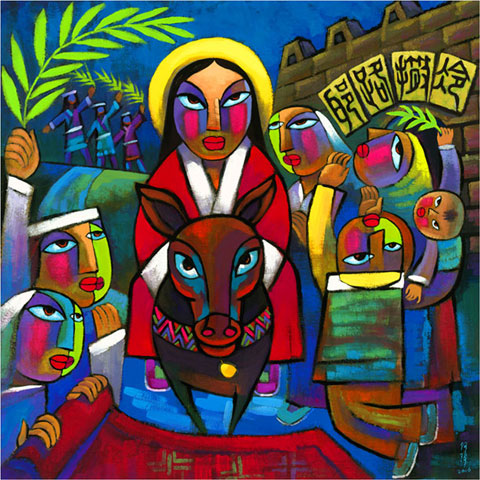
The Triumphal Entry, by He Qi

As they approached Jerusalem and came to Bethphage on the Mount of Olives, Jesus sent two disciples, saying to them, “Go to the village ahead of you, and at once you will find a donkey tied there, with her colt by her. Untie them and bring them to me. If anyone says anything to you, say that the Lord needs them, and he will send them right away.”

This took place to fulfill what was spoken through the prophet:

“Say to Daughter Zion,
    ‘See, your king comes to you,
gentle and riding on a donkey,
    and on a colt, the foal of a donkey.’”

The disciples went and did as Jesus had instructed them. They brought the donkey and the colt and placed their cloaks on them for Jesus to sit on. A very large crowd spread their cloaks on the road, while others cut branches from the trees and spread them on the road. The crowds that went ahead of him and those that followed shouted,

“Hosanna to the Son of David!”

“Blessed is he who comes in the name of the Lord!”

“Hosanna in the highest heaven!”

When Jesus entered Jerusalem, the whole city was stirred and asked, “Who is this?”

The crowds answered, “This is Jesus, the prophet from Nazareth in Galilee.” (New International Version)

A Humble Leader

Gentle humility and strong leadership are not mutually exclusive concepts. They can and should co-exist together.

Los Angeles County traffic cops receive plenty of complaints about their work. After all, most motorists don’t think they deserve a ticket. Each complaint gets documented and placed in the officer’s personnel file. One officer, however, Deputy Sheriff Elton Simmons, made 25,000 traffic stops over a span of 20 years, without a single complaint on his record.

When his supervisor started looking through Simmons’ file, he was stunned to find plenty of commendations, but not a single complaint. It was so unusual, that a CBS News crew was assigned to follow Simmons in an attempt to learn his secret. They described Deputy Simmons as having a “pitch-perfect mix of authority and diplomacy” without a trace of arrogance or self-righteousness.

Although handing out plenty of tickets, they never came with a guilt trip.  Deputy Simmons described his mentality: “I’m here with you. I won’t look down at you.” 

One driver who got a ticket from Simmons said, “It’s his smile. How could you be mad at that guy?”  “Apparently, you can’t,” concluded the CBS News team. “Time after time, ticket after ticket, we saw Officer Simmons melt away a polar ice cap of preconceptions.”

A Meek Celebrity

As Jesus entered Jerusalem for the last week of his life, he was at the height of his fame. Christ’s teaching and healing ministry touched thousands of people. Jesus was the most famous celebrity to come into town since David captured the city a thousand years before. 

But Jesus did not ride into Jerusalem as a great and mighty warrior who conquered Jerusalem in a military battle. There is coming a time, at the end of the age, when Jesus will take on this role, but that was not his purpose on this occasion. 

Hosanna in the Highest, by Malaysian artist Hanna-Cheriyan Varghese

One of the challenges for people in every era is to properly balance scriptural truth. Many Jews emphasized King David’s victories in battle, and his great political dynasty, and so, tended to overlook that David was also a humble servant. 

King David showed steadfast love and kindness to his subjects and submitted himself to God in such a way that, even with opportunities to seize the kingship from Saul who was trying to take his life, he left vengeance to God alone.

Christ’s triumphal entry portrays Jesus as King, the Son of David, but as a gentle king. He embodied both powerful authority and gentle humility. Jesus wanted the crowd to understand that he was not like most kings – he was a lowly king. 

Jesus as a meek celebrity seemed so odd that many people saw that combination of gentle authority as being wishy-washy. Jesus didn’t fit any of the typical labels that people expected. They wondered, “Is he a Pharisee? Or a Zealot? What’s his position on the Romans?  How is he going to lead us out from under Gentile rule?” There was lots of anxiety and concern over Jesus; the people could not nail down exactly what kind of guy he was.

A Servant Pastor

Over the years, as a Pastor, many people have wanted to label me as something, but have had a hard time doing it. Am I liberal or conservative? liturgical or non-liturgical? open or closed to particular people or groups? e.g. LGBTQ folks, Black Lives Matter, etc.

The problem with all this is that it assumes you cannot be both, as if life is all either/or, instead of both/and. It makes ministry about choosing sides, instead of breaking down barriers.

Meekness and strength, gentleness and authority, humility and leadership, grace and truth, love and anger, are all meant to be together – not compartmentalized in sequestered ghettos of the mind.

Jesus sought to hold kingly authority and divine righteousness together, at the same time, all the time. Christ came into Jerusalem to face the cross and take upon himself the sin of the whole world. He came as a gentle king.

Yet, many people do not want this kind of leader because they think leadership is all about power – taking charge with strong authority, telling people what to do, and controlling every aspect of the realm.  

Jesus, at times, acts like a decisive and absolute authority. He knocks over the tables of the money changers in the temple, curses fig trees, and refuses to answer direct questions. But then he turns around and goes against the people’s expectations of him as a leader by riding on a lowly donkey, inviting tax collectors and prostitutes to join him, going after the lost, and embracing the least persons in society.

A Donkey Lord

Jesus displayed a combination that seemed confusing and wishy-washy to many. Christ is both sovereign lord, and humble servant. Jesus riding on a donkey seemed a strange fusion of authority and humility. 

On the one hand, a donkey was the beast of burden for most working class poor people. Donkeys are ordinary, and not like war horses. Kings didn’t ride into conquered cities on donkeys. But, on the other hand, the donkey is also linked to Messiah’s power and authority.

Rejoice, rejoice, people of Zion!
    Shout for joy, you people of Jerusalem!
    Look, your king is coming to you!
He comes triumphant and victorious,
    but humble and riding on a donkey—
    on a colt, the foal of a donkey.

The Lord says,

“I will remove the war chariots from Israel
    and take the horses from Jerusalem;
    the bows used in battle will be destroyed.
Your king will make peace among the nations;
    he will rule from sea to sea,
    from the Euphrates River to the ends of the earth.” (Zechariah 9:9-10, GNT)

Jesus is the ultimate leader who uses his authority for the benefit of others, to bring peace. Jesus did not use his authority to consolidate power and squish enemies, but instead, gave his life so that others might live. 

Gentle and meek does not mean being a washrag or a limp noodle. Rather, it means to have power under control, e.g. a broke horse; it is power for useful purposes to serve people, not like other kings who were concerned with getting, consolidating, and keeping power, at all costs.

Jesus is the crucified Messiah; the modest leader; the lowly Lord; the God Man. We must hold it all, not emphasizing one aspect above another, so that we have the complete picture of Christ.

A Gracious Royal

Believers and followers of Jesus are royal children of the King. That means we live in the way of Jesus by bestowing grace to others. What does this “look like?”

  • In our families, Christian parents do not merely bark orders at kids, but love and support them by humbly and gently coming alongside and helping. 
  • In our neighborhoods, Christian citizens pray for the welfare of their neighbors, even and especially the ones who we may not like very well.   
  • In our work, Christian workers use their skills and abilities to serve others, transforming what we do from a secular job to a sacred vocation. 
  • In our daily life, Christians scan the horizon to seek people whom we might show God’s kindness, instead of just waiting for something to fall into our laps, if it ever does.

A Talking Donkey

From the Old Testament, we know that donkeys can talk (Numbers 22:21-38). If Christ’s donkey could speak, I imagine him saying: 

“King Jesus, why did you choose a lowly donkey like me to carry you to ride in your parade? Didn’t you have a friend who owned a horse – a spirited royal mount, fit for a king to ride? Why choose me, a small unassuming beast of burden, trained to plow and not to carry kings?”

It is a privilege to be a Christian. Perhaps you will say: 

“King Jesus, why did you choose me, a lowly unimportant person to bear you in my world today? I am poor and unimportant, trained to work, and not to carry kings – let alone the King of kings; and yet, you’ve chosen me to carry you in triumph in this world’s parade. King Jesus, keep me humble, so everyone may say, ‘Blessed is he who comes in the name of the Lord,’ and not ‘what a great Christian he is.’”

God of all, you gave your only begotten Son to take the form of a servant, and to be obedient, even to death on a cross: give us the same mind that was in Christ Jesus that, sharing in his humility, we may come to be with him in his glory, who lives and reigns with you and the Holy Spirit, one God, now and forever. Amen.

Remember the Poor and Needy (Deuteronomy 24:17-25:4)

Harvest in Provence by Vincent Van Gogh, 1888

Do not deprive the foreigner or the fatherless of justice or take the cloak of the widow as a pledge. Remember that you were slaves in Egypt and the Lord your God redeemed you from there. That is why I command you to do this.

When you are harvesting in your field and you overlook a sheaf, do not go back to get it. Leave it for the foreigner, the fatherless and the widow, so that the Lord your God may bless you in all the work of your hands. When you beat the olives from your trees, do not go over the branches a second time. Leave what remains for the foreigner, the fatherless and the widow. When you harvest the grapes in your vineyard, do not go over the vines again. Leave what remains for the foreigner, the fatherless and the widow. Remember that you were slaves in Egypt. That is why I command you to do this.

When people have a dispute, they are to take it to court and the judges will decide the case, acquitting the innocent and condemning the guilty. If the guilty person deserves to be beaten, the judge shall make them lie down and have them flogged in his presence with the number of lashes the crime deserves, but the judge must not impose more than forty lashes. If the guilty party is flogged more than that, your fellow Israelite will be degraded in your eyes.

Do not muzzle an ox while it is treading out the grain. (New International Version)

In an ideal world, we would all use our common inner sense of justice, fairness, and kindness; we would pay attention to our conscience. Yet, as you and I know all too well, we are far from living in an idyllic setting.

Instead, we live in a fundamentally broken world – complete with injustice, disagreements, disputes, petty squabbles, and blatant insensitivity to others.

It seems we shouldn’t have to be told how to concern ourselves for the common good of all persons; yet that’s exactly what needs to happen. So, the Lord made it plain what the expectations are for meeting societal needs. And it’s already inside of us; we just need to recognize it’s there, tap into it, and obey our better angels.

The Lord expects:

  • No favoritism, cronyism, and isolationism. Immigrants, foreigners, and folks different from us are to be treated with equal justice and sensitivity. Cliques which are hawkish about keeping certain persons out of their group is mostly selfish and sometimes mean-spirited; and it’s always a sort of discrimination which God expects us to avoid.
  • Attention to the poor among us. In the ancient world, and still is some parts of our world today, when the crops are harvested, the needy would tag behind the harvesters in order to pick up what was left behind. Basic human kindness tells us that not only do we let them do this, but we also purposely leave a bit for them to get for themselves and their families. In our modern era, practices of exorbitant interest and unfair housing need to be replaced with concern for the less fortunate. Wealth is meant to be shared, not hoarded. To not do so is to steal from the poor.
  • Punishments which fit the crime. Inequitable societies are rife with kangaroo courts and unjust laws which favor a particular group of persons. It’s humiliating for a minority prisoner to serve a much longer sentence than a person who is in the majority of society… and we wonder why some folks are so angry sometimes. Good grief.
  • Inclusion. Concern for the common good of society doesn’t exclude folks we don’t like or don’t understand. The reason we are not to “muzzle an ox while its treading out the grain” is that they’re doing a job and they don’t need any hindrances to their work. Placing restrictions or extra rules on one group over another just because of race, ethnicity, religion, gender, or class is sinfully exclusionary.

The bottom line is that God cares about persons trapped in poverty. 

In the Old Testament, there are seven different words for the “poor.” The range of meanings includes those who are poor because of laziness, those born into poverty, those who are poor because of inhuman oppression or slavery, simple beggars, and the pious humble poor – who have no choice but to put their trust in God because of their grinding poverty.

The Law was quite clear about how to treat the poor:

Since there will never cease to be some in need on the earth, I therefore command you, “Open your hand to the poor and needy neighbor in your land.” (Deuteronomy 15:11, NRSV) 

The mistreatment, exploitation, and just plain inattention to the poor and needy were a chief reason God sent the prophets to Israel: 

Listen to me, you who walk on helpless people,
    you who are trying to destroy the poor people of this country, saying,
“When will the New Moon festival be over
    so we can sell grain?
When will the Sabbath be over
    so we can bring out wheat to sell?
We can charge them more
    and give them less,
    and we can change the scales to cheat the people.

We will buy poor people for silver,
    and needy people for the price of a pair of sandals.
    We will even sell the wheat that was swept up from the floor.”

The Lord has sworn by his name, the Pride of Jacob, “I will never forget everything that these people did. (Amos 8:4-7, NCV) 

The major theme of Deuteronomy is remembering. Don’t ever forget where you came from so that the memory of your past helps shape what kind of person you are in the present.

We must be reminded that it is the poor in spirit who enter the kingdom of heaven, not the proud spirit who forgets the poor. 

The humble person offers grace to people who cannot offer her something in return. It’s one thing to be merciful to people who will turn around later and scratch our backs. But it’s an altogether different thing to show mercy, regardless of whether they can pay you back. 

We are to speak and act with mercy to all persons, without prejudice. 

Eventually, an idyllic world will come. Until that time, we are to speed its coming by showing basic human kindness and compassion to the least among us.

Lord God, you give honor to the least, those who are forgotten, overlooked and misjudged. You came to give first place to the last, those left behind, misunderstood and undervalued. You came to give a warm welcome to the lost, those who are orphaned, abandoned and destitute. Help us to be your ears to listen to their cries; your voice speaking out love and acceptance; your feet walking beside those in need; and your hands to clothe, feed and shelter them. Lord, in your mercy, hear our prayer. Amen.

Obey with Integrity and Love (Psalm 15)

God, who gets invited
    to dinner at your place?
How do we get on your guest list?

 “Walk straight,
    act right,
        tell the truth.

“Don’t hurt your friend,
    don’t blame your neighbor;
        despise the despicable.

“Keep your word even when it costs you,
    make an honest living,
        never take a bribe.

“You’ll never get
blacklisted
if you live like this.” (The Message)

Nearly all of us had to work hard to get good grades in school. Each schoolyear began with a blank slate; then, what we did with learning the lessons determined the grade.

So, it’s unthinkable for many of us to consider that we all begin God’s school with A’s. We’re all 4.0 students. There’s only a lower grade if we neglect to do the things necessary as an A student. And, as it turns out, the most important things are a matter of basic human kindness and respect for others.

At the end-of-the-year banquet, awards are given. If we’ve done what’s expected, then the invitation to come to the front and receive the award is assured.

Yet, if anyone has gone out of their way to be deliberately stupid and ignore what’s right, then they aren’t going to show up at the banquet. They’ll dismiss it as a waste of their time and blabber about how they don’t be around a bunch do-gooder pricks and Abe Lincoln’s, blah-blah-blah.

Integrity, honesty, kindness, accountability, and commitment matter. Virtue shows itself through the practice of obedience.

We might get hung up on obedience for a few reasons:

  1. Many Westerners, especially Americans, have a strong anti-authoritarian strain; obedience smacks them as something negative. For some, they would rather stick-it-to-the-man than obey. Even Christians might sacralize their disobedience by linking obedience to law – as if gospel and obedience are antithetical.
  2. A lot of people have been personally hurt because they tried to do the right thing by obeying their authorities, but it ended badly. Now, they aren’t so sure about the whole obedience thing.
  3. We just plain don’t want anyone else telling us what to do and not do; and that includes not wanting to obey God. So, we focus on the freedom to do what we want, to the exclusion of obedience.

Yet, there’s no way to get around the pervasive reality of obedience to Torah, to Yahweh. Obedience is both the glue which holds a people together, as well as the major means of expressing love to God and others.

Jesus said, “If you love me, obey my commandments.” (John 14:15, NLT)

Love and obedience go together in Holy Scripture like a hand in a glove. Jesus insisted that upholding Torah and loving others is by obedience to divine commands.

When Jesus first began his teaching and healing ministry, he sat all the people down who were following him and gave them a summary of the Old Testament understanding of God’s righteousness. These are the things, Jesus explained, that characterize a person who loves God:

Blessed are the poor in spirit, for theirs is the kingdom of God. 

Blessed are those who mourn, for they shall be comforted. 

Blessed are the meek, for they will inherit the earth. 

Blessed are those who hunger and thirst for righteousness, for they will be filled. 

Blessed are the merciful, for they will be shown mercy. 

Blessed are the pure in heart, for they will see God.  Blessed are the peacemakers, for they will be called sons of God. 

Blessed are they who are persecuted for righteousness, for theirs is the kingdom of God (Matthew 5:12-17, NIV).

Obedient believers are characterized by their:

  • Authentic humility
  • Deep concern over sin, to the point of tears
  • Gentle and meek spirit toward others
  • Intense desire for personal righteousness and corporate justice
  • Daily life of mercy, purity, and peacemaking
  • Willingness to accept adversity as part of the spiritual life

“Love the Lord your God with all your heart and with all your soul and with all your mind. This is the first and greatest commandment. And the second is like it: Love your neighbor as yourself.”

Jesus (Matthew 22:36-40, NIV)

Humanity is meant for wholeness, integration, and alignment of head, heart, and gut – with the glue of obedient love. We are designed to have all of life in parity and balance – work, play, family, and faith – because God is Lord of it all, not just the spiritual parts.

Historic confessional Christianity acknowledges that obedience is both duty and delight – and they go together in perfect harmony.

Believers consider it a both a high charge and a wonderful privilege to love the Lord with a life devoted to obeying divine commands.

It’s just that sometimes we have our lives so planned and pre-determined that when God’s Spirit shows up to take us to a place of obedience, we struggle to realize what’s happening. And we miss what the Lord is doing in this world. 

At other times, we read scriptural commands and feel the gentle nudging of God’s Spirit, yet we either cannot or will not respond out of fear, busyness, or grief. 

Then there are times in which we are attentive to God’s Word and Spirit, seeking to obey – only to mess up and fail at it. It can leave us wondering if God could ever really do anything in or through us.

The truth is this: Love conquers all. Grace overcomes everything. Mercy never fails.

We are here on this earth because of how much the Lord is devoted to us. Even though we often walk the spiritual road in a three-steps-forward-two-steps-backward kind of way, God accommodates to our weakness. 

So, we keep learning the ways of the Lord under the tutelage of God’s Spirit – who patiently and powerfully works within us so that God’s kingdom breaks into this world and God’s will is done on earth as it is in heaven.

Blessed God, I seek not my own will but to fulfill your will in my everyday life. Enable me and strengthen me for this sacred duty and delight, in the power of your Spirit. Amen.