The Parable of the Persistent Widow (Luke 18:1-8)

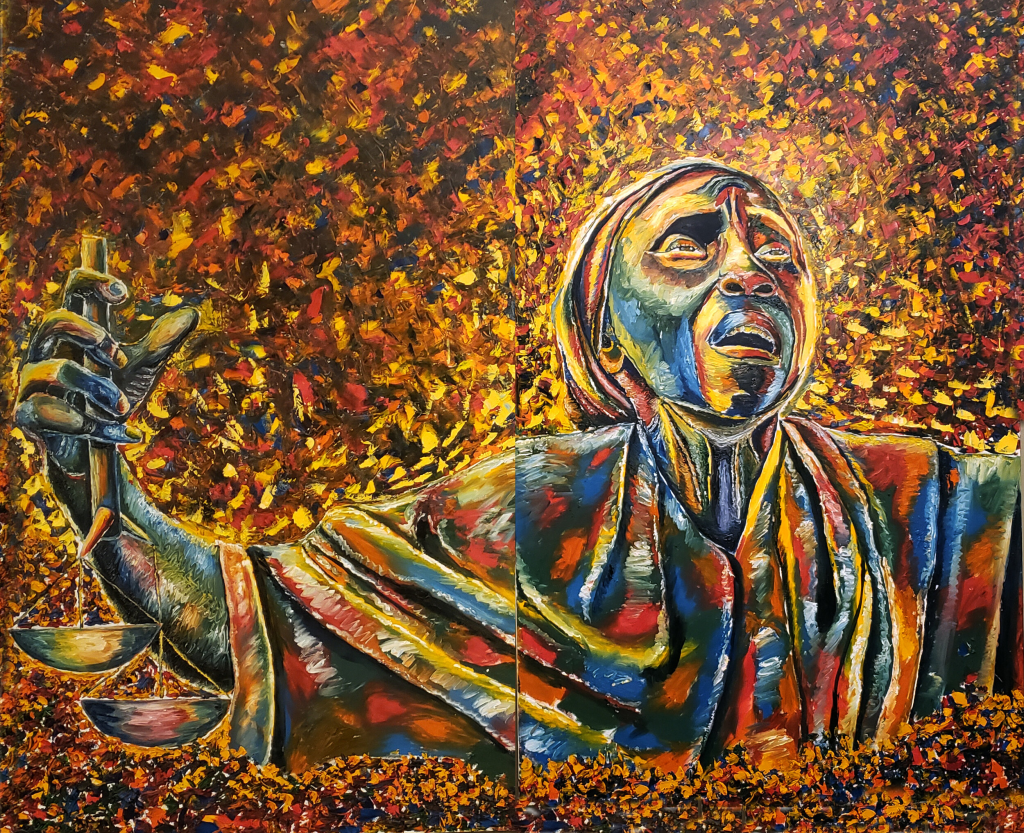
“The Persistent Widow” by Ronnie Farmer, Jr.

Then Jesus told his disciples a parable to show them that they should always pray and not give up. He said: “In a certain town there was a judge who neither feared God nor cared what people thought. And there was a widow in that town who kept coming to him with the plea, ‘Grant me justice against my adversary.’

“For some time he refused. But finally he said to himself, ‘Even though I don’t fear God or care what people think, yet because this widow keeps bothering me, I will see that she gets justice, so that she won’t eventually come and attack me!’”

And the Lord said, “Listen to what the unjust judge says. And will not God bring about justice for his chosen ones, who cry out to him day and night? Will he keep putting them off? I tell you, he will see that they get justice, and quickly. However, when the Son of Man comes, will he find faith on the earth?” (New International Version)

“God desires of us nothing more ardently than that we ask many and great things of him, and he is displeased if we do not confidently ask and entreat.”

Martin Luther

God wants us to pray! Prayer happens from a place of faith because to pray, one must believe that God is good and answers prayer. Conversely, prayerlessness is faithlessness. A person of little faith prays only a little. A person full of faith cannot stop praying.

Today’s Gospel lesson is a parable about not losing heart, about justice, and ultimately about faith.

Be Persistent In Prayer

For the Gospel writer, Luke, the widow, along with orphans, the diseased, and the handicapped, represent those who are dependent and vulnerable. And so, Jesus took a particular interest in them. (Luke 20:47, 21:3)

Widows are also presented by Luke as prophetic, active, and faithful. The widow in Christ’s parable, much like the other widows mentioned by Luke, is persistent and persuasive enough to get the justice she demands – even from an unjust judge. Her persistent petitioning is held up as a lesson in prayer.

Don’t lose heart and give up praying when your prayers are not answered as quickly as you want. No matter the prayer, we typically hope for and even expect them to be answered quickly. And if they don’t, we may get upset or discouraged.

“We must patiently, believingly, continue in prayer until we obtain an answer… Most frequently we fail in not continuing in prayer until the blessing is obtained, and in not expecting the blessing.”

George Müller

We pray daily for a variety of situations as individuals and as a congregation. Not all those prayers get answered in the ways we expect. Many times, it can seem like nothing is changing, or things are just getting worse. It is possible for us to despair in those moments and give up.

Yet, even if we do not immediately see an answer to our prayers, we need to keep praying. Even if we are suffering and seeing darkness all around us, we should not stop crying out to the Lord. And the content of those prayers is important.

Be Persistent In Justice

The parable is like a sandwich. The two pieces of rye bread are prayer and faith, with justice being the ham and cheese between them. The meat of the parable is in the ingredients of the prayers.

The widow is the vulnerable justice-seeker, and the powerholder is the unjust judge. The powerful and just God replaces the unjust authority’s reluctance, granting justice to vulnerable people who cry out to him day and night.

We are to persistently and passionately pray as Jesus instructed us:

“Father,
hallowed be your name,
your kingdom come.
Give us each day our daily bread.
Forgive us our sins,
    for we also forgive everyone who sins against us.
And lead us not into temptation….”

“So I say to you: Ask and it will be given to you; seek and you will find; knock and the door will be opened to you. For everyone who asks receives; the one who seeks finds; and to the one who knocks, the door will be opened.” (Luke 11:2-4, 9-10, NIV)

Jesus said, “Seek his kingdom, and these things [food, clothing, basic necessities] will be given to you as well. Do not be afraid, little flock, for your Father has been pleased to give you the kingdom. Sell your possessions and give to the poor. Provide purses for yourselves that will not wear out, a treasure in heaven that will never fail, where no thief comes near, and no moth destroys. For where your treasure is, there your heart will be also.” (Luke 12:31-34, NIV)

Be Persistent In Faith

Christ’s parable ends with a question: When the Son of Man comes, will he find faith on the earth? In Luke’s Gospel, there are several folks whom Jesus commended for their faith:

  • A Roman centurion asked Jesus to heal his servant, being confident that Christ could do so without even being present to do it. Jesus commented, “I tell you, I have not found such great faith, even in Israel.” (Luke 7:1-10)
  • A “sinful” woman anointed the feet of Jesus with perfume and her tears, loving the Lord despite the judgmental people around her. Jesus said to the woman, “Your faith has saved you; go in peace.” (Luke 7:36-50)
  • Friends of a paralyzed man dug through a roof to get him access to Jesus, knowing that Christ could heal. When Jesus saw their faith, he said, “Friend, your sins are forgiven.” (Luke 5:17-26)
  • An unclean woman, because of a chronic issue of bleeding, touched the edge of Christ’s cloak, believing that even this small touch will heal her. Jesus said to her, “Daughter, your faith has healed you. Go in peace.” (Luke 8:43-48)
  • A Samaritan leper cried out for mercy, recognizing that Jesus is the Christ who could heal him; and then fell at his feet in profound gratitude. Jesus said to him, “Rise and go; your faith has made you well.” (Luke 17:11-19)
  • A blind beggar called out to Jesus, seeing with spiritual eyes who Jesus really is. Jesus said to him, “Receive your sight; your faith has healed you.” (Luke 18:35-43)

So, will Jesus find faith on the earth when he returns?  Yes, he will, but it may likely be in unexpected places — not among the religious professionals or the ones certain of their own righteousness, but among the outsiders, the unlovely, the unclean, the ones certain of their sinfulness.

Perhaps the best sign of faith is a willingness to persist in prayer, like widow who persisted against all odds in her struggle for justice with the powerful judge.

Conclusion

We must have faith in Christ, and not in faith itself.

If we are honest, every one of us who has made a difficult prayer request, mustering-up all the faith we can, and then being disappointed when it did not happen, has been hurt. The unstable person vacillates when this happens, playing the “God-loves-me, God-loves-me-not” game. The person of faith, however, believes God answers prayer, and that if it is not answered when I want, God knows what’s up and will answer it in God’s own good time and grace.

None of this is about the amount of faith. Maybe you have told yourself, or somebody else has said to you, that you don’t have enough faith, and that’s why your prayer was not answered.

“The value of persistent prayer is not that God will hear us, but that we will finally hear God.”

William McGill

Know this: positive thinking is not the same as Christian faith. Faith is neither a matter of optimism nor of sending $19.95 to some hack preacher who promises to give you the secret of answered prayer, along with a free gold cross.

Taking a lesson from Christ’s parable about the persistent widow, we can put aside tepid, milquetoast, mumbling prayers with hunched shoulders (i.e. “Well, God, if it is your will, could you help me?”) and instead, because of our union with Jesus Christ and our redemption in him, pray confidently and boldly. In Christ, we have the privilege and authority to do so.

Blessed heavenly Father, we praise you for the grace we possess through the Lord Jesus Christ. We rejoice in Christ’s teaching, the gift of faith, the privilege to approach your throne with boldness, and the victory you have provided for us through Christ’s crucifixion, resurrection, and ascension. 

We pray your mercy over our sins, the sins of other believers, and the sins of our world. We confess the sin of prayerlessness, faithlessness, apathy, complacency, and indifference to your concerns for righteousness and justice. We acknowledge the wickedness of our world through injustice, oppression, and exploitation of others.

We recognize that the kingdom of darkness has laid strategies against us, trying to keep your people from faith and prayer. So, in the name of the Lord Jesus Christ, we claim our place as children of God. We smash and pull down all the strongholds which Satan has erected against humanity – and pray that the power of Christ’s resurrection would hinder and frustrate the plans formed against us. 

We, your people, accept the role of standing in the gap for others in prayer. In Christ, we are mighty through God to the pulling down of strongholds. So, we bring all the work of the Lord Jesus Christ – his incarnation, crucifixion, resurrection, ascension, and glorification directly against all of Satan’s power in their lives.

By faith we pray for fruitful lives of spiritual abundance, social justice, and sanctified relationships in the name of Jesus Christ our Lord.  Amen.

Who Are We Listening To? (Jeremiah 23:9-22)

My head is reeling,
    my limbs are limp,
I’m staggering like a drunk,
    seeing double from too much wine—
And all because of God,
    because of his holy words.

Now for what God says regarding the lying prophets:

“Can you believe it? A country teeming with adulterers!
    faithless, promiscuous idolater-adulterers!
They’re a curse on the land.
    The land’s a wasteland.
Their unfaithfulness
    is turning the country into a cesspool,
Prophets and priests devoted to desecration.
    They have nothing to do with me as their God.
My very own Temple, mind you—
    mud-spattered with their crimes.” God’s Decree.
“But they won’t get by with it.
    They’ll find themselves on a slippery slope,
Careening into the darkness,
    somersaulting into the pitch-black dark.
I’ll make them pay for their crimes.
    It will be the Year of Doom.” God’s Decree.

“Over in Samaria I saw prophets
    acting like silly fools—shocking!
They preached using that no-god Baal for a text,
    messing with the minds of my people.
And the Jerusalem prophets are even worse—horrible!—
    sex-driven, living a lie,
Subsidizing a culture of wickedness,
    and never giving it a second thought.
They’re as bad as those wretches in old Sodom,
    the degenerates of old Gomorrah.”

So, here’s the Message to the prophets from God-of-the-Angel-Armies:

“I’ll cook them a supper of maggoty meat
    with after-dinner drinks of strychnine.
The Jerusalem prophets are behind all this.
    They’re the cause of the godlessness polluting this country.”

A Message from God-of-the-Angel-Armies:

“Don’t listen to the sermons of the prophets.
    It’s all hot air. Lies, lies, and more lies.
They make it all up.
    Not a word they speak comes from me.
They preach their ‘Everything Will Turn Out Fine’ sermon
    to congregations with no taste for God,
Their ‘Nothing Bad Will Ever Happen to You’ sermon
    to people who are set in their own ways.

“Have any of these prophets bothered to meet with me, the true God?
    bothered to take in what I have to say?
    listened to and then lived out my Word?
Look out! God’s hurricane will be let loose—
    my hurricane blast,
Spinning the heads of the wicked like tops!
    God’s raging anger won’t let up
Until I’ve made a clean sweep,
    completing the job I began.
When the job’s done,
    you’ll see that it’s been well done.

“I never sent these prophets,
    but they ran anyway.
I never spoke to them,
    but they preached away.
If they’d have bothered to sit down and meet with me,
    they’d have preached my Message to my people.
They’d have gotten them back on the right track,
    gotten them out of their evil ruts. (The Message)

Jeremiah had a hard gig as a prophet of the Lord. And what made it especially difficult was the continual stream of false prophets, preaching their “everything will turn out just fine” sermons in the face of economic injustice, social unrighteousness, emotional denial, and spiritual adultery.

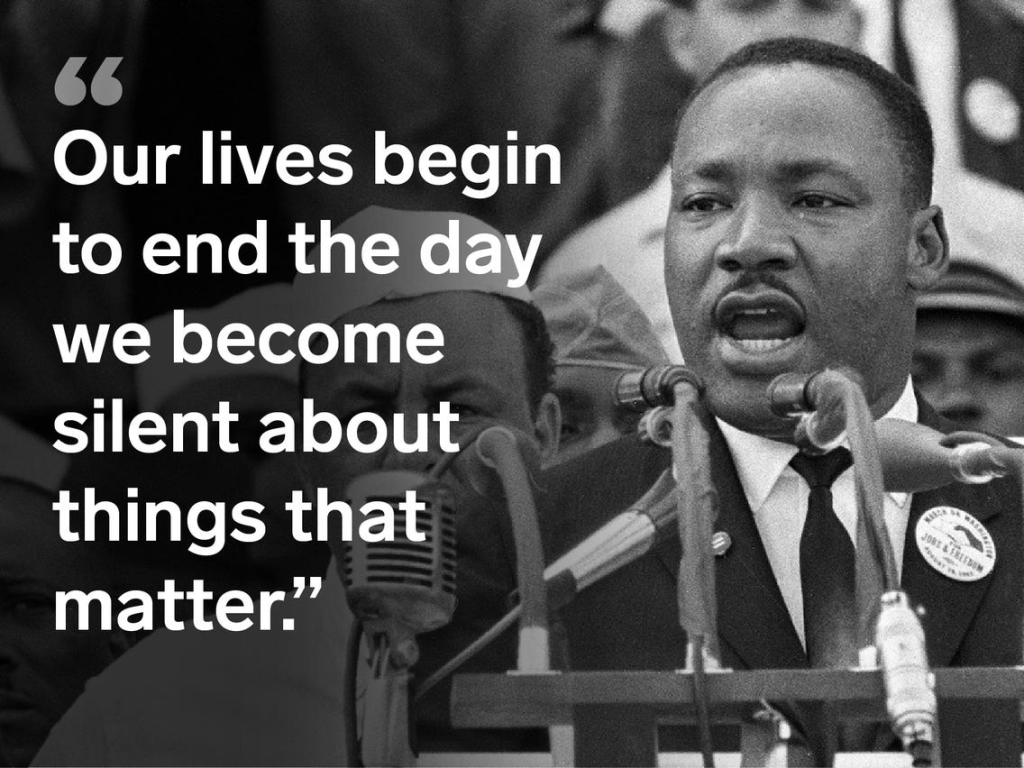
Methinks that Martin Luther King, Jr. must have felt a kinship with the prophet Jeremiah. After all, he was much like a modern-day prophet. In word and deed, he kept asking people to close the distance between the values they espoused and their actual behavior. 

The terrible treatment King and his allies received during the civil rights movement through non-violent marches and demonstrations, brought-out the awful gap between espoused American values of freedom, fairness, and tolerance, and the reality that Blacks really did not possess these in any manner close to the white population. 

Every prophetic ministry compels people to come face-to-face with the disparity between beliefs and behaviors.

Jeremiah knew all about the gulf between expressed values and actual conduct. And he faced a very large chasm between the two. 

Like Reverend King, Jeremiah was imprisoned, had rocks thrown at him, and was jeered for his message of calling people to live up to God’s agenda for humanity. 

White supremacy, or at least white privilege, was taken for granted in much of America before King. In the same way, Israelite privilege was taken for granted in Jerusalem, in Jeremiah’s day. Unfaithful prophets kept proclaiming Jewish supremacy and insisted that the Lord would be on their side of things. 

But the Lord insisted that these supposed prophets have neither attended a meeting of any divine council in heaven nor ever heard God speak to them.

I urge you, brothers and sisters, to keep an eye on those who create dissensions and hindrances, in opposition to the teaching that you have learned; avoid them. For such people do not serve our Lord Christ but their own appetites, and by smooth talk and flattery they deceive the hearts of the simple-minded. (Romans 16:17-18, NRSV)

The spirit of the age simply accepted power, privilege, and pedigree as the norm that ought to always endure. But God thinks differently about it. And so, the Lord sends prophets to call people back to justice, righteousness, and peace for the benefit of all persons.  

The zeitgeist of our own age is one of turmoil, uncertainty – and even chaos, violence, and death. We have our own contemporary self-appointed prophets who proclaim peace where there is no peace; safety, at the expense of others’ protection; militant forms of xenophobia; and an American exceptionalism which places a thin veneer of respectability over the graves of dead people’s bones.

The Lord will not contend with this forever.

An exercise in healthy introspection would be to consider these questions:

  • What are our most cherished values?
  • Where did we get them? Who are we listening to?
  • Are they God’s values? 
  • Who is really in control as the arbiter of values?
  • How might godly values of justice, righteousness, and peace be expressed in our everyday actions and behaviors?
  • Will we seek to engraft such values into our organizations, systems, faith communities, neighborhoods, and governments?
  • Can we work together in humility?
  • Do we have the courage to change, to share power, and to seek the common good of all persons?

Lord, have mercy, and grant us your peace.

All-Seeing God, you know the true state of every heart and every people group. Do your work of making me holy in all I do and say so that your values, and the words and ways of Jesus, might be expressed through me in the power of the Holy Spirit. Amen.

Psalm 10 – Backstabbers

Why are you far away, Lord?
Why do you hide yourself
    when I am in trouble?
Proud and brutal people
    hunt down the poor.
But let them get caught
    by their own evil plans!

The wicked brag about
    their deepest desires.
Those greedy people hate
    and curse you, Lord.
The wicked are too proud
to turn to you
    or even think about you.
They are always successful,
though they can’t understand
    your teachings,
and they keep sneering
    at their enemies.

In their hearts they say,
    “Nothing can hurt us!
We’ll always be happy
    and free from trouble.”
They curse and tell lies,
and all they talk about
    is how to be cruel
    or how to do wrong.

They hide outside villages,
waiting to strike and murder
    some innocent victim.
They are hungry lions
    hiding in the bushes,
hoping to catch
    some helpless passerby.
They trap the poor in nets
    and drag them away.
They crouch down and wait
    to grab a victim.
They say, “God can’t see!
    He’s got on a blindfold.”

Do something, Lord God,
and use your powerful arm
    to help those in need.
The wicked don’t respect you.
In their hearts they say,
    “God won’t punish us!”

But you see the trouble
and the distress,
    and you will do something.
The poor can count on you,
    and so can orphans.
Now break the power
    of all merciless people.
Punish them for doing wrong
    and make them stop.

Our Lord, you will always rule,
but every godless nation
    will vanish from the earth.
You listen to the longings
    of those who suffer.
You offer them hope,
and you pay attention
    to their cries for help.
You defend orphans
    and everyone else in need,
so that no one on earth
    can terrify others again. (Contemporary English Version)

Nobody can go through life without having to deal with evil in the form of two-faced people. It’s just part of the human condition to experience it. 

The O’Jays sang about such persons in their 1972 song, Backstabbers: 

(What they do!)
(They smile in your face)
All the time they want to take your place
The back stabbers (back stabbers)
(They smile in your face)
All the time they want to take your place.

The psalmist knew first-hand about such people, all too well. He experienced their lies and their constant thoughts about cruelty to others and doing wrong. He watched their schadenfreude, that is, their delight in seeing others harmed and hurt. Outwardly, such devious people feign friendship; but meanwhile, they inwardly sneer and plot how to destroy. 

Schadenfreude: satisfaction or pleasure felt at someone else’s misfortune.

However, there is a God who sees all of it, both the outward calloused deeds, as well as the inward plotting of insidious works. And, what’s more, God will act.

The problem for most of us, the victims of the backstabber’s blade, is that the time between God seeing and God acting is sometimes far too long. We cry out for justice, and rightly so. God sees and hears. And God acts when it is time to act, without being on our schedule to do it.

Meanwhile, during this awkward in-between time, until God dispenses the divine will on both the evil and the good, the righteous person remains hopeful and confident that their cries are being heard and that divine protection will prevail. The psalmist assures us that the Lord listens to the longings of those who suffer. God offers them hope and pays attention to their cries for help.

Don’t let evil get the best of you; get the best of evil by doing good.

Romans 12:21, MSG

The way to face down the presence of hard-hearted people is to be both active and passive in the right ways: 

  • Actively cry out to God in prayer
  • Actively work for good
  • Take a pass on exacting revenge
  • Take a pass on nursing grudges and hate

If we can encourage one another to persevere in being consistently good, even while in the teeth of evil, it will go a long way toward spreading God’s benevolent and gracious kingdom and seeing God’s moral and ethical will done in our families, communities, and world.

Unfortunately, backstabbers will always be with us, no matter where we go, this side of heaven. Stay calm, don’t let the evil stick to your soul, and step back to see the big picture that vengeance belongs to the Lord… and maybe listen to some O’Jays while you’re at it.

God of justice and righteousness, you defend those who are vulnerable and in need. You will act so that no one on earth can terrify and harm others again. Shoo the bullying and belligerent ways of Satan away so that your heavenly kingdom may take root in the church and the world for the sake of Jesus our Savior. Amen

Jeremiah 7:1-15 – Holding People Accountable

The prophet Jeremiah, Basilica of St Vitalis, Ravenna, Italy—Photo by mountainpix

The word that came to Jeremiah from the Lord: Stand in the gate of the Lord’s house, and proclaim there this word, and say, Hear the word of the Lord, all you people of Judah, you who enter these gates to worship the Lord. Thus says the Lord of hosts, the God of Israel: Amend your ways and your doings and let me dwell with you in this place. Do not trust in these deceptive words: “This is the temple of the Lord, the temple of the Lord, the temple of the Lord.”

For if you truly amend your ways and your doings, if you truly act justly one with another, if you do not oppress the alien, the orphan, and the widow or shed innocent blood in this place, and if you do not go after other gods to your own hurt, then I will dwell with you in this place, in the land that I gave to your ancestors forever and ever.

Here you are, trusting in deceptive words to no avail. Will you steal, murder, commit adultery, swear falsely, make offerings to Baal, and go after other gods that you have not known and then come and stand before me in this house, which is called by my name, and say, “We are safe!”—only to go on doing all these abominations? Has this house, which is called by my name, become a den of robbers in your sight? I, too, am watching, says the Lord. Go now to my place that was in Shiloh, where I made my name dwell at first, and see what I did to it for the wickedness of my people Israel. 

And now, because you have done all these things, says the Lord, and when I spoke to you persistently, you did not listen, and when I called you, you did not answer, therefore I will do to the house that is called by my name, in which you trust, and to the place that I gave to you and to your ancestors just what I did to Shiloh. And I will cast you out of my sight, just as I cast out all your kinsfolk, all the offspring of Ephraim. (New Revised Standard Version)

One of the dangers of the religious life is slipping into the view that possessing a certain thing protects us from all harm – sort of like a talisman or rabbit’s foot.

Today’s Old Testament lesson is a classic example of succumbing to just such a danger. The ancient Jews in Jerusalem, in the days of the prophet Jeremiah, sincerely believed that because they had God’s temple in their city that this would protect them from any kind of attack from the outside. 

What is more, since they viewed the temple as an incredibly powerful good-luck-charm, the people thought that they could do whatever they wanted; they were covered and protected. So, they had no sense of accountability to the holy God whose temple overlooked Jerusalem and saw all of their unjust ways.

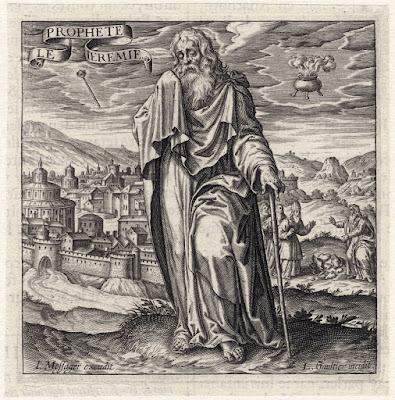
An engraving of the prophet Jeremiah by Léonard Gaultier (1561-1641)

Separated by a few millennia, we might see the folly with this magical type of thinking. Yet, it is just as easy for us to slip into the same mentality. 

Whenever we Americans think that our nation is so great that no one will ever take us over; or when we sincerely believe that because we are a missionary-sending nation that God will protect us; or when we buy into the notion that we can live however we want, but God would never judge us!; after all, we aren’t as bad as other nations!; well, then, we have come under the same condemnation as the Jews of old, we need to hear God’s Word for us today.

Jeremiah’s message was uncompromising. He clearly let the people know that while they have been living their hedonistic lives, God has been trying to talk them. But the people refused to listen. The prophet insisted that having the temple in the city is not some inoculation from keeping enemies at bay.

The prophet Jeremiah asserted that the people must change their ways, start living right, and be fair and honest with each other. They need to stop taking advantage of foreigners, orphans, and widows. They cannot kill innocent people and worship other gods, then turn around and invoke the temple as God’s presence and sanction on their security.

Justice is the responsibility of everyone; there are no favorites with God. The Lord does not favor particular people, ethnicities, or nations above others. Because one is an American, or not, makes no difference. Race and gender don’t come into view.

The sovereign God will hold all people culpable for their violent speech and behavior, no matter who they are or where they are from. Oppression, injustice, and spiritual gerrymandering will be dealt with by Judge Jesus, for both Jew and Gentile, man and woman, Westerner and Easterner, young and old.

For whom God has given much, much will be required. The Lord holds all people accountable for their actions.

Holy God, you still speak today through your Holy Word. Help me to listen well and pay attention to what you are saying so that I might honor you through humility and obedience for the sake of Jesus. Amen.