Anti-Intellectualism

Everyone with good sense
    wants to learn. (Proverbs 18:15, CEV)

Anti-intellectualism:

  1. opposition to or hostility toward intellectuals and the modern academic, artistic, social, religious, and other theories associated with them
  2. the belief or doctrine that intellect and reason are less important than actions and emotions in solving practical problems and understanding reality

Holy Scripture encourages knowledge, understanding, and wisdom. In order to be a truly wise and understanding person, there must be a combination of knowledge and experience. When these two elements come together, and are practiced over a long period of time, then spiritual maturity is realized.

In every church I’ve ever served across the decades there have been individuals and groups of people in my congregations who are anti-intellectual. They were not big fans of seminaries. They often mistrusted highly educated persons with multiple degrees. And they had a hard time submitting to any authority structure that smacked to them of being elitist.

Unfortunately, the majority of those persons, in my experience, refused to learn in any other way other than their own personal experience. I don’t think I need to tell you the many pitfalls such a stance creates: constant misinterpretation of situations; prejudice toward others whom they don’t understand; and chronic disobedience to every authority in their life.

It likely wouldn’t surprise you to know that these sorts of parishioners rarely, if ever, read their Bibles, or even seek to learn other than hearing Sunday sermons. They reek of spiritual immaturity and pride, being puffed-up with themselves that they aren’t like the elites in power.

Now imagine what a group of people like this would be like if they were in the highest levels of government… But we need not imagine; the reality is in front of us every day.

To understand the current political climate in the United States, it seems to me we need to see that the present governmental administration, at its heart, is an anti-intellectual movement.

Now please know that I am not saying that everyone in the administration is stupid. What I am saying is that many if not most Republicans have a deep seated problem with educational elites – hence the sustained attention on American universities, especially Harvard.

They believe themselves to be practical, no nonsense people who can get things done without umpteen committees and eggheaded reports. The problem, however, is that in their belief of experiential superiority, they’ve refused to listen. They end up making snap judgments of situations and other people. In other words, they can quickly make a disaster of things whenever they’re in charge.

Furthermore, what the anti-intellectuals end up doing most is grasping for as much worldly power as they can gain.

For Protestant Evangelicals, their desire for power stems from their perceived loss of a golden age of Christendom. Back then they were in power – prayer in schools, no abortion, the Ten Commandments in every court house, riding your bike in the neighborhood with safety, etc.

Yet, because there is such a paucity of listening and seeking to understand, the anti-intellectuals fail to understand that their own golden age was a bronze age of Jim Crow laws, failed reservation promises, and the need to operate in the shadows for all sorts of other persons.

Holy Scripture’s Book of Proverbs – which is a combination of accumulated knowledge and lived experience – has something to say about those who refuse to listen and learn from others:

With wisdom you will learn
what is right
    and honest and fair.
    with knowledge. (Proverbs 2:9-10, CEV)

Fools think they know
    what is best,
but a sensible person
    listens to advice. (Proverbs 12:15-16, CEV)


Stupidity leads to foolishness;
    be smart and learn. (Proverbs 14:18, CEV)

Fools have no desire to learn,
instead they would rather
    give their own opinion. (Proverbs 18:2, CEV)

Pride leads to destruction;
    humility leads to honor.
It’s stupid and embarrassing
to give an answer
    before you listen. (Proverbs 18:12-14, CEV)

An ignorant fool learns
    by seeing others punished;
a sensible person learns
    by being instructed. (Proverbs 21:11, CEV)

If we apply our hearts to wisdom, we will learn:

  • the pursuit of power at all costs creates stupidity
  • the disdain and/or ignorance of others has adverse consequences for all
  • there has always been an anti-intellectual strain throughout the history of the world (including U.S. history)
  • the act of placing blame on others (such as the so-called “elites”) will come back to bite us

It does no good to reason with an anti-intellectual, namely because they will not avail themselves of logic nor learning.

Instead, it is wise to treat an anti-intellectual like we ourselves would want to be treated: to have another listen to us and be curious about why we hold to what we hold, without judgment; and to have another respect our ability to choose for ourselves.

Can you imagine a world where we would all commit ourselves to listening and learning, acquiring knowledge, understanding, and wisdom? We would likely live in a very different world than the one we are in today.

May the course of this world be peaceably governed by divine providence. And may the church everywhere joyfully serve God in confidence and serenity. Amen.

Divine Judgment and Human Judgmentalism (Luke 21:20-24)

Jesus Wept Over It, by Enrique Simonet, 1892

“When you see Jerusalem surrounded by armies, then know that its desolation has come near. Then those in Judea must flee to the mountains, and those inside the city must leave it, and those out in the country must not enter it, for these are days of vengeance, as a fulfillment of all that is written. Woe to those who are pregnant and to those who are nursing infants in those days! For there will be great distress on the earth and wrath against this people; they will fall by the edge of the sword and be taken away as captives among all nations, and Jerusalem will be trampled on by the nations, until the times of the nations are fulfilled. (New Revised Standard Version)

Judgment is coming… and is already here…

To be more specific, God’s judgment is coming; and humanity’s judgmentalism is already here.

Because of our judgmental spirits, we ought not be surprised that the judgment of God will be here soon.

I cannot get through a day – barely an hour – without hearing judgmental statements coming from another’s mouth. And sometimes, it’s my own mouth.

Judgmentalism is rife. It’s everywhere. And there’s no way to escape it. In a “normal” day (if there is such a thing for me) I hear all sorts of statements, without even trying to hear them. And when I do, I usually have a thought about it (in the parentheses):

  • “They did it because they don’t care about anything.” (And you don’t seem to give a rat’s rear end about understanding why they did it.)
  • “They deserved all the bad stuff they received.” (And you don’t?)
  • “The only reason they got the job to begin with is because of their connections.” (I didn’t realize that you are all-seeing, like God)
  • “You don’t know what you’re talking about!” (Maybe, but neither do you.)
  • “The rain is terrible.” (That’s your assessment. But it isn’t the local farmer’s assessment of the rain. He thinks it’s wonderful.)

Judgmentalism is the tendency to make quick and excessively critical judgments of others, especially moral judgments which characterize another’s thinking or way of being as immoral, unethical, monstrous, and/or harmful.

Our human judgmentalism of one another tends to detract from the sort of judgment we ought to be paying attention to.

Ultimately, none of us sits as Judge to arbitrate what who deserves punishment, or not. That is the job of Judge Jesus. So, when the true judge speaks, it behooves us to listen and follow through with what he (Christ) says about upcoming divine judgment.

When Jesus said his words of Jerusalem’s impending destruction, he was making it clear that these would be days of God’s vengeance, of divine judgment against the people. It would not last forever, because the wrath of God never does.

Yet, judgment is imminent. God will not let times of injustice, unrighteousness, and hatred last without end.

Therefore, Jesus was warning his disciples, and all who would follow him, about how they are to live while they await the end of all things.

We are not to be led astray, and be fooled by anyone who claims the name of Christ, yet lives like a devil. Unfortunately, some will foolishly succumb to falsehood. Everyone will suffer in some way.

Believers are to be watchful and prayerful. This is not passivity on our part, but actively putting a great deal of energy into becoming wise and interceding on behalf of others.

If we cannot sit still in silence, in contemplative prayer, for even 20 minutes, then we have a problem. It will be quite difficult to discern the good, right, and just.

If we cannot go half the day without making a judgmental statement about another person, then we have an addiction which needs to be broken.

If we continue to have reasons why we cannot (and therefore will not) read or listen to Holy Scripture, especially the New Testament Gospels of Jesus, then we are likely following someone else other than Christ.

If we keep moaning about the state of the world, the problems in our families, and all the local issues of our communities, then it is imperative that we come back to examining the words and ways of Jesus and deal with our own junk, instead lamenting everyone else’s.

If you know how to prepare for a zombie apocalypse, a new movie that’s coming out, or a birthday party for someone, but don’t have any idea about how to make life preparations for a coming disaster (let alone your own eventual death) then the last thing that ought to be happening is judging another person for anything at all.

You’ve got some work to do to get ready for the coming of Christ.

“Let us be alert to the season in which we are living. It is the season of the Blessed Hope, calling for us to cut our ties with the world and build ourselves on this One who will soon appear. He is our hope—a Blessed Hope enabling us to rise above our times and fix our gaze upon Him.”

A.W. Tozer

It’s possible that you may want to judge me for saying not to be judgmental. It’s happened more than once in my life. Yet, if we can learn to distinguish between the person and the behavior, then we can deal with unjust behavior, and leave any condemnation of the person to God.

If ever we struggle to know what to do, one can never go wrong with showing grace.

Gracious God, I repent for being quick to pass judgement both in speech and thought. For every time my words or actions of judgment and condemnation have hurt someone, I repent. Lord, I pray that I will not focus on the faults or shortcomings of others. Help me to see others through the eyes of grace. Amen.

Be Careful How You Judge (2 Samuel 10:6-12)

Hanun humiliates David’s ambassadors, c.1240 C.E.

When the Ammonites realized that they had become obnoxious to David, they hired twenty thousand Aramean foot soldiers from Beth Rehob and Zobah, as well as the king of Maakah with a thousand men, and also twelve thousand men from Tob.

On hearing this, David sent Joab out with the entire army of fighting men. The Ammonites came out and drew up in battle formation at the entrance of their city gate, while the Arameans of Zobah and Rehob and the men of Tob and Maakah were by themselves in the open country.

Joab saw that there were battle lines in front of him and behind him; so he selected some of the best troops in Israel and deployed them against the Arameans. He put the rest of the men under the command of Abishai his brother and deployed them against the Ammonites. 

Joab said, “If the Arameans are too strong for me, then you are to come to my rescue; but if the Ammonites are too strong for you, then I will come to rescue you. Be strong, and let us fight bravely for our people and the cities of our God. The Lord will do what is good in his sight.” (New International Version)

Cockiness can get you into a lot of trouble. It’s one thing to exude confidence; and it’s another thing to act like a puffed up peacock and do stupid stuff because of arrogance. The Israelite general Joab had the former; the Ammonites the latter.

King David had sent envoys to Ammon in the event of a new Ammonite king taking the throne after his father’s death. David was in the groove of extending kindness and establishing himself as the sort of ruler who has a heart, as well as a head.

However, Hanun the Ammonite king, viewed the Israelite delegation of people in a negative light, believing they had malevolent motives for coming. So, the king’s officials “seized David’s envoys, shaved off half of each man’s beard, cut off their garments at the buttocks, and sent them away.” (2 Samuel 10:4)

Not the smartest move on the planet. Humiliating a group of Israelites sent by David was a bad idea. The Ammonites, understandably, were put immediately on King David’s naughty list. And they then responded by recruiting mercenaries to their side, getting the clue that David wasn’t about to stand for the offense against Israel.

So, the Ammonites hired the Arameans to help fight Israel. But they were no match for the shrewd and seasoned Jewish general Joab. The mercenaries were soundly defeated, really because of God’s sovereign intervention over the much larger force put together by the Ammonites.

This ancient animosity and relational haggling tends to reflect the human condition, even to this day. It’s easy to fall into misinterpretations and misunderstandings that lead to conflict.

A lot of biblical interpreters read between the lines of the story, and see less than altruistic motives on David’s part. That may or may not be true. The story simply has David sending a delegation to Ammon in the event of the Ammonite king’s death – with the reason stated that David wanted to show kindness, just as the previous king had done with him.

It’s characteristic of judgmental spirits to look for people who agree with them – whether those people are Ammonite royalty or Bible interpreters. We tend to see what we are familiar with and know – which is why the interpretive process can and does vary widely amongst scholars and readers alike.

The Ammonite court bought into a perception of King David. And based upon that view, they believed a course of action which included humiliating others and finding mercenaries was the proper way to proceed.

But those sorts of methods themselves ought to raise a red flag with us, and cause us to question the perceptions and judgments behind them.

The king of Ammon believed he was acting in the right, and the Ammonites sought to justify themselves as legitimately acting with violence because of an Israelite threat.

By taking a Christian perspective, I believe we can be encouraged, rather than react with questionable tactics toward others who humiliate us and spout verbal violence upon us. A theological worldview discerns that righteousness will prevail. Justice and righteousness may not happen soon, and maybe not even in our lifetime; yet, it will eventually overcome any and all evil.

Jesus was unjustly judged by others who believed he was in league with the devil and was opposed to the law of Moses. Righteousness did prevail, but not after a great deal of suffering, which included a cross and a death.

King David himself did not withdraw from the situation, nor did he ignore it. David faced his accusers and entrusted himself and his nation to the God who is right and just.

We need not withdraw or ignore others in the face of judgmentalism. And we also need not resort to the same methods and tactics of judgmental people.

Showing kindness is important, and it must not be dependent upon whether one will respond favorably to us, or not. Sometimes you will experience judgmental spirits, no matter what.

Furthermore, be careful of the way you interpret another’s words and actions, and also how you respond to others. Jesus said:

“Do not judge, or you too will be judged. For in the same way you judge others, you will be judged, and with the measure you use, it will be measured to you.” (Matthew 7:1-2, NIV)

Those who love truth will tend to avoid snap judgments. God always makes a right judgment, and is the ultimate Judge of the universe. It is the Lord we need to please, and not any group of people.

A prayer of Thomas à Kempis (1380-1471):

Grant me, O Lord, to know what I ought to know,
To love what I ought to love,
To praise what delights You most,
To value what is precious in Your sight,
To hate what is offensive to You.
Do not suffer me to judge according to the sight of my eyes,
Nor to pass sentence according to the hearing of the ears of ignorant persons;
But to discern with a true judgment between things visible and spiritual,
And above all, always to inquire what is the good pleasure of Your will. Amen.

Yet Another Conflict (Acts 21:27-39)

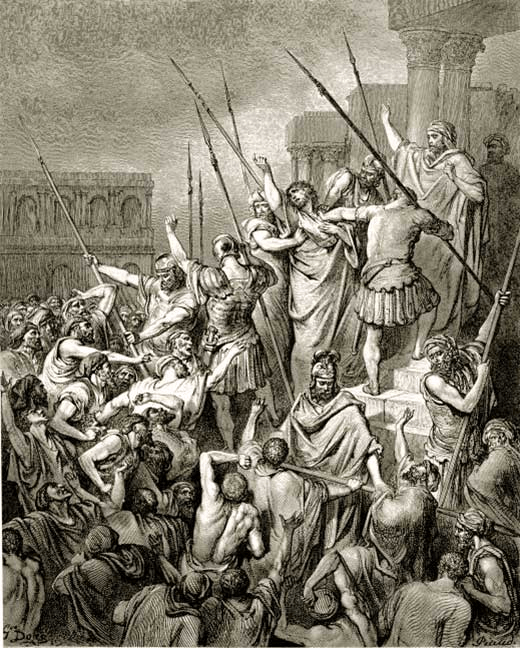
Apostle Paul in Jerusalem, by Gustave Doré, 1878

When the seven days were nearly over, some Jews from the province of Asia saw Paul at the temple. They stirred up the whole crowd and seized him, shouting, “Fellow Israelites, help us! This is the man who teaches everyone everywhere against our people and our law and this place. And besides, he has brought Greeks into the temple and defiled this holy place.” (They had previously seen Trophimus the Ephesian in the city with Paul and assumed that Paul had brought him into the temple.)

The whole city was aroused, and the people came running from all directions. Seizing Paul, they dragged him from the temple, and immediately the gates were shut. While they were trying to kill him, news reached the commander of the Roman troops that the whole city of Jerusalem was in an uproar. He at once took some officers and soldiers and ran down to the crowd. When the rioters saw the commander and his soldiers, they stopped beating Paul.

The commander came up and arrested him and ordered him to be bound with two chains. Then he asked who he was and what he had done. Some in the crowd shouted one thing and some another, and since the commander could not get at the truth because of the uproar, he ordered that Paul be taken into the barracks. When Paul reached the steps, the violence of the mob was so great he had to be carried by the soldiers. The crowd that followed kept shouting, “Get rid of him!”

As the soldiers were about to take Paul into the barracks, he asked the commander, “May I say something to you?”

“Do you speak Greek?” he replied. “Aren’t you the Egyptian who started a revolt and led four thousand terrorists out into the wilderness some time ago?”

Paul answered, “I am a Jew, from Tarsus in Cilicia, a citizen of no ordinary city. Please let me speak to the people.” (New International Version)

The Apostle Paul arrived in Jerusalem, after a sojourn in Greece and the province of Asia. He had been gathering a collection for the believers in need. In his journey, Paul received messages, warnings, and even prophecy that he would be arrested if he went to Jerusalem.

Since the prophecy did not tell Paul to stay away, he kept going, ready not only to be arrested but to also die for his faith, if need be. (Acts 21:10-14)

Iron handcuffs (chains) from the Roman Empire, Archaeological Museum in Durrës, Albania

The first week of being Jerusalem entailed the status quo for Paul: He dealt with yet another church conflict between Jews and Gentiles. Then, the prophecy began to unfold and become reality.

Jews from Asia, who had seen Paul in the Temple and recognized him as a Christian agitator, immediately jumped to the conclusion that Paul was up to no good. It appeared to them that Paul had taken a Gentile into the Temple, thus defiling it, which in fact, he had not.

But when you have a grudge against someone, and an axe to grind, you begin making mental correlations and causations that aren’t really there.

So, the Jews from Asia got the crowd all stirred up by judging Paul as a person who teaches everyone everywhere against the people, the law, and the Temple. In other words, they accused Paul of being anti-Semitic and fomenting violence against the Jews.

Ironically, however, that is just what the Asian Jews did themselves. Without just evidence, they evoked the crowd’s emotions enough to drag Paul from the Temple. And they weren’t inviting him to tea. It seems they had every intention of doing him in, and not by throwing sugar cubes at him.

The only thing that stopped a death that day was the Roman authority getting in between Paul and the crowd. As per the prophecy, Paul was arrested and bound with chains.

The crowd had turned so riotous that the Roman commander could not ascertain Paul’s identity. The mob became violent, so Paul was whisked away by the Roman soldiers. As he left, the shouts of “Away with him!” could be heard throughout the city.

Jesus had a similar experience, but went to his death without any opportunity for a defense speech before an angry crowd.

Paul requested, however, to address the mob. And the Roman commander was aghast to learn that Paul spoke Greek – supposing that he was just another annoying religious nut on the street corner who got up into everyone’s grill a bit too much.

Yet, the commander quickly discovered that he was dealing with a citizen of the Empire who was no kooky preacher. Here we see a turn of events and a flip-flop between two groups of people.

It’s the Roman army who upheld proper justice and protected the interests of the individual; whereas the Jewish crowd became vigilante, ironically violating their own law by trying to put an innocent person to death without justification.

In a twist of history, the Roman arrest of Paul was his deliverance from a Jewish mob. Go figure.

Today’s story opens for me a set of questions that are both genuine, as well as a bit rhetorical:

  • How often do we – as both individuals and churches – accuse others of being unfaithful and/or unbiblical, when it is we ourselves who are going rogue from Holy Scripture?
  • In what ways do we handle false charges, judgmentalism, and unjustified criticism from others who misunderstand and/or misinterpret us?
  • What do we do (and not do) whenever there are differences within the church, family, community, workplace, or nation?
  • Does our manner of approaching conflict include the verbal violence of gossip and slander and/or actual physical violence through passive-aggressive behavior?
  • Am I looking too closely and/or critically under the hood of your soul? What will you do with me, let alone Jesus?

If you can receive this, I recommend taking some time and space today for answering those questions honestly through writing them in a journal and/or talking about them with a trusted friend.

May God have mercy upon our human institutions, societies, and relationships. To God be the glory. Amen.