
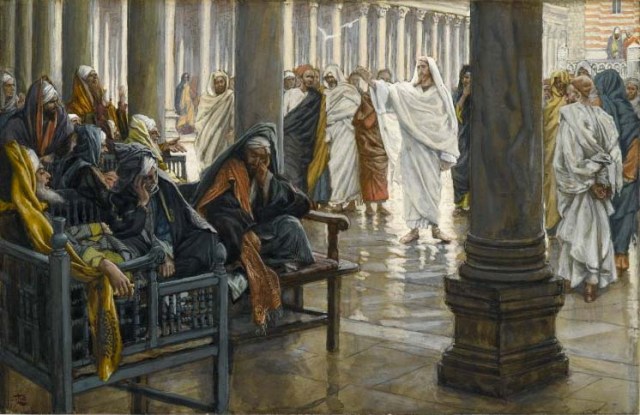
Luke 10:13-16 – Confronting Hard Hearts

“Woe unto You” by French painter James Tissot (1836-1902)

“Woe to you, Chorazin! Woe to you, Bethsaida! For if the miracles that were performed in you had been performed in Tyre and Sidon, they would have repented long ago, sitting in sackcloth and ashes. But it will be more bearable for Tyre and Sidon at the judgment than for you. And you, Capernaum, will you be lifted to the heavens? No, you will go down to Hades.

“Whoever listens to you listens to me; whoever rejects you rejects me; but whoever rejects me rejects him who sent me.” (New International Version)

Hardness of heart is the greatest malady and the most serious condition which could ever afflict a spiritual person.

A soft heart needs only gentle words and humble responses in order to continue learning and growing in life. Not so with the hard heart. It needs a mighty chisel from God to scrape the encrusted barnacles off the heart so that it might receive goodness.

This is why today’s Gospel lesson recounts some rather harsh words from Jesus. Christ had some hard things to say in order to get at the hardness of heart he was experiencing from the people. His scathing words were specifically leveled at the towns in which he had performed miraculous healings. Their inability to accept what was happening in front of their very faces testified to how hard their hearts truly were.

The miracles of Jesus, in addition to being gracious restorations of individual lives, were also meant to demonstrate that the kingdom of God has broken into history in the person of Jesus Christ. The crowd refused to acknowledge this reality. So, Jesus began leveling a rebuke to the towns who observed his ministry firsthand, and yet did nothing in response to those good works.

A hard heart observing Christ’s ministry will likely be unresponsive to Jesus. A soft heart will likely reply with humility by forsaking everything to follow him. For Jesus, the height of hubris was to simply ignore his righteous works of merciful teaching and benevolent healing.

Christ’s denunciation of the particular towns came not because he was experiencing opposition or persecution; rather, he was denouncing them for their bonehead lack of response and refusal to change their lives to conform to what they were seeing and experiencing from God.

The crowd heard Christ’s teaching and saw his miracles, and it had no effect on them. So, Jesus gave them a big “C’mon, man!”

Judgment becomes the lot of someone who is unaffected and unresponsive to the vast sea of human need around them, viewing Jesus as just another voice, and living a life of mediocrity in the face of opportunity.

The Holy Spirit has been provided, who is the power source of the Christian life. We possess all the resources of grace necessary to step into this world and make a difference, yet so many do nothing but occupy a place in the pew [or couch] because they are too afraid to sacrifice their time in meaningful ministry.

There are neighbors, relatives, and co-workers who are lost and lonely, in need of the kind of grace Jesus gives, yet too many of us are oblivious to them and instead are constantly worried about things that, in the end, don’t really matter at all.

We have opportunities to grow in the grace and knowledge of Jesus Christ through a vast array of available ministries, yet many do not take the chance to change and be spiritually stretched. For these situations and more, the words of Jesus are there in front of our faces, and yet some, out of hardness of heart, will have the audacity to read them and remain unchanged, unchallenged, and unresponsive.

If our highest values in life are sameness, stability, and security, we may very well, at the least, miss Jesus altogether, and, at worst, find ourselves under his condemnation. These verses are for those whom Jesus has become all too familiar, as if he is just another piece of furniture in the living room – the coffee table with a dusty Bible resting on it.

There are times when nice gets us nowhere and we must have hard conversations because of hard hearts.

Yes, conversations, and not verbal rockets launched from one group to another. Jesus did not denounce from a distance; he did it up close and personal. Furthermore, he was specific and not generic about why he was speaking in the way he did.

So, may you be able to pray this prayer of repentance today with heartfelt conviction:

Almighty God, Father of our Lord Jesus Christ, Sovereign Lord of the universe, Creator of humanity, we, your unfaithful children, are sorry for our sins and the lives that we have lived apart from your grace. We sincerely believe and confess in our hearts that only through the precious blood of our Lord Jesus Christ on the cross, can we obtain your forgiveness.

We repent that: in thought, word, and deed, we have committed serious offences against you and our neighbors. Through spiritual laziness and prideful lust for power, we have provoked hatred, division, despair, and hurt within our communities.

Through our greed, deceit, and indifference, we have inflicted serious damage, unnecessary conflict, and aggravated destruction to those different than us.

Through our selfishness, insensitivity, and bias (both conscious and unconscious) we have encouraged and emboldened those who inflict hurt, pain, and sorrow on those who are already oppressed and poor.

In the name of religion, doctrine, and even of Christ himself, we have wounded fellow believers and those who genuinely pursue a faith different than ours.

In stubbornness, pride, and arrogance, we have caused division and strife within your church and among your people.

Mercifully send your Holy Spirit, the Spirit of order and comfort, to cleanse us from all unrighteousness; to restore in us true faith in Christ which brings truth, peace and harmony; and, to help us walk together
with our brothers and sisters in the peace of our Lord Jesus Christ, to the glory of your name. Amen.

Romans 2:1-11 – Against Criticism and Judgment

Some of you accuse others of doing wrong. But there is no excuse for what you do. When you judge others, you condemn yourselves, because you are guilty of doing the very same things. We know that God is right to judge everyone who behaves in this way. Do you really think God won’t punish you, when you behave exactly like the people you accuse? You surely don’t think much of God’s wonderful goodness or of his patience and willingness to put up with you. Don’t you know that the reason God is good to you is because he wants you to turn to him?

But you are stubborn and refuse to turn to God. So, you are making things even worse for yourselves on that day when he will show how angry he is and will judge the world with fairness. God will reward each of us for what we have done. He will give eternal life to everyone who has patiently done what is good in the hope of receiving glory, honor, and life that lasts forever. But he will show how angry and furious he can be with every selfish person who rejects the truth and wants to do evil. All who are wicked will be punished with trouble and suffering. It doesn’t matter if they are Jews or Gentiles. But all who do right will be rewarded with glory, honor, and peace, whether they are Jews or Gentiles. God doesn’t have any favorites! (Contemporary English Version)

“Everything that irritates us about others can lead us to an understanding of ourselves.”

Carl Jung

Since it is the Christian season of Lent, the Revised Common Lectionary freights the readings with biblical sections about repentance. It can be a hard slog, this inner work we are called to do. Yet, it leads to the peaceable fruit of righteousness for those spiritual athletes who train their souls for the will of God.

One of the first lessons we learn in our desert journey through Lent is that judgment belongs to God, not us.

Claiming the moniker of self-appointed Judge will, ironically, get one judged. There is only one true Judge. And Judge Jesus renders decisions which are always right, just, and fair, with no favoritism, cronyism, or malice.

A critical spirit is an evil spirit. It vaults oneself over and above others who are viewed as inferior, unworthy of love and belonging. It is the very antithesis of Christ’s way of being in the world with others.

The Apostle Paul, writing to the Church at Rome, merely upheld the teaching of his Lord Jesus, who said:

“Do not judge, so that you may not be judged. For with the judgment you make, you will be judged, and the measure you give will be the measure you get.” (Matthew 7:1-2, NRSV)

Although most people would affirm that showing favoritism is a bad thing, in practice we have a difficult time avoiding it – especially in polarizing times such as ours. Political mudslinging is (unfortunately) a time-honored American tradition. And so is religious judgmentalism.

Some of the most emotionally laden vitriol comes from folks who are so heavily entrenched in their religious convictions that they believe any deviation from their way of belief is worthy of scathing criticism.

People, however, do not change because someone criticizes or judges them. They experience transformation through basic divine and human kindness.

As a hospital chaplain in a behavioral health unit, I wholeheartedly affirm this to be true. Many patients have been told repeatedly by family or friends to stop their destructive behavior or thinking, get their lives together, move on, wake up, etc. – all with the condescending edge of criticizing judgment.

Yet, when someone takes notice, is curious about them, treats them like a fellow person, offers helpful encouragement, and a listening ear without trying to fix, souls become open to receiving the healing grace of love and truth.

God shows no partiality, and neither should we, period.

God is right, just, and fair in all dealings with everyone. The Lord judges according to divine standards of righteousness and mercy – no matter one’s race, ethnicity, gender, economic status, or social standing. And it is all laced with the love and compassion of Christ.

Christians are not exempt or given a pass on being judgmental, as if owning multiple Bibles or giving lots of money exempts one from a wagging tongue and an insensitive spirit.

Our own unhealthy practices, bad habits, and angry outbursts will be treated just like any non-Christian by God. In a time when decrying the moral condition of our world is nearly a spectator sport, the New Testament lesson for today reminds us that we must first be concerned for the condition of our own hearts before we can point the finger at another.

If we want revival in the land and repentance from others, then it must first be directed and practiced by oneself.

We all equally stand in need of God’s grace in Jesus.  There is a symbiotic relationship between our actions and the state of our hearts.  A soft and tender heart toward God leads to obedience; disobedience hardens the heart and leads to God’s wrath, no matter the individual.

So, it will help if we all faithfully engage in daily spiritual practices which keep our hearts attentive and alert to God’s will and way. 

No matter how busy we are, or how we feel, to forego or ignore the Word of God and prayer on a regular basis will slowly calcify our hearts and render them unable to respond rightly to grace. Instead, we can drink deeply of the gospel throughout every day so that we may experience peace.

A critical spirit begins to melt away when the tools of empathy, compassion, understanding, and acceptance are used to forge connections and provide support.

It takes no training to bludgeon someone with condemning criticism. However, it takes repeated practice to speak and act with grace, mercy, and peace, especially when we are stressed and/or anxious about our surrounding circumstances.

“Be curious, not judgmental.”

Walt Whitman

Instead of judgment, observe and be curious. Seek more information. Ask clarifying questions. Expand the gap between observation and conclusion.

The ability to have an awareness of one’s own emotions, to be mindful of self and surroundings, and to do it all with neither criticism nor judgment is perhaps the highest form of intelligence and spirituality.

Kindness is what leads others to repentance, not condemnation. Grace has the final word, not judgment. So, let us be blessed through a gentle spirit which spreads the goodness of God throughout the world.

Lord God, almighty and everlasting Father, we have sinned against you, through our own fault, in thought, and word, and deed, and in what we have left undone. For the sake of your Son, our Lord, Jesus Christ, forgive us all our offenses and grant that we may serve you in newness of life, to the glory of your Name. Amen.

Jesus Will Have None of It

Welcome, friends. As we journey with Jesus through this Lenten season, Christ is challenging four false assumptions about sin and guilt. Through parable and direct teaching, he insists we all must change – rather than simply looking for others to do so. Click the videos below, as we discover together that, when it comes to scapegoating and blame-shifting, Jesus will have none of it.

Pastor Tim Ehrhardt, Luke 13:1-9

Almighty and ever living God,
you invite us deeper into your world, your people, your Lent.
May this time be one of outward focus;
seeking you in those we often ignore.
Help us live a Lent focused on freedom, generosity, and encounter.
Give us hearts hungry to serve you
and those who need what we have to give. Amen.

Luke 13:1-9 – Jesus Will Have None of It

Now there were some present at that time who told Jesus about the Galileans whose blood Pilate had mixed with their sacrifices. Jesus answered, “Do you think that these Galileans were worse sinners than all the other Galileans because they suffered this way? I tell you, no! But unless you repent, you too will all perish. Or those eighteen who died when the tower in Siloam fell on them—do you think they were more guilty than all the others living in Jerusalem? I tell you, no! But unless you repent, you too will all perish.”

Then he told this parable: “A man had a fig tree growing in his vineyard, and he went to look for fruit on it but did not find any. So, he said to the man who took care of the vineyard, ‘For three years now I’ve been coming to look for fruit on this fig tree and haven’t found any. Cut it down! Why should it use up the soil?’

“‘Sir,’ the man replied, ‘leave it alone for one more year, and I’ll dig around it and fertilize it. If it bears fruit next year, fine! If not, then cut it down.’” (New International Version)

Jesus stood in a crowd of thousands of people. They peppered him with questions about all kinds of issues and situations. Christ responded with a combination of direct exhortations and pointed parables, designed to leave the people reflecting and thinking about what he said.

Christ’s direct exhortation is this: Repent. Change your mind. Christ’s pointed parable message is this: Bear fruit. Change your behavior.

The two go together. A fruitless life points to the need for repentance; and repentance results in bearing the fruit of love, joy, peace, patience, kindness, goodness, gentleness, and self-control.

Jesus, throughout his earthly ministry, relentlessly went after the fruitless dead religion of his day. Jesus believed that such religion needed to be cut out and thrown away. 

Therefore, the Lord exposed the assumptions that people have about sin, faith, and judgment. Jesus challenged four false assumptions or presuppositions that people often hold. In dealing with them, Jesus wanted to foster a change of heart which would lead to a change in behavior.

First Wrong Assumption: Other people’s sin is more serious than mine.

It’s a common human tendency to focus on the bad things in the world what other people do, rather than focus on our own heart and life. We can always identify people who are worse sinners than us! 

The crowd believed Pontius Pilate was a terrible sinner who needed to be dealt with, and they wanted Jesus to get on board to their way of thinking. The people wanted to talk trash about the Romans.

“Repentance is nothing else but a reformation of the whole life according to the Law of God.”

John Calvin

We must beware of people who constantly bemoan the state of the world and the sins of others, while ignoring their own issues or how they might be contributing to the problem. It’s so much easier to scapegoat a person or group of people, believing that if “those people” change, then everything will be okay.

But Jesus will have none of it.

Christ steered the discussion to personal repentance. Although you and I cannot control, change, or fix anyone, we can practice self-control, change our personal habits, and be the solution to our own problems.

Everywhere we go, the world is rife with criticisms and accusations of others. It’s always somebody else’s fault for the ills of the world and even the church.

Republicans blame Democrats. Democrats blame Republicans. Anti-vaxers blame the government. The vaccinated blame the previous government. Everyone thinks that if the other changes, all will be well. 

In the church, when things aren’t right, Christians might ask things like, “Who sinned, the pastor or the congregation, the church or the denomination?” With the decline of religion in the land, we look for a scapegoat. 

But Jesus will have none of it.

Christ cut through all the scapegoating and blame-shifting by saying that every single person needs to repent, without exception. Then, Jesus upped the ante with a parable by challenging us with a very probing thought: 

Are we bearing fruit, or just taking up space? 

Whenever we howl for judgment on others, but insist on grace for ourselves, we are the ones in need of repentance.

Second Assumption: My sin isn’t that serious.

When King Frederick II, an eighteenth-century King of Prussia, was visiting a prison in Berlin, the inmates insisted they had been unjustly imprisoned – all except one. That one sat quietly in a corner, while all the rest protested their innocence. Seeing him sitting there oblivious to the commotion, the king asked him what he was there for:

“Armed robbery, your Honor.”

The king asked, “Were you guilty?”

“Yes, Sir,” he answered. “I entirely deserve my punishment.”

The king then gave an order to the guard: “Release this guilty man. I don’t want him corrupting all these innocent people.”

We may concede that we are all sinners, but then struggle with believing that our personal sin really deserves imprisonment. So, we see no need for repentance. It isn’t that bad.

But Jesus will have none of it. 

Here are some questions raised by today’s Gospel lesson: 

Do I continually locate sin outside of my life, or do I discern the sinfulness of my own heart? 

Do I believe people in hardship are more sinful than me? 

Can I envision that I must change for the church and the world to change? 

Is my life fruitful, or fruitless? 

How can I become fruitful? 

What must I repent of? 

What will happen if I don’t repent?

Third Assumption: God will not judge me.

Some might concede we are all sinners, and my own sin is bad. “But is it really so bad that God would judge me?”  Again, the two big ideas Jesus is working with here is that everyone needs repentance, and everyone needs to bear spiritual fruit in keeping with such repentance. 

Jesus alerts us that the future involves a Judgment Day. All shall be held accountable for fruit-bearing, or the lack thereof. No fruit on the branch means it will be cut down and thrown into the fire.

Jesus was talking to a crowd of people who were quite religious. They were faithful temple worshipers, and had weekly practices of giving, fasting, and prayer. But they needed to repent of trusting in self and stuff. 

They believed God would judge the evil Romans and everyone else who did not live or think like them. They were God’s people; the Lord would not judge them!

But Jesus will have none of it.

The Lord almighty looked for justice, but saw bloodshed;
    for righteousness, but heard cries of distress. (Isaiah 5:7, NIV)

Learn to do right; seek justice.
    Defend the oppressed.
Take up the cause of the fatherless;
    plead the case of the widow.

Isaiah 1:17, NIV

Jesus wants spiritual fruit in keeping with repentance. Believing the right things and doing the right service never justifies indulging in hate, rage, anger, discord, selfish ambition, envy, impatience, unkindness, and ungraciousness. Doing a particular set of religious duties never gives one a license to use their attitude, their tongue, or their life in whatever way they want.

Fourth Assumption: I have plenty of time.

Okay, other people’s sin is not worse than mine. My sin is serious. God will deal with my sin if I do not repent. But I have time to deal with it, right? I will get around to it when I get a chance. 

But Jesus will have none of it.

Jesus was establishing a sense of urgency into the crowd. Repentance is not something to put off until tomorrow. Today is the day to deal with sin. If a lack of fruitfulness persists, judgment is imminent. Jesus was not trying to scare people into repentance; he was just letting them know that procrastination puts us in a precarious position. We don’t have unlimited time. We are on the clock.   

Just because God is gracious, merciful, kind, and patient does not mean that he won’t cut the dead religion tree down.

Today is the day of repentance, the day to quit looking for everyone else to repent and change, the day to take our own sin seriously, the day to discern that God does not show favoritism and will judge all persons equally and fairly. 

Today is the day because the hour is almost here when Jesus will return to judge the living and the dead.

Conclusion

So, we must repent of a lack of fruitfulness. The spiritual fruit God is looking for is love, joy, peace, patience, kindness, goodness, faithfulness, gentleness and self-control. 

When an apple trees bear fruit, some of those apples do not just bear the apple’s skin, some the apple’s core, some the apple’s meat. No! When an apple tree bears fruit, it bears apples – whole ones with all the things that make an apple an apple. 

There is no leg to stand on with the notion that I have love, but no patience; or display a lack of peace, but practice self-control. We either have the fruit of the Spirit, or we do not! If we have some of these, but not others, we have genetically modified fruit which has not been raised in the soil of the gospel.

Each one of us needs to look in our heart in this season of Lent and accurately assess the current state of our lives before God. Then, we need to repent, to change those things which the Spirit of God identifies. And, like a farmer, we are to cultivate, fertilize, and tend to our hearts in ways that will produce a crop.

Gracious God, our sins are too heavy to carry, too real to hide, and too deep to undo. Forgive what our lips tremble to name, what our hearts can no longer bear, and what has become for us a consuming fire of judgment. Set us free from a past that we cannot change; open to us a future in which we can be changed; and grant us grace to grow more and more in your likeness and image, through Jesus Christ, the light of the world. Amen.