Grace Changes Everything (Isaiah 12:1-6)

In that day [to come] you will say:

“I will praise you, Lord.
    Although you were angry with me,
your anger has turned away
    and you have comforted me.
Surely God is my salvation;
    I will trust and not be afraid.
The Lord, the Lord himself, is my strength and my defense;
    he has become my salvation.”
With joy you will draw water
    from the wells of salvation.

In that day you will say:

“Give praise to the Lord, proclaim his name;
    make known among the nations what he has done,
    and proclaim that his name is exalted.
Sing to the Lord, for he has done glorious things;
    let this be known to all the world.
Shout aloud and sing for joy, people of Zion,
    for great is the Holy One of Israel among you.” (New International Version)

The Bad News

The reason prophecies are made about better times ahead is because the times now are not so good. That was true of Isaiah’s day, and still remains true today.

It’s easy to identify what’s wrong in this world, especially during a political election cycle! It’s not so easy to recognize the ways we keep ourselves as Christians in bad times. A big reason why, and I unabashedly state it, even though I say it much to my chagrin:

Christianity in our day has mostly failed at spiritual transformation because we have not identified and named the real evils we face, thus leaving us largely irrelevant to a world desperately in need of Jesus Christ.

Jesus, speaking to religious folk who should have known better, said:

“You have neglected the more important matters of the law—justice, mercy and faithfulness… You blind guides! You strain out a gnat but swallow a camel.” (Matthew 23:23-24, NIV)

The tragedy of our age, which was the same tragedy of Isaiah’s age, is that there are so many godless followers of God. They fuss about trifles while ignoring more serious matters. Many Christians’ faith is not much more than conforming to cultural Christian norms while mostly ignoring the realities in front of their faces.

We say we need God but then turn to Google for answers and solutions.

We bemoan the lack of righteousness in the nation, then obnoxiously argue with others and create unnecessary relational wedges.

We decry the injustice of our cities and our world, then do nothing to address the problems and change it.

We talk about the need for others to change rather than first looking in the mirror. Yet, even when we do that, we walk away and forget what we look like.

“For it is time for judgment to begin with God’s household; and if it begins with us, what will the outcome be for those who do not obey the gospel of God?” (1 Peter 4:17, NIV)

The Good News

However, judgment is not the last word. Even though the prophecy of Isaiah is thick with it, and I started out with less than uplifting words, there is one word that transcends every word: grace.

The grace of God is remarkable! The Lord made promises to Israel in Isaiah’s day not based upon what they would or would not do; God made promises to the people by God’s own radical and scandalous grace. It wasn’t a matter of playing Let’s Make a Deal, with God saying, “If you get your act together, then I will be good to you.” No, before Israel even had a chance to return to the Lord, God was already choosing to be merciful.

I am absolutely convinced with the firmest conviction possible that the Scriptures of the Old and New Testaments are all about God and God’s own unbounded, unfettered, free, crazy, illogical, and wildly wonderful grace.

Because God is Love, the Lord constantly goes out of the way to be gracious so that we can live up to being the sort of people our dogs think we are already.

If we miss the message of God’s grace in the Holy Scriptures, we have missed salvation – because only grace can save us. Without grace, we are lost. Today’s Old Testament lesson is full of praise because it’s a response to the undeserved grace which God freely gives. 

If grace isn’t the answer, we aren’t asking the right question. Grace is love that seeks you out when you have nothing to give in return. Grace is wildly generous. Grace does not use carrot sticks, scorecards, or power politics. Grace never demands – it only gives. 

Grace is unconditional acceptance given to an undeserving person by an unobligated giver. 

That is what God did for Israel… and for us. And when we get a hold of this truth, even a little bit, our hearts become bubblers of praise.

The Bible is an extended drama of redemption; and Isaiah’s prophecy is an adventure of God’s steadfast love toward unlovable people – which is why Isaiah is one of the most quoted books of the Old Testament by Jesus. Jesus came because of grace. 

Jesus came to release us from our obsessive need to be right, our compulsion to be rewarded, and our demands to be respected. 

Because Jesus came to set sinful captives free, life does not have to be a joyless effort of justifying and validating ourselves before others. The grace of God in Christ is a game-changer. And with but a glimpse of grace, we are forever undone by God’s mercy.

Grace leads us to praise God

“Praise be to the God and Father of our Lord Jesus Christ, who has blessed us in the heavenly realms with every spiritual blessing in Christ. For he chose us… In love he predestined us… to the praise of his glorious grace, which he has freely given us in the One he loves.” (Ephesians 1:3-6, NIV)

Grace causes us to trust God

If God is for us, who can be against us? (Romans 8:31, NIV)

Grace results in our comfort and satisfaction in God

Never again will they hunger;
    never again will they thirst.
The sun will not beat down on them,
    nor any scorching heat.
For the Lamb at the center of the throne
    will be their shepherd;
he will lead them to springs of living water.
    And God will wipe away every tear from their eyes. (Revelation 7:16-17, NIV)

Grace creates in us thanksgiving to God

“We know that the one who raised the Lord Jesus from the dead will also raise us with Jesus and present us with you to himself. All this is for your benefit, so that the grace that is reaching more and more people may cause thanksgiving to overflow to the glory of God.” (2 Corinthians 4:14-15, NIV)

The Lord has seen you at your worst, and still loves you. And if that isn’t something that gets you expressing gratitude to God, then you have failed to see God in your dog. We make known among the nations what God has done because God has really done something in our lives worth babbling our thanksgiving over to everyone. And grace helps us to do it.

Grace causes us to sing together to God

When grace takes hold of a congregation, there is no mumbling of songs – there are loud shouts and singing for joy because God is good! We need times of both silence and contemplative worship and times of becoming unhinged with some noisy worship to the God who has saved us and given us something to sing about. 

Oh, sing to the Lord a new song!
For He has done marvelous things;
His right hand and His holy arm have gained Him the victory. (Psalm 98:1, NKJV)

Conclusion

The world mostly ignores God. Some Christians take God’s grace for granted. The greatest sin of all is the sheer absence of grace – because where there is no grace, there is no God. God is the expert in transforming apathetic people into caring, compassionate, and concerned citizens of the kingdom who raise their voices and declare the works of the Lord.

Isaiah’s entire prophecy is about returning to the Lord. And the upcoming season of Advent is all about God’s relentless pursuit of wayward people – the anticipation of grace coming in the form of an infant – and the bringing of grace to a people living in darkness.

Let us, then, return to the Lord… be captivated by grace… renew our love for Jesus… lose ourselves in praise and adoration of the One who gave everything for us.

Let us worship Christ the King and proclaim the name of Jesus as exalted over everything and everyone.

Gracious God, we come with nothing but ourselves and our baggage of sin. Forgive, cleanse, renew, revive, refresh, and reform us according to the ways of Jesus Christ. Thank you for your undeserved grace. We give you praise for the lengths you went to secure our forgiveness. With a joy too deep for words, we humbly offer to you our lives so that the name of Jesus will be exalted through us, to your glory and honor. Amen.


From Desolation to Restoration (Jeremiah 33:1-13)

While Jeremiah was still locked up in jail, a second Message from God was given to him:

“This is God’s Message, the God who made earth, made it livable and lasting, known everywhere as God: ‘Call to me and I will answer you. I’ll tell you marvelous and wondrous things that you could never figure out on your own.’

“This is what God, the God of Israel, has to say about what’s going on in this city, about the homes of both people and kings that have been demolished, about all the ravages of war and the killing by the Chaldeans, and about the streets littered with the dead bodies of those killed because of my raging anger—about all that’s happened because the evil actions in this city have turned my stomach in disgust.

“But now take another look. I’m going to give this city a thorough renovation, working a true healing inside and out. I’m going to show them life whole, life brimming with blessings. I’ll restore everything that was lost to Judah and Jerusalem. I’ll build everything back as good as new. I’ll scrub them clean from the dirt they’ve done against me. I’ll forgive everything they’ve done wrong, forgive all their rebellions. And Jerusalem will be a center of joy and praise and glory for all the countries on earth. They’ll get reports on all the good I’m doing for her. They’ll be in awe of the blessings I am pouring on her.

“Yes, God’s Message: ‘You’re going to look at this place, these empty and desolate towns of Judah and streets of Jerusalem, and say, “A wasteland. Unlivable. Not even a dog could live here.” But the time is coming when you’re going to hear laughter and celebration, marriage festivities, people exclaiming, “Thank God-of-the-Angel-Armies. He’s so good! His love never quits,” as they bring thank offerings into God’s Temple. I’ll restore everything that was lost in this land. I’ll make everything as good as new.’ I, God, say so.

“God-of-the-Angel-Armies says: ‘This coming desolation, unfit for even a stray dog, is once again going to become a pasture for shepherds who care for their flocks. You’ll see flocks everywhere—in the mountains around the towns of the Shephelah and Negev, all over the territory of Benjamin, around Jerusalem and the towns of Judah—flocks under the care of shepherds who keep track of each sheep.’ God says so. (The Message)

The prophecy of Jeremiah is a large and rather difficult biblical book to read – not because it’s hard to understand, but for the continual words of divine judgment. Jerusalem, the center of the world and the jewel of Judaism, would be destroyed by a pagan army.

This was a very unpopular message in the city of Jerusalem. It was the sort of message which landed Jeremiah in prison, more than once. No one, in any age, wants to hear a steady stream of how their society will be crushed by enemies they despise.

Yet, consistent with all the prophetic books of the Old Testament, judgment and destruction never have the last word. There are rhythms of grace and restoration that move imperceptibly underneath the black crud of worldly injustice. And those movements will eventually create a wave of renewal which can wash away the apathy, anger, and avarice around us.

We, as readers examining the prophecy a millennia and half later, may fail to notice that God’s judgment is no spur of the moment thing. The destruction of Jerusalem by the Babylonians was centuries in the making.

The patience and continual wooing of the Lord for the people to return to fidelity of worship and practice of justice is what dominates the prophecy – and not some capricious deity who spontaneously flares in anger and scorches the earth.

All we have is now. This present moment is the one we are living. So, instead of worrying about the future – either of getting to heaven, or of avoiding hell – we are to love and serve the Lord in the now, and love our neighbor, in this present time we have to do it.

God will take care of the future. We can trust God to do what is right, just, and fair for ourselves and everyone else.

For the Christian, the gospel of Jesus Christ is a life to be lived, not just a set of rules or rituals to observe or doctrines to believe.

Every spiritual person since the dawn of time has struggled with the temptation to bifurcate the inner and outer self. That is a path of disintegration. It ends in destruction.

Jeremiah’s prophecy is an acknowledgment and naming of doing outward religious practices, while possessing an inward disposition which is very far from God.

The people were practicing “rabbit’s foot” religion, that is, believing that as long as they kept certain observances in place, then that would inoculate them from any harm – and they could do whatever they wanted.

Indeed, their hearts became hardened to the voice of the Lord and the cries of the oppressed. Yet, judgment never has the final say; grace and mercy do.

As bad as things may get, our circumstances are never too deep for God to turn them around. Restoration and renewal are divine specialties. And if a heart becomes so hard as to be petrified, the Lord is able to replace the heart of stone for a heart of flesh.

A dry and inhabitable soul can turn to a lush garden. A desolate life can be transformed to a habitation of justice, righteousness, and peace. The ire and irk of God can change to divine blessing and holy joy.

All spiritual restoration begins with silence… humility… repentance… return….

Renewal is a process, not an event. It is slow and tedious, pedantic and pedestrian. Restoration takes time. It is living one day at a time, putting one foot in front of the other, making daily choices of trust and faith which eventually add up to a beautiful life.

And along the way, the steadfast love of God never fails – always there, always supportive. Like earthly gravity, heavenly love is constant, continually keeping us grounded, even when we don’t acknowledge or understand it.

So, may today, and every day, be for you a walk of faith, trusting in the restorative presence of God to heal and transform pain and hopelessness to peace and well-being. May all desolate souls be restored. Amen.

Psalm 10 – Backstabbers

Why are you far away, Lord?
Why do you hide yourself
    when I am in trouble?
Proud and brutal people
    hunt down the poor.
But let them get caught
    by their own evil plans!

The wicked brag about
    their deepest desires.
Those greedy people hate
    and curse you, Lord.
The wicked are too proud
to turn to you
    or even think about you.
They are always successful,
though they can’t understand
    your teachings,
and they keep sneering
    at their enemies.

In their hearts they say,
    “Nothing can hurt us!
We’ll always be happy
    and free from trouble.”
They curse and tell lies,
and all they talk about
    is how to be cruel
    or how to do wrong.

They hide outside villages,
waiting to strike and murder
    some innocent victim.
They are hungry lions
    hiding in the bushes,
hoping to catch
    some helpless passerby.
They trap the poor in nets
    and drag them away.
They crouch down and wait
    to grab a victim.
They say, “God can’t see!
    He’s got on a blindfold.”

Do something, Lord God,
and use your powerful arm
    to help those in need.
The wicked don’t respect you.
In their hearts they say,
    “God won’t punish us!”

But you see the trouble
and the distress,
    and you will do something.
The poor can count on you,
    and so can orphans.
Now break the power
    of all merciless people.
Punish them for doing wrong
    and make them stop.

Our Lord, you will always rule,
but every godless nation
    will vanish from the earth.
You listen to the longings
    of those who suffer.
You offer them hope,
and you pay attention
    to their cries for help.
You defend orphans
    and everyone else in need,
so that no one on earth
    can terrify others again. (Contemporary English Version)

Nobody can go through life without having to deal with evil in the form of two-faced people. It’s just part of the human condition to experience it. 

The O’Jays sang about such persons in their 1972 song, Backstabbers: 

(What they do!)
(They smile in your face)
All the time they want to take your place
The back stabbers (back stabbers)
(They smile in your face)
All the time they want to take your place.

The psalmist knew first-hand about such people, all too well. He experienced their lies and their constant thoughts about cruelty to others and doing wrong. He watched their schadenfreude, that is, their delight in seeing others harmed and hurt. Outwardly, such devious people feign friendship; but meanwhile, they inwardly sneer and plot how to destroy. 

Schadenfreude: satisfaction or pleasure felt at someone else’s misfortune.

However, there is a God who sees all of it, both the outward calloused deeds, as well as the inward plotting of insidious works. And, what’s more, God will act.

The problem for most of us, the victims of the backstabber’s blade, is that the time between God seeing and God acting is sometimes far too long. We cry out for justice, and rightly so. God sees and hears. And God acts when it is time to act, without being on our schedule to do it.

Meanwhile, during this awkward in-between time, until God dispenses the divine will on both the evil and the good, the righteous person remains hopeful and confident that their cries are being heard and that divine protection will prevail. The psalmist assures us that the Lord listens to the longings of those who suffer. God offers them hope and pays attention to their cries for help.

Don’t let evil get the best of you; get the best of evil by doing good.

Romans 12:21, MSG

The way to face down the presence of hard-hearted people is to be both active and passive in the right ways: 

  • Actively cry out to God in prayer
  • Actively work for good
  • Take a pass on exacting revenge
  • Take a pass on nursing grudges and hate

If we can encourage one another to persevere in being consistently good, even while in the teeth of evil, it will go a long way toward spreading God’s benevolent and gracious kingdom and seeing God’s moral and ethical will done in our families, communities, and world.

Unfortunately, backstabbers will always be with us, no matter where we go, this side of heaven. Stay calm, don’t let the evil stick to your soul, and step back to see the big picture that vengeance belongs to the Lord… and maybe listen to some O’Jays while you’re at it.

God of justice and righteousness, you defend those who are vulnerable and in need. You will act so that no one on earth can terrify and harm others again. Shoo the bullying and belligerent ways of Satan away so that your heavenly kingdom may take root in the church and the world for the sake of Jesus our Savior. Amen

Jeremiah 7:1-15 – Holding People Accountable

The prophet Jeremiah, Basilica of St Vitalis, Ravenna, Italy—Photo by mountainpix

The word that came to Jeremiah from the Lord: Stand in the gate of the Lord’s house, and proclaim there this word, and say, Hear the word of the Lord, all you people of Judah, you who enter these gates to worship the Lord. Thus says the Lord of hosts, the God of Israel: Amend your ways and your doings and let me dwell with you in this place. Do not trust in these deceptive words: “This is the temple of the Lord, the temple of the Lord, the temple of the Lord.”

For if you truly amend your ways and your doings, if you truly act justly one with another, if you do not oppress the alien, the orphan, and the widow or shed innocent blood in this place, and if you do not go after other gods to your own hurt, then I will dwell with you in this place, in the land that I gave to your ancestors forever and ever.

Here you are, trusting in deceptive words to no avail. Will you steal, murder, commit adultery, swear falsely, make offerings to Baal, and go after other gods that you have not known and then come and stand before me in this house, which is called by my name, and say, “We are safe!”—only to go on doing all these abominations? Has this house, which is called by my name, become a den of robbers in your sight? I, too, am watching, says the Lord. Go now to my place that was in Shiloh, where I made my name dwell at first, and see what I did to it for the wickedness of my people Israel. 

And now, because you have done all these things, says the Lord, and when I spoke to you persistently, you did not listen, and when I called you, you did not answer, therefore I will do to the house that is called by my name, in which you trust, and to the place that I gave to you and to your ancestors just what I did to Shiloh. And I will cast you out of my sight, just as I cast out all your kinsfolk, all the offspring of Ephraim. (New Revised Standard Version)

One of the dangers of the religious life is slipping into the view that possessing a certain thing protects us from all harm – sort of like a talisman or rabbit’s foot.

Today’s Old Testament lesson is a classic example of succumbing to just such a danger. The ancient Jews in Jerusalem, in the days of the prophet Jeremiah, sincerely believed that because they had God’s temple in their city that this would protect them from any kind of attack from the outside. 

What is more, since they viewed the temple as an incredibly powerful good-luck-charm, the people thought that they could do whatever they wanted; they were covered and protected. So, they had no sense of accountability to the holy God whose temple overlooked Jerusalem and saw all of their unjust ways.

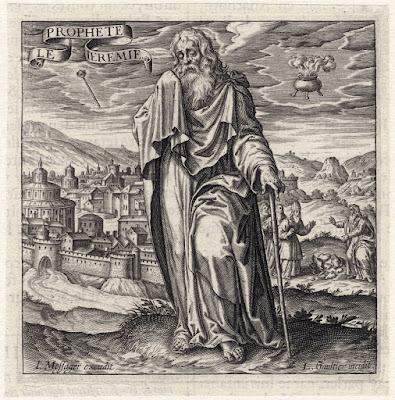
An engraving of the prophet Jeremiah by Léonard Gaultier (1561-1641)

Separated by a few millennia, we might see the folly with this magical type of thinking. Yet, it is just as easy for us to slip into the same mentality. 

Whenever we Americans think that our nation is so great that no one will ever take us over; or when we sincerely believe that because we are a missionary-sending nation that God will protect us; or when we buy into the notion that we can live however we want, but God would never judge us!; after all, we aren’t as bad as other nations!; well, then, we have come under the same condemnation as the Jews of old, we need to hear God’s Word for us today.

Jeremiah’s message was uncompromising. He clearly let the people know that while they have been living their hedonistic lives, God has been trying to talk them. But the people refused to listen. The prophet insisted that having the temple in the city is not some inoculation from keeping enemies at bay.

The prophet Jeremiah asserted that the people must change their ways, start living right, and be fair and honest with each other. They need to stop taking advantage of foreigners, orphans, and widows. They cannot kill innocent people and worship other gods, then turn around and invoke the temple as God’s presence and sanction on their security.

Justice is the responsibility of everyone; there are no favorites with God. The Lord does not favor particular people, ethnicities, or nations above others. Because one is an American, or not, makes no difference. Race and gender don’t come into view.

The sovereign God will hold all people culpable for their violent speech and behavior, no matter who they are or where they are from. Oppression, injustice, and spiritual gerrymandering will be dealt with by Judge Jesus, for both Jew and Gentile, man and woman, Westerner and Easterner, young and old.

For whom God has given much, much will be required. The Lord holds all people accountable for their actions.

Holy God, you still speak today through your Holy Word. Help me to listen well and pay attention to what you are saying so that I might honor you through humility and obedience for the sake of Jesus. Amen.