Lessons From a Genealogy (Ruth 4:18-22)

Now these are the descendants of Perez: Perez became the father of Hezron, Hezron of Ram, Ram of Amminadab, Amminadab of Nahshon, Nahshon of Salmon, Salmon of Boaz, Boaz of Obed, Obed of Jesse, and Jesse of David. (New Revised Standard Version)

No, I didn’t make a mistake about what the verses are for today from the Revised Common Lectionary. Yes, the Old Testament lesson is a brief genealogy. And yes, there is something to learn from this.

The Bible contains a lot of genealogies. Although they may be boring, with names we have difficulty pronouncing, every genealogy serves the same purpose that it does for your own family history.

Genealogies remind us of our connection with past generations. And this interconnectedness has influenced us in profound ways. You and I are the result of what history has produced. We are who we are, to a significant degree, because of the people who came before us.

By listing someone’s descendants in writing, it indicates an ongoing developing story which has happened, and continues to develop up to the present time, and even into the future.

One aspect about biblical genealogies that must be noted: Ancient compilers of genealogical lists did not often include every single person in the genealogy. They typically listed the more significant persons, and left out persons who barely dented history.

That’s because the biblical writer’s purpose in giving a genealogy was not necessarily to be exact and precise about each individual past actor. Rather, the writer usually has a moral and/or theological reason for providing the list.

For the writer of the Book of Ruth, the reason for this genealogy was to establish the bloodline and pedigree of King David. Perez was a son of the patriarch Judah (and Tamar). Boaz was a descendant of Judah. Boaz married Ruth, and they had a son, Obed, who was the grandfather of David.

I hope that you see the grace in every biblical genealogy. Including in our genealogy for today, we have two women, Tamar and Ruth. Both of them were unlikely candidates for producing a king. And even more unlikely to be included in greatest Christian genealogy of them all, the lineage of Jesus (Matthew 1:1-17)

The Gospel writer Matthew included in his genealogical list a note about Boaz. He was the son of Rahab. Yes, the same Rahab who was the prostitute in Jericho, and became a faithful woman included in God’s covenant community. (Matthew 1:5-6)

Ruth was a “heathen” woman from Moab, a nation which historically was hostile to Judah. Yet, through her own pious actions, Ruth became a worthy member of Judah, and listed as a great mother of the Jewish people.

The brief genealogy we have here is a part of an historical continuity in God’s covenant community. From Abraham to Judah to David to Jesus, and to the Christian Church, this both literal and spiritual heritage is brought about through a daughter-in-law of Naomi the Jew, Ruth.

None of us are truly alone. We are all connected as people. And Christians are spiritually linked to the covenant as God’s people, by faith.

Just as Abraham “believed God, and it was reckoned to him as righteousness,” so, you see, those who believe are the descendants of Abraham. And the scripture, foreseeing that God would reckon as righteous the gentiles by faith, declared the gospel beforehand to Abraham, saying, “All the gentiles shall be blessed in you.” For this reason, those who believe are blessed with Abraham who believed. (Galatians 3:6-9, NRSV)

This connection to the past, prevents us from having an over-individualistic faith in God and relationship to the Lord. We belong to the historical and worldwide communion of saints. We, both personally and communally, belong to God.

For the writer of the Book of Ruth, history is important. Genealogy is significant. God’s covenant matters. The Church’s life is bound up in the person of Christ, in King Jesus, Son of David, Son of Boaz and Ruth, Son of Abraham.

Not only do we belong to God, but we also belong to one another. We belong to ordinary people who showed extraordinary faith.

And it is through ordinary people that God works out divine purposes on this earth for the common good of all people.

We have many grandparents in the faith. We are linked to them by faith. There is a mystical spiritual connection that we enjoy with them. And that connection is shared with others of the faith, as well.

For by the grace given to me I say to everyone among you not to think of yourself more highly than you ought to think but to think with sober judgment, each according to the measure of faith that God has assigned. For as in one body we have many members and not all the members have the same function, so we, who are many, are one body in Christ, and individually we are members one of another. (Romans 12:3-5, NRSV)

Blessed Christ, you do not call us servants, but friends—companions on this mission to see love, peace, and hope made known. You do not leave us to fend for ourselves, but invite us into community with you and others. Draw us closer to you and one another, and help us to become companions and confidants in our collective journey of faith and perseverance. Amen.

Learn To Do Right (Isaiah 1:1-4, 16-20)

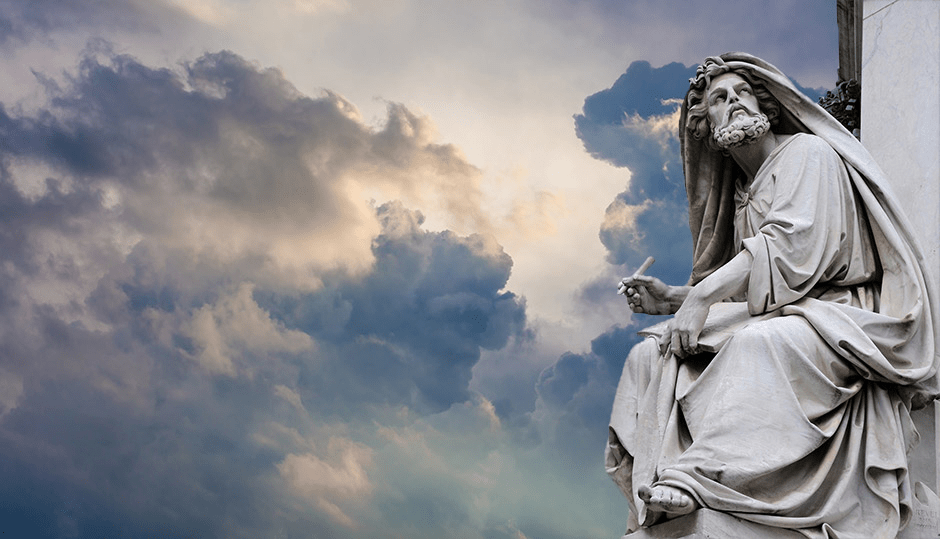
Statue of Isaiah the Prophet, by Salvatore Revelli (1816-1859), Rome, Italy

The vision concerning Judah and Jerusalem that Isaiah son of Amoz saw during the reigns of Uzziah, Jotham, Ahaz and Hezekiah, kings of Judah.

Hear me, you heavens! Listen, earth!
    For the Lord has spoken:
“I reared children and brought them up,
    but they have rebelled against me.
The ox knows its master,
    the donkey its owner’s manger,
but Israel does not know,
    my people do not understand.”

Woe to the sinful nation,
    a people whose guilt is great,
a brood of evildoers,
    children given to corruption!
They have forsaken the Lord;
    they have spurned the Holy One of Israel
    and turned their backs on him…

Wash and make yourselves clean.
    Take your evil deeds out of my sight;
    stop doing wrong.
Learn to do right; seek justice.
    Defend the oppressed.
Take up the cause of the fatherless;
    plead the case of the widow.

“Come now, let us settle the matter,”
    says the Lord.
“Though your sins are like scarlet,
    they shall be as white as snow;
though they are red as crimson,
    they shall be like wool.
If you are willing and obedient,
    you will eat the good things of the land;
but if you resist and rebel,
    you will be devoured by the sword.”
For the mouth of the Lord has spoken. (New International Version)

Whenever the prophet has a vision, everyone better perk up and take notice.

After the northern Jewish kingdom of Israel fell to the Assyrians in 722 B.C.E., they lost their national identity. The southern Jewish kingdom of Judah, and its capitol Jerusalem, continued to exist for nearly a century and a half – even though they were vassals of either the Assyrians or the Babylonians.

Yet, Judah still functioned as its own nation in a semi-independent state. It was during this time that the prophet Isaiah had his vision, under the kingship of those descended from King David.

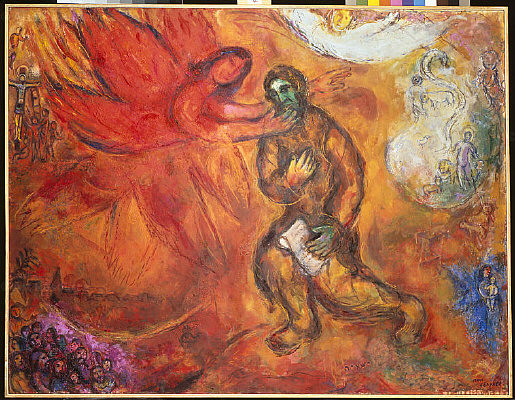
The Prophet Isaiah, by Marc Chagall,1968

The initial section of Isaiah’s prophecy is a series of oracles that establish the relationship between God and the nation of Judah, especially Jerusalem. The gist of God’s message is that the people are guilty of lots of sins.

However, the Lord left a gracious opening for them; their fate was not yet sealed. The nation could repent of their sins and experience a future restoration. God wanted to bring a resolution, and not have the people keep going in their unhealthy ways.

Throughout Isaiah’s vision, God is presented as a Father, with the children being Israel (both northern and southern kingdoms). And Father God has a complaint against them. The people’s principal sins were rebellion and ignorance. They spurned God’s authority, and did not accept their family intimacy with God.

Thus, the Lord is quite disappointed with the people. Heavenly witnesses are called to hear the charges of wrongdoing. The troubles of the nation were to be interpreted as warnings and disciplines, meant to lead them to stop and do right. Yet it seems that the warnings go unheeded by the people. It appears that God’s efforts to woo the people back are in vain.

Although the people’s continued sacrificial worship is merely done as a mere perfunctory act, and without true hearts of devotion for what is just and right, God offered them a chance to make things right, so that they could do justice and embrace righteousness.

God made it clear what it would take to repent: learn to do good; seek justice; recuse the oppressed; defend the orphan; plead for the widow. God even issued an invitation for a divine/human dialogue to happen.

Grace and cleansing from sin are possible, that is, if the people are willing and obedient, instead of remaining rebellious and refusing to do what is right, just, and good.

The nation was at a crossroads and had to make a decision. Would they choose wisely or foolishly?

Decision-making is critical. Some choices are harder than others. Yet the ability to decide is a God-given gift and ability.

Making decisions is fraught with consequences; we may try to anticipate or ignore what might happen with a particular choice. And how we go about decision-making is important. Who do we listen to? What information do we need? How will this choice shake out in the end?

Intentions are not choices, but are simply a mental resolve to do or not do something, at some point. And to not make a decision is to have already made a decision to either procrastinate or not do anything at all.

There are also decisions of duty. This may or may not be admirable. There is also the choice of attitude and energy given to the decision – because a choice of doing one’s duty can be done with joy or grumpiness, excitement or bitterness, with a bright disposition or a flat sullen affect.

It’s not really hard to guess or assess the choices of the people in Judah and Jerusalem in Isaiah’s day. They were doing an outward duty of temple worship, but without any heart to it.

Many of the people looked upon their duty as a sort of magical talisman that would ward off any trouble or army invasion. With that kind of approach, the people looked upon the rest of their time as their own, as discretionary, as the choice to do whatever they wanted to do.

If their business practices were dubious and not quite right, then big deal. After all, they give their money at the temple.

If the leaders played favorites and overlooked the needy person among them, then so what? The poor and oppressed can work harder, right?

And if orphans and widows – who were the most vulnerable persons in society – were not completely cared for, then that’s sad, but too bad for them.

I can picture an ancient city council saying something like, “We have a lot on our plate, dealing with foreign powers, the economy, and political issues. Those needy persons need to get a clue. It’s their own fault for hanging around and not leaving the city for greener pastures. Not our problem.”

Oh, but it very much was their problem. It was everyone’s problem, and each person’s responsibility, to ensure that God’s justice, goodness, and righteousness was infused throughout the entire city and nation.

Hence, the reason for the book of Isaiah. Tackle the moral and ethical problems head on before it’s too late and the gravity of judgment presses everyone out of the land.

What’s needed is a willing heart inclined to walk into divine obedience, without any talkback, and without any negotiations or deals.

God is merciful, and is willing to talk it out. But justice must be done. Needs must be met. People must be cared for. The Lord’s will must be done, here on earth, as it is always done in heaven. Is this what you are about, or not? Will you learn to do right?

Most merciful God, shine the light of your gracious love upon my cold hard heart. Enlighten my mind and dispel the darkness; speak the truth and help me obey; and have pity upon me. Forgive me yet again of my offenses, transgressions, and guilty acts. Grant me the grace to serve you with faithfulness and care for your people with love and purity, today and always. Amen.

Genesis 49:1-33 – The Long View

Blessing of the Twelve Tribes

Then Jacob called for his sons and said: “Gather around so I can tell you what will happen to you in days to come.

“Assemble and listen, sons of Jacob;
listen to your father Israel.

“Reuben, you are my firstborn,
my might, the first sign of my strength,
excelling in honor, excelling in power.
Turbulent as the waters, you will no longer excel,
for you went up onto your father’s bed,
onto my couch and defiled it.

“Simeon and Levi are brothers—
their swords are weapons of violence.
Let me not enter their council,
let me not join their assembly,
for they have killed men in their anger
and hamstrung oxen as they pleased.
Cursed be their anger, so fierce,
and their fury, so cruel!
I will scatter them in Jacob
and disperse them in Israel.

“Judah, your brothers will praise you;
your hand will be on the neck of your enemies;
your father’s sons will bow down to you.
You are a lion’s cub, Judah;
you return from the prey, my son.
Like a lion he crouches and lies down,
like a lioness—who dares to rouse him?
The scepter will not depart from Judah,
nor the ruler’s staff from between his feet,
until he to whom it belongs shall come
and the obedience of the nations shall be his.
He will tether his donkey to a vine,
his colt to the choicest branch;
he will wash his garments in wine,
his robes in the blood of grapes.
His eyes will be darker than wine,
his teeth whiter than milk.

“Zebulun will live by the seashore
and become a haven for ships;
his border will extend toward Sidon.

“Issachar is a rawboned donkey
lying down among the sheep pens.
When he sees how good his resting place is
and how pleasant is his land,
he will bend his shoulder to the burden
and submit to forced labor.

“Dan will provide justice for his people
as one of the tribes of Israel.
Dan will be a snake by the roadside,
a viper along the path,
that bites the horse’s heels
so that its rider tumbles backward.

“I look for your deliverance, Lord.

“Gad will be attacked by a band of raiders,
but he will attack them at their heels.

“Asher’s food will be rich;
he will provide delicacies fit for a king.

“Naphtali is a doe set free
that bears beautiful fawns.

“Joseph is a fruitful vine,
a fruitful vine near a spring,
whose branches climb over a wall.
With bitterness archers attacked him;
they shot at him with hostility.
But his bow remained steady,
his strong arms stayed limber,
because of the hand of the Mighty One of Jacob,
because of the Shepherd, the Rock of Israel,
because of your father’s God, who helps you,
because of the Almighty, who blesses you
with blessings of the skies above,
blessings of the deep springs below,
blessings of the breast and womb.
Your father’s blessings are greater
than the blessings of the ancient mountains,
than the bounty of the age-old hills.
Let all these rest on the head of Joseph,
on the brow of the prince among his brothers.

“Benjamin is a ravenous wolf;
in the morning he devours the prey,
in the evening he divides the plunder.”

All these are the twelve tribes of Israel, and this is what their father said to them when he blessed them, giving each the blessing appropriate to him.

Then he gave them these instructions: “I am about to be gathered to my people. Bury me with my fathers in the cave in the field of Ephron the Hittite, the cave in the field of Machpelah, near Mamre in Canaan, which Abraham bought along with the field as a burial place from Ephron the Hittite. There Abraham and his wife Sarah were buried, there Isaac and his wife Rebekah were buried, and there I buried Leah. The field and the cave in it were bought from the Hittites.”

When Jacob had finished giving instructions to his sons, he drew his feet up into the bed, breathed his last and was gathered to his people. (NIV)

The theme of confidence works its way through the patriarch Jacob’s deathbed prophecies and blessings – a resolute conviction in the promises of God, that he will accomplish what he said he would do. Jacob expressed the hope and sure belief that God would bring the Israelites out of Egypt and into the land of Canaan as their inheritance – and, ultimately to the City of God, the eternal inheritance.

The Christian will find much in Judah’s blessing as the promise of the coming Christ, Jesus. Mentioning the implements of “staff” and “scepter” are symbols of authority. And, the reference to a donkey communicated a ruler was coming, as donkeys were the preferred mounts of royalty in ancient times. What is more, the washing of garments in wine, and eyes darker than wine, are allusions to the future blessing and abundance there will be through the tribe of Judah. In fact, the first miracle of Jesus was turning water into wine – a deliberate attempt by the Apostle John to connect Jesus with Old Testament messianic prophecies of abundance and blessing. (John 2:1-12)

long hallway

It is important for us to take the long view of life, keeping in mind that it took eighteen centuries for Jacob’s prophecy of Judah to occur. This long view is what gives us our confidence in life and provides the patience and perseverance we need right now.  Keeping in mind the big picture of God’s work in this world is necessary because if we do not, we will likely become discouraged with the circumstances we face right now.

The reason Jacob makes it into the great Hall of Faith is not because he was squeaky clean and perfect in how he lived his life, but because he took the long view, the big picture, and saw that God was going to fulfill his promises to Israel:

By an act of faith, Jacob on his deathbed blessed each of Joseph’s sons in turn, blessing them with God’s blessing, not his own—as he bowed in worship upon his staff. (Hebrews 11:21, MSG)

Furthermore, when we string the following three verses together across both Testaments, we see the long view of God’s purposes:

It is true that you planned to do something bad to me. But really, God was planning good things. God’s plan was to use me to save the lives of many people. And that is what happened. (Genesis 50:20, ERV)

For I know the plans I have for you,” declares the Lord, “plans to prosper you and not to harm you, plans to give you hope and a future. (Jeremiah 29:11, NIV)  

And we know that all things work together for good to those who love God, to those who are the called according to his purpose. (Romans 8:28, NKJV)

In the Christian faith tradition, all God’s promises come together and are fulfilled in the person and work of Jesus. He is our salvation, our inheritance, and our hope.  To give our lives to him in complete trust of faith is both our challenge and our privilege.

May we live by faith, and not by fear.

Be present, O merciful God, and protect us through anxious times, so that we who are wearied by the changes of this life may rest in your eternal steadiness. Keep watch, dear God, with those who work, or watch, or weep this night, and give your angels charge over those who sleep. Tend the sick, Lord Christ; give rest to the weary, bless the dying, soothe the suffering, pity the afflicted, shield the joyous; and all for your love’s sake. Amen.