Delivery and Deliverance (Isaiah 66:7-11)

Before she was in labor
    she gave birth;
before her pain came upon her
    she delivered a son.
Who has heard of such a thing?
    Who has seen such things?
Shall a land be born in one day?
    Shall a nation be delivered in one moment?
Yet as soon as Zion was in labor
    she delivered her children.
Shall I open the womb and not deliver?
    says the Lord;
shall I, the one who delivers, shut the womb?
    says your God.

Rejoice with Jerusalem, and be glad for her,
    all you who love her;
rejoice with her in joy,
    all you who mourn over her—
that you may nurse and be satisfied
    from her consoling breast,
that you may drink deeply with delight
    from her glorious bosom. (New Revised Standard Version)

Conception. Happiness. Wondering. Uncomfortable. Preparation. Pain. More pain. Delivery. Exhaustion. Joy. Celebration. New life. Bringing children into this world is a process. And its hard work.

Feeding. Pooping. Sleeping. Exhaustion. More feeding. Lots more pooping. Thank God, more sleeping. Still exhausted. So, when does the mother ever get to eat, go to the bathroom by herself, and sleep? Maybe tomorrow, or maybe in another life….

Despite all of this, there are still words which keep mothers (and fathers) going: Satisfaction. Delight. Awe. Praise. Love. Hope. Faith. Yes, faith. Lots of faith. So much faith that it’s as if the parent puts all their weight on it, and leans into it, perhaps more out of sheer necessity than anything else.

The Christian season of Advent has been growing over the past weeks. It is now large and very ready for Christmas Day and the celebration of the Christmas season (the 12 days from December 25 to the Day of Epiphany on January 6).

But we aren’t quite there yet. There is still the anticipation of birth. The Christ child is coming.

It’s quite something to imagine that God would be so humble as to become humiliated. What a wonder it is, that there is such a thing as an incarnation, that Jesus entered this world as both a human baby and a divine king.

God came to this world for us, on our behalf, to redeem, renew, and restore lost humanity. That’s a lot of love. If you think about it, the mother’s incredible love had to come from somewhere.

Love is what sustains the world. So, love must be nurtured. The feelings of it are not always there within us.

Yet, if we will continually seek to maintain the godliness which is love inside of us, we can find ourselves being little incarnations of Jesus walking about this earth providing succor, without any withholding or hatred.

To love is to love. Without conditions. To love a friend but hate an enemy is to cancel out the love. It must be all love, or it isn’t love, at all.

The person, group, organization, institution, community, or church in a miserable and wretched state is in need of restoration. That is, they are in a great need of receiving love and giving love.

If they have responsibilities toward others, and have been neglectful, they must come to the breast of God. And those who did not receive their due justice and fair recompense must also come.

Advent is more than a season in the year to recognize. And Christ’s incarnation is much more than a doctrine to believe. Advent and incarnation are powerful realities which we must live into.

The good news of this season is that God intervenes effectively to do good for those who are faithful. It’s a newness as sudden and as wonderful as the birth of a baby. The Lord does away with barrenness and hopelessness, and brings new life.

It is this good news that brings out joy. Where once there was mourning and sadness, there is now satisfaction, comfort, and consolation. God is the One who brings it about.

Therefore, it is helpful to remember and recall the words of Jesus to his disciples:

Very truly, I tell you, you will weep and mourn, but the world will rejoice; you will have pain, but your pain will turn into joy. When a woman is in labor, she has pain because her hour has come. But when her child is born, she no longer remembers the anguish because of the joy of having brought a human being into the world. So you have pain now, but I will see you again, and your hearts will rejoice, and no one will take your joy from you. (John 16:20-22, NRSV)

The joy and celebration of this first advent will lead to a second advent, the return of Christ. The peace and satisfaction we may enjoy now is only here in part. The fullness of peace will be ushered in at the end of time.

This is the sort of tension that we must continually maintain, holding together in both hands our sorrow and joy, disappointment and hope, hardship and love, at the same time, all the time, until that day when there is not only a delivery, but a deliverance from all evil.

Lord God, we adore you because you have come to us in the past.
You have spoken to us in the Law of Israel.
You have challenged us in the words of the prophets.
You have shown us in Jesus what you are really like.

Lord God, we adore you because you still come to us now.
You come to us through other people and their love and concern for us.
You come to us through people who need our help.
You come to us as we worship you with others.

Lord God, we adore you because you will come to us at the end.
You will be with us at the hour of death.
You will still reign supreme when all human institutions fail.
You will still be God when our history has run its course.

We welcome you, the God who comes.
Come to us now in the power of Jesus Christ our Lord. Amen.

Sing a New Song (Psalm 98:1-5)

Oh, sing to the Lord a new song!
For He has done marvelous things;
His right hand and His holy arm have gained Him the victory.
The Lord has made known His salvation;
His righteousness He has revealed in the sight of the nations.
He has remembered His mercy and His faithfulness to the house of Israel;
All the ends of the earth have seen the salvation of our God.

Shout joyfully to the Lord, all the earth;
Break forth in song, rejoice, and sing praises.
Sing to the Lord with the harp,
With the harp and the sound of a psalm, (New King James Version)

I still remember, years ago when I was in college, a guy with a pony tail and wearing flip-flops, walking up with a guitar on his back in front of a gathering of fellow students who were Christians.

Yet, most evident, was his broad smile which seemed to engulf his entire face. He talked about his life before Christ – which was all of his life up until the week before – and what Jesus had done for him.

Then, he took his guitar and announced that he wrote a song to this very text, the first few verses of Psalm 98. I wish I had a recording of it, especially because of how he sang it with such volume and exuberance, as if the words had just been crafted yesterday.

Even though the psalm is ancient, the psalmist himself was inviting people to sing a song infused with a new perception of life on this earth.

There is always plenty of room to reflect on what God has done, and is doing, in this very big world. Not only can we consider the immensity and intricacy of the created order, but we can also declare all the things we cannot detect with our five senses.

And perhaps those are the things which impact us the most, when we sense and feel the reality of God’s work in the world, and in our lives. At least that’s what my pony-tailed smiling friend was so excited about.

The things which exist beyond our normal human experience are no less real than our daily mundane activities. This is the realm where the Lord makes the greatest impact of all. God hasn’t only done great things, but has done great things for me.

We have to use metaphors and personifications in order to even begin understanding the wonder and awe of God’s saving power in our very real here-and-now lives. God’s mighty right hand and holy arm of power speak to the incredible strength and authority which can reach into the thickest and nastiest of garbage dumpsters to pull out the pearl of great price, that is, you and me.

Consider God, the One who puts all things right, and is just and good in all things – paying attention to the least of us, and lifting up with divine deliverance from the most dire and awful of circumstances.

Indeed, the Lord has made God’s salvation known, and revealed God’s righteousness to the nations.

Sometimes it takes someone with a fresh new song to wake us up to the reality that we can discern the activity of God every day, in all the ordinary and myriad ways of our lives. Along with all of creation, and pony-tail guy, we join the chorus of those who are already singing with the unique voice God provided for us.

And those many songs all include, at their center, the reality that before I chose God, God chose me; that when I forget, God remembers; that with my waxing and waning of love, God is consistently steadfast and faithful with love; and that God provides salvation, and judges the people with equity, even when I show favoritism.

With each new testimony of God’s saving work, it becomes harder and harder for others to insist that God is absent, hidden, or negligent. God is there. God is here. God is everywhere.

We can get so wrapped up in our own small worlds, and our own little safe places, where everyone looks like me, acts like me, and thinks like me. But the world is much bigger than our contrived spaces in which we can set ourselves up as master and commander.

The Lord mercifully breaks through all of our puny posturing and petulance, and saves us from ourselves. God pushes and cajoles us to see beyond the end of our noses. We are moved to see a new perspective we haven’t noticed before.

And once we make out what God is doing, and does for me, then bursting into song with shouting and volume is the organic response to our experience. If you think about it, there is really no other way to respond, once you have gotten a glimpse of God’s activity, and discerned something that was previously undiscernible.

Even the rocks will cry out in the face of such love and grace.

It’s okay to open your mouth, once your eyes have been opened, and let a new song come tumbling out. Because joy is the response of being delivered from what once bound us.

Gracious and Loving God, you have filled the world with beauty: Open our eyes to behold your gracious hand in all these works; that, rejoicing in your whole creation, we may learn to serve you with gladness; for the sake of him through whom all things were made, your Son Jesus Christ our Lord.

Abundant Life (1 Kings 8:1-21)

Solomon dedicates the Temple at Jerusalem, by James Tissot (1836-1902)

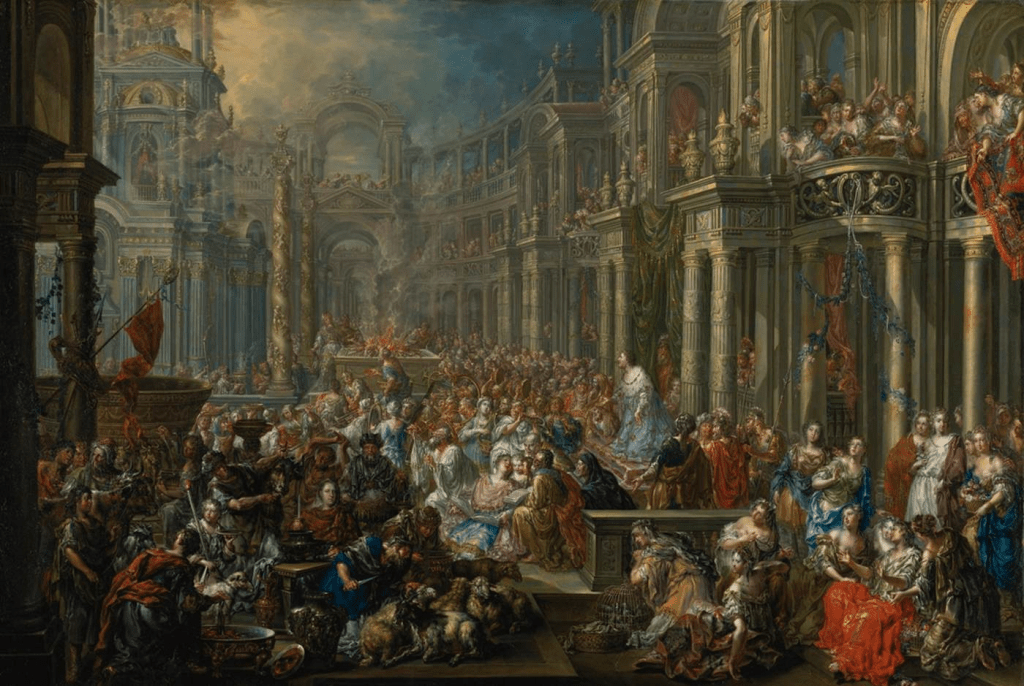
Solomon then summoned to Jerusalem the elders of Israel and all the heads of the tribes—the leaders of the ancestral families of the Israelites. They were to bring the Ark of the Lord’s Covenant to the Temple from its location in the City of David, also known as Zion. So all the men of Israel assembled before King Solomon at the annual Festival of Shelters, which is held in early autumn in the month of Ethanim.

When all the elders of Israel arrived, the priests picked up the Ark. The priests and Levites brought up the Ark of the Lord along with the special tent and all the sacred items that had been in it. There, before the Ark, King Solomon and the entire community of Israel sacrificed so many sheep, goats, and cattle that no one could keep count!

Then the priests carried the Ark of the Lord’s Covenant into the inner sanctuary of the Temple—the Most Holy Place—and placed it beneath the wings of the cherubim. The cherubim spread their wings over the Ark, forming a canopy over the Ark and its carrying poles. These poles were so long that their ends could be seen from the Holy Place, which is in front of the Most Holy Place, but not from the outside. They are still there to this day. Nothing was in the Ark except the two stone tablets that Moses had placed in it at Mount Sinai, where the Lord made a covenant with the people of Israel when they left the land of Egypt.

When the priests came out of the Holy Place, a thick cloud filled the Temple of the Lord. The priests could not continue their service because of the cloud, for the glorious presence of the Lord filled the Temple of the Lord.

Then Solomon prayed, “O Lord, you have said that you would live in a thick cloud of darkness. Now I have built a glorious Temple for you, a place where you can live forever!”

Then the king turned around to the entire community of Israel standing before him and gave this blessing: “Praise the Lord, the God of Israel, who has kept the promise he made to my father, David. For he told my father, ‘From the day I brought my people Israel out of Egypt, I have never chosen a city among any of the tribes of Israel as the place where a Temple should be built to honor my name. But I have chosen David to be king over my people Israel.’”

Then Solomon said, “My father, David, wanted to build this Temple to honor the name of the Lord, the God of Israel. But the Lord told him, ‘You wanted to build the Temple to honor my name. Your intention is good, but you are not the one to do it. One of your own sons will build the Temple to honor me.’

“And now the Lord has fulfilled the promise he made, for I have become king in my father’s place, and now I sit on the throne of Israel, just as the Lord promised. I have built this Temple to honor the name of the Lord, the God of Israel. And I have prepared a place there for the Ark, which contains the covenant that the Lord made with our ancestors when he brought them out of Egypt.” (New Living Translation)

Dedication of Solomon’s Temple in Jerusalem, by Johann Georg Platzer (1704-1761)

I admit, at many times, that I am prone to melancholy. I tend to be quick at accepting blame, and rather slow at owning my good work. Another way of putting this is that it is easier to give than to receive.

Those who have endured a lot of hard circumstances, and persevered through many adversities, can sometimes be reticent to accept the good, the abundant, and the beautiful, whenever it comes to us in this life.

Waiting for the other shoe to drop, far too many people hold back themselves from receiving and enjoying the really good things in life. They worry that the goodness will disappear, or be taken away; and so, they withhold gratitude and blessing, whenever they are in the presence of great abundance.

Just so you know, in case there are those of you who need to hear it spelled out plainly: That’s messed up.

People are meant to be abundantly generous, as well as wildly receptive. It’s likely why there are so many spiritually unhealthy persons in the world.

Bless their hearts, they give a lot, without receiving much, and then their spiritual diarrhea makes it so they can’t give anymore. And they oftentimes give to those who are in such a habit of receiving (and not giving) that the receiver’s spiritual constipation becomes a terrible problem.

Let’s avoid both extremes by letting ourselves both give and receive with equal abandon. No one can be spiritually growing, healthy, and mature without the dynamic of giving and receiving.

Solomon knew how to do both. King Solomon was the king of abundance. He accepted and received big; and he gave and blessed big. Nobody before him or after him received and gave more.

The Temple, in all of its glory and grandeur, with the Ark of the Covenant encrusted with gold as the central object in the building, was all for a God who doesn’t live in houses, a God who is invisible.

In Solomon’s dedication of the Temple, he made it clear that the God of Israel is not, and cannot, be restricted to, or located within, a single place. Thus, the Lord is limitless, and not subject to any human manipulation.

God is free to give with great abandon. And God is also free to take away. Blessed be the name of the Lord God. If we continually try and anticipate or predict what God will do, we will likely be a nervous ball of anxiety all of the time, wondering when the unexpected and/or unwanted will visit us.

It is much better to receive the good things the Lord gives us, and enjoy them while we have them.

“I came that they may have life and have it abundantly.”

Jesus (John 10:10)

Nothing is permanent, with the exception of relationships and love. So, if we can connect the temporal material things of this life in service to the immaterial realities of this universe, then we are in a position to experience peace, joy, and satisfaction.

If and when the material disappears, or is taken away, then it shall neither defeat us, nor destroy us. For our relational connections with God and others exist, and are free flowing, with the energy of gracious receiving and giving as the conduit of abundant life.

Melancholy is important and has its place for us in this present life; yet, so do things like celebration, dedication, joy, exuberance, emotional commitment, and open love. Indeed, to have these in abundance is a reflection of the God of abundance, in whose name we are bold to pray:

God of abundance, you have fed us with the bread of life and cup of salvation; you have united us with Christ and one another; and you have made us one with all your people in heaven and on earth. Now send us forth in the power of your Spirit, that we may proclaim your redeeming love to the world and continue forever in the risen life of Christ our Savior. Amen.

Holding Both Victory and Defeat (2 Samuel 19:1-18)

David mourns the death of Absalom, by Gustave Doré (1832-1883)

Joab was told, “The king is weeping and mourning for Absalom.” And for the whole army the victory that day was turned into mourning, because on that day the troops heard it said, “The king is grieving for his son.” The men stole into the city that day as men steal in who are ashamed when they flee from battle. The king covered his face and cried aloud, “O my son Absalom! O Absalom, my son, my son!”

Then Joab went into the house to the king and said, “Today you have humiliated all your men, who have just saved your life and the lives of your sons and daughters and the lives of your wives and concubines. You love those who hate you and hate those who love you. You have made it clear today that the commanders and their men mean nothing to you. I see that you would be pleased if Absalom were alive today and all of us were dead. Now go out and encourage your men. I swear by the Lord that if you don’t go out, not a man will be left with you by nightfall. This will be worse for you than all the calamities that have come on you from your youth till now.”

So the king got up and took his seat in the gateway. When the men were told, “The king is sitting in the gateway,” they all came before him.

Meanwhile, the Israelites had fled to their homes.

Throughout the tribes of Israel, all the people were arguing among themselves, saying, “The king delivered us from the hand of our enemies; he is the one who rescued us from the hand of the Philistines. But now he has fled the country to escape from Absalom; and Absalom, whom we anointed to rule over us, has died in battle. So why do you say nothing about bringing the king back?”

King David sent this message to Zadok and Abiathar, the priests: “Ask the elders of Judah, ‘Why should you be the last to bring the king back to his palace, since what is being said throughout Israel has reached the king at his quarters? You are my relatives, my own flesh and blood. So why should you be the last to bring back the king?’ And say to Amasa, ‘Are you not my own flesh and blood? May God deal with me, be it ever so severely, if you are not the commander of my army for life in place of Joab.’”

He won over the hearts of the men of Judah so that they were all of one mind. They sent word to the king, “Return, you and all your men.” Then the king returned and went as far as the Jordan.

Now the men of Judah had come to Gilgal to go out and meet the king and bring him across the Jordan. Shimei son of Gera, the Benjamite from Bahurim, hurried down with the men of Judah to meet King David. With him were a thousand Benjamites, along with Ziba, the steward of Saul’s household, and his fifteen sons and twenty servants. They rushed to the Jordan, where the king was. They crossed at the ford to take the king’s household over and to do whatever he wished. (New International Version)

King David learns of Absalom’s death, by Unknown artist, c.1590

King David’s son, Absalom had become a bitter and angry man, especially toward his father. He took his time to build a conspiracy against David, in order to replace him as king. Absalom succeeded in taking Jerusalem.

However, King David escaped with those loyal to him. Although Absalom had the upper hand and could have followed through with overtaking David, a monkey wrench in counsel led to David gaining a fighting chance. It all eventually led to the death of Absalom in battle.

And this is where King David showed yet again the sort of incongruence that, it seems, only a parent can do. His loyal men won the battle, yet Absalom was slain because of Joab, the commander. David’s grief over his son’s loss was palpable; he wept and lamented, despite the great victory that had been achieved against the odds.

Indeed, David experienced the dilemma of being both a father and a king – and it ripped his heart.

Throughout the narratives of David, Joab is presented as a no-nonsense business-like guy. He didn’t have much tolerance for the touchy-feely stuff, and let the king know it. Joab often had a right assessment of things, but conversely, he often spoke and acted in a wrong manner.

Joab essentially picked up a strange parental role of scolding David into facing his present circumstance. The troops needed assurance; and it could only come from the king, whom they were fighting for in the first place.

So, David acquiesced to Joab, and took his public seat, receiving the army as victors. Yet, King David had enough of Joab’s unfeeling shenanigans, and summarily replaced him as commander of the military.

With Absalom dead, and David acting more like a king again, it isn’t long before Israel and Judah receive him back as their king, and take him to Jerusalem to once again rule over the land. David had to discover, yet again, in a new situation what it means to hold both victory and defeat, joy and sorrow, together.

It’s typical for us as biblical readers to ask, “What’s the point of the story?” We tend to like our bottom lines and neat summaries of things. After all, we’re busy people with things to do and people to see. Just give it to me straight, and I’ll go on my merry way.

But Scripture reading doesn’t work like that. It’s not fast food. Scriptural narratives require us to slowly chew on them, to sit with them for a while, and to take the time for reflection, prayer, and listening.

In doing this, we will likely discover that we could read the same story at different times and at various seasons of our lives, and come away with a different “bottom line” in each fresh reading of the text.

This is why I am a committed Bible reader (and thinker!). In some cases, I’ve read the same story hundreds of times. Nearly always, I walk away from the encounter seeing something new or discovering an insight of the text (or myself!) that I had never seen before.

So, these daily Bible reflections are my thoughts of Scripture that I had at a particular time and place. Having said that, I wonder what stirs within you as you read and encounter the story of King David after the death of his son Absalom…

Feel free to share your thoughts.

O Lord, we call upon You in times of both sorrow and joy. Give us the strength and the will to bear our heavy burdens, as well as to wisely carry our manageable ones. In all things, help us feel the warmth and love of Your divine compassion. Amen.