And, let us sing the oldie but goody Christian chorus…
May the Lord bless you, protect you, sustain you, and guard you; May the Lord shine upon you with favor, and surround you with love and kindness; May the Lord look upon you with divine approval, and give you the peace of a tranquil heart and life. Amen.
I am the youngest of five children, and because of that reality I had to follow my siblings in school with many of the same teachers they had. I heard these statements more than once: “Why can’t you be more like your sister?” (the studious valedictorian) and “Why aren’t you like your brother?” (the nice quiet one). I sometimes had this icky feeling in school that I somehow fell short because I wasn’t like them.
The task of the Christian is to imitate Christ – not impersonate Jesus by being someone we are not. God created each of us uniquely and has sovereignly gathered us together as the church. So, we need to strive to be the best individual person possible in imitating Jesus by means of who we are, learning to work together, appreciating one another as we seek to follow Christ.
The Apostle Paul wrote the New Testament letter to the Philippian Church because the fellowship had broken down into some rancorous in-fighting. This left the believers disillusioned. So, Paul passed on four imitations of Christ (not impersonations) to help them (and us) experience the unity God desires for his people.
1. We are to imitate Christ through passing on the right values (Philippians 2:1-2).
Shared values, not smooth sailing, keeps a group of people together. Paul appealed to lived experience. If anyone has experienced encouragement, comfort, fellowship, tenderness, or compassion, then we need to recognize it, remember it, and then pass it on to others. Those values happened because God granted blessings to us through other people. In other words, we owe to others what God has done through others for us.
These common valued experiences occur as we participate in the life of our triune God. They come from the perfect relational dynamic that endlessly occurs within God himself as Father, Son, and Spirt. As we spend time with God and are filled with the divine life, these relational values spill-over in our human interactions.
Passing on encouragement and compassion is not a function of willpower in trying to impersonate Jesus; it is a matter of spending time with God – because people tend to imitate those they hang around. If we spend time with people who typically complain, we will end up constantly cranky. If we hang out with people who continually pray, we will find ourselves reflexively praying about everything. If we are around chronically negative people, we will become constantly unhappy. If we make it a regular practice to hang out with Jesus, we discover that we are imitating him in our relationships through encouragement, love, comfort, and compassion.
The word “joy” pops up a lot in Paul’s letter to the Philippians, yet it is never an exhortation to be joyful but rather an exhortation to unity. The by-product of unity is joy. Joy and happiness are the direct result of unity, and unity comes from embracing the shared common values Paul expressed.
2. We are to imitate Christ through passing on the right service (Philippians 2:3-4).
Humility is the remedy for dissension and disunity. Strife comes from stubbornly guarding our own opinions. Humility, however, considers others better than oneself. We are to do nothing out of selfishness or vain conceit. Instead, we are to imitate Jesus – to take up our crosses and follow him through dying to things which create disunity. Trying to impersonate Jesus results in lording over people and circumstances. It leads to division. However, imitating Jesus results in being like him in his humility and gentleness. It brings unity and peace.
Nik Wallenda is a Christian and a high wire artist. In 2012 he walked a tightrope across Niagara Falls; and, in 2013 he became the first person to high wire walk across the Grand Canyon. Nearly a combined billion people saw those two incredible feats. After every tight rope walk for the crowds, Nik Wallenda engages in a simple spiritual discipline: he walks where the throngs of people just stood and watched him, and quietly picks up their trash.
Wallenda says about this practice, “My purpose is simply to help clean up after myself. The huge crowd left a great deal of trash behind, and I feel compelled to pitch in. Besides, after the inordinate amount of attention I sought and received, I need to keep myself grounded. Three hours of cleaning up debris is good for my soul. Humility does not come naturally to me. So, if I must force myself into situations that are humbling, so be it …. I know that I need to get down on my hands and knees like everyone else. I do it because it is a way to keep from tripping. As a follower of Jesus, I see him washing the feet of others. I do it because if I don’t serve others, I’ll be serving nothing but my ego.”
3. We are to imitate Christ by passing on the right attitude (Philippians 2:5-11).
The Apostle Paul bluntly stated that our attitude is to be the same as Jesus: laying down life for the benefit of others. Impersonating Jesus leads to a martyr complex that wants others see our good works. However, imitating Christ’s attitude is to serve without being concerned who sees it or who gets the credit. It is an attitude of passing on what we have received from God.
In the way of Jesus, the way up is down; the way to gain is by giving; the way to life is through death; the way to praise God is humble service for others. When my grandson was in one of his many hospital stays in the epilepsy ward, I watched him (3 years old at the time and without any prompting) make his way from room to room encouraging other patients and serving them. In the room where a ten year old girl had just had brain surgery with no hair and unattractive bandages, I overheard him say, “Oh, I like your new hat; it looks great on you!” Making his way to the next room of a twelve-year-old boy who was near death, he said, “Would you like a drink? I can get a drink for you!”
I saw parents in the epilepsy ward who were as different from one another as you could imagine. Yet, we all shared a common purpose which gave us a common attitude. We all wanted these kids to be seizure free, and we were doing whatever it took to help each other realize that dream.
Jesus humbled himself and became a man, being obedient to death on a cross, because his purpose was for humanity to be sin-free. Christ did whatever it took to make that happen. If a small little boy can be used of God, then how much can you and I adopt the attitude of Jesus and do whatever it takes to see that people realize freedom in Jesus Christ!?
4. We are to imitate Christ through passing on the right commitments (Philippians 2:12-13).
The Christian life is meant to be lived together with other believers. We can try to impersonate Jesus, which will result in trying to impress the wrong crowd. However, when we imitate Christ, we commit ourselves to the people God has placed in our lives. Just as it was not our choice which family we were born into, so it is not our choice which spiritual family we are born again into. The church is not a voluntary society, any more than a family is. The church belongs to Jesus and we are neither to just fluidly move in and out of it as if it were a hobby that we toy with once-in-a-while, nor treat it as a spectator sport just watching what happens and playing arm-chair quarterback on Monday morning.
Paul exhorted the believers to work out their salvation with fear and trembling. That means we are to live-out our collective salvation together in being mindful of each other. In other words, unity takes a lot of work – work which requires imitating Christ through a shared commitment to one another.
The promise we have is that when we do this kind of good work that it is God who acts to bend everything to his good purposes. This is a wonderful promise, one we need to take to heart with a good dose of godly reverence and awe.
Conclusion
My oldest sister was the valedictorian of her class. I did not follow in her steps. My brother was the kind of kid that teachers envied to have in their classes. I think my teachers wondered if we were from the same family. My other sister was friends with all her teachers, and they all enjoyed her. I just remember getting a lot of sighs and eye-rolling from my teachers. I often struggled with my identity as a kid.
I found my identity in Christ. I discovered I did not have to be like anyone else. God used me for who I am right where I was, learning to imitate Jesus. We need not be worried or discouraged about how far short we fall in comparison to others. Instead, we are to be concerned about how God wants to fulfill all his good promises in Christ through us – because at the name of Jesus every knee will bow and every tongue will confess that Jesus is Lord to the glory of God. We are to pass on to others every good thing we have in Jesus Christ.
Christ’s Church is not so much made up of saints or sinners as it is made up of saintly sinners and sinning saints. The Church is at the same time both beautiful and ugly, holy, and wicked, full of faith and full of fear. The Body of Christ is the place of spiritual sensitivity as well as a den of depravity. So, anyone searching for a squeaky-clean church on a nice upward path of success with everything done to perfection and where no one ever gets hurt or unhappy… it does not exist; and, it never did.
Jesus stands alongside his imperfect people, despite their faults and egotism. Jesus intimately knows our damaged emotions and our open putrid spiritual abscesses. Yet, he treats us with mercy because he never tires of rehabilitating and reforming his Church.
Christ’s disciple, Peter, is the poster child for all the mixed motives and imperfect following of God we experience. For example, Peter stepped out of the boat in great faith and walked on the water, only to begin sinking because of his great fear. It was Peter who made a bold and right confession of faith, and then turned around here in our story for today and bought into Satan’s agenda. And Jesus was right there next to Peter all the way. Christ both rebukes and loves, all the while never abandoning us, but always working in and through us to accomplish his kingdom purposes.
Here is what we need to know or be reminded of today: Following Jesus involves pain and sacrifice because we live in a broken mixed-up world, and, on top of it, Christ’s Church is still imperfect and in the process of becoming holy. If we will admit it, we are all like Peter – a little devil who needs to get in line behind Jesus. (Matthew 16:21-28)
Peter Admonishes Jesus by Unknown artist
We all, at times, get frustrated and/or disgusted with the whole church thing. We can whine and complain and even avoid it. Or, we can commit to taking up our cross, and give our lives for Jesus Christ. We can choose to put love into the church where love is not, even when we do not feel loved. Priest and professor, Ron Rollheiser, once gave the following analogy about staying together around Jesus:
Imagine that the family is home for Christmas, but your spouse is sulking, you are fighting being tired and angry, your seventeen year old son is restless and doesn’t want to be there, your aging mother isn’t well and you are anxious about her, your uncle Charlie is batty as an owl… and everyone is too lazy or selfish to help you prepare the dinner. You are ready to celebrate but your family is anything but a Hallmark card. All their hurts and hang-ups are not far from the surface, but you are celebrating Christmas and, underneath it all, there is joy present. A human version of the messianic banquet is taking place and a human family is meeting around Christ’s birth….
In the same way, here we are, the community of the redeemed. We gather in our imperfect way, a crazy mix of sinner and saint. But we gather in and around Jesus – and that makes all the difference. There is a reason we are here on this earth, a reason much bigger than all our dysfunctional ways and dyspeptic attitudes. Jesus Christ is building-up the people of God and he will keep doing it until the end of the age. In other words, Jesus is not quite finished with us yet; we still have some things to learn about the need for sacrifice.
The need for sacrifice by Jesus. (Matthew 16:21-23)
Jesus stated openly and in detail what must happen. It was necessary for Christ to suffer deeply and die a cruel death; it was God’s will and plan. Yet, good ol’ Peter was not down for this plan, at all. He took Jesus aside and rebuked him, believing him to be off his rocker for even suggesting such a terrible scenario. Jesus, however, turned the tables on Peter and rebuked him right back. Essentially, what Jesus said is that being Christ-centered without being cross-centered is satanic.
The error of Peter was that he presumed to know what was best for Jesus. He believed the suffering of the cross would “never” happen. Peter’s perceptions were dim and limited; he did not clearly see how broken the world really is and how much it would take to heal it. Jesus needed to offer himself as a sacrifice for the sins of the entire planet.
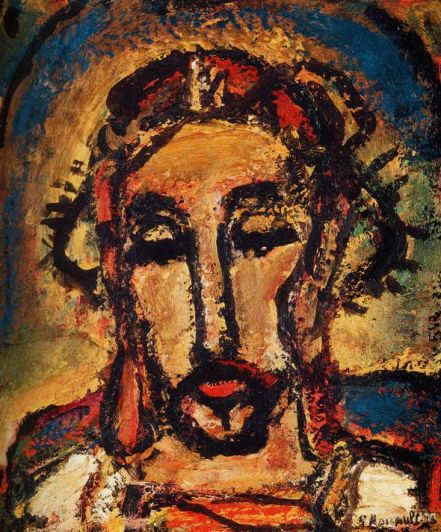
Crucifixion of Christ by Georges Rouault, 1936
Sometimes, like Peter, we might think that the way I see and the way I perceive is the way things really are, or, at least, how they should be. Peter had been walking with Jesus for a few years, watching and enjoying his ministry of teaching, healing, and extending compassion. It was all good for Peter, and, therefore in his mind, it should not change. Peter wanted to hold this moment forever. After all, why try and fix something that is not broken? Oh, but broken the world is – so much so that it required the ultimate sacrifice.
Just because it was good for Peter did not mean it was good for everybody or should always be this way. If Peter were to have his way, we would all be in hell right now; it would not have been good for us. We, like Peter, are finite humans with limited understanding and perceptions. We can easily slip into a satanic mode of believing that because something is going fine for me that everyone else is doing okay, too. I like it, I want it, so what is the problem?
The problem is that we too easily look at life through narrowly selfish lenses, and then cannot see other people’s needs; cannot perceive the lost world around us with any sense of reality; cannot see that Jesus has an agenda very different from our own. Our limited perceptions come out in saying things like, “Oh, she is just depressed because she is avoiding responsibility.” “People on government welfare are lazy.” “He’s addicted because he doesn’t want to help himself.” “They’re demonstrating on the streets because they are a bunch of malcontents.” These, and a legion of statements like it, betray a satanic worldview devoid of grace and a compulsive need to find blame, believing that if there is personal suffering there must be personal sin.
In truth, we are all part of one human family, and we are all in this together; one person’s joys are our joys; one person’s struggles are our struggles. We really are our brother’s keeper. The detachment we can have toward other human beings is completely foreign to the words of Jesus. The Christian life involves suffering, and Jesus invites us to follow him in his way of sacrifice.
The need for sacrifice by the followers of Jesus. (Matthew 16:24-28)
There is a way to reverse demonic thinking. Jesus issues an invitation to practice self-denial, to fall in line behind him, and walk with him in his suffering. Self-denial is not so much doing something like giving up sweets for Lent as it is giving up on ourselves as our own masters. It is the decision to make the words and ways of Jesus the guiding direction for our lives. It is the choice to quit holding onto the way I think things ought to be, and to take the time to listen to Jesus.
The logic of Jesus is relentless. Life comes through death, so, we must give up our lives to find them. It does us no good to adulterate our lives by serving the gods of success and perfectionism. Jesus invites us to quit our moonlighting job with the world and go all in with him. Only in this way will we truly find life.
Jesus was saying more than just submitting to suffering – we are to embrace it. In doing so, we will find reward and joy. For those familiar with this path, they can tell you that suffering is a blessing because they have found the true purpose and meaning of life.
Crucifixion with Lamp by New Zealand artist Colin McCahon, 1947
Few people have suffered as much as the nineteenth-century missionary medical doctor to Africa, David Livingstone. He was a pioneer explorer who opened the interior of Africa to the outside world. He had two reasons for doing so: To be able to take the good news of Christ’s suffering to the African people; and, to open Africa to legitimate trade so that the illicit slave trade would end.
Dr. Livingstone’s hand was once bitten and maimed by a lion; his wife died while on the mission field; he was most often alone on his travels; the one house he built was destroyed in a fire; he was typically wracked with dysentery and fever, or some other illness in the jungle. Someone once commented to him that he had sacrificed a lot for going in the way of Jesus. Livingstone’s response was, “Sacrifice? The only sacrifice is to live outside the will of God.” When asked what helped him get through so much hardship, he said that the words of Jesus to take up his cross were always ringing in his ears.
We may believe we must watch out for ourselves; that we need to push for our personal preferences; that if I accept this invitation to follow Jesus in the way of self-denial I will be miserable and people will walk all over me. Such thoughts are demonic whispers in our ears.
There are two ways of thinking and approaching the Christian life: There is the way which believes success, perfection, and a pain-free life is the evidence of God’s working; while the other way believes that suffering is right and necessary to connect with God and to be in solidarity with those who suffer.
Suffering, rejection, and execution did not fit into Peter’s church growth plan or factor into his view of Messiah. So, I will say it plainly: We do not exist only for ourselves. We do not exist to be a spiritual country club. We do exist to follow Jesus in his path of sacrifice and suffering for a world of people who desperately need to know the grace of forgiveness and the mercy of Christ. Jesus died. We are to die to ourselves. Christ lives; so, we are to live a new life. In God’s upside-down kingdom, joy comes through suffering. We are to follow Jesus as the mix of sinners and saints that we are.
Peter eventually learned his lesson from Jesus. After Christ’s resurrection and ascension, Peter caught fire with courage and boldness – which landed him in hot water with the Jewish ruling council. As a result, he was severely whipped and flogged and told to keep in line. Peter’s response demonstrates how far he had come. He left the experience rejoicing that he had been counted worthy of suffering disgrace for the Name of Jesus Christ. (Acts 5:41)
Max Baer, Jr. playing the incomparable country as corn flakes Jethro Bodine on The Beverly Hillbillies
I rejoiced greatly in the Lord that at last you renewed your concern for me. Indeed, you were concerned, but you had no opportunity to show it. I am not saying this because I am in need, for I have learned to be content whatever the circumstances. I know what it is to be in need, and I know what it is to have plenty. I have learned the secret of being content in any and every situation, whether well fed or hungry, whether living in plenty or in want. I can do all this through him who gives me strength. Yet it was good of you to share in my troubles. Moreover, as you Philippians know, in the early days of your acquaintance with the gospel, when I set out from Macedonia, not one church shared with me in the matter of giving and receiving, except you only. (NIV)
In the English language, the words “you” and “your” can be either singular or plural. Unless, of course, we go with the southern “y’all.” But for a northerner like me, I’ve got to determine which by looking at the context that it’s in. In the language of the New Testament, Greek, we know which words are singular and which are plural because, well, they’re different words which aren’t spelled the same. It’s important to know in the book of Philippians that all the “you” pronouns are plural. That’s important because the theme of unity and solidarity runs affectionately throughout the Apostle Paul’s letter to the Church in Philippi. In fact, for Paul, the reason he gibbers on so much about joy in his letter is because it’s only realized when unity is around. Unity really dills Paul’s pickles.
The entire Philippian church and not just those two really caring parishioners like Uncle Bundlejoy and Cousin Cozysweet, shared in Paul’s troubles with him. The whole kit-and-caboodle partnered with him through financial resources, prayer, and ministry. Paul had confidence that every need the Philippians had would be supplied just as sure as God put worms in sour apples.
They learned a valuable lesson from Paul: that unity through generosity brings contentment in all circumstances and eases anxieties. The Philippian believers got a glimpse of the paradox that through giving they become rich. When tightwad believers are around, a church frets so much they could worry the horns off a billy goat. But when generosity settles in, people are more content than a flea on a pup.
Folks who only care about their personal needs and independent wealth aren’t right in the head – their cornbread’s not done in the middle. God wants everyone to know the blessing of working together in a worthy common cause. Generosity and contentment go together like bacon and eggs. A charitable spirit in a group of people leads to more joy and happiness than a gopher in soft dirt.
Hoarding makes a church more nervous than a long-tailed cat in a room full of rocking chairs. If we want to be free of backbiting and worry, then we need to be wild about generosity. Give like the sun and the whole world grows tall.
Be generous with your money, generous with your words of encouragement toward others, and generous with your gratitude to God. Besides, giving is more fun than a sack full of kittens. And if you do give till you laugh, maybe you’ll see good ol’ Paul standing there grinning like a possum eating a sweet potato.
Generous God, your storehouse of grace and mercy is infinite and unending. Help me to partner with you in a way that makes my generosity flow in the same direction yours does so that Jesus Christ is glorified, and his church is edified through the power of the Holy Spirit. Amen.











 Rev. Tim Ehrhardt