Psalm 100 – Know That the Lord is God

Shout for Joy by Lucy Adams

Shout for joy to the Lord, all the earth.
    Worship the Lord with gladness;
    come before him with joyful songs.
Know that the Lord is God.
    It is he who made us, and we are his;
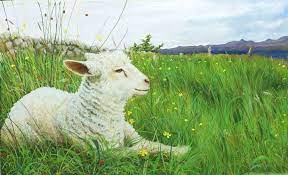
    we are his people, the sheep of his pasture.

Enter his gates with thanksgiving
    and his courts with praise;
    give thanks to him and praise his name.
For the Lord is good and his love endures forever;
    his faithfulness continues through all generations. (New International Version)

The worship of God cannot be contained with one dimension of a person – their spirit. Worshiping God requires the body, mind, and emotions, as well. Anything less, is withholding praise. We are to worship with our entire being.

The original use of today’s psalm was for the ancient Israelites approaching the temple to worship God.  Before worshipers ever came into the presence of the Lord, they were preparing themselves to encounter God through giving thanks, using this very psalm.

When King David and other Hebrew writers penned their poetic songs, they centered what they most wanted to draw attention to in the middle, so that what came before it and after it pointed to that central message. The center of the psalm is:

Know that the Lord is God. Knowing God is to experience the divine through a close relationship. It means we have a place and a purpose. It is a knowing and belonging which exists deep down in our gut.

We get to know God by how he has worked in people’s lives, as well as our own. So, gatherings of believers (whether physical or virtual) are an opportunity to reinforce collective values, strengthen faith, and encourage the discouraged.

Faithful worshipers deeply desire to focus on who God is and what God has done, remembering and rehearsing divine qualities and deeds. Through this activity, we help one another know the Lord. And knowing God is what real life is all about. The Lord is worthy of all the praise, adoration, and worship we can give.

There are three imperatives (commands) that come before the middle phrase to know that the Lord is God; and three imperatives coming after it.  All six imperatives are meant to help us know God better, to give our proper praise to the Lord.

Shout for joy to the Lord, all the earth. Declaring loudly of God’s gracious and loving character, expressed through right, just, and fair actions.

Worship the Lord with gladness. Kneeling and prostrating before God in humble reverence, awe, and adoration.

Come before the Lord with joyful songs. Approaching God’s throne with confidence and boldness.

Those are the three imperatives which lead us to know the Lord. 

The following three imperatives point back to know that the Lord is God:

Enter the Lord’s gates with thanksgiving. Immersing oneself in the presence of God.

Give thanks to the Lord. Giving voice in gratitude to God

Praise the name of the Lord. Declaring God’s holy name with heartfelt expression.

We belong to God. God’s people celebrate this tremendous experience of belonging with deliberate actions that put us in a position to know God better.

I keep asking that the God of our Lord Jesus Christ, the glorious Father, may give you the Spirit of wisdom and revelation, so that you may know him better. (Ephesians 1:17, NIV)

One of my all-time favorite verses in the Bible has to do with knowing God:

I want to know Christ—yes, to know the power of his resurrection and participation in his sufferings, becoming like him in his death.

Philippians 3:10, NIV

Everything in our lives, whether good or bad, is designed to help us know God better. Shared experiences with each other encourage Christians to keep living for Jesus. All of life, from a Christian perspective, points us to the mid-point of history, Jesus Christ, and him crucified, risen, and coming again.

And this is eternal life, that they may know you, the only true God, and Jesus Christ whom you have sent. (John 17:3, NRSV)

So, let us express gratitude today for all the gracious ways of God’s self-revealing and reaching out to save such ones as us.

I pray that out of his glorious riches he may strengthen you with power through his Spirit in your inner being, so that Christ may dwell in your hearts through faith. And I pray that you, being rooted and established in love, may have power, together with all the Lord’s holy people, to grasp how wide and long and high and deep is the love of Christ, and to know this love that surpasses knowledge—that you may be filled to the measure of all the fullness of God.

Now to him who is able to do immeasurably more than all we ask or imagine, according to his power that is at work within us, to him be glory in the church and in Christ Jesus throughout all generations, for ever and ever! Amen. (Ephesians 3:16-21, NIV)

Gracious and almighty God, the One who works on my behalf, give me grace to put away the rootless existence of someone who has no place; and help me to experientially know your radical acceptance and inclusion into the dance of the Trinity – Father, Son, and Spirit – one God, now and forever. Amen.

Grace and peace be yours in abundance through the knowledge of God and of Jesus our Lord. (2 Peter 1:2, NIV)

Amen. Soli Deo Gloria.

Luke 12:29-32 – Be Content

And do not set your heart on what you will eat or drink; do not worry about it. For the pagan world runs after all such things, and your Father knows that you need them. But seek his kingdom, and these things will be given to you as well.

“Do not be afraid, little flock, for your Father has been pleased to give you the kingdom. (New International Version)

If we’re honest with God, we acknowledge that we often worry a lot about tomorrow and how our needs will be met. 

Every day we send God moribund signals that our heads are not in the moment, and that our hearts are not into today. We fret about the future, leaving us profoundly discontent. So, we do busywork, distract ourselves with social media, and numb ourselves with spirits rather than turn to the Holy Spirit – all in the futile attempt to reduce the racing thoughts in our heads.

Far too many of us fail to enjoy the present moment. Our minds are someplace else. 

Contented people do not find their happiness in far-off places, in someday being able to acquire the things they desire, or in having a laser-like orientation to achieving a future goal. Instead, they find contentment in their present circumstances. 

Those living without fear and eschewing worry have discovered that happiness is not found in a new job, a new car, a new spouse, or a new anything.

“If I ever go looking for my heart’s desire again, I won’t look any further than my own backyard because if it isn’t there, I never really lost it to begin with.”

Dorothy, The Wizard of Oz

Focusing on the present does not mean ignoring the past or neglecting the future; it just means we are to put our primary attention on living in the here and now rather than on a romanticized future free of doubt, insecurity, and uncertainty. 

If we are not present to the here and now, we either get stuck in the past or continually worry about the future.  Everything then becomes either about recapturing some bygone era or of dreaming about some idyllic future state – buying into the wrongheaded notion that whenever I get out of school, or get married, or have kids, or get the job I want, or the kids leave home, or I retire, then all will be good, and I shall finally have contentment. 

Planning for the future is wise, good, and necessary; worrying about it and neglecting the present is bad.

Whenever we rush through the present to get to the future, we lose what God wants to do for us now.  It takes flow, mindfulness, and savor to fully engage the present.

“Flow” is a psychological term that means “being in the zone,” that is, to be actively involved in the present situation with focused attention. 

“Mindfulness” means to be aware of your present surroundings, and to especially be aware of your present state of mind and emotions; it is to pay attention to all that is within you and around you. 

To “savor” something is to enjoy it so much that you want it to last forever. It is to be slow, deliberate, and enjoyable. It’s about the journey, not just the destination.

Flow, mindfulness, and savor are what Jesus asked us to do. Christ wants us to stop and smell the roses. He wants us to give focused attention to what is currently in front of us; to be mindful of all the wonder of creation that presently surrounds us; and, to take the time to simply savor and enjoy it all. 

Once I was in a bible study with a group of people and the family’s dog kept licking a particular person to the point of distraction. Finally, I said to the group: “What do you think God is trying to tell us through the dog?”  We ended up having a very enlightening conversation on our own relationships with God and one another.

We are to be present to today. 

This is the day that the Lord has made;
    let us rejoice and be glad in it.

Psalm 118:24, NRSV

When we realize life is short, we will not waste it on worrying about the future. Although we don’t know about tomorrow, we do know about today. And today we are to enjoy God’s good gifts to us in the here and now.

So, teach us to consider our mortality,
so that we might live wisely. (Psalm 90:12, NET)

The wise way to live is one day at a time. That was God’s message through the prophet Jeremiah to the exiled Israelites. The ancient Jews kept spending their time reminiscing about the past and wishing for a better future.  So, God told them what to do in their exile:

“Build homes, and plan to stay. Plant gardens and eat the food they produce. Marry and have children. Then find spouses for them so that you may have many grandchildren. Multiply! Do not dwindle away! And work for the peace and prosperity of the city where I sent you into exile. Pray to the Lord for it, for its welfare will determine your welfare.” (Jeremiah 29:5-7, NLT)

Being content means to enjoy today, to savor the present moment God has you in, even if you don’t like where you are right now.

So go eat your food and enjoy it;
    drink your wine and be happy,
because that is what God wants you to do.
Put on nice clothes
    and make yourself look good.

Enjoy life with the wife you love. Enjoy all the useless days of this useless life God has given you here on earth, because it is all you have. So, enjoy the work you do here on earth. Whatever work you do, do your best, because you are going to the grave, where there is no working, no planning, no knowledge, and no wisdom. (Ecclesiastes 9:7-10, NCV)

Appreciate God’s simple gifts

Sometimes we look so hard for a future miracle, and want out from the circumstance we are in, that we fail to experience contentment in the present time. We are to enjoy the simple pleasures of life which God gives to us, even within our adversity.

I know what it is to be in need, and I know what it is to have plenty. I have learned the secret of being content in any and every situation, whether well fed or hungry, whether living in plenty or in want. (Philippians 4:12, NIV)

No matter what is going on in our lives, whether good or not, we can still appreciate a beautiful sunset, a good book, a walk on the beach, time with friends, good food, and a host of other simple gifts which God provides for us on a daily basis. Yet, we must stop long enough to experience and enjoy them.

Remember to celebrate

We are meant to celebrate life. The genuineness of Christianity is seen whenever Christians throw the best parties and have the most fun.

Someday we are all going to die. Rather than this being a downer, it is an opportunity to ponder an important question: Will you celebrate the time you have here on this earth and enjoy it? 

It’s not hedonistic (living for pleasure) to enjoy life and have a party. It’s actually a biblical thing to do. A spirit of celebration is a Christian spirit.

Work with enthusiasm

Dive in and enjoy your work. We end up worrying whenever our focus is on the destination. However, the real point of life is to enjoy the journey and the process. Be present to your work now and enjoy a job well done for the day, instead of looking forward to a fatter paycheck and a better job in the future.

My God will meet all your needs according to the riches of his glory in Christ Jesus.

Philippians 4:19, NIV

Engage in work with joyful abandon, and not with compulsive perfectionism (which is joyless and life-draining). Find ways of enjoyment within the kind of work that may be draining and not very exciting. Every job has mundane repetitive work to it. Yet, how we go about that work is significant.

If the here-and-now is not the best time of your life, then you and I need to be mindful to the words of Jesus because our focus is somehow misplaced. Contented people focus on the present, what is happening now, today, and they do not worry about tomorrow because that future state is the responsibility of God. 

Ever-present God, enlarge my heart to receive more of your grace and contentment. Rescue me from my small thoughts of your love and goodness. Free me from any unbelief and uncover my many fears. May I rest secure in the knowledge that you are good and everything you do is right, just, and fair. Amen. 

Revelation 1:9-20 – I Am Fully Alive

Notre Dame Cathedral Basilica in Ottawa, Canada

I, John, your brother and companion in the suffering and kingdom and patient endurance that are ours in Jesus, was on the island of Patmos because of the word of God and the testimony of Jesus. On the Lord’s Day I was in the Spirit, and I heard behind me a loud voice like a trumpet, which said: “Write on a scroll what you see and send it to the seven churches: to Ephesus, Smyrna, Pergamum, Thyatira, Sardis, Philadelphia and Laodicea.”

I turned around to see the voice that was speaking to me. And when I turned I saw seven golden lampstands, and among the lampstands was someone like a son of man, dressed in a robe reaching down to his feet and with a golden sash around his chest. The hair on his head was white like wool, as white as snow, and his eyes were like blazing fire. His feet were like bronze glowing in a furnace, and his voice was like the sound of rushing waters. In his right hand he held seven stars, and coming out of his mouth was a sharp, double-edged sword. His face was like the sun shining in all its brilliance.

When I saw him, I fell at his feet as though dead. Then he placed his right hand on me and said: “Do not be afraid. I am the First and the Last. I am the Living One; I was dead, and now look, I am alive for ever and ever! And I hold the keys of death and Hades.

“Write, therefore, what you have seen, what is now and what will take place later. The mystery of the seven stars that you saw in my right hand and of the seven golden lampstands is this: The seven stars are the angels of the seven churches, and the seven lampstands are the seven churches. (New International Version)

“Let every man and woman count himself immortal. Let him catch the revelation of Jesus in his resurrection. Let him say not merely, ‘Christ is risen,’ but ‘I shall rise.’”

Phillips Brooks (1835-1893)

Easter Sunday may have come and gone, but the church remains in the season called “Eastertide,” which extends forty days until celebrating Christ’s ascension to heaven. This means that Easter is not just a one day affair; it is a joyous time of focusing on new life and exulting in the resurrected Lord. 

The Apostle John had a vision of the resurrected Jesus in his glory. Although John was quivering in his sandals, the Lord assured him that he need not be afraid. Christ is not dead but living.

Jesus is alive! Since Christ is risen, God’s people are united with him in his resurrection. That means the church is alive. Yes, the church is a-l-i-v-e, alive! 

The term “dead church” gets bantered around quite a bit these days. But that is really an oxymoron; a genuine Christ redeemed Body of believers cannot possibly be dead; they are alive! 

If a church is dead, it is not a church. It could be a country club, a benevolent organization, and even a moral institution, but a church is not a church if it is dead because Jesus is alive, and his Body is anything but dead.

Christians have life in Jesus Christ. We are alive forevermore because Jesus will never again die. So, then, we are to live as vigorous and vibrant believers. 

What things will you do differently since you know you cannot die? 

How will the knowledge of your eternal alive-ness impact you today and every day? 

The truth is: We have been raised with Christ to new life; we cannot die because death no longer has mastery over us. We can now live by faith in the Son of God who loved us and gave himself for us.

Just as Christ was raised from the dead through the glory of the Father, we too may live a new life.

For if we have been united with him in a death like his, we will certainly also be united with him in a resurrection like his. For we know that our old self was crucified with him so that the body ruled by sin might be done away with, that we should no longer be slaves to sin—because anyone who has died has been set free from sin.

Now if we died with Christ, we believe that we will also live with him. For we know that since Christ was raised from the dead, he cannot die again; death no longer has mastery over him. The death he died, he died to sin once for all; but the life he lives, he lives to God.

In the same way, count yourselves dead to sin but alive to God in Christ Jesus. (Romans 6:4-11, NIV)

“The glory of God is a person fully alive, and the life of a person is the vision of God.”

St. Irenaeus (130-202, C.E.)

Humanity’s alive-ness is what most fully displays the glory of God on this earth. Christ living within the believer is a powerful and potent manifestation of God’s goodness.

Whereas we may think that great miracles are the best sign of God’s presence and power in the world, the truth is that being full alive, and living into the new life we possess, is a bright light which shows the way of transformation to a fallen planet in the vice grip of sin, death, and hell.

God’s generosity, wisdom, and love are supremely viewed with the changed life of an individual. Living life to the full in this post-resurrection era, influences how we treat one another because we nobly honor our fellow humanity as people bearing the divine image of God.

We, therefore, in our alive-ness, seek to understand one another because we know that each person around us is worth understanding. Our being fully alive moves us to cultivate a virtuous life, knowing that a life well-lived is the best witness to God’s glory.

Believers raised with Christ are filled with joy, realizing that living is in itself a great good. We hope to carry this joy into the world and bear witness to the beauty of each human life.

O God, as people fully alive, make us bold in love, courageous in hope, and whole in faith. May the blessing of God almighty – Father, Son, and Spirit – be upon the Church everywhere, today and always, through Christ our risen Lord. Amen.

Hebrews 12:1-3 – Wednesday of Holy Week

As for us, we have this large crowd of witnesses around us. So then, let us rid ourselves of everything that gets in the way, and of the sin which holds on to us so tightly, and let us run with determination the race that lies before us. Let us keep our eyes fixed on Jesus, on whom our faith depends, from beginning to end. He did not give up because of the cross! On the contrary, because of the joy that was waiting for him, he thought nothing of the disgrace of dying on the cross, and he is now seated at the right side of God’s throne.

Think of what he went through; how he put up with so much hatred from sinners! So do not let yourselves become discouraged and give up. (Good News Translation)

“If there is a meaning in life at all, then there must be a meaning in suffering. Suffering is an ineradicable part of life, even as fate and death. Without suffering and death, human life cannot be complete.”

Viktor E. Frankl

We are moving, step by step, inexorably to the cross of Christ. Along the way we will face opposition, ridicule, misunderstanding, and betrayal. We will be befuddled and feel confused. The path of discipleship is not easy.

And yet, on this Holy Wednesday, today’s New Testament lesson informs us that all the suffering of Christ was motivated and animated because of joy. 

The road to the cross, along with the cross itself, is painful, in every sense of the word. None of this tortuous suffering seems joyful, at all! There’s no definition, in any dictionary, of joy including severe spiritual anguish, bodily harm, and emotional shame. Joy isn’t remotely mentioned when talking about betrayal from someone close to you.

Jesus did not relish the pain. He was no masochist. Pain with no purpose is nothing but tragic despair. Rather, Jesus clearly understood what the end of his suffering would accomplish: the saving of many lives.

It is most necessary that we do not try to sanitize Christ’s death.

Although many beautiful crosses can be found in stores, the cross of Jesus was anything but lovely to look at. It was bloody. The cross was a harsh implement of torture and execution, meant to expose the condemned to public shame.

Trying to make sense of this great sacrifice on our behalf can be difficult. No earthly illustration or word-picture can begin to adequately capture the idea of vicarious suffering. Perhaps, then, we may understand the necessity of discipline, effort, endurance, and yes, pain, in order to accomplish a goal. We know from agonizing experience that the realization of our most important goals requires a great deal of blood, sweat, and tears. 

In a former life I was a cross country runner (back far enough for Sherman to set the way-back machine). Whenever I was running on a road or a golf course, I would sometimes get that very nasty and sharp pain in my side while running. It is called a side cramp, or side stitch. 

If you have never experienced such a cramp, the pain feels like an intense stabbing, as if someone were taking a knife and twisting it inside you. Runners know there’s only one thing to do when this occurs: Keep running through the pain, and then it will subside in a few minutes. To stop running only exacerbates and prolongs getting over the hurt, not to mention losing a race.

Jesus endured the cross knowing he was going to experience terrible excruciating pain. He also knew that avoiding the shame and agony would only make things worse; it wouldn’t take care of the problem of sin. 

Jesus persevered through the foulness and degradation of the cross for you and me. All of the wretched pain was worth it to him. Christ did not circumvent the cross; he embraced it so that the result would be people’s deliverance from guilt and shame, death and hell. 

The end game of Christ’s redemptive work on the cross was joy over deposing the ruler of this dark world and obliterating the obstacles to people’s faith.

Suffering often does not fit into our equation of the Christian life. However, it needs to. No suffering, no salvation. Since Jesus bled and died for us, it is our privilege to follow him and walk with him along the Via Dolorosa, the way of suffering. 

Holy Week is a time to reflect and remember on such a great sacrifice, and to consider our Christian lives in the face of such great love. On this Wednesday, allow yourself to feel the bittersweet experience of simultaneous pain and joy – the very real bitterness of seeing the Lord crucified, along with the exultation of joy over being washed clean by the blood of the Lamb.

Gracious Lord Jesus, I give you eternal thanks for your mercy toward me through the cross. It is a small thing for me to follow you even it means great suffering on my part. My life is yours. Use it as you will, through the power of the Holy Spirit. Amen.