Receive the Blessing (Genesis 48:8-19)

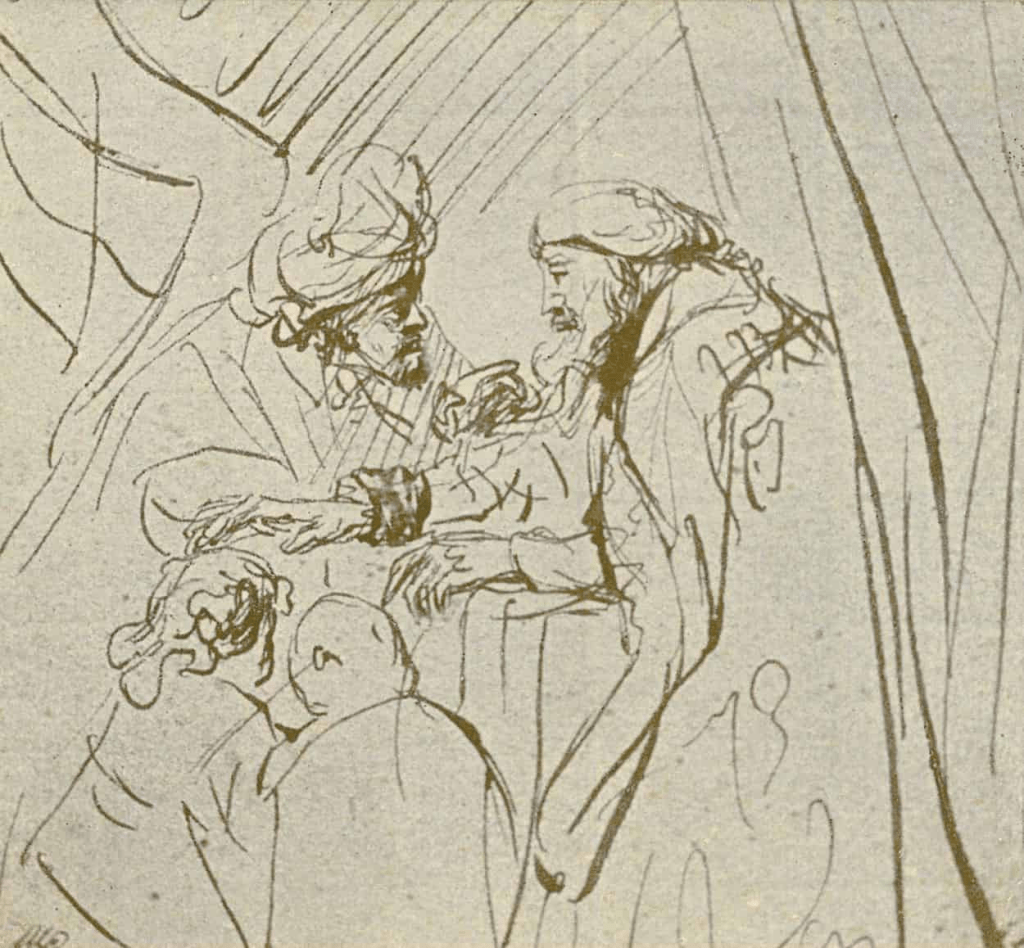
Jacob Blessing Ephraim and Manasseh, by Rembrandt van Rijn (1606-1669)

When Israel saw the sons of Joseph, he asked, “Who are these?”

“They are the sons God has given me here,” Joseph said to his father.

Then Israel said, “Bring them to me so I may bless them.”

Now Israel’s eyes were failing because of old age, and he could hardly see. So Joseph brought his sons close to him, and his father kissed them and embraced them.

Israel said to Joseph, “I never expected to see your face again, and now God has allowed me to see your children too.”

Then Joseph removed them from Israel’s knees and bowed down with his face to the ground. And Joseph took both of them, Ephraim on his right toward Israel’s left hand and Manasseh on his left toward Israel’s right hand, and brought them close to him. But Israel reached out his right hand and put it on Ephraim’s head, though he was the younger, and crossing his arms, he put his left hand on Manasseh’s head, even though Manasseh was the firstborn.

Then he blessed Joseph and said,

“May the God before whom my fathers,
    Abraham and Isaac, walked faithfully,
the God who has been my shepherd
    all my life to this day,
the Angel who has delivered me from all harm
    —may he bless these boys.
May they be called by my name
    and the names of my fathers, Abraham and Isaac,
and may they increase greatly
    on the earth.”

When Joseph saw his father placing his right hand on Ephraim’s head he was displeased; so he took hold of his father’s hand to move it from Ephraim’s head to Manasseh’s head. Joseph said to him, “No, my father, this one is the firstborn; put your right hand on his head.”

But his father refused and said, “I know, my son, I know. He too will become a people, and he too will become great. Nevertheless, his younger brother will be greater than he, and his descendants will become a group of nations.” (New International Version)

Jacob Blessing Ephraim and Manasseh, by Frederick Pickersgill (1820-1900)

Jacob (Israel) was on his deathbed. His son, Joseph, was in charge of all Egypt. Jacob had Joseph bring his two sons to him so that he could bless them. Joseph fully expected that his father would follow the convention of primogeniture, that is, the elder son receives a double inheritance. But that is not what happened. Jacob purposely went against normal convention.

It was not, however, against biblical convention. In the stories of Ishmael and Isaac, Esau and Jacob, the rights of the first-born are superseded by the promises of the next-born.

Family rules, ethnic customs, and cultural procedures are fine. Yet, when those practices become inflexible laws which are never to be different, then we get into trouble. Joseph had an expectation of how the blessing of his sons was to go. Jacob had another idea about it.

“We’ve never done it that way before,” are the seven last words of any institution. Any group organized around that belief is doomed. If we cannot make a distinction between the letter and the spirit of a law, rule, or custom, then our inflexibility will eventually break us.

In the ancient world, and even in many cultures today, birth order determines how things go with families, societal rights, and personal obligations. The firstborn occupies an esteemed position. In Judaism, when the temple still stood, the first fruits and firstborn of animals were considered the best sacrifices.

By blessing the younger son, and going against expected convention, Jacob taught future generations a valuable lesson: A person’s actions and character matter more than birth order. What’s more, being blessed first or last or whenever is not what guarantees future success.

Jacob had firsthand knowledge and experience that life is unpredictable and requires faith in God. One’s life cannot be projected and determined along an upward linear trajectory. We cannot predict what will happen in our lives by laying things out with Cartesian coordinates. Ultimate control belongs to God, not us. And that’s a good thing, because the Lord is good, all the time.

Our Lord, everything you do
    is kind and thoughtful,
and you are near to everyone
    whose prayers are sincere.
You satisfy the desires
    of all your worshipers,
and you come to save them
    when they ask for help.
You take care of everyone
who loves you,
    but you destroy the wicked. (Psalm 145:17-20, CEV)

It’s best to trust in pure goodness than to rely upon human ingenuity. Abraham – who was not a firstborn son, but the youngest of three – received the call from God to receive blessing. Isaac inherited the birthright over his older half-brother Ishmael. Jacob himself received the birthright over his older twin brother Esau. And Joseph, next to the youngest in a long line of sons from Jacob, was the clear head of the clan.

In matters of human faith and divine promises, birth order and typical cultural mores don’t apply. More important is fidelity to God, concern for one’s fellow humanity, and upholding love for the family. And it is these very things that are important going forward. Inevitably, suffering comes. And when it does, birth order, primogeniture, and societal expectations aren’t going to get you through it.

It is likely that the main reason why some folks embrace the adage “we’ve never done it that way before” is because of fear. Doing the same thing over and over again, even if it isn’t helpful anymore or is useless in a particular situation, still feels normal and secure. Moving out in faith is scary; we don’t really know how things are going to shake out.

This is why our concept and understanding of God is so crucial. A good God acts on our best interests and does not act with malevolence toward us.

I prayed to the Lord, and he answered me;
    he freed me from all my fears.
The oppressed look to him and are glad;
    they will never be disappointed. (Psalm 34:4-5, GNT)

Only obeying the letter of the law leads to fear. Only acknowledging the spirit of the law results in bondage. Only by observing both the letter and the spirit of the law will we experience freedom from fear and deliverance from anxious striving for blessing.

Blessing is given freely by the God who delights in doing so. Let the Lord bless you in the ways God wants to do so.

May God have mercy on you, bless you, and show you kindness, today and every day. And may the grace of the Lord Jesus, the love of God the Father, and the encouragement of the Holy Spirit be with you, now and forever. Amen. 

To Forgive Is Divine (Genesis 50:15-26)

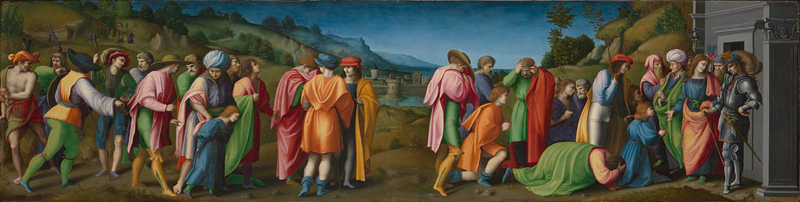
Joseph pardons his brothers, by Bacchiacca (1495-1557) http://www.nationalgallery.org.uk/paintings/NG1219

When Joseph’s brothers realized that their father was now dead, they said, “What if Joseph bears a grudge against us, and wants to pay us back seriously for all of the terrible things we did to him?” So they approached Joseph and said, “Your father gave orders before he died, telling us, ‘This is what you should say to Joseph. “Please, forgive your brothers’ sins and misdeeds, for they did terrible things to you. Now, please forgive the sins of the servants of your father’s God.”’” Joseph wept when they spoke to him.

His brothers wept too, fell down in front of him, and said, “We’re here as your slaves.”

But Joseph said to them, “Don’t be afraid. Am I God? You planned something bad for me, but God produced something good from it, in order to save the lives of many people, just as he’s doing today. Now, don’t be afraid. I will take care of you and your children.” So he put them at ease and spoke reassuringly to them.

Thus Joseph lived in Egypt, he and his father’s household. Joseph lived 110 years and saw Ephraim’s grandchildren. The children of Machir, Manasseh’s son, were also born on Joseph’s knees. Joseph said to his brothers, “I’m about to die. God will certainly take care of you and bring you out of this land to the land he promised to Abraham, to Isaac, and to Jacob.” Joseph made Israel’s sons promise, “When God takes care of you, you must bring up my bones out of here.” Joseph died when he was 110 years old. They embalmed him and placed him in a coffin in Egypt. (Common English Bible)

“All people commit sins and make mistakes. God forgives them, and people are acting in a divine way when they forgive.”

Alexander Pope, “An Essay on Criticism”

If there was anyone who had a supposed right to be bitter and unforgiving, it would be Joseph. His brothers had hated him, left him for dead, sold him into slavery, and lied to their father Jacob about him. For years, Joseph languished in servitude and prison – for no fault of his own.

And yet, Joseph was able to discern that it wasn’t his place to be the judge. At the end of his life, he had the perspective and the insight to understand that all the hardship earlier in his life was noticed by God, and then bent for good and divine purposes in the saving of many lives.

If we can keep in mind that it is God’s business to run the world, and our business to forgive others, then life will go a lot better for everyone.

Many people live discontented lives because they say to themselves, “I will not forget what you did, and I will not forgive.” Persistent thoughts of revenge only serve as a cancer that destroys the mind’s thoughts, erodes the soul, and hinders the heart’s ability to love. 

But people who practice forgiveness are much less likely to be hateful, hostile, and belligerent toward others. They are healthier and happier, and more at peace.

I’ve had many people tell me over the years, “But you don’t know what I’ve been through.” My typical response is, “You don’t know what I’ve been through, either. You may not even believe some of the things I have experienced, and some of the things that have happened to me and were said to me. So, can I tell you what I have done to forgive those who have sinned against me?”

1. When I am trying to forgive someone, I pray for them.

It’s hard to keep resenting someone and wish them ill, whenever you are praying for them on a regular basis. Joseph was the victim of his brothers’ abuse. If there was ever a dysfunctional family to grow up in, it was Joseph’s. Being sold into slavery by your own brothers and being the target of their derision would cause anyone to be upset. But, many years later, Joseph chose to forgive his brothers. He acted with their best interests at mind. He prayed for them and did not actively work against them. What’s more, he saw the hand of God in it all.

2. I write a letter of forgiveness (which I may or may not send).

In the letter I write in full detail how the person hurt me. I leave nothing out. I express exactly how it made me feel, and how it affected my life. Then, I express forgiveness and say that I will not hold the offense over their head. The following is a five-step process for forgiving others using the acrostic REACH:

Recall 

Name the hurt, and name it squarely. Don’t fudge by saying it’s not that bad, or as bad as others have experienced. Call it what it is: deceit, stealing, harassment, assault, abuse, adultery, verbal shaming, murder, etc. 

The Truth and Reconciliation Commission in South Africa after apartheid was based on providing full disclosure of all crimes. Those that stepped forward, giving a complete account of their actions, were offered a full pardon. 

Archbishop Desmond Tutu, who led the commission, was most struck by how many people wanted to hear what had happened to their loved ones from the perpetrators themselves so that they could know whom to forgive. Methinks we have much to learn from our African brothers and sisters.

Empathize

Try and see the offense from the other person’s perspective. Attempt to put yourself in the other’s shoes. This does not mean we paper over the offense; it just means we don’t demonize another as a monster. That only feeds and fuels our own lack of forgiveness. When we view others as non-human, then we feel no responsibility to forgive.

Altruistic

Choose to do the right thing and treat the other person well, not necessarily because they deserve it, but because it is within your control to extend grace. Again, this is what Joseph chose to do with his brothers. He gave them words of assurance, and promises of taking care of them and their children.

Commit

Commit to practicing forgiveness. Make the decision to do it. Don’t wait too long for your feelings to catch up to you.  

Bear with each other and forgive one another if any of you has a grievance against someone. Forgive as the Lord forgave you.

The Apostle Paul (Colossians 3:13, NIV)

Hold

Hold on to your forgiveness. Just because you make the decision to forgive does not mean you’ll never have to do it again. Once you have forgiven, let it be a stake in the ground in which you look back to it again and again, saying, “I forgave him/her, and I will not let the enemy of my soul keep trying to make me bitter about it all over again.” 

One of the reasons we repeat the Lord’s Prayer Sunday after Sunday in my church is to keep forgiving those who have sinned against us.

3. I talk to a trusted friend, mentor, or counselor about my effort to forgive.

Many people get stuck and have an inability to forgive because they don’t seek a wise person to help them walk through the process of forgiving. 

The easy path is to complain about the offense to someone we know who will react with the same level of disgust and spirit of revenge that we ourselves have in our hearts. But that only reinforces the bitterness. We must have someone who can offer us what we need to hear, and not only what we want to hear.

Forgiveness is at the heart of the gospel, and, so, ought to be at the core of a healthy spiritual life. It is always open season on offering grace, forgiveness, and reconciliation. To see all of life from a divine perspective is to forgive.

Pray like this:

Our Father who is in heaven,

uphold the holiness of your name.

Bring in your kingdom

so that your will is done on earth as it’s done in heaven.

Give us the bread we need for today.

Forgive us for the ways we have wronged you,

just as we also forgive those who have wronged us.

And don’t lead us into temptation,

but rescue us from the evil one.

If you forgive others their sins, your heavenly Father will also forgive you. But if you don’t forgive others, neither will your Father forgive your sins. (Matthew 6:9-15, CEB)

See the Big Picture (Genesis 41:37-57)

The proposal pleased Pharaoh and all his servants. Pharaoh said to his servants, “Can we find anyone else like this, one in whom is the spirit of God?” So Pharaoh said to Joseph, “Since God has shown you all this, there is no one so discerning and wise as you. You shall be over my house, and all my people shall order themselves as you command; only with regard to the throne will I be greater than you.” And Pharaoh said to Joseph, “See, I have set you over all the land of Egypt.” 

Removing his signet ring from his hand, Pharaoh put it on Joseph’s hand; he arrayed him in garments of fine linen and put a gold chain around his neck. He had him ride in the chariot of his second-in-command, and they cried out in front of him, “Bow the knee!” Thus he set him over all the land of Egypt. 

Moreover, Pharaoh said to Joseph, “I am Pharaoh, and without your consent no one shall lift up hand or foot in all the land of Egypt.” Pharaoh gave Joseph the name Zaphenath-paneah, and he gave him Asenath daughter of Potiphera, priest of On, as his wife. Thus Joseph gained authority over the land of Egypt.

Joseph was thirty years old when he entered the service of Pharaoh king of Egypt. And Joseph went out from the presence of Pharaoh and went through all the land of Egypt. During the seven plenteous years the earth produced abundantly. He gathered up all the food of the seven years when there was plenty in the land of Egypt and stored up food in the cities; he stored up in every city the food from the fields around it. So Joseph stored up grain in such abundance—like the sand of the sea—that he stopped measuring it; it was beyond measure.

Before the years of famine came, Joseph had two sons, whom Asenath daughter of Potiphera, priest of On, bore to him. Joseph named the firstborn Manasseh, “For,” he said, “God has made me forget all my hardship and all my father’s house.” The second he named Ephraim, “For God has made me fruitful in the land of my misfortunes.”

The seven years of plenty that prevailed in the land of Egypt came to an end, and the seven years of famine began to come, just as Joseph had said. There was famine in every country, but throughout the land of Egypt there was bread. 

When all the land of Egypt was famished, the people cried to Pharaoh for bread. Pharaoh said to all the Egyptians, “Go to Joseph; what he says to you, do.” And since the famine had spread over all the land, Joseph opened all the storehouses and sold to the Egyptians, for the famine was severe in the land of Egypt. 

Moreover, all the world came to Joseph in Egypt to buy grain, because the famine became severe throughout the world. (New Revised Standard Version)

Mosaic of Joseph overseeing the gathering of grain during the seven years of plenty, c.1275 C.E., St. Mark’s Basilica, Venice, Italy

It’s easy to get lost and miss the forest for the trees; we may become too involved in the details of a problem to look at the situation as a whole. Whenever we are in the middle of hard times, it can be difficult to see the big picture of what’s really going on.

Joseph had been in a peck of trouble. He literally found himself deep in trouble by being tossed into a dark hole of a well by his jealous brothers. Then, the same brothers turned around and pulled him up, only to sell him in slavery to a caravan heading for Egypt. (Genesis 37)

While in Egypt, Joseph became the head servant in the household of Potiphar, the captain of the guard for Pharaoh. But again, trouble found Joseph, even though the guy was diligent and squeaky clean in his moral living. Mrs. Potiphar had eyes for Joseph – who did not reciprocate her advances. There’s no wrath quite like a woman’s scorn, and off to jail Joseph went. (Genesis 39)

In prison Joseph waited… and waited. It seemed as though he had been forgotten. And although he had come to be in charge of his fellow inmates because the jail keeper trusted him so much, Joseph was still in the place of bondage. (Genesis 40) So, what would you do if you were in similar circumstances?

Blame others. Bellyache. Bully your way around with a chip on your shoulder. Become bitter about the ways you’ve been shafted and the brunt of injustice. Those are things that many of us might do in the throes of one injustice after another. But not Joseph.

Holy Scripture has no record of Joseph responding with complaint nor discouragement. Joseph seemed to have a sense that there were larger forces at work behind the scenes – that God could be trusted to work out the adverse situations for divine purposes.

So, when Joseph went from the bottom slug in a prison to the top dog in Egypt, the big picture became much more clear. From age 17 to age 30, Joseph labored as the right hand servant in charge of Potiphar’s household, and then as the right hand man to the jail keeper in prison. Now, Joseph becomes the right hand to Pharaoh, the administrator over all of Egypt.

All along, the Lord was getting Joseph ready for something supremely large – life and death sort of stuff. It turns out that, with Joseph in charge, tens of thousands of lives may have been spared because of his insight, foresight, and hindsight.

Joseph had divine insight as an interpreter of dreams – a gift which he acknowledged was given to him by God. He had the foresight and wisdom to take that insight and turn it into a solid administrative plan for saving many lives from a terrible famine. And Joseph continually had the benefit of hindsight in knowing who he was and where he came from – believing that he was part of a specially called family whom the Lord had a divine hand upon.

Every experience, each event, and the myriad mundane tasks which Joseph had to endure for 13 long years were like individual bricks being mortared together into a building which would eventually house enough life-learning to accomplish a life-saving governmental administration which kept food on the table for thousands of people.

Perhaps you and I don’t always get to see what’s going on above us, what is truly being worked out to bring help and justice to the world. Yet, we can rest assure that there is a God in heaven who sees, cares, and is planning salvation for people. And we are part of that large divine plan, if we have the faith to understand there is more going on than our present circumstances and physical eyes can see.

Righteous God and Father of all: Raise up among us people who keep faith alive, hope awakened, and love abundant. Guard our daily vocations and set them apart for your good purposes. Grant us the privilege of seeing our daily work accomplish the saving and blessing of many lives. Renew us in your mercy, sanctify us with your Spirit, and redeem our time so that we may serve you and steward well our lives, through Jesus Christ our Lord. Amen.

Forgotten, but Blessed (Genesis 40:1-23)

Joseph, the cupbearer, and the baker in prison, by Gerbrand van den Eeckhout, 1643

Sometime later, Pharaoh’s chief cupbearer and chief baker offended their royal master. Pharaoh became angry with these two officials, and he put them in the prison where Joseph was, in the palace of the captain of the guard. They remained in prison for quite some time, and the captain of the guard assigned them to Joseph, who looked after them.

While they were in prison, Pharaoh’s cupbearer and baker each had a dream one night, and each dream had its own meaning. When Joseph saw them the next morning, he noticed that they both looked upset. “Why do you look so worried today?” he asked them.

And they replied, “We both had dreams last night, but no one can tell us what they mean.”

“Interpreting dreams is God’s business,” Joseph replied. “Go ahead and tell me your dreams.”

So the chief cupbearer told Joseph his dream first. “In my dream,” he said, “I saw a grapevine in front of me. The vine had three branches that began to bud and blossom, and soon it produced clusters of ripe grapes. I was holding Pharaoh’s wine cup in my hand, so I took a cluster of grapes and squeezed the juice into the cup. Then I placed the cup in Pharaoh’s hand.”

“This is what the dream means,” Joseph said. “The three branches represent three days. Within three days Pharaoh will lift you up and restore you to your position as his chief cupbearer. And please remember me and do me a favor when things go well for you. Mention me to Pharaoh, so he might let me out of this place.For I was kidnapped from my homeland, the land of the Hebrews, and now I’m here in prison, but I did nothing to deserve it.”

When the chief baker saw that Joseph had given the first dream such a positive interpretation, he said to Joseph, “I had a dream, too. In my dream there were three baskets of white pastries stacked on my head. The top basket contained all kinds of pastries for Pharaoh, but the birds came and ate them from the basket on my head.”

“This is what the dream means,” Joseph told him. “The three baskets also represent three days. Three days from now Pharaoh will lift you up and impale your body on a pole. Then birds will come and peck away at your flesh.”

Pharaoh’s birthday came three days later, and he prepared a banquet for all his officials and staff. He summoned his chief cupbearer and chief baker to join the other officials. He then restored the chief cupbearer to his former position, so he could again hand Pharaoh his cup. But Pharaoh impaled the chief baker, just as Joseph had predicted when he interpreted his dream. Pharaoh’s chief cupbearer, however, forgot all about Joseph, never giving him another thought. (New Living Translation)

Joseph, the cupbearer, and the baker, by Alexander Ivanov (1806-1858)

It is a sinking (and stinking) feeling to be forgotten, as if no one cares. But we know God cares. And we also know Joseph did nothing wrong. How did he get to this point of being left in a prison? What’s up with that?

Joseph’s Story

The story of Joseph (Genesis 37, 39-50) is one of the longest narratives in the Old Testament. Joseph was next to the youngest of 12 sons born to their father Jacob. Rachel was Jacob’s favorite wife and Joseph’s mother – which also made Joseph one Jacob’s favorites. This didn’t go down well with the rest of the sons. Joseph’s brothers (unbeknownst by Jacob) sold him into slavery.

Joseph was taken to Egypt and became the servant of Pharaoh’s captain of the guard, Potiphar. Joseph distinguished himself as competent, skillful, and virtuous. It was actually his integrity which got him into prison. Refusing to sleep with Potiphar’s wife, she became an angry woman and accused Joseph of something he didn’t do. The captain promptly dispatched him to jail.

Human Hatred and Unfaithfulness

Joseph became a slave in Egypt because of jealousy, hatred, and lack of faithfulness on the part of Joseph’s brothers. They disowned him, sold him, and rid themselves of him. The brothers wanted to forget Joseph, and they did.

Furthermore, Joseph became a prisoner in Egypt because of anger, hate, and betrayal of faith. Potiphar’s wife didn’t get what she wanted from Joseph, so she lied and fumed, landing Joseph in a dank prison. He was left without another thought – forgotten and jailed for no fault of his own.

And just when we think the story might turn around, and Joseph will be freed from his unjust imprisonment, the chief cupbearer (wine steward) promptly forgot him and said nothing to Pharaoh after he was out of jail and restored to his position. Once again, Joseph is the undeserved recipient of unfaithfulness. He remains in prison for another two years. Oy.

As much as we might like to get past all these unjust and maddening situations, Holy Scripture does not let us off the hook so easily. We have to sit with Joseph for a while, and feel what he feels, experience what he experiences, so that we can learn our own lessons from him.

Whether we like it, or not, suffering is a reality. And yet, although sometimes forgotten by humanity, we are remembered by divinity….

Divine Presence in the Middle of Suffering

God is present with us through hardship and adversity. Joseph’s story sets up the contrast between fickle humans and a faithful God. A lot of people in Joseph’s life let him down. But God was there as the continual divine presence throughout every circumstance, both good and bad…

  • God gifted Joseph and had special plans for him. God was with Joseph in his dreams. (Genesis 37:5-11) 
  • God was with Joseph, so that he succeeded in everything he did; the Lord caused all that Joseph did to prosper. (Genesis 39:2-3)
  • God showed Joseph steadfast love, and gave him favor in the sight of the chief jailer. The jailer did not worry about anything, because the Lord was with Joseph and made him successful in all that he did. (Genesis 39:21, 23)
  • God was present with Joseph in helping him interpret dreams, even in difficult situations. (Genesis 40:8)

God’s presence makes a difference. The Lord met Joseph in his suffering – yet did not leave him there. God entered Joseph’s suffering, was present with him while in it, and eventually brought him out of it, to another and better place. And in the process, God blessed others through Joseph.

Not only did Joseph survive, but he also thrived in the middle of injustice. God quietly went about the business of using Joseph as an agent of blessing everywhere he was sent: To Potiphar and his household; to the chief jailer and all those in prison; and then to Pharaoh and all of Egypt.

In the end, even the conniving and caballing brothers receive blessing — through Joseph. In this way, the Lord was fulfilling the divine promise to Abraham — that he and Sarah and their descendants would be blessed; and that through them, all the nations of the earth would also be blessed.

God is present with those in suffering. Yet, the way God works almost never seems fast enough for those who are suffering. We, along with the psalm writers, cry out, “How long, O Lord!?”

In situations, such as Joseph’s, it won’t do to offer platitudes to “Let go, and let God,” “Everything works for good,” or “God never gives us more than we can handle.” Sheesh. I doubt anyone in life-or-death situations relies on nifty phrases. They want God, and they understandably want God now.

Whether quick or slow, hard or unbearable, the biblical promise nevertheless stills stands that God meets us in our suffering. And God does not leave us there. God also calls us and moves us to more pleasant places. And know this: In the process and in the journey, God will bless others through us.

O God:
Give me strength to live another day;
Let me not turn coward before its difficulties or prove passive to its duties;
Let me not lose faith in other people;
Keep me sweet and sound of heart, in spite of ingratitude, treachery, or meanness;
Preserve me from minding little stings or from giving them;
Help me to keep my heart clean, and to live so honestly and fearlessly that no outward failure can dishearten me or take away the joy of conscious integrity;
Open wide the eyes of my soul that I may see good in all things;
Grant me this day some new vision of truth;
Inspire me with a spirit of joy and gladness;
and make me the cup of strength to suffering souls;
in the name of the strong Deliverer, our Lord and Savior, Jesus Christ. Amen.