Second Sunday of Advent – Prepare the Way (Luke 3:1-6)

The Call from John the Baptist to Repent, by Renier de Huy, 12th century

In the fifteenth year of the reign of Tiberius Caesar, when Pontius Pilate was governor of Judea, and Herod was ruler of Galilee, and his brother Philip ruler of the region of Ituraea and Trachonitis, and Lysanias ruler of Abilene, during the high priesthood of Annas and Caiaphas, the word of God came to John son of Zechariah in the wilderness. He went into all the region around the Jordan, proclaiming a baptism of repentance for the forgiveness of sins, as it is written in the book of the words of the prophet Isaiah,

“The voice of one crying out in the wilderness:
‘Prepare the way of the Lord;
    make his paths straight.
Every valley shall be filled,
    and every mountain and hill shall be made low,
and the crooked shall be made straight,
    and the rough ways made smooth,
and all flesh shall see the salvation of God.’ ” (New Revised Standard Bible)

In this Christian season of Advent, we are reminded that God is not only high above us, transcendent, far away; God is also close to us, immanent, and with us.

We remember at this time of year that God does not remain distant, but entered our time and space at a particular moment in history, for a distinct purpose.

The Roman Empire was powerful, large, and very much in control of every place where it existed. The litany of imperial rulers and authorities which the Gospel writer Luke listed is meant to give us a feel of the Roman weight, and how much Roman might was ensconced in Judea.

The world at the turn of the common era was under the dominion of powerful people with lots of influence. But God did not come to any of them. Instead, God came to a loner – a man who spent his time out in the wilderness. His name was John, the son of Zechariah. We know him as John the Baptist.

With God coming to John at a precise point of time in a particular place, that made John a prophet with a singular message. John was born for this. (Luke 1:76)

It is fitting that a man hanging out on the fringes of society all by himself would be the one to prepare the way for Messiah.

After all, Messiah’s message would be one of bringing good news to the poor, proclaiming release to prisoners, and freeing those who are oppressed. (Luke 4:18-19; Isaiah 61:1-2)

God’s prophetic calling for John was one of preparation. John was to prepare the way of the Lord. He was to get the people ready to receive Messiah.

John went about his ministry of preparation by calling folks to repent, to change their minds and amend their ways, so that there might be forgiveness.

In a reference from the prophet Isaiah, Luke alluded to Jewish exiles returning from their Babylonian captivity. The actual physical road from Babylon to Jerusalem was a hard journey due to the distance and topography.

The “road” or the “way” in Holy Scripture is also a metaphor for the spiritual journey we take in this life. And that road has a lot of challenges to it. The very act of walking as a pilgrim over a long arduous journey changes a person.

It is rarely the destination that makes a person; it’s the journey itself which leads one to a changed life of thinking differently, and seeing things from a perspective we’ve never seen before.

The smoothing out of the road is a way of saying God is making it easier for people to return to the Lord, to get them ready for a new life with promises fulfilled and unexpected joy.

In other words, valleys raised and mountains flattened represent God’s efforts at helping us experience a complete transformation of life. The Lord will do everything possible to make renewal and restoration happen for us.

The Lord will set things right. In our contemporary world that is now largely controlled by powerful oligarchs and the super-rich, God will turn it upside-down. All of the world’s current powerful people will find themselves looking up, not down.

It would be nice and reassuring if I could give you certainty about the journey ahead. But I cannot do that. Yet, what I can do is assure us of what is at the end of the road. Look beyond the current days of self-centered leadership and popular ignorance, and understand that all flesh shall see the salvation of God.

Prepare the way of the Lord. We do that by how we go about walking the road. Each step we take every day is important and makes a difference. And when we stumble, there is plenty of grace to help get us back on our feet and moving forward.

We are all collectively journeying together to Bethlehem. And as we daily move and walk, at the end of our journey, Jesus is there.

But when the fullness of time had come, God sent his Son, born of a woman, born under the law, in order to redeem those who were under the law, so that we might receive adoption as children. (Galatians 4:4, NRSV)

And nothing can stop us or separate us from the love of God that is in Jesus Christ our Lord.

For I am convinced that neither death, nor life, nor angels, nor rulers, nor things present, nor things to come, nor powers, nor height, nor depth, nor anything else in all creation will be able to separate us from the love of God in Christ Jesus our Lord. (Romans 8:38-39, NRSV)

The journey may be arduous. You might feel like giving up. But Jesus is our Immanuel, God with us. In him, is our hope and our joy.

O Holy One of Israel, out of the embrace of mercy and righteousness, you have brought forth joy and dignity for your people. Remember now your ancient promise; make straight the paths that lead to you, and smooth the rough ways, so that in our day we might bring forth your compassion for all humanity. Amen.

Confronting the Evil in Front of Us (Mark 6:14-29)

St. John the Baptist rebuking Herod, by Giovanni Fattori (1825-1908)

King Herod heard of it, for Jesus’s name had become known. Some were saying, “John the baptizer has been raised from the dead, and for this reason these powers are at work in him.” But others said, “It is Elijah.” And others said, “It is a prophet, like one of the prophets of old.” But when Herod heard of it, he said, “John, whom I beheaded, has been raised.”

For Herod himself had sent men who arrested John, bound him, and put him in prison on account of Herodias, his brother Philip’s wife, because Herod had married her. For John had been telling Herod, “It is not lawful for you to have your brother’s wife.” 

And Herodias had a grudge against him and wanted to kill him. But she could not, for Herod feared John, knowing that he was a righteous and holy man, and he protected him. When he heard him, he was greatly perplexed, and yet he liked to listen to him. 

But an opportunity came when Herod on his birthday gave a banquet for his courtiers and officers and for the leaders of Galilee. When his daughter Herodias came in and danced, she pleased Herod and his guests, and the king said to the girl, “Ask me for whatever you wish, and I will give it.” And he swore to her, “Whatever you ask me, I will give you, even half of my kingdom.” 

She went out and said to her mother, “What should I ask for?” She replied, “The head of John the baptizer.” Immediately she rushed back to the king and requested, “I want you to give me at once the head of John the Baptist on a platter.” The king was deeply grieved, yet out of regard for his oaths and for the guests, he did not want to refuse her. 

Immediately the king sent a soldier of the guard with orders to bring John’s head. He went and beheaded him in the prison, brought his head on a platter, and gave it to the girl. Then the girl gave it to her mother. When his disciples heard about it, they came and took his body and laid it in a tomb. (New Revised Standard Version)

Feast of Herod with the Beheading of St John the Baptist, in the Museo del Prado, Madrid, Spain

The earthly life and mission of Jesus was connected to the social and political affairs of Judea and the Roman Empire. In truth, Christ’s impact is never only ethereal; rather, it smacks against every system and organization in this world.

John the Baptist’s death was closely connected to Christ’s mission and ministry; and it was also a result of the social and political forces John was subjected to. This would explain why Herod thought of Jesus as a resurrected John, after killing him. Both the messages of John and Jesus were met with resistance by the powers that be.

Marriages in the ancient world, especially among governmental officials, were primarily political affairs, and not love arrangements. The more authority and power a person had, the greater the political implications and impact there was. And marriage was one way of consolidating more power.

Herod’s marriage to Herodias may have been politically expedient, but was ethically repugnant, and John let him know about it. Herod was both a Jew and a Roman official, with his actual allegiance being to himself.

Herodias considered John as politically repugnant and found it unethically expedient to silence him once and for all when she had the opportunity. John the Baptist discovered first-hand that hell hath no fury like a woman’s scorn. Herodias hated him and waited for an opportune time to be rid of him once and for all.

But not only did Herodias orchestrate John’s demise, she did it in a way that sought to humiliate him. To die in battle at the hand of an enemy soldier was an honorable death; but to be executed because of a woman’s handiwork was a mark of shame.

Anyone who lives for God and speaks truth to power will nearly always suffer deep consequences. Hence, this is why a great many prophets ended up dead, often by tortuous methods – including Jesus and nearly all his original disciples.

Unfortunately, there are individuals in this world who are incapable of doing good.

Whenever such persons talk a good line, or do a good deed, it’s always in the service of a larger evil agenda. They often end up in positions of authority, simply because they have no scruples and will lie to you with a straight face.

And they will do anything to not only hold on to their power, but to acquire more so that they can be in control of everything around them. Of course, the people around such a person are miserable. They typically feel powerless to change the situation.

So, if there’s going to be transformation, there will need to be a prophet – someone like John the Baptist – who has the courage to speak truth to power and remind the world that God is the sovereign of the universe.

The Gospel writer Mark presents Herodias as a person with influence and power who only cares about her own interests. She had no scruples in using her daughter for malevolent purposes.

Whereas the young daughter of the synagogue ruler Jairus was (earlier in Mark’s account) raised to life by Jesus, in today’s story the young daughter of Herodias became the vehicle of a grisly murder. And, of all things, it’s this girl who brought the severed head of John the Baptist on a platter to her mother.

We are meant to see the impact and consequence when those in power have self-centered objectives and dark hearts. This is in direct contrast to both Jesus Christ and John the Baptist, both of whom gave their lives for that which is right, just, and good.

God’s mercy and redemption will eventually overwhelm all of creation. The cross and resurrection of Christ have won the victory over evil. Yet, until Christ returns, the dark forces of this old world know their time is short; and they are doing everything they can to throw a monkey wrench into the benevolent machine of grace, before the demonic forces themselves are thrown into the pit forever.

Christian mission and ministry was never designed to be easy nor pain-free. But it is meant to bring hope, love, redemption, peace, and satisfaction to all who believe.

Christ has connected himself to us. Let’s keep that gracious connection going by doing what is right and living a good and just life, and confronting the evil in front of us – to the glory of God. Amen.

The Lamb of God (John 1:29-34)

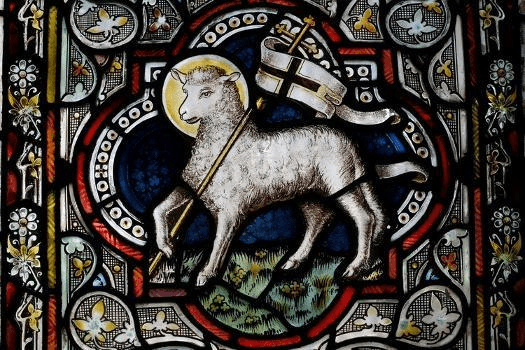
Stained glass of the Agnus Dei (Lamb of God), Chamonix, France

The next day John saw Jesus coming toward him and said, “Look, the Lamb of God, who takes away the sin of the world! This is the one I meant when I said, ‘A man who comes after me has surpassed me because he was before me.’ I myself did not know him, but the reason I came baptizing with water was that he might be revealed to Israel.”

Then John gave this testimony: “I saw the Spirit come down from heaven as a dove and remain on him. And I myself did not know him, but the one who sent me to baptize with water told me, ‘The man on whom you see the Spirit come down and remain is the one who will baptize with the Holy Spirit.’ I have seen and I testify that this is God’s Chosen One.” (New International Version)

The Gospel of John is all about finding and seeing Jesus – and then believing. Jesus is seen from various angles, namely because, as the embodiment of God, he requires a multi-perspectival look. In today’s lesson, we see John the Baptist exhorting everyone to take a look at Jesus as the Lamb of God.

Throughout the Apostle John’s Gospel, we see the gradual unfolding of belief amongst people, including the faith of John the Baptist. The Baptist’s initial understanding was that he was in the presence of someone of much greater worth than himself. Only by means of God’s Spirit is John able to gain increased insight concerning Jesus.

It’s important to point out that faith is never a static sort of thing. Rather, faith is always moving in a direction; it’s dynamic. Faith is more than a gift that’s put in a box and given and received. There is continual discovery to faith. It’s as if we’ve been given the gift of a Russian doll, and there are ever-increasing gifts within the gift. There are multiple levels of belief to explore and discover.

Spiritual insight is an initial gift of faith. There is, however, more. With insight there follows the ability to distinguish between material and immaterial realities. This is one reason why the Gospel of John can be difficult to understand – because within one verse, statement, or story, there are double, even triple, meanings to it.

John often invites us to see the spiritual reality that is there underneath the physical. It will take eyes of faith to see, because sheer physical sight will not see the entire reality. And at the end of faith is Jesus, to confess and believe that he is indeed the very Son of God.

The Holy Spirit in today’s lesson actually serves as the divine witness to John the Baptist’s burgeoning development of faith in Christ; John sees Jesus not only as coming from God, but as God.

The confirming voice of the Spirit at the baptism of Jesus lets everyone know that this Lamb of God, Jesus, the Son of God, will take away the sin of the world in his eventual Passover death.

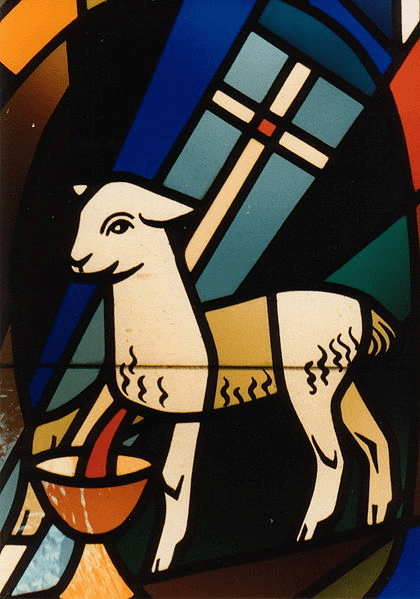
Stained glass of the Agnus Dei, El Cajon, California

To take away sin means to remove it and purify the person from it. John’s increased understanding discerns that his words and his baptism with water don’t bring this removal and purification; but they do point to Jesus. Christ as the one who is able to immerse people in the cleansing bath of grace.

Jesus Christ is qualified and able to call, gather, and cleanse not only Israel, but also the world and all the scattered children of God. Thus, John the Baptist’s ministry is to reveal Jesus to Israel; it’s directed to the entire world and to the taking away of the world’s great sin, once and for all.

The reference to Jesus as the “Lamb of God” is a familiar one to Christians. Lambs are common throughout the Bible. A lamb, however, that takes away sin is somewhat novel (although a scapegoat symbolically takes aways Israel’s sin into the desert, Leviticus 16:8-10). Passover lambs, lambs offered twice daily and in several offerings and acts of worship, were a part of many guilt and purification rituals in the Old Testament. (Leviticus 9:1-13; 14:1-13)

It seems to me that the Apostle John understood Jesus as the Lamb which removes sin by being the representative and once for all sacrifice to end all sacrifices. There is no longer any need to keep offering these various lambs day after day, festival after festival, year after year; Jesus is the efficacious one who ends it all and finally purifies and atones with potent deliverance from sin.

Day after day every priest stands and performs his religious duties; again and again he offers the same sacrifices, which can never take away sins. But when this priest [Jesus] had offered for all time one sacrifice for sins, he sat down at the right hand of God, and since that time he waits for his enemies to be made his footstool. For by one sacrifice he has made perfect forever those who are being made holy. (Hebrews 10:11-14, NIV)

And what is more, it’s this same Lamb of God who will again show up – even though slain, and yet lives – to gather together all the nations of the earth, lead them as the singular Good Shepherd, vanquish all the enemies who oppose goodness, and establish divine light in a sort of eternally lit menorah that blesses the world. (Revelation 5:6-12; 6:1; 7:17; 14:1: 1714; 21:22-23)

The baptism with water of Jesus by John the Baptist, therefore, confirmed and anticipated the baptizing (purifying) work of the Holy Spirit that only Jesus would accomplish. For John baptized with water, but Jesus baptizes with both water and Spirit – demonstrating his singular ability as Savior and Lord.

In this Christian season of Epiphany, Jesus – the Lamb of God who takes away sin and purifies with the Spirit – is Christianity’s eternal light and life.

The bright star still compels people to come and see, as well as leads the little Christs called “Christians” to take their light and let it shine wherever they go. It is a light of mercy and mystery, grace and goodness, wonder and wisdom. It is, I believe wholeheartedly, the light the world needs in order to bring an end to division and connect one another in peace and goodwill.

May it be so, to the glory of God. Amen.

Baptism of the Lord (Mark 1:4-11)

The Baptism of Jesus, by Rosalind Hore

So John the Baptist showed up in the desert and told everyone, “Turn back to God and be baptized! Then your sins will be forgiven.”

From all Judea and Jerusalem crowds of people went to John. They told how sorry they were for their sins, and he baptized them in the Jordan River.

John wore clothes made of camel’s hair. He had a leather strap around his waist and ate grasshoppers and wild honey.

John also told the people, “Someone more powerful is going to come. And I am not good enough even to stoop down and untie his sandals. I baptize you with water, but he will baptize you with the Holy Spirit!”

About that time Jesus came from Nazareth in Galilee, and John baptized him in the Jordan River. As soon as Jesus came out of the water, he saw the sky open and the Holy Spirit coming down to him like a dove. A voice from heaven said, “You are my own dear Son, and I am pleased with you.” (Contemporary English Version)

Why is the baptism of Jesus important?    

The baptism of the Lord is a regular staple each year on the Christian Calendar, because Christ’s baptism is a theologically profound event that announces the fact of his divinity in a dramatic way. The story of his baptism helps us understand Christ’s identity, as well as his mission.

Because God the Father acknowledged Jesus as God the Son, we are encountering God’s will for us through the words and actions of Christ. Jesus is the hinge upon which all history turns. The centrality of Jesus for everything we say and do is confirmed and expected through the event of his baptism.

Baptism is a ritual that signals new life. Jesus came to be baptized by John in the Jordan River – not because he personally needed to repent of sin – but so that he might identify with us as humans and signal for us the true way of life for people.

Jesus’ Baptism, by Laura James

With the Father’s affirmation of Christ, the Lord Jesus is our authority. All authority on heaven and earth has been given to him. He is the author and finisher of our faith. So we must pay careful attention to Jesus.

Here we are, two millennia removed from the earthly ministry of Christ. For some, the name of Jesus might be so familiar that they end up ignoring him. Or, others might become so disappointed with Jesus that, over time, they simply slip away from him. That’s why the author of the book of Hebrews exhorted: 

We must give our full attention to what we were told, so we won’t drift away. The message spoken by angels proved to be true, and all who disobeyed or rejected it were punished as they deserved. So if we refuse this great way of being saved, how can we hope to escape? The Lord himself was the first to tell about it, and people who heard the message proved to us that it was true. (Hebrews 2:1-3, CEV)

By remembering our own baptisms, and the authoritative claim Christ has upon us, we are able to keep what is most important in front of us at all times.

Why is the descent of the Holy Spirit significant?

If God the Father established the authority of Jesus over all things, then the Holy Spirit coming upon Jesus empowered him to exercise that authority over everything, especially the demonic realm. Jesus was given the Spirit so that he would confront evil in the world.

Our own baptisms are a participation in the baptism of Christ. We receive the same power. We are called to the same practice of self-denial in order to confront evil in our lives and in the world. The descent of the Spirit in Christ’s baptism opens to us a road of carrying our cross daily, and losing our lives in order to save them.

In Christ, we died to guilt and shame. We were baptized into Christ, and were therefore baptized into his death.  That means Jesus has opened the way for us to live a new life and no longer be slaves to sin. It furthermore means that we have been given the Spirit to deal with the continuing presence of sin in this life. 

Through Jesus Christ the Spirit of life set us free from sin and death. Therefore, we have been given the power to resist the devil and set our minds on what the Spirit desires. 

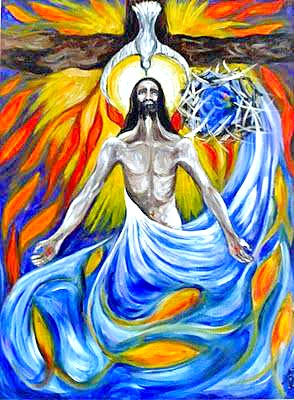
Baptism of Christ, by He Qi

So, we have an obligation, and it’s not to the sinful nature. Our responsibility is to put to death the misdeeds of the body. We can do this because we have not been given a spirit that makes us slaves to fear, but have received the spirit of sonship. (Romans 8:1-17)

Thus, God is not only Father of Jesus, but our Father, as well. We can cry “Abba and have all the help of heaven behind us in our quest to follow Jesus. This is all possible because of the descent of the Spirit in Christ’s baptism – a baptism that we participate in through our own baptisms.

How does heaven opening help me today?

Heaven was ripped and torn open, letting us know the striking reality that God does not remain far away, but has come near to us in the Son, the Lord Jesus.

Long ago in many ways and at many times God’s prophets spoke his message to our ancestors. But now at last, God sent his Son to bring his message to us. God created the universe by his Son, and everything will someday belong to the Son. God’s Son has all the brightness of God’s own glory and is like him in every way. By his own mighty word, he holds the universe together. After the Son had washed away our sins, he sat down at the right side of the glorious God in heaven. (Hebrews 1:1-3, CEV)

Heaven was again ripped open at the death of Christ. The curtain of the temple that separated the inner sanctuary from everything else was torn in two from top to bottom – signifying that once and for all, God is near, and has become close to us in the person of Jesus Christ.

So whenever we are in need, we should come bravely before the throne of our merciful God. There we will be treated with undeserved grace, and we will find help. (Hebrews 4:16, CEV)

What is our appropriate response to the baptism of the Lord?

Since Jesus is the rightful ruler of the universe; the authority over all things; a faithful high priest always living to intercede for us; the power to transform and give new life; the Deliverer from sin, death, and hell; then our proper response is confession, repentance, and the expectation of change.

The Lord’s baptism exposes all the things we rely upon other than Jesus, such as our own ability to set goals and accomplish them through sheer willpower; ideas and ingenuity; hard work and experience.

Yet we can rely on Jesus, and have the sort of change that he can bring. Rather than expecting everyone else, and every circumstance to change, God calls us to change through the empowering presence of the Holy Spirit – the same Spirit given to Jesus.

We have the opportunity and the invitation to trust Jesus. Just as it took humility for Jesus to be baptized by John in the Jordan River, so it takes humility for us to come to Christ and admit our need for help and inner transformation.

Almighty ever-living God,
who, when Christ had been baptized in the River Jordan,
and as the Holy Spirit descended upon him,
solemnly declared him your beloved Son,
grant that your children by adoption,
reborn of water and the Holy Spirit,
may always be well pleasing to you. Amen.