“Why, God!?”

why god

“Why, God!?” is a refrain expressed by all kinds of people and, most likely, by you at some point in your life.  That’s because we all face suffering, on some level.  The circumstances might vary from person to person, but we all have been touched by this fallen world and experience some sort of brokenness.

Brokenness of either/both body and soul comes in all shapes and sizes.  Yes, it sometimes is the result of our own foolish and/or self-destructive choices.  But sick bodies, broken spirits, and damaged souls are just as likely to occur simply because we live in this world that’s askew from how it should be.  In other words, sometimes we really are victims of disease, accidents, natural disasters, and mysterious evil that we have trouble putting a name to.

In such situations, it’s very normal of the human condition to cry: “Why, God!?”  I like honesty, and this is an honest question.  Personally, I don’t “poo-poo” people who are frank and sincere with God.  Yes, sometimes that question is only rhetorical – not really asking a question but expressing anger.  That’s okay, too, because God is more than big enough to handle a question asked in frustration, even rage.  Even a cursory reading of the book of Psalms reveals David’s emotions of not understanding many of his situations and exactly what he’d like to see happen.  Sometimes he pukes some awfully raw feelings onto God – and those emotionally charged words made their way as being a part of the Bible.

I get it.  Suffering is an unwanted companion, and we’d like to send it packing and have nothing to do with it.  Yet, suffering and the evil it can wreak is not outside the purview of God.  As heinous and as powerful as suffering might manifest itself, it is never beyond God’s capacity to touch it with resurrection power.

The answer to our “why?” question is, frankly, not usually answered – and even if it does get answered, sometimes we don’t like what we hear.  I want to make an observation about the New Testament Gospels and the life of Jesus, and I want you to consider it for a moment.  The observation is this:

Jesus never explained evil and suffering. 

Christ did not send out fliers and emails for a seminar on suffering from a divine perspective to be held at the downtown Jerusalem Hilton.  Instead, Jesus, the supreme Pastor, was present with people in their pain and wondering.  Jesus Christ did not provide cerebral answers to questions; he asked his own questions and filled people with God’s grace, forgiveness, and love.

Jesus encountered people in their concrete real-live struggles and trouble, and, when a group of five-thousand people were hungry, he asked, “Who will feed them?” and when folks were struggling with how to make ends-meet, “Where is your treasure?” and to those with misplaced values, “What does it profit?”  Christ’s questions were designed to shepherd and lead people toward a path of healing, not necessarily a way of being cured.  Jesus Christ’s words and actions were meant to show people that he himself is the path toward peace, healing, and, sometimes, even the perceived need to be healed.

In the encounter with a Samaritan woman, Jesus, the Pastor, comes along and has a lengthy conversation with her that began with talking about getting a drink of water on a hot day and ends with the woman being in touch, maybe for the first time, with her deepest need of being accepted, loved, and satisfied.  Sometimes I chuckle over some scholars and writers pouring over this story in John’s Gospel, trying to find the secret sauce or discernible outline to speaking with people in need of emotional and spiritual healing or enlightenment.  Yet, again, I’ll just make a simple observation about the story:

Jesus put love where love was not.

woman at the well

The woman did not have love from the Jews because she was a “half-breed” Samaritan.  Furthermore, she had a string of loveless marriages and was with a man who apparently was just using her.  Then, Jesus showed up.  He abandoned all contemporary Jewish convention by speaking with a Samaritan woman.  He put his agenda on hold.  He was fully present to her.  He asked questions and took the time to listen.  And then he extended to her the kind of love that she desperately needed. Drinking water from a deep well became a powerful metaphor and picture of cleansing and refreshment to a dry and parched soul that had not known love for a very long time.  Jesus changed her life.  He put love where love was not (John 4:1-42).

So, let’s wheel back around to the question of “why?” and “why” we ask it in the first place.  Typically, we want a fix.  We’re broken, and it’s a big enough mess that the only repair person is God.  God, however, doesn’t feel the same anxiety we do about the dilemma (in fact, he doesn’t have any worry at all).  Instead, God does something we usually don’t expect.  He sends someone to care, and another to help, and yet another to pray, and even more to meet various needs.  Behind the scenes, far from our fear-laden hearts, the Lord of the universe is paying attention to us and orchestrating a massive campaign of love.

In those times when it seems chaos will win the day, and in those seasons when evil appears to have the high ground, please know that there is a God in heaven who sees your life and is personally writing a protest song against the injustice and unfairness of what is happening.  And Christ’s resurrection is at the center of that song.  When it’s sung, it will melt fear, cause demons to flee, and create transformation in ways that you would never have seen coming.  Where we are looking for a supernatural miracle, God is eyeing to bring common ordinary people to your doorstep with a basket full of love.

When Jesus left this earth, here is exactly what he wanted his followers to know going forward:

“And remember, I am with you always, to the end of the age.” (Matthew 28:20).

The ever-present love of Christ shall never leave you, nor forsake you.  You can count on it.  Allow your “why” question to turn into a “who” question.  “Who” will be with me to the end, will pour his love into my heart, and will hold me up when I can’t stand anymore?  Every path leads to one infinite source of living water: Jesus Christ.  It is to him that you and I are to find our peace and our rest.

Mark 12:18-27 – Go Ahead, Ask Jesus Anything

q & a

Sadducees, who deny that there is a resurrection, came to Jesus and asked, “Teacher, Moses wrote for us that if a man’s brother dies, leaving a widow but no children, the brother must marry the widow and raise up children for his brother.  Now there were seven brothers. The first one married a woman; when he died, he left no children.  The second married her and died without leaving any children. The third did the same.  None of the seven left any children. Finally, the woman died.  At the resurrection, when they all rise up, whose wife will she be? All seven were married to her.”

Jesus said to them, “Isn’t this the reason you are wrong, because you don’t know either the scriptures or God’s power?  When people rise from the dead, they won’t marry nor will they be given in marriage. Instead, they will be like God’s angels.  As for the resurrection from the dead, haven’t you read in the scroll from Moses, in the passage about the burning bush, how God said to Moses, I am the God of Abraham, the God of Isaac, and the God of Jacob?  He isn’t the God of the dead but of the living. You are seriously mistaken.”

Okay, let’s just dive right in with the observational lessons:

  • Don’t be a dip-wad and try and trip up Jesus with philosophically ethereal questions
  • If you like being rebuked by Jesus as being ignorant, mistaken, and wrong, just try and be in control of how a conversation with him ought to go
  • Abraham, Isaac, Jacob, and Jesus are all alive – Sadducees, not so much
  • Jesus will take the time to listen to you close enough to give you feedback – and maybe the kind you weren’t looking for
  • What we get hung up on, Jesus doesn’t – and what Jesus sticks on, we act like Teflon about
  • Do you really want me to keep going….?

To deny resurrection is to deny Jesus.  He died.  He’s now alive.  Hence, there is a resurrection.  More than that, because Christ lives, others live.  This is the Christian’s hope.  I fully understand that plenty of people don’t believe in resurrection.  Fine.  I would simply point such a person no further than their own mind and heart.  “Search your feelings,” as the Jedi would say, “What do they tell you?”  The evidence you need, you already have.

And this was the penultimate lesson of Jesus to the inquisitive Sadducees.  They already had the answer to their question for Jesus.  It was right under their noses the entire time.  They just didn’t see it.

You already have everything you need for life and godliness in this present evil age.  One of the great sages of the last century, Dorothy from The Wizard of Oz, wisely said:

“If I ever go looking for my heart’s desire again, I won’t look any further than my own backyard.  Because if it isn’t there, I never really lost it to begin with.”

Resurrection has always been there because God has always been around – even when we don’t see him, perceive him, or acknowledge him.  It probably wouldn’t be a good idea to procrastinate the inevitable end of life scenario that awaits us all.  Anytime is the right time to do a bit of personal funeral planning.  But if we mire it all with the esoteric hypothetical questions about what would happen in the most far-fetched of scenarios, methinks God is big and smart enough to see through our puny charade.

Better to ponder what is truly within your own soul, and how Jesus might already be present without you even knowing it.  A good place to start in peering within is to give a straightforward honest reading of the New Testament Gospels and discover what resonates deeply with you about the person and work of Jesus.

Feel free to question him about anything you want; just brace yourself for what kind of answer you might receive.

The Power of a Name

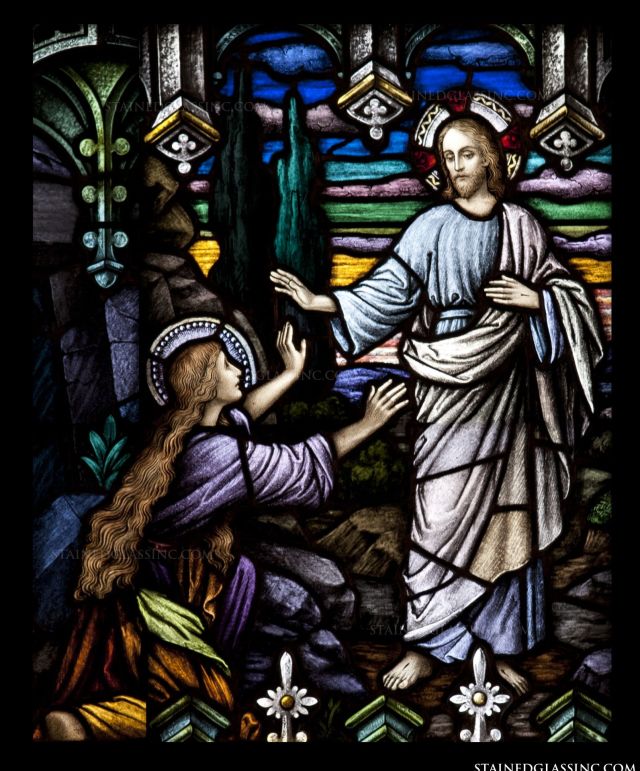
jesus and mary magdalene

It is more than ironic that one of the most powerful emotions on the planet is a feeling that is simply overlooked and often not recognized: the sense of being forgotten.  I’m not talking about rejection, but just being looked past by another, neglected, or an afterthought.  The sense that you are on no one’s radar can be more than disappointing – it can be devastating and destructive.  Yet, there is a way in which you and I can push back on this reality for the benefit of others and ourselves.  And on the other side of it, there is immense joy and satisfaction.

Notice that I didn’t mention the feeling of rejection along with the sense of being forgotten.  Rejection is certainly something you don’t like to experience.  It’s not a pleasurable emotion.  But it isn’t the same as being overlooked.  At least with getting a repudiating brush-off you are acknowledged by another.  That is, someone noticed you enough to even give a rebuff your way.  But with being neglected and forgotten, there is nothing.  If you have ever gotten the silent treatment from a parent, a co-worker, or a parishioner, then you likely know that getting any kind of words, even harsh ones, can seem better than being ignored altogether.

Sometimes neglect is a life and death issue.  There was an occasion when Greek-speaking widows in the book of Acts were overlooked.  They were not given their share when the food supplies were handed out each day (Acts 6:1).  When this came to the Apostles attention, it was a serious enough situation to warrant a major overhaul to the ministry system.  Deacons were formed, roles were clarified, and a group of women received much needed food.  In our society today, elder abuse is real.  Sometimes we might forget (again with the irony) that leaving senior citizens alone and ignoring them is also a potent form of abuse.

Then, there is the situation of Mary Magdalene.  She had a “past.”  This Mary was immoral and influenced by the darkness (Mark 16:9; Luke 8:2).  She was only a nameless person to be used for the benefit of others.  Then, she met Jesus and her world changed.  The darkness turned to light.  Jesus treated her like no other before.  Mary was as much a follower, maybe even more, than the twelve disciples.  It was she who poured the expensive perfume on Christ’s feet and applied it with her hair and her tears (John 12:1-8).  If there was anyone who loved Jesus, it was Mary.

So, you can imagine Mary’s grief when she saw her Lord tortured, crucified, and dead.  The one person on earth who looked at Mary and saw something more than an immoral woman, who looked beyond the infiltration of demonic influence and observed a woman who needed to be seen and truly loved was now gone.  But the story doesn’t end there….

“Mary stood outside near the tomb, crying. As she cried, she bent down to look into the tomb. She saw two angels dressed in white, seated where the body of Jesus had been, one at the head and one at the foot.  The angels asked her, ‘Woman, why are you crying?’  She replied, “They have taken away my Lord, and I don’t know where they’ve put him.” As soon as she had said this, she turned around and saw Jesus standing there, but she didn’t know it was Jesus.  Jesus said to her, ‘Woman, why are you crying? Who are you looking for?’ Thinking he was the gardener, she replied, ‘Sir, if you have carried him away, tell me where you have put him, and I will get him.’  Jesus said to her, ‘Mary.’ She turned and said to him in Aramaic, ‘Rabboni’ (which means Teacher).  Jesus said to her, ‘Don’t hold on to me, for I haven’t yet gone up to my Father. Go to my brothers and sisters and tell them, ‘I’m going up to my Father and your Father, to my God and your God.’”  Mary Magdalene left and announced to the disciples, ‘I’ve seen the Lord.’ Then she told them what he said to her.” (John 20:11-18, CEB)

Take note of how Jesus dealt with Mary.  He asked her two questions: “Woman, why are you crying?” and “Who are you looking for?”  Jesus didn’t ignore Mary.  He didn’t immediately get on with the business of prepping for ascension and overlook her grief.  Jesus also didn’t talk down to Mary.  By asking questions, our Lord entered her grief and was present to Mary in her sheer lament over not knowing where Jesus was.  What Jesus did instead is, I believe, one of the most powerful things which can happen and is clearly the antidote to all feelings of being overlooked, forgotten, and neglected.  Jesus said one word: “Mary.” He said her name.

Nameless people are forgotten people.  But those with names are real.  Saying someone’s name acknowledges, recognizes, and even validates another person.  That’s why when we are upset and mad at someone, we often don’t like to say their name.  Instead, they get referred to with some other moniker such as “his mother” or “that pastor” or “some guy.”  But when we use a name, it opens to us all a realm of grace, love, and compassion.  It’s easy to ignore another if they have no name.  Knowing a name and using it is the secret superpower which is available to everyone.  Even those without academic degrees and special training have ability to change the world with only the knowledge of one word: a person’s name.

Mary’s immense grief was turned upside-down in a moment to exuberant joy – through the power of her name being spoken by the Lord who cared enough to say it.

Jesus knows your name.  What’s more, he is pleased to say it.  Even now, Jesus sits at the right hand of his Father in heaven interceding for you by using your name.

If there is a skill which is worth developing, it is the ability to know people’s names and to say them.  Sometimes folks remark to me that they can’t believe my memory with names.  Um, not so much.  My memory is not really very good anymore.  It’s just that, if I want to know someone’s name I use it as often as I possibly can without sounding weird about it.  Repetition sinks it into my pea brain, not intelligence or some gift.

Which gets us back to the feeling of being forgotten, unnoticed, and/or ignored.  Acknowledging a person through using their name shoos away those negative feelings for others as well as helps give us connection with others.  In other words, it’s more than good sense to use people’s names – it is the very stuff of healthy relationships.  Relations don’t sour because of differences; they go south when we stop using given names.

Those who care don’t have a special caring gene.  They just know the power of a name.  And it matters to them to liberally validate others with the grace which comes with knowing and using another’s name.  And speaking of names, the Scriptures tell us that there is only one “Name” under heaven by which we are saved: The Name of Jesus (Acts 4:12).  There is such power in naming, that it is truly a life and death affair.  In the name of Jesus Christ there is no overlooking, no neglect, no being forgotten.  With Jesus, there is connection, relationship, attention, and remembrance.

Maundy Thursday

jesus washing feet 2

Love.  We need it.  Without love, there is nothing to live for; relationships devolve into silent standoffs and destructive triangles; and, the world ceases to spin on its axis.  With love, however, all things are beautiful; personal relations have meaning and joy; and, all seems right and just in the world.

Yet, love comes with a cost.  Because we live in a broken world full of pride and hubris, greed and avarice, hate and envy, we are victims of loveless systems and unjust actions.  We need love to rescue us, to redeem us from the sheer muck of existence.  It’s as if we are constantly walking knee deep through sludge so thick we can barely get anywhere.  We need saving.  We need Jesus.

Christians everywhere around the world are journeying through Holy Week, the most sacred time of the year for followers of Christ.  When we think about Holy Week, we are familiar with Good Friday and certainly Easter; but Maundy Thursday?

On this day the church remembers the last evening that Jesus shared with his disciples in the upper room before his arrest and crucifixion.  The experiences in the upper room were highly significant because this was the last teaching, modeling, and instruction Jesus gave before facing the cross.  Jesus was careful and deliberate to communicate exactly what was important to him: to love one another.

Maundy Thursday marks three important events in Christ’s Last Supper with his disciples:

  • The washing of the disciples’ feet (the action of loving service)
  • The instituting of the Lord’s Supper (the remembrance of loving sacrifice)
  • The giving of a “new” commandment to love one another (the mandate of a loving lifestyle).

Let’s briefly unpack these words and actions from Jesus.

For Jesus, his last night with his disciples was all about love, God’s love.  On that fateful night, having loved his disciples for the past three years, Jesus showed them the full extent of his love by taking the posture of a servant and washing each and every one of the disciples’ feet, including Judas.  After demonstrating for them a totally humble service, Jesus said,

“I have set you an example that you should do as I have done for you” (John 13:15, NIV). 

This was an incredible act of love.  We need to rightly observe that Jesus Christ loves me just as I am, and not as I should be.  He loves me even with my dirty stinky feet, my herky-jerky commitment to him, and my pre-meditated sin.

Not only did Jesus wash the disciples’ feet, but he lifted the cup of wine and boldly asserted:

“Take this and divide it among you.  For I tell you I will not drink again of the fruit of the vine until the kingdom of God comes.”  And he took the bread, gave thanks and broke it, and gave it to them, saying, “This is my body given for you, do this in remembrance of me.”  In the same way, after the supper he took the cup saying, “This cup is the new covenant in my blood, which is poured out for you” (Luke 22:17-20, NIV). 

Because of these words of Jesus, the church everywhere throughout the world, for two millennia, have practiced this communion, this supper so that we might have the redemptive events of Jesus pressed firmly into both our minds and our hearts by means of the visceral and common elements of bread and wine.  We are to not just know about Jesus, but are to experience being united with him.

Having washed the disciples’ feet, and proclaimed to them the meaning of his impending death, Jesus gave them a clear commandment:

“A new command I give you: Love one another. As I have loved you, so you must love one another.  By this everyone will know that you are my disciples, if you love one another.” (John 13:34-35, NIV)

Love one another, insisted Jesus, by imitating his humble service.  We represent Christ on this earth when we carefully, diligently, and persistently practice love.  Although love was by no means a new concept for the disciples, in the form and teaching of Jesus love was shown with four distinctions:

  1. Jesus is the new model of love
  2. A new motive of love, that Christ first loved me
  3. A new motivator to help us love, the Holy Spirit
  4. A new mission, the evangelization of the world using the power of Christ’s love to accomplish it

So, you see, Maundy Thursday is a highly significant day on the Church Calendar – one which deserves to be observed, and an opportunity to remember the important words and actions of Jesus on our behalf.  Through Jesus Christ we are to live always in love, modeling our life and church ministry after him.

In Christ we are to allow love to characterize our life together as we proclaim God’s love in words and deeds.  A watching world will only take notice and desire to be a part of our fellowship if we are deeply and profoundly centered in the love of God in Christ.  This is the reality that Maundy Thursday brings to us.