Hebrews 9:11-15 – Monday of Holy Week

Wood Cross

When the Messiah arrived, high priest of the superior things of this new covenant, he bypassed the old tent and its trappings in this created world and went straight into heaven’s “tent”—the true Holy Place—once and for all. He also bypassed the sacrifices consisting of goat and calf blood, instead using his own blood as the price to set us free once and for all. If that animal blood and the other rituals of purification were effective in cleaning up certain matters of our religion and behavior, think how much more the blood of Christ cleans up our whole lives, inside and out. Through the Spirit, Christ offered himself as an unblemished sacrifice, freeing us from all those dead-end efforts to make ourselves respectable, so that we can live all out for God. (The Message)

The Christian Holy Week is an opportunity to embrace the value and practice of journeying with Jesus.  Just as birthday and anniversary celebrations allows us a different rhythm of life for a time, or as holidays provide us with certain family traditions, so Holy Week can be a special and unique time of contemplation and reflection on the last week of Christ’s earthly life.  As we journey with Jesus, consider the days of this week:

Palm Sunday is a focus on the entry of Christ into Jerusalem to shouts of “Hosanna! Blessed is he who comes in the name of the Lord!”

Monday of Holy Week looks ahead to Christ’s sacrifice with Mary’s anticipatory grief through a heartfelt and beautiful anointing of Jesus’ feet with her hair and her tears.

Tuesday of Holy Week depicts the difficulty of the disciples in wrapping their hearts and minds around what Jesus is telling them about his impending death.

Wednesday of Holy Week is known in some Christian traditions as “Spy Wednesday” because we remember that Jesus was betrayed by Judas, a clandestine spy among the disciples.

Maundy Thursday marks three significant events in Christ’s last week:  his washing of the disciples’ feet; his institution of the Lord’s Supper; and, his new commandment to love one another.

Good Friday marks the death of Jesus Christ.  It is “good” because his death means redemption for the world.  We especially remember why the cross is so very important, that it is the once-for-all sacrifice to end all sacrifices.  There is now eternal forgiveness.

Holy Saturday remembers the death of Jesus and his body in the grave with the Romans securing and keeping guard over it.

Easter Sunday is the culmination of all the expectations of God’s people, and the fulfillment of all God’s promises to them in Christ.  We rejoice, celebrate, and renew our love and commitment to God for raising Jesus from death.  His resurrection means new life for us.  He is risen, indeed!

Observing Holy Week is rather different this year.  Whereas this week typically takes the form of attending special church services, we are presently reliant on virtual community and spiritual presence.  It seems to me that, more than ever, we are reminded of our wonderful privilege in a worldwide community of redeemed persons who together are focusing on the life and death of Jesus.  If ever there was a time to realize our incredible connection with believers across the earth in contemplation and celebration together as Christ’s own Church, now is such a time.

Together with Christ’s Church throughout the globe we have opportunity to read treasured Christian Scriptures over the course of the week and to focus on the passion narratives in the Gospels.  For the follower of Jesus Christ, these are the fundamentals of our faith, the base upon which our eternal lives are constructed.  We return to the redemptive events of Jesus again and again so that for the entirety of the year we can live in careful devotion to the Savior who has brought us salvation from sin and offers new life.

Holy Week is here.  So, we choose to remember and give thanks with both quiet gratitude and loud shouts of praise, with solemn reflection and expressive response.  There is no time like it in the year.

Grant to us, Almighty God, that in our weakness we might be revived and renewed through the Passion of your one and only Son Jesus, our Lord, who lives and reigns with you and the Holy Spirit, one God, now and forever.  Amen.

Psalm 31:9-16 – Lord, Have Mercy

woman sitting on wooden planks
Photo by Keenan Constance on Pexels.com

Lord, have mercy, because I am in misery.
    My eyes are weak from so much crying,
    and my whole being is tired from grief.
My life is ending in sadness,
    and my years are spent in crying.
My troubles are using up my strength,
    and my bones are getting weaker.
Because of all my troubles, my enemies hate me,
    and even my neighbors look down on me.
When my friends see me,
    they are afraid and run.
I am like a piece of a broken pot.
    I am forgotten as if I were dead.
I have heard many insults.
    Terror is all around me.
They make plans against me
    and want to kill me. 

Lord, I trust you.
    I have said, “You are my God.”
My life is in your hands.
    Save me from my enemies
    and from those who are chasing me.
Show your kindness to me, your servant.
    Save me because of your love. (NCV) 

None of us signed-up for suffering.  Yet, not a one of us can avoid it.  Pain comes in all kinds of forms – and perhaps the worst kind of wound is the one inflicted from others looking down at you when you’re already experiencing trouble and damaged emotions.  Whether it is a group of people, such as Asians facing ridicule and anger because of COVID-19, or COVID-19 patients themselves who sometimes become a pariah, the physical effects of pain can oftentimes be secondary to the primary hurt experienced within the spirit. 

David of old knew first-hand about suffering through hard circumstances.  There were times when he felt completely overwhelmed by wicked people trying to take his life.  If we could put ourselves in David’s sandals, we can understand why he was worn-out to the point of not sleeping, not eating well, even with a hint of paranoia.  David entrusted himself to God, and truly believed he was in the Lord’s hands – and that fact was his go-to truth. 

Jesus uttered his last words on the cruel cross from this very psalm: “Father, into your hands I commit my spirit” (Luke 23:46).  The cross was obviously a place of extreme bodily pain.  That pain, however, was dwarfed by the great spiritual pain of holding the entire world’s hurts, their curse of separation.  The stress of both body and soul must have been crushing for Jesus.  Yet, there was a strength of assurance smack in the middle of that pain – the confidence of knowing he was in good hands, just like David’s confidence a millennium before. 

There are times when we all struggle with why afflictions happen to us, whatever form they might take in us.  It is in such times of being forgotten by others that we are most remembered by God; it is in the situations of trouble that God is the expert in deliverance; it is when people revile us, say terrible things about us, and talk behind our backs that God comes alongside and whispers his grace and steadfast love to us.  It is when life is downright hard that we see a soft-hearted God standing to help us and hold us. 

While we are feeling our suffering, God is carefully crafting within us resilience through the rejection, empathy in our loneliness, purpose because of the trauma, forgiveness out of the shame, courage from having been failed, and self-awareness in the wake of emotional devastation. 

The biblical psalms are the consummate place to run to when we are most in need.  They provide the means to lift heartfelt prayers when our own words fail us.  The psalms give us structure and meaning when the world around us makes no sense.  The psalms do not always give us answers to our most vexing questions; they do, however, point us to the God who is attentive to the least, the lost, and the lonely.   

Lord, have mercy. Christ have mercy.  Lord, have mercy on us and grant us your peace.  Amen. 

Click It Is Well with My Soul sung by Anthem Lights and be reminded that we neither bear our sufferings alone, nor needlessly.

Matthew 22:23-33 – The God of Life

sunrays

That same day the Sadducees, who say there is no resurrection, came to him with a question. “Teacher,” they said, “Moses told us that if a man dies without having children, his brother must marry the widow and raise up offspring for him. Now there were seven brothers among us. The first one married and died, and since he had no children, he left his wife to his brother. The same thing happened to the second and third brother, right on down to the seventh. Finally, the woman died. Now then, at the resurrection, whose wife will she be of the seven, since all of them were married to her?”

Jesus replied, “You are in error because you do not know the Scriptures or the power of God. At the resurrection people will neither marry nor be given in marriage; they will be like the angels in heaven. But about the resurrection of the dead—have you not read what God said to you, ‘I am the God of Abraham, the God of Isaac, and the God of Jacob’? He is not the God of the dead but of the living.”

When the crowds heard this, they were astonished at his teaching. (NIV)

The first century Sadducees learned the hard way.  Trying to discredit Jesus in public is a bad idea. Somehow, probably in a back room and drinking too much wine, they came up with a story that was designed to show once and for all that Jesus was nothing but some hayseed yokel from the bumpkin village of Nazareth who believed in a crazy notion like resurrection.  They wanted a once-for-all public showdown that Jesus was a backward hick, not worth the time of day.  So they concocted a bizarre hypothetical story meant to discredit the supernatural.  They went to the Old Testament to point out the law that if a man dies without having children, the brother must marry the widow and so keep the legacy and land of the dead man in his family.  By conjecturing that if this were to happen seven times over, whose wife would she be among all the brothers at this supposed resurrection? As they were snickering to themselves believing that they had demonstrated the absurdity of resurrection, Jesus turned the tables on the Sadducees.

Jesus bluntly stated that the Sadducees were the ones with an absurd story.  Their whole notion of what the resurrection is and what’s important about it was lost on them.  Jesus said they were biblically illiterate – they don’t know the Scriptures.  And, furthermore, since they don’t really know the Law, they really know nothing of God’s power.  This was a major dig on a group of people who prided themselves on being an educated elite.

Resurrection, Jesus said, isn’t anything like they described.  Resurrection isn’t a restoration of the same life we have here and now; it’s a different life altogether – a new life!  To prove what he said, Jesus had a simple yet profound statement:  I AM the God of Abraham, Isaac, and Jacob; God is not the God of the dead, but of the living.  Not “I was” but “I am.”  God is God of living people, of life, not of corpses and cadavers, not even of zombies.

The whole point of resurrection is new life – not a resuscitated life, not a reconstituted life, but a new life altogether.  The terms ‘death’ and ‘life’ in Scripture are relational terms.  Death is separation from others; life is a connection with people.  Life, in the Bible, literally means ‘to step into,’ and death means ‘to step away from.’  So, then, in order to be a fully alive human being we step into God by loving him with all our heart, soul, mind, and strength; and, by loving my neighbor as myself.  Life means meaningful and loving connections with both God and other people.

toddler in white hoodie during daytime
Photo by Negative Space on Pexels.com

God is not just the God of the past (he saved me) or the future (I’m going to heaven); he is the God of the present, of this moment.  He exists now and is with us.  And what he wants from us is to choose life, that is, to step into relationships, to lean into others, and not choose death by stepping away and withdrawing out of guilt, shame, or fear.

When we distance ourselves from God and others, it is a way of death.  We then become in need of a new life.  Everyone experiences conflict and/or anxiety in relationships at various times.  The person who goes the way of death withdraws emotionally from God and other people and may even eventually just cut themselves off from others completely.  I’m not referring to a literal physical hermit who’s in the woods by himself with only a grizzly bear for a friend.  I’m talking about someone who is out of touch with others by through superficial talk and never dealing with anything unpleasant or uncomfortable.  Entire groups of people can act this way, as well, by dealing with their anxiety by refusing to interact on a meaningful level.  Such persons or groups tend to practice avoiding others through being emotionally distant; their prayer requests seldom go beyond skin deep and rarely, if ever, traffic in feelings.

Another way of separation, of death, is the practice of under-functioning and over-functioning in relationships.  Individuals who under-function refuse to take responsibility for their own emotions and behavior – they keep looking for someone else to blame their problems on and/or for someone to fix their situation.  Under-functioning people believe someone else will give, others will serve, and better people than them will do the world a service.  Into this situation enters the over-functioning person.  They are all too glad to accept responsibility for other people’s emotions and shortcomings.  When there’s a job to be done, everyone loves the over-functioning person.  Over-functioning individuals believe they know the right way to do things and they get results.  They talk more than listen, give advice freely, and take responsibility for the feelings and choices of others.  In a family, the under-functioning person relies on triangle relationships (that is, dealing indirectly with someone through another person) in which the over-functioning person handles all the heavy relational work.  Both under-functioning and over-functioning are ways of death because it is a stepping away from what is really going on inside of us; it is avoiding the shadows of my own heart and focusing on someone else’s heart.

We all need life.  We are hard-wired for community, family, and relationships.  We need a God who raises the dead and gives new life.  Stepping into relationships and choosing life means we courageously talk about what we truly think and feel and clearly communicate our limits and boundaries with each other.  Stepping into relationships and having life means we take responsibility for our own ideas and decisions and don’t coerce or manipulate others into doing the hard work of relationship for us.  It means we make decisions based on what is best for everyone, and not what simply is my personal preference.

Jesus
“I AM the resurrection and the life.”

God is the God of life.  Resurrection is both real and necessary.  Jesus said in John 11:25 – “I am the resurrection and the life.  He who believes in me will live, even though he dies; and whoever lives and believes in me will never die.”  Experiencing the power of God in our lives means to eschew the path of the Sadducees in the way they dealt with Jesus.  Instead, we have the privilege and the opportunity to step into a real, life-giving relationship with Jesus through reading and discovering our bibles and talking about what we find in it.  We pray, not because we are supposed to, but because it is the means of a living relationship and vital connection with God.

In such a time as this, we all need life – relationships that support one another and buoy each other’s values and spirituality.  Life is meant to be lived together in a sense of solidarity and camaraderie – with love as the glue which binds us as humanity.  Collective hardship becomes a sacred opportunity to experience life.  Jesus said, “I have come that they may have life, and have it to the full.” (John 10:10)

May your experience of God be abundant and satisfying.  Amen.

Matthew 9:18-34 – Faith

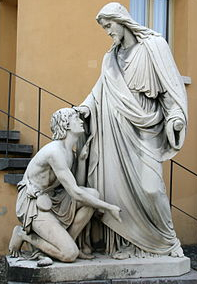
Jesus healing the blind
Jesus Healing the Blind by Johann Heinrich Stöver, 1861

As Jesus went on from there, two blind men followed him, crying loudly, “Have mercy on us, Son of David!” When he entered the house, the blind men came to him; and Jesus said to them, “Do you believe that I am able to do this?” They said to him, “Yes, Lord.” Then he touched their eyes and said, “According to your faith let it be done to you.” And their eyes were opened. Then Jesus sternly ordered them, “See that no one knows of this.” But they went away and spread the news about him throughout that district.

After they had gone away, a demoniac who was mute was brought to him. And when the demon had been cast out, the one who had been mute spoke; and the crowds were amazed and said, “Never has anything like this been seen in Israel.” But the Pharisees said, “By the ruler of the demons he casts out the demons.” (NRSV)

In these days of staring into the face of pandemic, I often find myself uttering the ancient prayer of the Church: “Lord have mercy.  Christ have mercy.  Lord have mercy and grant us your peace.”  For me, the COVID-19 virus is getting real, real fast.  I feel the heaviness of hospital staff, and of families experiencing the weight of concern for loved ones with the virus.

It is in such topsy-turvy times as these that I come back again and again to deep spiritual convictions which inform what I do each day.  One of those underlying creeds is this:

Jesus is trustworthy, no matter whether my faith or the faith of others is small or great.

In our Gospel lesson for today, two blind men were healed according to their faith in Jesus.  The diverse healing accounts of Jesus in the New Testament, whether the faith was large or small in those healed, leads me to the conclusion that:

It isn’t faith itself that heals, saves, or transforms – it is Jesus.

What the healing accounts have in common in the Gospels is that they are directed to Jesus as the object of faith.  It isn’t about the level of faith, but about where the faith is placed.  For the Christian, faith itself doesn’t mean much if it isn’t in Jesus.  If I place a large and sincere faith in an inanimate object such as money; in a position of power; or, even in my own independence, my faith isn’t worth much.  If I have a huge faith in a doctor or a psychiatrist to heal my body or my mind, I will quickly discover there are limits to their abilities.  If I have a confident faith that my family will meet all my needs, my faith will eventually run into failure when they let me down.  That’s because the ultimate object of my faith is Jesus.  If all my faith eggs are in the church basket, my faith will eventually face a crisis because it is a misplaced faith.  Furthermore, the answer I provide for others is not simply getting them to attend church or to adopt my moral code. I believe Jesus heals, transforms, and delivers people from sickness, sin, trouble, and overwhelming circumstances in his own good time.

Jesus is the same yesterday, today, and forever.  (Hebrews 13:8)

We know with certainty that circumstances change, as everyday seems to bring new levels and permutations of unprecedented alterations to our lives – and through it all, Jesus remains as the ever-present Savior, seated at the right hand of God ceaselessly interceding on behalf of those who offer even the slightest mustard seed of faith.

Almighty God, you know that we have no power in ourselves to help ourselves: Keep me both outwardly in my body and inwardly in my soul, that I may be defended from all adversities which may happen to the body, and from all evil thoughts which may assault and hurt the soul; through Jesus Christ our Lord, who lives and reigns with you and the Holy Spirit, one God, forever and ever.  Amen.